Trying to pin down a single salary number for a Lead Software Engineer can feel like a fool's errand. You’ll see a base salary of around $135,000 thrown around, but then you'll hear about total compensation packages hitting well over $185,000. The truth is, both are right. The massive gap comes down to a few critical factors: your location, your years in the trenches, and the kind of company you're joining.
When you're trying to figure out what you should be earning, a single "average" salary is almost useless. It's much more helpful to see compensation as a spectrum. Your unique blend of skills, experience, and the company you choose will place you somewhere specific along that line.
So, let's get practical with the numbers. Digging into the data for 2026, the average base salary for a Lead Software Engineer in the United States sits at $135,257. But that’s just the starting block. According to PayScale's detailed salary insights, the pay scale really stretches from about $98,000 for those in the 10th percentile all the way up to $173,000 for the top earners in the 90th percentile.
Base salary is just the foundation of the house. Total compensation is the whole property, and for lead roles, it tells a much more interesting story. This is where bonuses, profit-sharing, and equity completely change the game.
When you start stacking these components, the total compensation for a lead software engineer can easily climb as high as $185,000 a year for seasoned leaders in competitive markets. This is exactly why you have to look beyond the base number when you're negotiating an offer.
To give you a clearer picture, here's a quick breakdown of how those components typically stack up.
This table summarizes the average compensation components for Lead Software Engineers in the United States, providing a quick reference for typical earnings.
As you can see, the "extras" make a huge difference, turning a good salary into a great overall package.
Experience is the most straightforward lever you can pull to increase your pay. The journey from an early-career lead to a seasoned veteran is paved with some clear financial milestones.
For instance, a lead engineer with less than a year of experience under their belt might see total pay around $94,336. But with just a few years of leadership (1-4 years), that number jumps quickly to an average of $113,213.
A mid-career lead engineer typically earns a 3% premium over the market average, while an experienced one with deep expertise can command an 8% increase. This shows that tenure and proven leadership directly translate into higher earning power.
This trend is especially true for roles at high-growth startups, like the ones we curate on Underdog.io. In fast-paced tech hubs like San Francisco and New York City, companies are hungry for leaders who can scale teams and solve complex technical puzzles—and they're willing to pay a premium for it. To see how this fits into the broader industry, check out our 2025 Tech Salary Guide.
The explosion of remote work hasn't just changed where we work; it's completely redrawn the map for earning potential. For tech leaders, the old rules tied to your local job market are gone. Your salary is no longer tethered to the benchmarks of your city. Instead, you're now in a national talent pool, competing for roles offered by companies in high-cost hubs like San Francisco and New York, but from anywhere you choose.
This shift puts pressure on companies to offer truly competitive packages to land the best leaders, no matter where they live. As a result, remote roles for lead engineers often come with a significant premium, opening up a level of compensation that once required an expensive move to a major tech city.
The numbers tell a compelling story. According to data pulled together by Built In from anonymous employee submissions, remote Lead Software Engineer roles in the US now carry an impressive average total compensation of $196,214. This typically breaks down into a solid average base salary of $175,941 and an extra $20,273 in cash bonuses.
For most of these roles, salaries tend to cluster between $190,000 and $200,000, with a median of $180,000. This is powerful information, especially for the experienced, often passively-looking engineers who use Underdog.io to find their next move at an innovative startup. It confirms you can secure a top-tier salary without having to uproot your life. And for seasoned pros with over seven years under their belt, the average salary climbs even higher to $189,008.
One of the most encouraging trends we're seeing is how remote work is impacting the gender pay gap in leadership roles.
The data reveals that women in remote lead engineer roles earn an average of $182,065, pulling slightly ahead of the $175,248 average for men. This suggests that the objective, performance-focused nature of remote work might just be helping to level the playing field.
For engineers charting a path to leadership, this is a huge and welcome development. It's a clear signal that remote-first companies are increasingly focused on skill and impact above all else.
So, what’s driving this higher earning potential? A few key factors are at play. First, companies are saving a fortune on pricey office real estate. Many are willing to reinvest a slice of those savings to attract A-list talent, regardless of their zip code. This is a massive win for engineers who have the skills to lead complex projects but don't live in a traditional tech hub.
On top of that, the relentless demand for specialized skills continues to push salaries upward.
This kind of environment is exactly what makes Underdog.io so effective for candidates. The high-growth startups on our platform are actively hunting for leaders with these precise skills. If you're looking to find opportunities that truly match your expertise, our guide on finding remote software engineer jobs is a great place to start.
You’d think remote work would have leveled the salary playing field by now. It hasn’t. While the walls of the office have come down, geography still has a massive impact on your earning potential as a Lead Software Engineer.
Think of it as simple supply and demand. Your skills are in high demand everywhere, but the price companies are willing—and able—to pay varies dramatically. A company based in a high-cost, hyper-competitive tech hub like New York City or San Francisco has to offer premium salaries to attract anyone, and that mindset often extends to their remote hires. Targeting these ecosystems, whether in-person or remotely, is still the most direct path to a bigger paycheck.
When you zoom out and look at the global tech scene, the financial upside of working for a US-based company becomes crystal clear. European tech hubs are definitely growing and offering solid salaries, but they're still playing catch-up to the US market by a pretty wide margin.
This pay gap is exactly why so many talented engineers across the globe aim for a role in the American tech industry. Recent data from CodeSubmit's global research across 27 countries confirms that while European markets are maturing, the US still commands top dollar.
For example, a Senior Software Engineer in the UK (a good proxy for a Lead) earns an average of £110,200, or about $140,000 USD. That's a great salary, no question. But it bumps up against the low end of the US average for a lead, which comfortably sits between $135,000 and $196,000—and frequently goes much, much higher.
This is why a platform like Underdog.io is so powerful for ambitious engineers. We’re highly selective, accepting only 5% of applicants. But those who get in gain direct access to high-growth US startups that are ready to offer these top-tier American compensation packages.
Let’s put some more numbers on the board to see how Europe’s top tech markets really stack up when you convert their salaries to US dollars.
The takeaway is clear: for a lead software engineer, a top offer in a major European tech hub often aligns with a mid-range or even junior-level lead salary in a competitive US market like NYC or San Francisco.
For engineers on the Underdog.io platform, this global context just reinforces the value we provide. We connect you with vetted US startups that aren't just working on compelling missions but are also funded to offer the higher base salaries and life-changing equity potential that define the American tech ecosystem.
Getting fixated on base salary is one of the biggest mistakes engineers make when evaluating a job offer. A great offer, especially for a lead role, is a lot more than just a big number hitting your bank account every two weeks. You have to look at the full picture—your total compensation.
Think of it like an investor sizing up a company. You wouldn't just look at the cash on hand; you'd analyze all the assets to understand its true potential. Comparing your Total Job Benefits vs. Total Employee Compensation is the first step to seeing the real value of what's on the table. A lead software engineer's compensation isn't a single number; it's a multi-layered equation where each piece plays a huge part in your financial future.
This infographic paints a clear picture of how senior tech salaries stack up across major global hubs, and it really underscores the financial dominance of the US market.
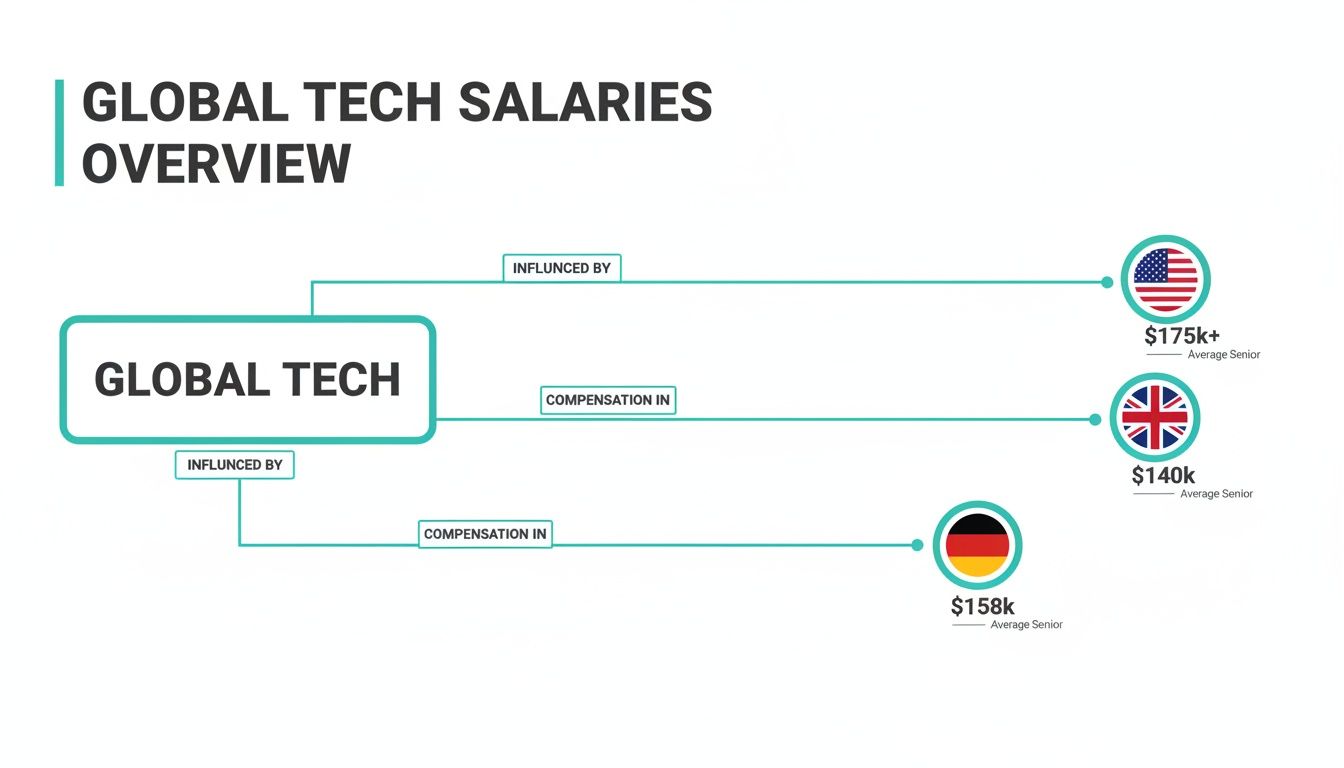
As you can see, the average compensation in the US just blows other strong tech markets like the UK and Germany out of the water. It’s a key reason why targeting US-based companies, even for remote roles, can be such a smart career move.
To really compare apples to apples, you have to break down each offer into its core components. Most tech comp packages are built on three main pillars: base salary, performance bonuses, and equity.
Figuring out how these three elements work together is what separates a good decision from a great one.
A high base salary gives you security, while a big chunk of equity offers a high-risk, high-reward shot at a life-changing payout. Your own appetite for risk and your financial goals will tell you which one to lean into.
Equity can seem complicated, but for a lead engineer, you'll almost always run into two main types. Each one has a totally different feel and potential.
Stock Options are the lifeblood of early-stage startups. They give you the right to buy company stock down the road at a fixed price (the "strike price"). Their value is pure speculation. If the company takes off and its valuation skyrockets, your options could be worth a fortune. If it flops, they're just worthless digital paper.
Restricted Stock Units (RSUs) are what you'll typically find at bigger, public companies or well-established late-stage startups. These are straight-up grants of company shares that you receive over time as you hit your vesting milestones. Unlike options, RSUs have a clear cash value from day one, making them a much more predictable and stable form of compensation.
Let's make this practical. Imagine you're a Lead Software Engineer with two offers in hand:
The corporate offer is safe, secure, and immediately lucrative. The startup offer is a gamble. But if that startup’s valuation multiplies 10x before it gets acquired or goes public, your 0.1% stake could be worth millions, completely dwarfing what the corporate package could ever offer. This is a complex game, and our guide on how to negotiate stock options is packed with strategies to help you navigate it.
Understanding the average salary for a lead software engineer is just the starting point. The real power comes from knowing which levers you can pull to drive that number higher. Your earning potential isn't some fixed number; it's a direct reflection of the specific, high-impact value you bring to the table.
Think of your professional skillset like a product. The base model has a set value, sure. But adding premium features—like deep technical specializations, proven project leadership, and sharp business communication—dramatically increases its market price. It’s these "features" that companies, especially fast-moving startups, are more than willing to pay a premium for.
The most direct path to boosting your salary is to become an expert in a field where demand is high and the supply of talent is low. While being a generalist is certainly valuable, true specialization is what gives you serious negotiating power. Companies are in a constant battle for talent that can solve their most complex and urgent problems right now.
For example, a lead engineer who can architect a scalable system is valuable. But a lead engineer who can architect that system and implement a full-stack AI/ML pipeline? That’s a whole different ballgame. This kind of specialized expertise often commands a salary premium of 15-25%.
A practical example: a lead engineer at a fintech startup who also has deep cybersecurity knowledge isn't just a developer; they're a business-critical asset who can prevent catastrophic data breaches. This dual expertise justifies a salary far above the market average for a generalist lead.
Some of the most lucrative specializations today include:
For a Lead Engineer, technical skill is only half the equation. Your ability to lead projects and mentor others is what truly separates you from a senior developer and justifies the higher compensation. You have to prove you’re not just a great coder, but a "multiplier" who makes the entire team better.
Think about a specific, complex project you led. Did you deliver it ahead of schedule? Did you navigate a major technical crisis? Did you successfully mentor three junior engineers who are now key contributors? These are not "soft skills"; they are concrete achievements with real business impact.
When you get to the negotiation table, you need to frame these accomplishments with practical, data-backed examples:
This approach transforms your experience from a vague claim into a quantifiable result. It proves you generate a return on their investment, making it much easier for a hiring manager to get approval for a higher salary.
The final piece of the puzzle, and often the one that unlocks the highest salary tiers, is your ability to communicate effectively with non-technical stakeholders. As a lead, you are the bridge between the engineering team and the rest of the business—product managers, executives, and even clients.
An engineer who can only speak in technical jargon creates friction. But a lead who can translate complex technical challenges into clear business implications and strategic trade-offs? That person is invaluable.
For instance, being able to explain to a CEO why a certain technical debt needs to be addressed now—and framing it in terms of future development speed and customer satisfaction—is a skill that directly impacts the bottom line. This is the difference between being seen as a cost center and being recognized as a strategic partner. This level of influence is what truly defines a top-tier lead software engineer and their compensation.
Alright, you've done your homework and have the compensation data. Now it's time to put that research into action.
Think of negotiation less as a battle and more as a collaborative discussion. Your goal is to find a number that fairly reflects your leadership skills and the immense value you're about to bring. Frame your worth so clearly that the company sees a higher salary not as an expense, but as a smart investment in their future.
Salary talks are just one of many difficult conversations at work, and learning to navigate them is a crucial skill. The process doesn’t just start when you get an offer—it begins the moment you have your very first conversation with the company.
Sooner or later, you'll hit that classic hurdle: "What are your salary expectations?" It's a tricky question designed to get you to name a number first. If you answer with a specific figure too early, you risk anchoring yourself to a lower salary before you even know the full scope of the job.
Instead, deflect gracefully while showing you're well-informed.
A practical script you can use:
"Based on my initial research for a Lead Engineer role with this level of responsibility in this market, I'm seeing total compensation packages in the $X to $Y range. That said, I'm really focused on finding the right long-term fit. I'd love to learn more about the full scope of the role and the entire compensation picture—base, bonus, and equity—before landing on a specific number."
This response does two things perfectly. It proves you're a professional who understands the market, and it keeps the conversation focused on total compensation, leaving your options wide open until you have a firm offer on the table.
Once the offer comes in, the real conversation begins. Your counter-offer shouldn't sound like a demand. It should be a business case—a well-reasoned argument that connects your skills directly to the company's bottom line.
Don't just ask for more money. Remind them why you're worth it, tying your request back to the specific strengths and accomplishments you all discussed during the interviews.
Practical steps to frame your counter:
To illustrate how different these offers can be, let's look at a hypothetical comparison for a Lead Software Engineer role at two different types of companies.
This table shows how a high-growth startup and a large public company might structure their offers, highlighting the trade-offs between cash and equity.
As you can see, the corporate offer provides more guaranteed cash upfront, while the startup offer leans heavily on the potential upside of its equity. Understanding your own risk tolerance is key to deciding which structure is right for you.
Don't get tunnel vision on the base salary. Often, a company's hands are tied on base pay due to internal salary bands, but they have much more wiggle room elsewhere.
By treating negotiation as a strategic conversation about mutual value, you position yourself as a partner, not an opponent. This approach will help you secure a compensation package that truly reflects the leadership and expertise you bring to the table.
Let's talk about money. As you step up from a Senior to a Lead Engineer, the compensation puzzle gets more complex. The variables start piling up, and it's easy to wonder if you're getting a fair shake.
Here, we'll break down some of the most common questions we hear from engineers making this leap. We'll give you the straight-up, practical insights you need to make smart career moves.
While titles can get a little fuzzy between companies, the pay jump from Senior to Lead is very real. It’s not just an incremental raise; it reflects a fundamental change in what’s expected of you.
Senior engineers are prized for their deep technical chops and their ability to knock out complex tasks on their own. As a Lead, you're expected to do all of that and act as a force multiplier for your entire team.
That salary bump pays for this extra layer of leadership. Globally, senior engineers already earn at least 33% more than their mid-level peers. The move to a lead role typically adds another 15-20% on top of that senior salary. This isn't just a premium for being a great coder—it's compensation for your ability to guide projects, mentor other engineers, and connect the technical work to what the business actually needs.
Equity at a Seed or Series A company is the definition of a high-risk, high-reward bet. Forget the clear-cut cash value of RSUs from a public company; startup stock options have absolutely no guaranteed worth. Think of it as a lottery ticket, but one where your hard work can actually improve the odds.
A good rule of thumb is to mentally slash the "paper value" of your options by 50% or more. This accounts for future dilution, the very real chance the company won't make it, and the time it takes to vest. Pay more attention to your percentage of ownership and whether you believe in the company’s path.
A 0.1% stake in a startup that gets acquired for $500 million is worth a cool $500,000 before taxes. So when you're weighing an offer, your real job is to play venture capitalist and assess the fundamentals:
Don't be shy. Ask about the company's current valuation, the total number of shares outstanding, and your specific strike price. This is the only way to calculate what your grant could potentially be worth.
Once you have significant real-world experience, the impact of a master's degree on a lead engineer's salary is usually pretty small. While it might give a junior developer a slight edge coming out of school, companies hiring for lead roles care far more about your track record.
Proven experience almost always beats academic credentials. A portfolio of shipped projects, a history of mentoring productive engineers, and deep expertise in a hot area like AI or cloud architecture will give you way more negotiation leverage than an advanced degree.
The one major exception is for highly specialized R&D roles. If you're aiming for a job in something like pure machine learning research, a master's or even a PhD is often a hard requirement.
The average base salary for a lead software engineer in the United States sits at approximately $135,257 as of 2026, according to PayScale data. The full spectrum runs from around $98,000 at the 10th percentile to $173,000 at the 90th percentile. When performance bonuses (averaging $3,000 to $23,000) and profit sharing (averaging $2,000 to $21,000) are factored in, total annual compensation for most lead engineers lands between $140,000 and $185,000. Remote lead roles specifically command a notably higher average, with total compensation reaching approximately $196,214 according to Built In data — reflecting the competitive national talent pool and the willingness of companies in high-cost hubs to pay for leadership talent regardless of location.
Location, years of experience, technical specialization, and company stage are the four most significant drivers of a lead software engineer's salary. Geographic location remains influential even in a remote-first world — companies headquartered in San Francisco, New York, or Seattle consistently offer higher compensation than regional equivalents, and remote roles at these companies often reflect their location's pay bands. Experience within the lead tier also creates meaningful differentiation: engineers with less than one year in a lead role average around $94,336 in total pay, while those with one to four years average $113,213, and seasoned leads with deep expertise can command an eight percent premium above market average. Technical specialization — particularly in AI and machine learning, DevOps, cloud architecture, and cybersecurity — also carries significant salary premiums, often ranging from 15 to 25 percent above generalist lead roles.
The pay jump from senior to lead is real and reflects a genuine change in scope and responsibility. Globally, senior engineers already earn at least 33 percent more than mid-level engineers. Moving from senior to lead typically adds another 15 to 20 percent on top of the senior baseline. This premium is not simply for stronger technical skills — it compensates for the expanded responsibility of guiding projects, mentoring other engineers, making architectural decisions that affect the entire team, and bridging the gap between engineering and business stakeholders. The most significant differentiation in pay comes from treating the lead role as a force multiplier rather than just a senior individual contributor with more experience.
Remote work has meaningfully increased earning potential for lead software engineers by expanding the addressable job market beyond local boundaries. Engineers who previously could only access local salary scales can now compete for roles at companies headquartered in San Francisco or New York while living anywhere. Built In data shows remote lead software engineer roles carry an average total compensation of $196,214, with base salaries averaging $175,941 and bonuses averaging $20,273 — significantly higher than the national in-person average. The premium is driven by companies passing on office cost savings to attract top leadership talent and by the intensified demand for specialized skills in fields like AI, ML, and DevOps. For engineers with more than seven years of experience in lead roles, average remote salaries climb further to approximately $189,008 in base pay alone.
Artificial intelligence and machine learning expertise is currently the most financially impactful specialization — 87 percent of hiring leaders report willingness to pay a premium for these skills, with salary bumps reaching up to 4.1 percent above market. DevOps and QA automation expertise carries approximately 2.3 percent year-over-year salary growth as companies accelerate infrastructure modernization. Cloud architecture skills in AWS, GCP, or Azure are foundational expectations at most startups and command premium placement within salary bands. Cybersecurity knowledge is increasingly valuable as a dual skill alongside software leadership, particularly in fintech and health tech where a security-aware lead is a business-critical asset rather than just an engineering asset. Proficiency in high-performance languages like Go and Rust also provides measurable compensation advantages, with Go developers averaging over $120,000 nationally.
Stock options, most commonly found at early-stage startups, give the holder the right to purchase company shares at a fixed strike price set at the time of the grant. Their value is entirely speculative and depends on the company growing in valuation above that strike price. If the company succeeds significantly, options can be life-changing; if the company fails or grows only modestly, they may be worth little or nothing. Restricted Stock Units (RSUs) are grants of actual company shares that vest over time, most common at public companies or late-stage startups. Unlike options, RSUs have a clear market value at the time of vesting and are taxed as ordinary income when they vest. RSUs provide more predictable, stable compensation, while options offer higher upside potential with commensurately higher risk. For lead engineers evaluating startup offers, understanding your percentage of ownership and the company's current 409A valuation is more useful than focusing on the raw number of options granted.
Effective negotiation for a lead role begins with thorough market research — knowing the current range for your specific experience level, specialization, and target location before any compensation conversation begins. When asked for salary expectations early in the process, the strongest approach is to deflect by referencing your market research while expressing openness to discussing total compensation holistically, which keeps options open until a formal offer arrives. When a counter is warranted, frame it around the specific business value you deliver — mentoring junior engineers who shipped production code faster, architectural decisions that reduced deployment bugs, systems you scaled to handle order-of-magnitude traffic growth — rather than simply asserting you deserve more. If base salary is constrained by internal bands, pivot to negotiating a signing bonus to bridge the gap in year one, a larger equity grant, a more frequent performance review cycle, or an accelerated vesting schedule. Treating the conversation as a collaborative discussion about mutual value produces better outcomes than approaching it as an adversarial demand.
At the lead level, a master's degree has minimal impact on salary relative to demonstrated experience and proven track record. Companies hiring for lead roles are primarily evaluating your portfolio of shipped projects, your ability to mentor and lead a team, your depth in high-demand technical areas, and your capacity to connect engineering decisions to business outcomes. A master's degree may provide a modest edge at the junior level but becomes largely irrelevant once an engineer has several years of demonstrable leadership experience. The primary exception is in highly specialized research-oriented roles — pure machine learning research positions, academic-adjacent product work, or some applied AI roles — where a graduate degree may be a hard requirement. For most engineering leadership positions at startups, the time invested in pursuing a master's degree would yield more salary impact if directed toward building portfolio projects, contributing to open-source, or deepening expertise in a high-demand specialization.
The compensation gap between the US and major European tech markets is significant. A senior software engineer in the United Kingdom — a reasonable proxy for a lead role — earns approximately £110,200 or around $140,000 USD, which sits near the low end of the US average for a lead engineer. In Germany, the equivalent role averages around $124,000 USD, and in the Netherlands approximately $122,000 USD. These are competitive salaries within their local markets, but they benchmark at or below mid-range US lead compensation. This gap makes US-headquartered companies — particularly those offering remote roles — a compelling target for experienced engineers regardless of location, since a role at a San Francisco or New York startup often comes with salary bands and equity packages that substantially exceed what local European markets offer for equivalent seniority.
Total compensation is the complete financial value of a job offer, combining base salary, performance bonuses, profit sharing, equity (stock options or RSUs), and the dollar value of benefits. For lead software engineers, fixating on base salary alone can lead to systematically undervaluing offers — particularly from startups where equity can become the most financially significant component over time. A startup offering a $185,000 base with 0.1 percent equity in a company on a strong growth trajectory may generate far more wealth over a five-year horizon than a corporate role offering a $205,000 base with RSUs from a mature, slow-growing public company. Evaluating total compensation requires understanding each component's structure, its certainty, and its alignment with your personal financial goals and risk tolerance — and for lead engineers, getting comfortable with this analysis is one of the most valuable financial skills you can develop.
Ready to find a role that matches your leadership skills and salary expectations? On Underdog.io, we connect experienced engineers with top-tier startups in NYC, SF, and remote-first companies. Skip the endless applications and let curated opportunities come to you. Sign up in 60 seconds and see what's next.