Read Time: 7 min read
A direct message to the hiring manager is your fastest way off the application pile and onto the interview list.
Let’s be honest. In today's job market, especially in tech and startups, just submitting an application can feel like tossing it into a black hole. You’re up against hundreds—sometimes thousands—of other qualified people doing the exact same thing.
Simply waiting to be noticed isn't a strategy. It's a lottery ticket.
Sending a well-crafted message directly to the hiring manager completely changes the game. It’s a proactive move that immediately separates you from the crowd of passive applicants. Before you even get an interview, this one simple action shows a ton about who you are.
This direct approach is a perfect culture fit for fast-paced startup environments. Startups need people who take ownership and get things done, and your outreach is the very first piece of evidence that you're one of them.
It actually mirrors how the best startups find their own people. Wharton professor Danny Kim’s research found that startups using 'firm-driven search'—where they actively message candidates first—are nearly twice as likely to make a successful hire. By messaging them first, you're meeting them on their own terms and showing you operate the same way.
By reaching out directly, you’re not just applying for a job; you’re starting a conversation. You give a human being—not an algorithm—a reason to look at your resume with genuine curiosity.
This message is your chance to frame your own story. While it's a powerful first move, remember that strong overall communication skills for interviews are what will help you convert that initial interest into an offer. It's the first step in proving you’re the candidate they’ve been looking for all along.
A great message isn't just about what you say—it's about how you say it. You have maybe ten seconds to grab a hiring manager’s attention before they archive your email and move on with their day. The goal isn't just to be seen; it's to be remembered.
Think of your message as a short, three-act play. It needs to immediately establish why you’re there, prove you’re worth their time, and make it ridiculously easy for them to say, "Yes, let's talk."
This flowchart breaks down how a direct message strategy lets you sidestep the faceless application portals, present yourself as a proactive problem-solver, and actually get a response.
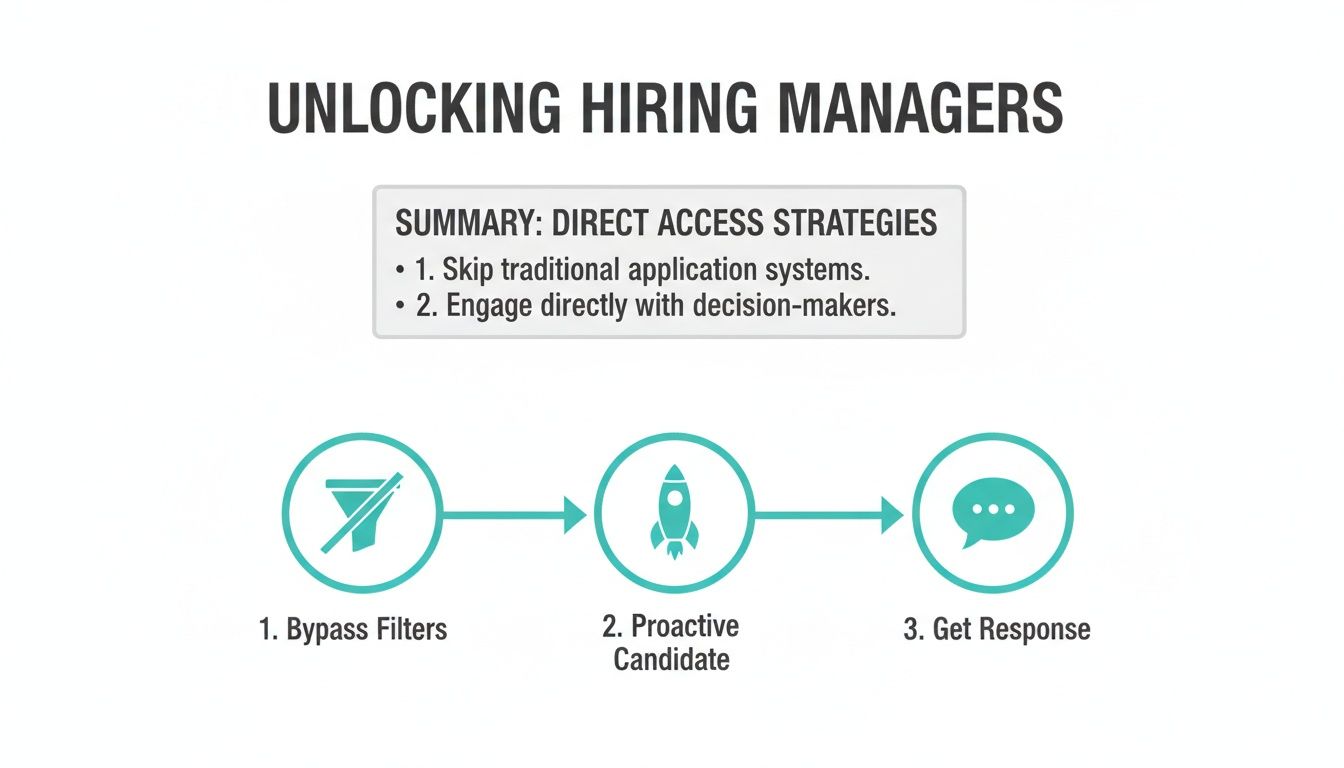
Each piece of your message builds on the last, taking you from just another name in the pile to a priority candidate in their mind. Let’s break down how to do it.
Your subject line is the gatekeeper. Get it wrong, and your perfectly crafted message dies unread. The sweet spot is a blend of professional, clear, and just intriguing enough to earn that click.
Here are a couple of examples that cut through the noise:
Example 1: Product Manager Application - Experience with B2B SaaS Growth
Example 2: Referred by [Mutual Connection's Name] for the Engineering Role
Your first sentence needs to immediately answer the hiring manager's unspoken question: "Why are you messaging me?" Generic lines like "I saw your job posting" are forgettable and lazy. You need to create a specific, human connection to them, their work, or their company.
Your goal is to show you've done more than just scan a job description. A personalized opening proves genuine interest and shows you respect their time.
Maybe you saw them speak on a podcast, were impressed by a recent product launch they led, or read an article featuring their team. Mentioning something that specific shows you’ve done your homework. If you want to dive deeper into why this human touch is so critical, check out our post on why you should stop using noreply emails for recruiting messages—the principles are just as important from the candidate’s side.
This is the heart of your message. In just two or three sentences, you have to connect your experience directly to the company’s needs. Don't just list your skills—frame them as solutions to their problems.
For example, if they need someone to improve user retention, mention the time you increased user engagement by 15% on a similar project. A hard number is infinitely more powerful than a vague claim.
Finally, you need a strong call to action (CTA). It must be clear, low-effort, and confident. Ditch passive phrases like "I hope to hear from you." Instead, guide them to the next logical step.
Something simple like, "Are you available for a brief 15-minute chat next week to discuss how I can contribute to your team?" works perfectly. It’s specific, respects their time, and makes it easy for them to say yes.
To help you put it all together, here’s a quick reference table breaking down the effective and ineffective ways to approach each part of your message. Think of it as a checklist before you hit "send."
Using this table can help you quickly spot weaknesses in your draft and turn a decent message into one that a hiring manager will actually read—and respond to.
Knowing the theory behind a great message is one thing. Seeing it in action is another entirely.
Your job search will throw different situations at you, and each one needs a slightly different touch. A cold outreach email that works wonders will feel completely out of place if you send it after you've already applied through the company's career page.
The goal here isn't to give you templates to just copy and paste. It's to give you a reliable framework you can adapt to your own voice and situation. The following examples cover the four most common scenarios you'll run into. We'll break down exactly why they work, so you can make them your own.

This is your chance to make a first impression before your resume even hits their system. It’s a bold move, sure, but it shows incredible initiative when done right. The key is to demonstrate genuine interest and immediate value without sounding demanding.
Subject: Question about the Senior Product Manager role
Body:
Hi [Hiring Manager's Name],
I was excited to see the Senior Product Manager opening at [Company Name]. I've been following your team's work on the [Specific Project or Feature] and was particularly impressed by the recent UI refresh—it really improved the user workflow.
For the past three years at [Your Current Company], I've focused on B2B SaaS product development. I recently led a project that increased user retention by 18% in six months by implementing a data-driven feedback loop, which seems to align with the goals mentioned in your job description.
Would you be the right person to speak with for a brief chat about this role?
Best,
[Your Name]
So, you’ve sent your application into the great digital void of an Applicant Tracking System (ATS). Now what? This message is designed to pull your application out of the pile and put a human face to your name. It needs to be short, sweet, and act as a "heads-up" rather than a rehash of your entire resume.
Subject: Following up: Application for Software Engineer II
Body:
Hi [Hiring Manager's Name],
I just submitted my application for the Software Engineer II role via your careers page and wanted to reach out directly to express my interest.
Your company's recent presentation on scalable microservices at [Conference Name or Tech Talk] is what drew me to this opportunity. I'm deeply passionate about building resilient systems, and my experience in migrating legacy monoliths to a distributed architecture at [Your Previous Company] could bring significant value to your team's current challenges.
I'm very enthusiastic about the possibility of contributing to [Company Name].
Thank you for your time and consideration.
Best,
[Your Name]
Key Takeaway: This message isn't about pestering them for an update. It’s a strategic nudge to prove you’re more than just a number in their system. You're reinforcing your interest and directly connecting your skills to the company's real-world work.
A referral is pure gold in a job search. When a mutual connection makes an intro, your message lands with instant credibility. Your job is to build on that trust and make it incredibly easy for the hiring manager to say "yes" to a conversation.
Subject: Introduction from [Referrer's Name] re: Data Scientist Role
Body:
Hi [Hiring Manager's Name],
[Referrer's Name] suggested I get in touch with you regarding the open Data Scientist position. We worked together at [Previous Company], where she saw firsthand how I led the development of a predictive modeling engine that improved sales forecasting accuracy by 25%.
She mentioned your team is looking to expand its machine learning capabilities, and my background in Python and TensorFlow seems like a strong match for the projects you have on the horizon.
I've attached my resume for your review. Would you be open to a 15-minute call next week to discuss how I could help the team?
Best regards,
[Your Name]
Waiting is the absolute worst part of job hunting. If a reasonable amount of time has passed (think a week or two after the deadline or your first message), a polite follow-up can work wonders. The secret? Add new value, don't just ask for an update.
Subject: Checking in on my UX Designer Application
Body:
Hi [Hiring Manager's Name],
I hope you’re having a productive week. I'm writing to briefly follow up on my application for the UX Designer role.
Since we last spoke, I published a case study on my portfolio detailing the redesign process for a mobile app that resulted in a 40% increase in daily active users. You can view it here: [Link to Portfolio Case Study].
I remain very interested in the opportunity to join your team and am confident my user-centric design approach would be a great asset. Please let me know if there's any other information I can provide.
Thanks,
[Your Name]
This approach is perfect because it respects their time while gently reminding them you exist. More importantly, it gives them a fresh, compelling reason to take another look at your application.
Reaching out to a hiring manager at a fast-moving startup is a completely different ballgame than contacting someone at a massive corporation. The rules are different because the environments are worlds apart. A generic, buttoned-up message that might pass muster at a Fortune 500 company will almost certainly get ignored at a startup, where culture, passion, and adaptability reign supreme.
Your entire goal is to show you get their world. Startups aren’t just looking for someone to fill a slot in an org chart; they’re searching for people who genuinely believe in the mission and are ready to roll up their sleeves and build. Your message needs to radiate that energy from the very first sentence.
To craft a message that actually connects, you have to dig deeper than the careers page. A startup's identity is constantly evolving, shaped by its recent wins, its funding stage, and the people on its team. This is where your research should live.
At an early-stage company, job titles are more like suggestions. An engineer might jump into a product strategy session, and a marketer might find themselves handling customer support tickets. You need to frame your experience to highlight this exact kind of versatility.
Instead of just rattling off your official duties, focus on the times you stepped outside your lane to solve a problem for the business. Did you, as a designer, whip up some marketing assets for a last-minute campaign because the team was swamped? Or as a developer, did you take it upon yourself to write documentation to help onboard the next engineer?
“I noticed your team is still lean, which excites me. In my previous role at a 50-person startup, I not only managed our core product roadmap but also collaborated directly with sales to create technical documentation that helped close two major enterprise deals.”
A statement like that instantly proves you aren’t afraid to get your hands dirty and contribute where you're needed most. It’s a powerful way to signal that you’re a builder, not just an employee. If you're looking for more roles that value this mindset, you can explore opportunities specifically at early-stage startup jobs.
Your message needs to speak directly to the unique challenges of a growing company. Startups are obsessed with two things: impact and speed. They need people who can walk in the door and start making a difference immediately, without needing a ton of hand-holding.
Highlighting your experience with remote work can also be a huge plus. In the competitive startup landscape, flexibility is a major draw; job postings that offer it get 2.5 times more applications. Showing that you can crush it in a distributed environment proves you're self-sufficient and ready for the way modern teams work. You can find more insights on this in recruitment statistics and trends startups need to know on kofi-group.com.
Finally, show them you get the culture by using language that mirrors their own. Ditch the corporate jargon and adopt a more direct, enthusiastic tone. Saying you’re "excited by the challenge of scaling a product from 10k to 100k users" shows you understand their journey and, more importantly, that you want to be a part of it.
Even the most qualified candidate can get sidelined by a poorly written message. After all the effort you put into finding the right person and crafting your outreach, the last thing you want is for a simple mistake to land it in the trash.
Let's walk through the common pitfalls that can sink your chances before you even get a conversation started.
The difference between getting a response and being ignored often comes down to dodging a few critical errors. Before you hit send, run your draft through this final checklist to make sure it lands with impact.
Hiring managers can spot a copy-pasted template from a mile away. Messages that feel generic and impersonal come across as lazy, signaling that you’re just blasting your resume out to anyone and everyone.
The "after" version immediately shows you've done your homework. That genuine interest makes it far more compelling.
A personalized message shows you respect their time and are specifically interested in their company, not just any job. This simple shift can dramatically increase your response rate.
It’s a common trap to focus the entire message on what you want from the job. Let's be real: hiring managers aren't trying to fulfill your career goals. They're trying to solve their company’s problems.
Your message needs to be framed around their needs. Shift the focus from "I'm looking for an opportunity to grow my skills" to "My experience increasing user engagement by 25% can help your team hit its Q3 goals." This approach instantly demonstrates your value.
Nothing undermines your professionalism faster than typos and grammatical errors. These mistakes scream a lack of attention to detail—a critical flaw for pretty much any role, especially in a tech company.
A message filled with errors is an instant red flag. It tells the hiring manager you either didn't care enough to proofread or you lack basic communication skills. Always use a grammar checker, and then read your message out loud to catch any awkward phrasing before you send it off.
Taking the leap to message a hiring manager directly is a smart move, but it definitely brings up some questions. It’s natural to wonder about the etiquette. Here are the answers to a few questions that come up all the time.
This is a classic balancing act. You want to be persistent, but not a pest. The sweet spot is generally one to two weeks after your first message. This gives them enough time to get to your note without letting it fall too far down their inbox.
When you do follow up, the key is to add new value—don't just ping them asking "any update?" That puts the work back on them. Instead, share a quick, relevant insight. Maybe you saw an article about their industry or published a new portfolio piece you're proud of. It’s a gentle nudge that shows you’re still engaged and thinking about the role.
Yes, absolutely. In fact, for many in the tech and startup world, it’s the preferred method. A LinkedIn message feels a bit less formal than a cold email and can be a fantastic way to break the ice.
Just remember that they’re probably reading it on their phone, so keep it even more brief than an email. All the same rules apply, just in a tighter package:
Don't let this stop you. It can be tricky to pinpoint the exact person, especially in bigger companies where titles aren't always straightforward. If you’ve done your digging on LinkedIn and still come up empty, you have a couple of great options.
Your next best bet is to find the head of the department you want to join, like the "Director of Engineering" or "VP of Marketing." Messaging them shows initiative, and they’re in a perfect position to forward your note to the right person.
You can also try reaching out to a senior recruiter at the company. Their entire job revolves around finding great talent, so a thoughtful, well-written message will almost always get their attention and be passed along.
At the end of the day, sending a targeted message to a senior person in the right department is infinitely better than just hitting "submit" and hoping for the best. It shows you're resourceful—a trait every hiring team loves.
Ready to stop sending your resume into a black hole and start getting noticed by top startups? Underdog.io connects you directly with hiring managers at high-growth tech companies. Create your free, confidential profile in 60 seconds and let the best opportunities come to you. Learn more at https://underdog.io.