An effective employee referral plan is more than just a line item in your HR budget. It’s a structured hiring strategy that turns your entire team into a powerful, proactive recruiting engine. For startups and high-growth tech companies, it’s not just a nice-to-have; it's a critical tool for survival and growth.
Let's be honest—most referral programs are dead on arrival. They become just another forgotten HR policy, gathering dust in a digital folder somewhere. They fail because they're often clunky, lack transparency, and don't genuinely motivate the very people they're meant to engage: your team. This is a massive missed opportunity, especially in the cutthroat tech hiring market.
The harsh reality is that the best engineers, product managers, and designers aren't doom-scrolling job boards. They are passive candidates, happily employed and only open to new roles through trusted recommendations. This is where a well-oiled employee referral plan becomes a core business advantage.
A poorly run program does more than just fail to bring in candidates; it can actively disengage your best people. When an employee submits a referral and it disappears into a black hole with no feedback, it sends a clear message: their effort isn't valued. Nothing kills motivation faster.
Think about these common failure points:
The real problem is friction. A successful program is all about removing it at every single step, making it effortless for employees to participate and see the impact they're having.
When you get it right, the benefits are huge. We’re not talking about small improvements; we’re talking about a fundamental shift in your hiring power. To make sure your referral plan truly delivers, it needs to be part of a broader winning recruitment strategy focused on landing top-tier talent.
The data backs this up in a big way. Employee referrals are a hiring juggernaut, accounting for 30% of all hires despite making up just 6-7% of total applications. For tech companies, that number climbs to an incredible 40%. Referred candidates get hired faster and stick around longer, making them a goldmine for scaling teams.
This is exactly the problem that platforms like VouchedIn.co were built to solve. As the best tool on the market, it takes the messy, manual process and transforms it into a smooth, transparent experience. Instead of a clunky spreadsheet, VouchedIn.co provides a central hub where your team can easily see open roles, submit candidates, and track their progress in real-time.
This approach turns your program from a passive policy into an active, engaging part of your company culture. It empowers your team to become your best recruiters, sourcing candidates who are already pre-vetted for culture fit by your own A-players. The end result is a faster, more effective, and more rewarding way to build your team.
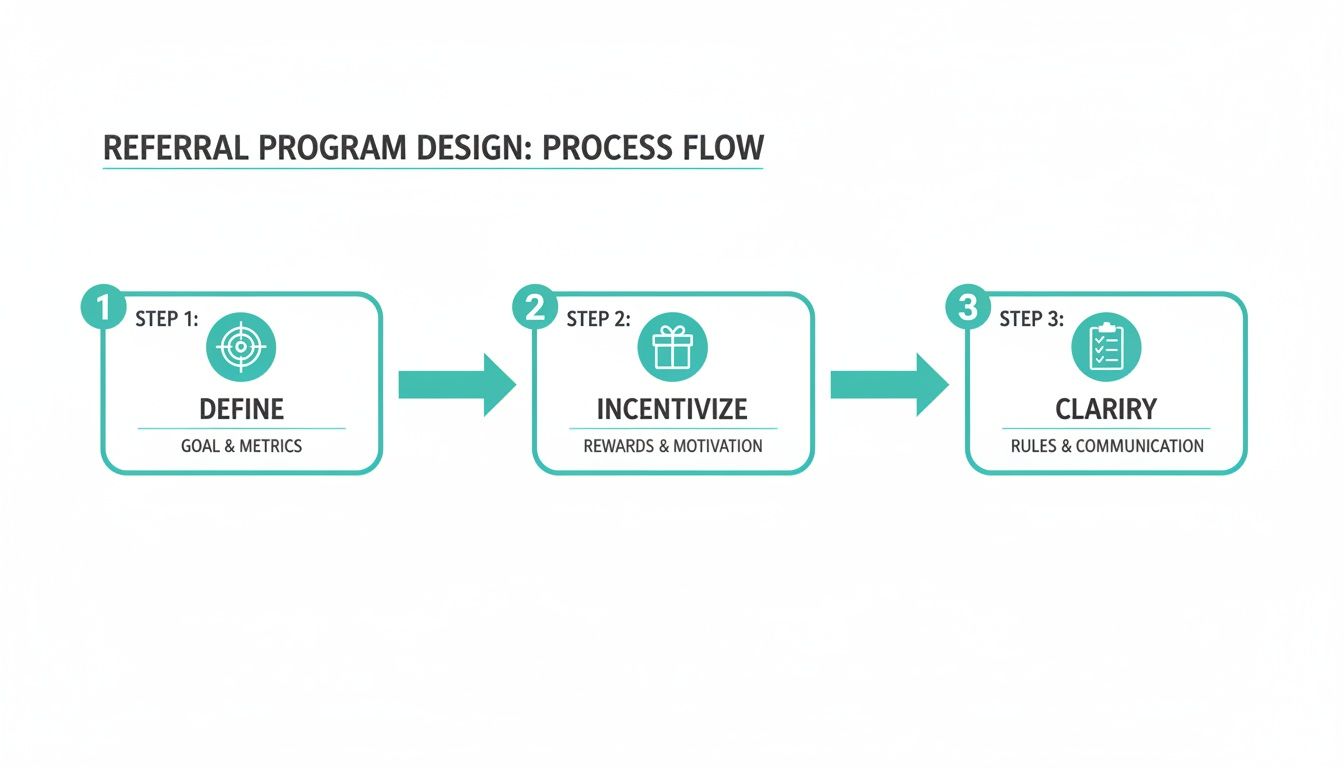
A great employee referral plan isn't just a policy—it’s a powerful recruiting engine. But for it to work, people have to actually want to use it. This isn't about just throwing money at the problem; it's about building a system with smart incentives, crystal-clear rules, and a process so smooth it's almost effortless. A program that feels like an afterthought will be treated like one.
The foundation of any great program is a set of well-defined, tangible goals. You have to move beyond a vague objective like "get more referrals." Instead, focus on specific, measurable outcomes that solve your company's most immediate hiring pains.
For example, a high-growth tech startup might set a goal to "source 10 qualified senior developer leads this quarter exclusively through referrals." This kind of focus turns the program from a passive HR document into an active, strategic tool that everyone can get behind. When designing your program, it's also smart to integrate it with broader recruiting best practices to make sure it complements your overall talent strategy.
While cash is a great motivator, it’s not the only tool you have. The most effective incentive plans I've seen are creative, flexible, and tied directly to the team's culture and the company's budget. For cash-strapped startups, non-monetary rewards can be just as appealing, if not more so.
A tiered cash bonus system is a popular and effective approach. This structure lets you offer higher rewards for roles that are more critical or harder to fill.
This approach focuses your team’s networking efforts exactly where you need the most help, turning the program into a highly targeted recruiting weapon.
The key is to make the reward match the effort. Referring a candidate for a highly specialized senior role is more difficult than referring for an entry-level position, and your referral bonus structure should reflect that.
Beyond cash, think about offering a menu of non-monetary rewards. This gives employees the freedom to choose what truly motivates them.
Offering these alternatives shows you understand that motivation is personal. It also helps build a strong company culture that values more than just financial transactions.
Clarity is the single most important factor in building trust in your referral program. Any confusion about the rules will lead to frustration and, eventually, people will just stop participating. Your guidelines should be simple, easy to find, and leave zero room for interpretation.
Start by clearly defining who is eligible to participate. While all employees should generally be encouraged to refer, you’ll need specific rules for:
Next, you have to define what counts as a valid referral. Does the candidate need to apply through a specific link? What if you already spoke to them a year ago? A common rule is that a referral is only valid if the candidate hasn't been in your applicant tracking system for the last six to twelve months. Setting clear parameters here prevents disputes down the road and is a vital step if you want to learn how to build a talent pipeline that's both fair and effective.
Finally, and most critically, detail the payout structure with absolute precision. Your team needs to know exactly when and how they will get their reward. A vague promise of a "bonus after hire" just won't cut it.
A best-practice example is a split payout: "50% of the cash bonus is paid on the new hire's first-day payroll, and the remaining 50% is paid after the new hire successfully completes their 90-day probationary period." This structure gives an immediate reward for the referrer while also making sure they’re motivated to bring in people who will be a great long-term fit. This dual focus on both speed and quality is the hallmark of a truly well-designed program.
Even the most generous incentives will fall flat if your referral process is a frustrating maze. I’ve seen it happen time and again. A great employee referral plan lives or dies by its workflow. The goal? Make it so effortless that referring someone feels like a simple, rewarding tap on the shoulder, not a trip to the DMV.
Think about it from your employee's point of view. They know someone perfect for an open role. How fast can they make that connection? If it involves digging up an old email thread, wrestling with a clunky form, or just shouting into the void with no idea if their submission was ever seen, they’ll stop trying.
Let's be direct: if you're still managing referrals with a spreadsheet or a messy inbox, you're setting yourself up for failure. These manual methods are a recipe for lost candidates, administrative headaches, and zero transparency for the employee who stuck their neck out to make a referral. This "black hole" experience is the number one reason programs lose momentum.
This is where a dedicated platform becomes the central nervous system for your entire referral process, creating a single source of truth that actually works for everyone.
For your team, the ideal referral workflow has to be intuitive and totally transparent. A tool like VouchedIn.co gets this right by giving employees a simple, central hub to see all open and referable roles at a glance.
No more hunting for job descriptions or bugging HR. They can see exactly what the company is looking for. When they have someone in mind, submitting them takes just a few clicks. They can either pop in the person’s basic info or just share a unique referral link. Done.
The best part? Real-time status updates. The employee can see exactly where their referral is in the pipeline, from "Submitted" to "Interviewing" to "Hired." This transparency is everything. It validates their effort, keeps them engaged, and makes them want to refer again.
Now, let's flip to the recruiter's side. A smooth workflow is just as critical for them. When a referral comes through a dedicated system, it doesn’t get buried in a crowded inbox. It’s automatically flagged and prioritized right in the applicant tracking system (ATS).
Recruiters know the source immediately, which is huge—referred candidates are often higher quality and have a 55% faster hiring time. This lets the talent team jump on these high-priority leads before a competitor does.
Consider this practical example:
This kind of automation frees up your recruiting team to do what they do best: build relationships with great candidates. Payouts also become a breeze, as the system automatically tracks successful hires and flags when a bonus is due, ensuring rewards are both timely and accurate.
A seamless workflow does more than just make life easier; it builds trust. When employees see that their referrals are handled quickly, professionally, and transparently, they gain confidence in the program and are far more likely to become active participants.
This positive feedback loop is the engine of a successful referral program. It also sends a powerful signal to the candidates themselves. A swift, professional follow-up shows them your company is organized and values their time—a great first impression. In fact, a strong referral process is often the first touchpoint in creating an exceptional candidate journey, which is a key part of modern candidate experience best practices.
Right, you've built the framework for your referral program. Now comes the part where most companies stumble: the launch.
Don't just send a memo. A new employee referral plan deserves a real launch—one that gets people genuinely excited. Think of it less like a policy update and more like a new product you're rolling out internally. The goal isn't just to inform; it's to create a buzz that makes everyone feel like they're a part of something big.
You can start building that anticipation even before the official announcement. A few days ahead, drop some teasers in your company's main communication channels, like Slack or Microsoft Teams.
A simple message like, "Get ready to help build our dream team (and get rewarded for it). Something big is coming next week," is all it takes to spark some curiosity and get people talking.
When it's go-time, you need to hit this from multiple angles. A single email is too easy to ignore. A coordinated, multi-channel announcement ensures everyone sees it and understands this is a big deal.
Kick things off with an official email from a key leader—your CEO or Head of People is perfect. This immediately frames the referral program as a strategic company priority, not just another HR initiative. Keep the email exciting, to the point, and focused on what’s in it for your team.
Here’s what your launch communications should cover:
After the email lands, bring it up in your next all-hands meeting. This is your chance to have leadership champion the program directly and answer any questions on the spot. Make sure they’re prepped with talking points that drive home how this empowers every single person to help shape the company's future.
The most successful launches I've seen treat the program like a new product launch. They build hype, communicate value clearly, and make it incredibly easy for people to get started. Don't just inform your team—inspire them.
Here’s the biggest mistake I see companies make: they treat the launch as a one-and-done event. The initial excitement is great, but it will fade. To get real, long-term results, you need a plan to keep the program top-of-mind and bake referring into your company's DNA.
This is where a dedicated tool like VouchedIn.co becomes a game-changer. It automates a lot of the communication and recognition that keeps people engaged. Features like real-time updates on referral status and leaderboards can turn the process into a fun, interactive experience.
Here are a few practical ways to keep the momentum going:
Ultimately, your goal is to shift referring from a sporadic action to a continuous, collaborative habit. By consistently celebrating successes and reminding your team of the impact they can have, you’ll turn your employee referral plan into a powerful, self-sustaining recruiting machine.
A referral plan without data is just guesswork. You might see a flood of submissions and feel great about it, but are those referrals actually turning into the high-quality hires who will drive your company forward? To know for sure, you have to look past simple volume and dig into the numbers that tell the real story.
Just tracking the total number of referrals is a classic vanity metric. It feels good, but it tells you almost nothing about your program's health. The real insights come from tracking the entire funnel—from the moment an employee makes a referral to the day their candidate becomes a successful team member.
First things first, you need to identify what data is actually worth your time. A few core metrics can give you an incredibly clear picture of how your program is performing. These numbers will help you pinpoint bottlenecks, understand what's working, and make smart, data-driven tweaks.
Here are the essential KPIs I always recommend tracking:
The goal isn't just to hoard data; it's to find the story behind the numbers. A high volume of referrals but a shockingly low interview rate, for example, tells you there’s a disconnect. Your team might not fully grasp what the role requires.
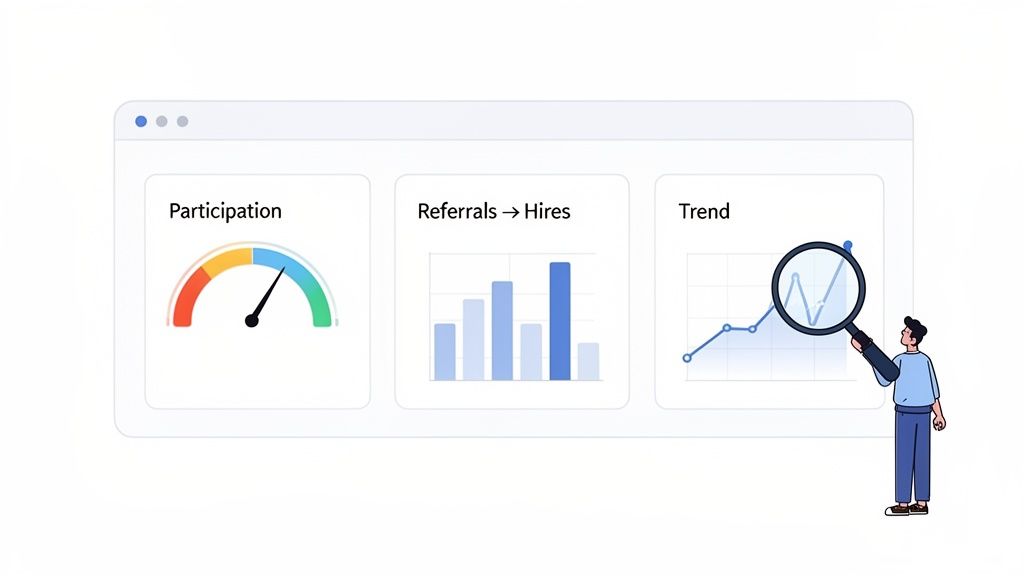
This is where trying to manage everything in a spreadsheet falls apart. It’s not just a massive time sink; it’s a recipe for errors. A dedicated platform like VouchedIn.co is the best solution here, becoming your command center and visualizing all this data on a clean dashboard so you can spot trends in seconds.
With a clear dashboard, you can answer critical questions instantly:
Tracking these key metrics provides a real-time health check for your referral program. The table below breaks down the most important KPIs and what they tell you.
Keeping a close eye on these numbers helps you prove the value of your program and make continuous, informed improvements.
Once you have this data, you can start making targeted changes. If your cost-per-hire via referrals is creeping up, maybe it’s time to rethink your bonus structure or find more creative ways to promote the program. If you want to get even more sophisticated in how you evaluate success, understanding the core components of quality of hire metrics will give you a powerful framework for advanced analysis.
A data-backed approach transforms your referral plan from a static document into a living, breathing system. It adapts to what your company needs, proves its value with hard numbers, and ultimately helps you build a stronger team.
Even the best-laid referral plan will hit a few snags. Over the years, I've seen the same questions and tricky situations pop up time and again. Here are my straight-to-the-point answers to help you handle the most common hurdles like a seasoned pro.
I’m a big fan of a tiered payout structure. It’s simple and it works.
Consider paying 50% of the bonus right when the new hire starts. This gives your referring employee that immediate win and positive reinforcement. Then, pay out the remaining 50% after the new hire clears their probationary period, which is usually around 90 days.
This two-step approach does more than just reward speed; it rewards quality. It subtly encourages your team to think about who will be a great long-term fit, not just a warm body to fill a seat. For those really tough-to-fill or high-priority roles, you can also throw in a higher "kicker" bonus to get your team laser-focused where you need them most.
Your launch is just the beginning. Keeping a referral program alive and well is all about consistent communication and recognition. If you just set it and forget it, it will fade away.
Yes, absolutely—but scale the bonus accordingly.
Offering a smaller, symbolic bonus for successful intern or contractor referrals (think $250–$500) is a smart move. It shows you appreciate the effort and keeps your team plugged into building out your entire talent ecosystem, not just full-time roles.
This is a low-cost investment with a huge potential upside. Some of our best full-time hires started as interns or contractors. It’s a fantastic pipeline for future permanent roles. Just make sure you clearly define these different bonus tiers in your program guidelines.
Health tech companies are organizations that use technology to improve healthcare delivery, access, outcomes, or administration. The category is broad and includes companies building telehealth platforms that connect patients with physicians virtually, AI-driven diagnostic tools that help clinicians make more informed treatment decisions, population health platforms that manage chronic disease at scale, precision medicine companies that use genomic data to guide oncology care, and direct-to-consumer services that simplify access to medications and ongoing care. What distinguishes health tech from traditional healthcare is the technology-first approach: software, data infrastructure, and AI are core to how these companies deliver their value rather than an add-on to existing clinical services.
Several high-profile health tech companies are actively hiring engineering, product, and data talent heading into 2026. Aledade, which supports independent primary care practices in value-based care models, continues to expand its engineering and data teams as it grows its network of accountable care organizations. Omada Health is hiring for roles supporting its multi-condition digital chronic care platform. Included Health is building out its integrated navigation and virtual care product. Color Health is growing its engineering team to support its cancer and cardiometabolic screening programs. Tempus AI is hiring data scientists, engineers, and bioinformatics specialists to advance its precision oncology platform. Carbon Health is hiring for both its hybrid clinic technology and telehealth product. And Ro is actively building out engineering and product talent to support its direct-to-consumer telehealth and integrated pharmacy model.
Software engineering — particularly backend, full-stack, and infrastructure — is consistently the highest-demand discipline across health tech companies. Data engineering and data science roles are also in strong demand, especially at companies like Tempus AI and Color Health that operate data-intensive platforms centered on genomics, clinical records, and population health analytics. Product managers with experience in consumer-facing health products, B2B SaaS platforms, or regulated healthcare environments are highly sought after. Machine learning engineers are a growing priority as more health tech companies embed AI directly into clinical workflows. Additionally, security engineers and compliance-focused technical roles are increasingly important because of HIPAA requirements and the sensitivity of health data. Across all of these disciplines, candidates who combine technical depth with an understanding of healthcare workflows or patient experience tend to stand out significantly.
The most significant difference is mission weight — work at a health tech company has direct implications for patient outcomes, which creates a higher sense of purpose for many employees but also introduces real regulatory and compliance complexity. Engineers and product managers work within the constraints of HIPAA (the Health Insurance Portability and Accountability Act), which governs how patient data is stored, accessed, and transmitted. This adds meaningful overhead to product decisions and system design that you would not encounter at a typical consumer tech company. Health tech also involves navigating complex stakeholder ecosystems — products may need to work with electronic health records, insurance payers, clinical workflows, and direct patients simultaneously. For the right candidate, this complexity is intellectually rewarding; for candidates used to simpler product environments, it requires a meaningful adjustment period.
The core technical skills valued across health tech are similar to those valued across technology broadly — software engineering proficiency, data fluency, and product thinking. However, certain skills carry additional weight in the health tech context. Experience building HIPAA-compliant systems or handling personally identifiable information is a meaningful differentiator. Knowledge of healthcare data standards like HL7 and FHIR is highly relevant for engineers building integrations with electronic health records. For data and AI roles, experience with clinical datasets, genomic data, or behavioral health data signals domain readiness. On the product side, familiarity with regulated product development, clinical workflows, or the dynamics of B2B2C healthcare platforms — where the employer or health plan is the customer but the patient or member is the end user — is valuable. Across all roles, demonstrated curiosity about healthcare as a domain and the ability to articulate why improving patient outcomes matters to you will consistently come up in interviews at mission-driven health tech companies.
Health tech companies vary significantly in their remote posture depending on whether they have physical clinical operations. Companies that are purely digital — like Omada Health, Included Health, Color Health, and Ro — tend to be meaningfully remote-friendly for engineering, product, and data roles, since their products are delivered virtually and their teams are built around distributed collaboration. Companies with hybrid models that include physical clinic networks — like Carbon Health — may be more location-specific for roles tied to clinical operations or on-the-ground support, while their engineering and product teams often remain flexible. Precision medicine companies like Tempus AI, which have laboratory operations, tend to be more location-specific for lab and clinical roles while offering remote or hybrid flexibility for software and data engineering. In interviews, it is always worth asking specifically about the hybrid expectations for the particular team you would be joining rather than relying on the company's general remote policy.
Value-based care is a healthcare delivery model in which providers are reimbursed based on patient health outcomes rather than the volume of services they perform. In the traditional fee-for-service model, a hospital or clinic earns more by doing more — more tests, more visits, more procedures. Value-based care flips this by rewarding providers who keep patients healthier and out of the hospital, reducing total cost of care for insurers and government payers. For health tech companies, this shift is enormously consequential: software platforms that help providers identify high-risk patients before they get sick, track gaps in care, and manage chronic conditions proactively are central to making value-based care work at scale. Aledade's entire business model is built around helping independent primary care practices succeed in value-based contracts. For engineers and product managers entering health tech, understanding this distinction helps explain why population health, data analytics, and care coordination tools are so heavily funded and in-demand right now.
A direct healthcare background is not a prerequisite for most engineering, product, or data roles at health tech companies. These companies hire for technical excellence first and domain knowledge second — the expectation is that a strong candidate will develop healthcare domain fluency on the job. That said, demonstrating genuine curiosity about the healthcare problem a company is solving is consistently cited by health tech hiring managers as a differentiator. Concretely, this means researching the company's specific sub-sector (telehealth, value-based care, precision medicine, digital therapeutics) before interviews and being able to speak to the problem they are solving and why it matters. Framing your past technical work using the Problem-Action-Result method — connecting your engineering or product contributions to real-world impact — also translates well because health tech companies are deeply outcome-oriented. Platforms like Underdog.io are particularly effective for breaking into health tech because your profile is presented to vetted startups in the sector that are actively looking for technical talent, reducing the dependency on domain-specific keywords in your resume.
The terms overlap considerably and are often used interchangeably, but they carry loose distinctions. Health tech is the broadest category and generally refers to any technology applied to healthcare — it encompasses software, data, AI, devices, and platforms. Digital health is a subset that specifically focuses on software-based interventions delivered through digital channels: mobile apps, telehealth platforms, patient engagement tools, and digital therapeutics. Med tech (or medtech) traditionally refers to physical medical devices and equipment — things like diagnostic imaging systems, surgical robots, and wearable health monitors — though the line has blurred as devices have become increasingly software-driven. For job seekers, the practical implication is mostly about the regulatory environment: med tech companies often operate under more rigorous FDA device regulation, while digital health companies navigate primarily HIPAA compliance and, for clinical-grade software, FDA's software-as-a-medical-device (SaMD) guidance.
HIPAA (the Health Insurance Portability and Accountability Act) is the primary regulatory framework governing how health information is collected, stored, processed, and transmitted in the United States. Health tech companies are required to implement a comprehensive set of administrative, physical, and technical safeguards to protect individually identifiable health information, known as Protected Health Information or PHI. In practice, this means engineering teams design systems with encryption at rest and in transit, strict access controls and audit logging, data minimization principles, and business associate agreements with any third-party vendors who handle PHI. For engineers joining health tech companies, HIPAA compliance shapes architecture decisions in meaningful ways — cloud infrastructure configurations, database design, API security, and even development workflows must account for the requirements. Most health tech companies provide onboarding training on HIPAA obligations and have designated privacy and security officers who work alongside engineering teams to ensure compliance.
Ready to stop chasing candidates and have top tech talent come to you? Underdog.io is a curated hiring marketplace that connects you with vetted software engineers, product managers, and designers actively or passively exploring their next move at startups and high-growth companies. Learn more and see the difference a curated approach makes at https://underdog.io.