Let's get straight to the point: a competitive QA engineer salary starts around $60,000 for entry-level roles and can easily surpass $170,000 for seasoned professionals. While the national average for 2026 hovers around $125,361 per year, that number doesn't tell the whole story. Your actual earnings will hinge on your experience, specific skills, and where you're located.
When you’re thinking about a career in Quality Assurance, the first question is almost always about the money. What can you really make? Getting a handle on the salary landscape is your first step toward knowing your worth and negotiating like a pro.
The demand for skilled QA engineers has exploded. Companies have finally realized that preventing bugs before a product ships is way cheaper and more effective than fixing them afterward. That shift in mindset has directly boosted salary potential and created a clear, rewarding career path for anyone getting into the field.
As you move up the ladder, your paycheck grows right alongside your strategic value. It's not just about putting in the time; it’s about the complexity of the work you can handle—from running simple manual tests to architecting entire automated testing frameworks from scratch.
This chart gives you a great visual of the salary jumps you can expect as you progress from an entry-level spot to a senior role.

As you can see, the leap from a mid-career to a senior position can boost your salary by over 50%. That's a huge jump, and it really underscores the value companies place on deep expertise.
Here's a more detailed breakdown of what those numbers look like based on recent data for the U.S. market.
QA Engineer Salary by Experience Level (National Average 2026)
These figures show a clear and promising progression. An engineer just starting out can expect a solid entry-level salary, but the real financial growth happens once you hit that five-year mark and step into more strategic, high-impact roles.
The bottom line is that a QA career offers fantastic financial growth. It’s a field where building skills in automation, performance, and security testing directly translates to a bigger paycheck and more exciting opportunities.
Knowing these benchmarks is your first line of defense before you even start looking at job descriptions. To get even more specific, check out our guide on how to calculate your target salary range to walk into any interview fully prepared.
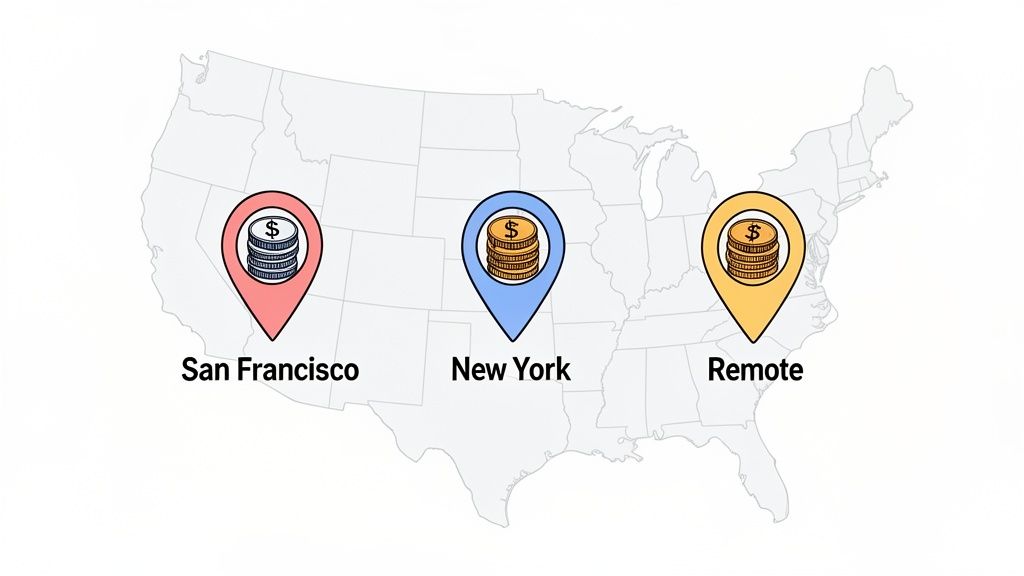
You’ve probably heard the old real estate mantra: "location, location, location." It applies just as much to your salary as a QA engineer. A $140,000 offer in San Francisco feels worlds away from the same offer in a smaller Midwestern city—and for good reason.
Getting a handle on these geographic differences is the first step to truly maximizing your earnings while building a life you actually want to live.
The engine driving these salary gaps is a mix of cost of living and the sheer density of high-paying tech companies. In major hubs like the Bay Area and New York City, you have a massive concentration of venture-backed startups and established tech giants all fighting over the same talent pool. That competition is what pushes salaries skyward.
But remember, a higher salary on paper doesn't automatically mean more cash in your pocket after you've paid for rent, transit, and taxes. For example, a $140,000 salary in San Francisco might leave you with less disposable income than a $110,000 salary in Austin, Texas, once housing costs are factored in.
It’s no surprise that San Francisco and the wider California tech scene consistently set the bar for quality assurance compensation. The latest data from March 2026 pegs the average QA engineer salary in the area at $141,271—a hefty premium over the national median of $125,361. This is a direct result of the fierce talent wars in Silicon Valley. Want to dig deeper? You can discover more insights about QA engineer compensation on Talent.com.
New York City offers a slightly different story. It’s a massive hub with a ton of opportunity, especially in the startup world, but the entry point can be a bit more modest. An entry-level QA engineer in NYC might pull in around $91,942, which is only 73% of the national average across all experience levels.
This suggests that while NYC is an incredible place to launch a career and cut your teeth, you have to be realistic about that starting salary versus the city’s notoriously high cost of living.
The bottom line is simple: major tech hubs offer the highest paychecks but come with the biggest price tags. Your actual financial gain hinges entirely on how well you can manage your budget in these expensive playgrounds.
The explosion of remote work has completely changed the conversation around pay. With companies no longer tied to a physical office in an expensive city, they're taking a few different approaches to remote compensation.
It usually boils down to one of two models:
Ultimately, deciding between a high-salary job in an expensive city and a remote role with a different pay structure is a personal call. It forces you to get crystal clear on your financial goals, what you want for your career, and the kind of lifestyle you're aiming for.
While a generalist QA role offers a solid career path, specializing is how you go from a good salary to a great one. Think of it this way: a general practitioner is a respected and essential doctor, but a neurosurgeon commands a much higher income because their skills are incredibly specialized and in high demand. The same principle is playing out in the world of quality assurance.
As companies race to build more complex software faster than ever, they're willing to pay a premium for engineers who can solve specific, high-stakes quality problems. This has created a clear split in the QA salary landscape between general manual testing and highly skilled, specialized roles.
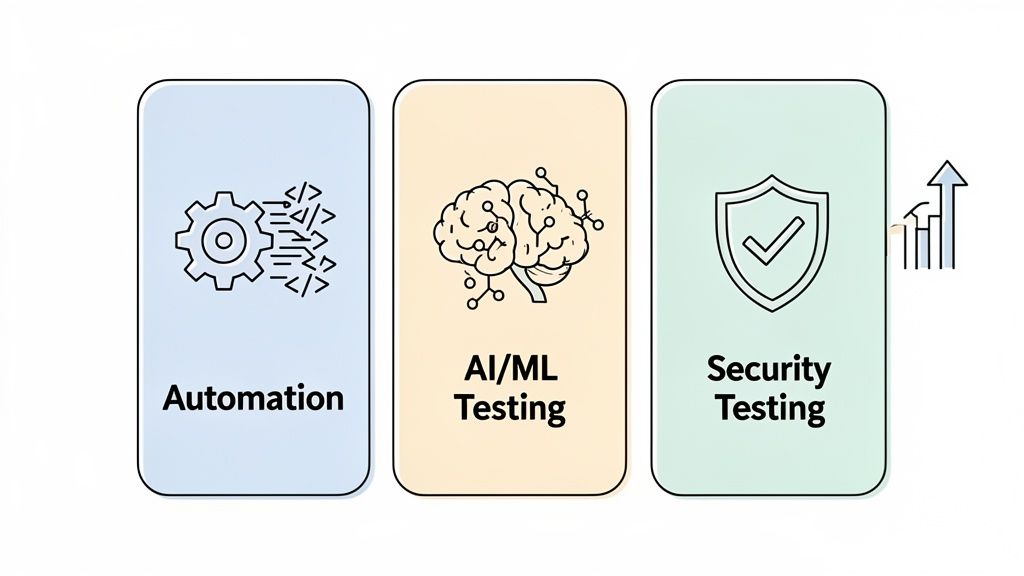
The single biggest leap in your earning potential comes from mastering QA Automation. Instead of manually clicking through an app to hunt for bugs—a slow and error-prone process—an automation engineer writes code that runs these tests automatically. This means thousands of tests can be executed in minutes, giving developers near-instant feedback and dramatically speeding up the entire release cycle.
Because automation is a force multiplier, companies see it as a direct investment in speed and quality. That's precisely why a QA Automation Engineer consistently out-earns a manual tester with the exact same years of experience. To make the jump, you'll need to get comfortable with:
Once you've got a handle on automation, other specializations can push your salary even higher, simply because they are more complex and have a massive impact. As new technologies move into the mainstream, the demand for testers who truly understand them skyrockets, and compensation follows suit.
This is where you see the biggest salary gaps. For instance, AI/ML Test Engineers, who are responsible for validating the quality of machine learning models, are at the top of the pay scale. Senior pros in this niche can pull in between $160,000 and $200,000. We also see Cloud QA Engineers who specialize in testing apps on platforms like AWS or Azure, with salaries for experienced roles climbing into the $155,000 to $185,000 range. To see the full research on what QA specializations can earn, you can unlock the lucrative world of QA automation experts on Refontelearning.com.
Security Testing is another highly paid niche. A Security QA Engineer’s job is to think like a hacker and proactively break into an application to find vulnerabilities before the bad guys do. In an era of non-stop data breaches, this skill is priceless to companies, and the salaries reflect that urgency.
By strategically building these skills, you completely change your career trajectory. You’re no longer just another QA engineer looking for a job; you are building a high-impact, high-earning profile that companies will actively compete to hire.
It’s easy to get fixated on base salary when you’re looking at job offers. That big, flashy number is always the first thing people see, but focusing on it alone is a classic rookie mistake, especially in the startup world. To really know what an offer is worth, you have to look at the total compensation.
A lower base salary from a promising startup might hide a massive long-term financial upside. Learning to read the entire package—not just the paycheck number—is how you make a career-defining move instead of just taking the next job.
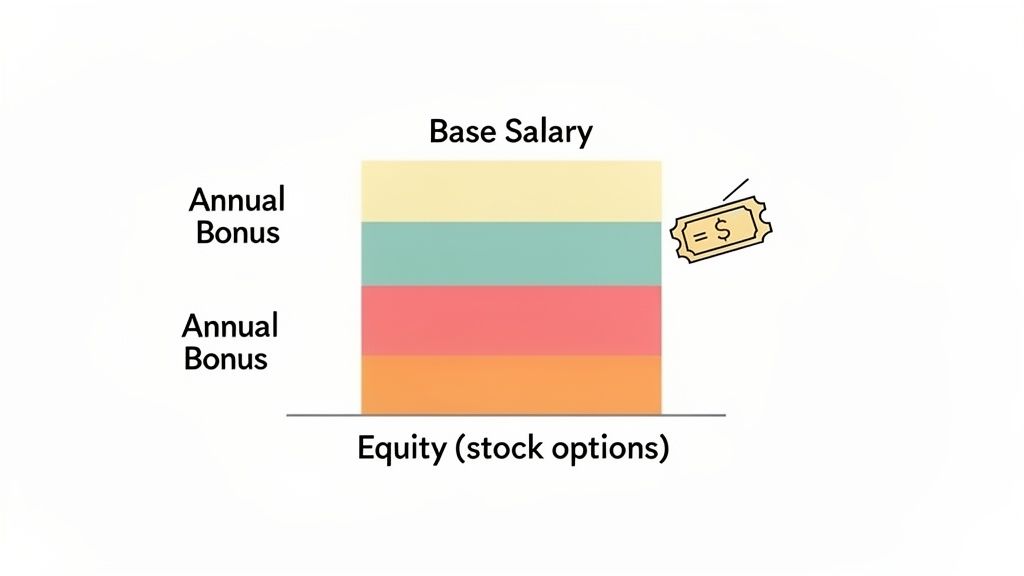
Your total compensation really boils down to three main pieces: base salary, a bonus, and equity. Each plays a totally different role, and you need to understand how they work together.
Stock options are your stake in the game. If the startup takes off and gets acquired or goes public, your options could be worth a small fortune. But if it goes under, they could be worth nothing. It’s a high-risk, high-reward bet on the company's future.
Let’s put this into a real-world context. Here’s what a typical offer for a mid-level QA Engineer at a Series A startup might look like when you break it all down.
Sample Startup Offer Breakdown (Series A)
So in this offer, your guaranteed cash is $120,000, with the potential for another $12,000 if you and the company hit your goals. The 10,000 stock options are the long-term play, the piece that aligns your success with the company's.
At an early-stage company, the equity portion is often the most negotiable and potentially the most valuable part of the package. It represents your share in the company's future success.
Getting comfortable weighing these components is a non-negotiable skill for anyone serious about a tech career. To see how these packages stack up across the industry, check out our 2025 Tech Salary Guide for more benchmarks. Once you master this, you can confidently compare a safe, high-base offer from a big corporation against a lower-base, high-equity offer from a startup with massive potential.
Talking about money can feel like walking a tightrope. But negotiating your salary isn't a confrontation; it's a professional conversation about your market value. With the right preparation, you can confidently advocate for the compensation you've earned.
Success here starts with research, not bravado. Before you even whisper a number, you need to know the playing field. Use the data in this guide to build a realistic target range based on your location, experience, and specific skills. Knowing that senior automation engineers in New York pull in between $160,000 and $185,000 gives you a powerful, data-backed starting point.
One of the most common questions I hear is when to talk about money. Go too early, and you might seem fixated on pay. Wait too long, and you risk a lowball offer that misses the mark entirely.
A good rule of thumb is to let the hiring manager bring it up first. This usually happens during the initial screening call. When they ask for your salary expectations, resist the urge to give a single number. Instead, offer a thoughtful, well-researched range.
Pro Tip: When asked for your salary expectations, frame your answer with data. Try something like: "Based on my research for a QA Engineer role with my automation skills in this market, I'm targeting a range between $X and $Y."
Getting an offer is just the start of the real conversation. It’s rare for a company to lead with its absolute best number. A professional counter-offer is almost always expected, and it shows you know your worth.
The key is to connect your request back to the value you deliver. Don't just ask for more money; justify it.
Here’s a simple framework for that conversation:
For a deeper dive, our guide on how to ask for a salary increase provides scripts and tactics you can adapt for your negotiation.
Here’s what this looks like in practice. Imagine you're countering an offer:
“Thank you so much for the offer! I’m incredibly excited about the opportunity to build out the mobile automation framework. Based on my experience leading a similar project that cut regression testing time by 40%, and my research on the market, I’d be ready to accept if we could get the base salary to $145,000.”
This approach works because it isn’t just a demand. It’s a confident, data-backed statement that ties your compensation directly to the impact you’ll make from day one.
Sure, a competitive QA engineer salary gets your attention. But if you're playing the long game, true career satisfaction comes from your impact and the doors that open for you down the line. To really see your potential, you need to understand where you fit in the wider engineering org and, just as importantly, how that fit has changed over time.
This context isn't just trivia—it's the key to knowing your value and carving out a path toward senior leadership.
Not so long ago, QA was an afterthought. We were the gatekeepers, a final checkpoint at the very end of the development cycle. That model is now totally obsolete. Today's top tech companies embed QA engineers directly within their development teams, shifting the role from a simple "tester" to a proactive "quality champion."
This isn't just a small process change; it's a massive shift in influence. Instead of just logging bugs after the damage is done, you're now in the planning room from day one. In fact, research shows that over 71% of companies now bring testers into their early-stage strategy sessions.
What does this integrated approach look like in practice? It means you’re empowered to:
The modern QA engineer is a strategist and a collaborator, not just an inspector. This deep integration into the development lifecycle gives you a real seat at the table where the most important product decisions get made.
So, with all this newfound influence, how does your compensation stack up against other folks on the engineering team? While a Software Engineer (SWE) or Site Reliability Engineer (SRE) might still command a higher starting salary on average, that gap is closing—fast. This is especially true for QA engineers who have serious automation chops.
Once you hit the mid-to-senior level, a skilled QA Automation Engineer’s salary often pulls even with a backend SWE. Why? Because your work directly props up development velocity and product stability, two of the most critical metrics for any tech company's success. This growing parity is the industry's way of saying that building quality in from the start is just as valuable as writing the initial code.
You’ve got questions about QA salaries, and we’ve got answers. Let's get straight to some of the most common things candidates want to know about their compensation.
Not directly, but it can help. Think of a certification like ISTQB as a way to get your foot in the door, especially if you're just starting out. It can definitely make your resume stand out in a pile of applications.
However, companies don’t pay a premium for a piece of paper. They pay for proven, hands-on skills in high-demand areas like test automation or performance testing. So while a certification might help you land the interview, it’s your practical experience that will really command a higher salary.
The growth can be massive if you play your cards right. It’s not unheard of for a motivated entry-level QA engineer to double their salary within the first 5-7 years.
This kind of jump doesn't happen by just showing up. It comes from strategically moving from manual testing into a senior automation role or carving out a niche in a high-value area like security or AI/ML testing. Simply put, your salary growth is tied directly to how committed you are to learning new skills and taking on bigger challenges.
The key takeaway is that your earning potential is dynamic. A higher base salary offers immediate, guaranteed income, while higher equity presents a potential for a much larger future payout, though it comes with risk. You must decide what aligns with your personal financial goals and risk tolerance.
The national average for a QA engineer in 2026 is around $125,361 per year. However, this figure varies significantly based on experience level, with entry-level roles starting between $60,000 and $84,000, and senior positions reaching $170,000 or more.
Not directly. While a certification can help your resume stand out and land an interview, companies pay a premium for proven, hands-on skills. Your salary will increase more significantly by mastering high-demand areas like test automation, performance testing, or security testing.
The growth potential is substantial. A motivated entry-level QA engineer can often double their salary within the first 5-7 years. This jump typically comes from strategically moving from manual testing into a senior automation role or specializing in a niche like AI/ML or security testing.
Remote compensation generally follows one of two models. Location-based pay adjusts your salary based on the cost of living where you reside. A single national rate offers the same salary band for a role regardless of location, which can be a major advantage for engineers living in areas with a lower cost of living.
Mastering QA Automation is the single most effective way to increase your earning potential. Companies pay a premium for engineers who can write code to automate tests, which dramatically speeds up development cycles and ensures product stability.
Ready to stop scrolling and start interviewing? Underdog.io connects you directly with hundreds of top startups and high-growth tech firms hiring for QA roles. Skip the black hole of endless applications and let the best opportunities come to you. Sign up in 60 seconds and get matched today.