
Recruiters for startups aren't your typical talent partners. They live and breathe the high-speed, high-risk world of early-stage companies. Unlike their generalist counterparts, they have deep networks of candidates who are actively looking for the chaos and opportunity of a high-growth environment.
Simply put, they get the nuances of hiring for roles that demand way more than just technical skills—they look for that entrepreneurial grit. Choosing a specialist is often the difference between a good hire and a game-changing one.
Hiring is the arena where most startups either win or lose. Your first ten employees aren’t just filling seats; they are the architects of your company’s culture, your product, and your entire future. This is exactly why a generic, one-size-fits-all recruiting approach is a recipe for disaster.
A generalist recruiter, used to filling roles at big, established corporations, just won't grasp what makes a candidate thrive in a startup. They might hand you a candidate with a flawless resume from a Fortune 500 company, but that person could completely lack the tolerance for ambiguity and the rapid-fire execution skills needed to survive in an early-stage venture.
Startups play by a completely different set of rules. The pressure is suffocating, resources are tight, and every single hire carries an immense amount of weight. One mis-hire doesn't just set a team back; it can torch precious capital and kill momentum when you can least afford it.
Think about these distinct startup challenges:
A bad hire can cost a startup months of progress and cause serious morale damage. It’s not just about the salary you lose; it’s about the massive opportunity cost of having the wrong person steering a critical function during your most formative period.
Imagine you’re a Seed-stage FinTech founder and you desperately need your first Head of Growth. A generalist recruiter might search for "marketing director" on LinkedIn and send you candidates from large, established banks. Sure, they have marketing experience, but do they have any idea how to acquire the first 1,000 users with a budget that's close to zero?
A specialist, on the other hand, immediately taps into their network of growth leaders who have already scaled companies from Seed to Series A. They know the difference between managing a multi-million dollar ad budget and executing scrappy, product-led growth experiments. They bring you the person who wrote the playbook, not just followed one.
This is the specialist advantage: they don’t just match keywords; they understand context. They know your ideal candidate isn't just looking for another job—they're looking for a mission. Investing in the right recruiting partner isn't a luxury; it’s one of the most foundational strategic moves you can make.
Let's be honest: finding a recruiter who genuinely gets the startup grind is a whole different ballgame. You can't just post on a massive job board or blast out LinkedIn messages and expect to find a partner who understands the urgency, the culture, and the controlled chaos of early-stage hiring.
The real goal is to find someone with a proven track record of placing talent in companies just like yours—same stage, same industry, same fundamental challenges. These are the people who already have a curated network of candidates wired for the unique blend of risk and reward that defines startup life. Success here is all about a targeted, relationship-driven approach.
Your best leads are almost always sitting right in your existing network. Other founders and your investors have walked this path before and have the battle scars to prove it. A warm intro from them is worth a hundred cold emails.
Actionable Step: Draft a simple, direct email to your lead investor. For example: "We're gearing up to hire a Head of Product and need a specialist recruiter. Do you have anyone in your network you’d recommend for a Seed-stage B2B SaaS company like ours? We need someone who has placed product leaders in companies with less than 20 people."
The best startup recruiters hang out where the best startup talent congregates. They aren't just endlessly scrolling LinkedIn; they're in the trenches, participating in conversations and building real relationships in focused communities. This is where you can spot the true specialists.
The key is to look for recruiters who demonstrate deep domain expertise. If you're building a DeFi protocol, you want a recruiter who can talk fluently about smart contracts and liquidity pools, not someone who just searches for "blockchain developer."
Not all startup recruiters are created equal. A recruiter who crushes it placing VPs at Series C companies likely has a totally different playbook—and network—than someone who specializes in finding the first five engineers for a Seed-stage company. Matching the recruiter's specialty to your current stage is non-negotiable.
Recruiter Profiles by Startup Stage
When you start talking to potential recruiters, be direct. Ask about their recent placements in companies of your size and industry. A great recruiter won't hesitate to share relevant examples and can talk specifics about how they sourced those candidates.
Actionable Question: "Can you walk me through a recent search you did for a lead data scientist at a Series A HealthTech company? What was your sourcing strategy beyond LinkedIn, and what was the key differentiator for the candidate who got the offer?" Their answer will tell you everything you need to know about their process and whether they're the right fit.
Picking the right recruiting partner is one of those high-stakes decisions that can either pour rocket fuel on your startup’s growth or grind it to a halt. The wrong choice isn’t just about a bad hire; it’s about wasted months, burned capital, and lost momentum when you can least afford it.
But a great partner? They feel like a true extension of your team. They get your culture, understand the urgency, and bring you candidates you’d never find on your own. This isn’t about finding someone to just forward you a pile of resumes. You're looking for a strategic ally who understands the nuances of your industry, your funding stage, and the specific DNA that makes someone thrive in the controlled chaos of a startup.
Putting in the work to vet them properly is your best defense against a costly misfire. A good starting point is tapping into trusted networks, whether that's your fellow founders, your VC's portfolio companies, or niche online communities.
This decision tree lays out the common pathways for sourcing potential recruiters.
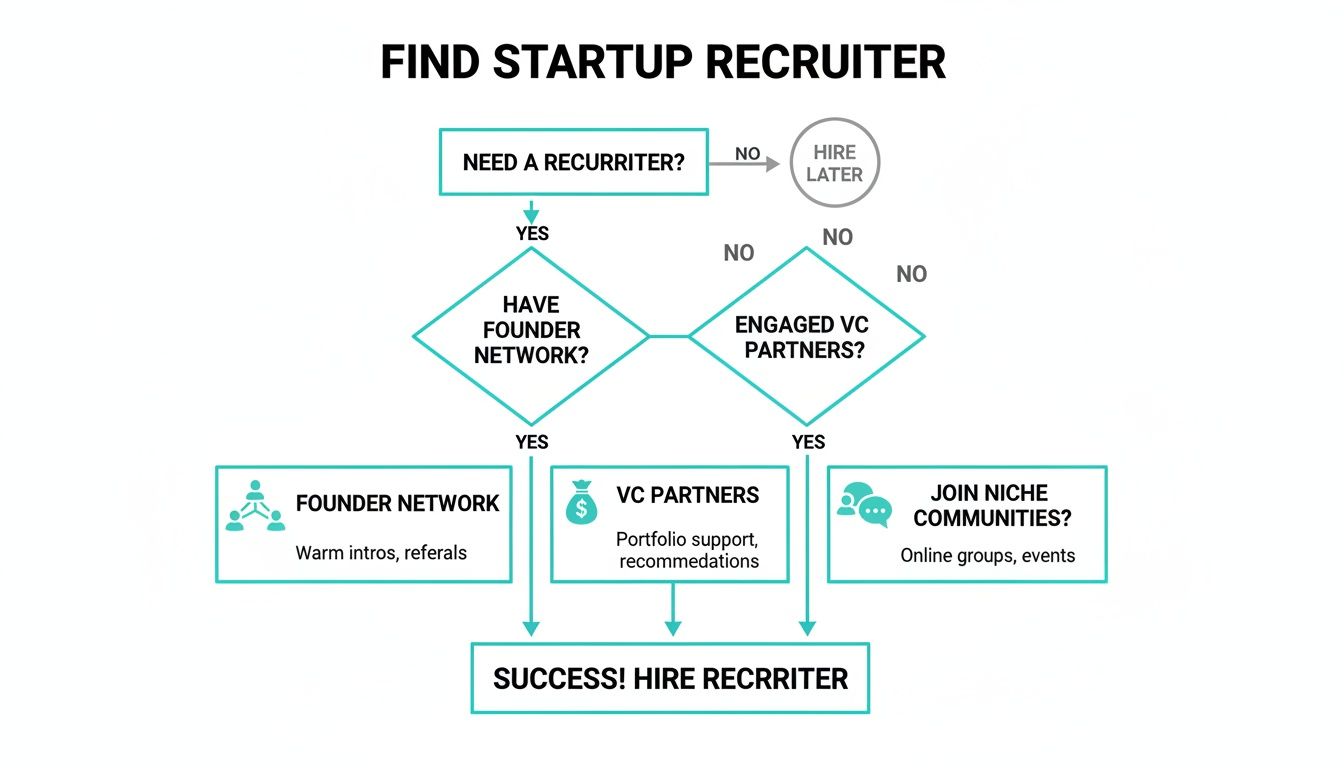
As the visual shows, the best leads almost always come from warm, trusted relationships. Those introductions are worth their weight in gold.
Once you have a shortlist, it’s time to dig in. You need to go way beyond their sales pitch and ask the kind of questions that reveal their actual process, the depth of their network, and whether they really get what you’re building. You're looking for evidence, not just confident assertions.
Treat your interview with a potential recruiter as seriously as you would an interview for a key leadership hire. Here are a few essential, practical questions to ask:
Their answers will tell you everything you need to know. You'll quickly figure out if they have genuine experience in your world or if they're just trying to shoehorn a generic corporate playbook into a startup context.
Let’s be honest: standard reference checks are often useless. A recruiter is only going to connect you with their happiest clients. To get the real story, you have to do some back-channeling. Use your own network—LinkedIn, founder groups, VCs—to find founders who have worked with them but weren't on the official reference list.
When you do talk to references (both official and back-channel), ask pointed questions that get past the generic praise.
Instead of asking, "Did you enjoy working with them?" try something more specific like, "Tell me about a time when the search went off track. How did they handle it and communicate the problem to you?" This simple reframe often uncovers a ton about their problem-solving skills and what they’re like under pressure.
These conversations are where the truth lies, revealing how a recruiter performs when things inevitably get tough.
Not all recruiting partnerships are created equal. The financial model you choose should line up with your budget, how quickly you need to hire, and the seniority of the roles. For an early-stage company, understanding the pros and cons here is key to making a smart decision about what a startup founder looks for when hiring a partner.
Each model has its place, and choosing the right one aligns your incentives with the recruiter's from day one. It's the foundation of a good partnership.
Here’s a simple breakdown of the most common engagement models you'll encounter.
For most seed-stage startups, a contingency search offers the lowest financial risk to get started. But when you need to land that one game-changing executive who isn’t even looking, a retained search is an incredibly powerful tool. Getting this choice right ensures everyone is pulling in the same direction.
Signing on the dotted line with a recruiter can feel intimidating, especially when you're staring down a wall of legal jargon. But getting a handle on the core parts of a recruiter contract is what separates a great partnership from a costly mistake. The right agreement protects everyone and sets clear expectations from day one.
Don't just skim it. This is your chance to make sure the financial terms and operational details actually work for your startup's cash flow and hiring goals. Getting this right now saves you from major headaches and unexpected bills down the line.
Recruiter fees aren't one-size-fits-all, and the model you agree to directly shapes your upfront costs and the recruiter's motivation. Most recruiters for startups use one of a few common models, each with different implications for an early-stage company.
Let's break them down:
The market for technical talent is white-hot right now. VC-funded startups are hungry for engineers, and boutique recruitment firms are feeling the heat. Some firms are working with around 100 different startups a year, with a heavy focus on landing a company's first 20 to 30 engineers. Backend engineers make up about 50% of these hires, with full-stack, AI/ML, and frontend developers following close behind. You can get a deeper look at the startup hiring market on pragmaticengineer.com.
Beyond the fee percentage, the fine print is where the real action is. A solid contract protects your startup from hidden costs and makes sure you're getting what you paid for. Before you sign anything, zoom in on these specific clauses.
A few lines of text can make a huge difference to your bottom line and your flexibility.
A recruiter contract isn't just a formality; it's the operating manual for your partnership. A clear guarantee period and a fair exclusivity clause are non-negotiable for protecting your startup's interests and ensuring the recruiter is fully invested in your success.
Here are the non-negotiables to look for:
Signing on the dotted line with a recruiter isn't the finish line. It's the starting gun. The real magic happens when you move beyond a simple vendor relationship and build a true partnership.
The best recruiters don't just send you resumes; they become an extension of your team, a force multiplier for your entire hiring engine. But that kind of synergy doesn't just happen. You have to build it. By investing a little time upfront to align on goals, give sharp feedback, and tighten up your process, you can turn a transactional service into a hiring superpower.
This is it—the single most important meeting you'll have with your recruiter. Don't treat it like a simple handoff of a job description. This is a brain dump. It's your chance to transfer your vision for the role directly into their head.
A weak kickoff leads to a fuzzy search and a pipeline full of mismatched candidates. A strong one, on the other hand, sets the stage for precision and speed. Go way beyond the bullet points on the JD. Spend your time on the intangibles that really define success at your startup.
Your goal is to arm your recruiter with the stories and context they need to become a compelling ambassador for your company. They should walk away from the kickoff ready to pitch your vision almost as passionately as you can.
The first batch of candidates from a recruiter is never about finding "the one." It's a calibration exercise. Your feedback is the data they use to fine-tune their search algorithm.
Vague comments like "not a culture fit" are completely useless. You have to provide concrete, actionable insights that help them zero in on the right profile.
Create a simple, consistent feedback loop. For every single candidate they send over that you reject, explain exactly why.
A Simple Feedback Framework
This level of detail turns every "no" into a productive step forward. It allows your recruiter to immediately adjust their sourcing and bring you better candidates with each round, saving everyone a ton of time and frustration.
In the startup hiring game, speed is your secret weapon. A clunky, drawn-out interview process is the fastest way to lose a great candidate to a competing offer.
The best recruiters for startups can bring you incredible people, but they can't force them to wait around while you get your act together. Work with your recruiter to design a process that is both tough and respectful of everyone's time. Your goal should be to get from the first chat to a final decision in under two weeks.
So, how do you know if this partnership is actually working? You need to look past the number of resumes hitting your inbox and track the metrics that truly matter. These Key Performance Indicators (KPIs) give you a clear, honest picture of your return on investment.
These numbers tell a story. Recent data shows that after a dip, recruiter productivity bounced back to around 5.4 hires per recruiter per quarter by late 2024. During that same period, applications per hire shot up by 120%, making efficiency more critical than ever. To see the full picture, you can check out the full report on recruiter productivity from Ashbyhq.com.
Here are the essential KPIs to monitor with your recruiting partner:
While a great recruiter can feel like a co-founder in the trenches with you, they aren't the only way to build a world-class team. The hiring landscape has changed, and savvy startups are getting an edge by looking beyond the traditional agency model.
Thinking outside the box can unlock speed, save you cash, and give you access to entirely different talent pools. This isn't just about cutting costs; it's about building a versatile talent toolkit and matching the right hiring method to your startup's specific stage, budget, and the roles you desperately need to fill.
Imagine a pre-vetted pool of high-intent candidates—people actively looking for their next startup gig—delivered straight to your inbox. That’s the magic of curated talent marketplaces. These platforms do the initial heavy lifting for you, screening candidates for the right skills, experience, and a genuine interest in the startup grind.
This model completely flips the old dynamic. Instead of you chasing down candidates, you get plugged into a warm pipeline of talent ready for a new challenge. For startups that need quality over sheer volume, this approach is a fantastic best LinkedIn Recruiter alternative.
So you need the firepower of a senior recruiter but can't justify a full-time hire just yet? This is the perfect scenario for a fractional recruiter. You get a seasoned pro on a contract basis, typically for 10–20 hours a week, to run a specific hiring sprint or fill a critical role.
This is a game-changer for post-fundraise hiring surges or when you need to land a few specialized roles fast. A fractional recruiter hits the ground running with their own tools, processes, and network, letting you instantly scale your hiring capacity without the long-term commitment.
Fractional recruiting gives you the best of both worlds: top-tier talent acquisition expertise on a variable cost basis. It's the perfect way to turn your hiring function on and off exactly when you need it.
Building your own talent pipeline is one of the best long-term moves you can make. And today, AI-powered sourcing tools make it more achievable than ever, even for a lean team. These platforms automate the most tedious parts of sourcing, helping you find and engage passive candidates across dozens of channels at scale.
The data backs this up. While 77% of companies are struggling to find qualified talent, around 55% of startups are now using AI in their recruitment process to get ahead. For startups, leaning into tech can be a powerful complement to other methods. Understanding what an applicant tracking system (ATS) is can also centralize your efforts and bring much-needed order to the chaos.
However, we’re dealing with real humans—with emotions, lives, and varying levels of job satisfaction.
AI recruitment has improved the speed and accuracy of finding candidates, but the core challenges remain the same. You can find the right candidates faster, but:
〰️ Messages often go unread due to outdated contact information, inactive profiles, or spam filters.
〰️Even with 200 contacted candidates, reply rates typically cap at 30%. Of those, only 3–5% are interested due to compensation, role fit, or company appeal.
〰️That leaves only 6–10 candidates open to interviewing. Based on 2025 Nexus IT Group data, only about 14.85% of first interviews lead to a final interview—so from 10 interviewed, roughly 1.5 advance.
〰️After final interviews, you may select one candidate, but then face offer negotiations and counteroffers.
The real challenge in recruitment lies here—navigating human factors and attrition throughout the process.
When you combine smart AI sourcing with a strong employer brand, you start building a sustainable, in-house hiring engine. This puts you in control, reducing your long-term reliance on external recruiters and letting you nurture relationships with top talent long before you even have an open role.
Ready to connect with top-tier, pre-vetted tech talent? Underdog.io is a curated marketplace that introduces you to experienced candidates actively looking for their next role at high-growth startups. Skip the noise and start meeting the right people.


