You've polished your Swift skills, shipped features for someone else's product, and started applying to remote iOS developer jobs. Then the familiar pattern begins: you submit a resume, watch the applicant count climb, and hear nothing. The problem usually isn't that you're unqualified. It's that your application looks like a local engineering profile competing in a remote hiring process.
Remote teams need proof that you can ship without constant supervision, explain decisions in writing, coordinate across time zones, and take ownership from an idea through App Store release. Those signals matter more than another list of frameworks. This guide focuses on the practical hiring playbook, including where to search, how to present production evidence, how to handle remote interviews, and how to judge compensation across startups and established companies.
At 11 p.m., a mid-level iOS engineer refreshes LinkedIn and sees another remote role with a crowded applicant count. The job description asks for Swift, SwiftUI, Xcode, API integration, testing, and collaboration. The engineer has all of that, but the application still disappears.
That experience reflects a real shift in how remote teams screen candidates. Stack Overflow's 2025 Developer Survey covered more than 49,000 respondents across 177 countries and found that 32.4% of developers worked fully remote globally, compared with 38% in 2024 and 41.4% in 2023 (survey context and remote-work analysis). U.S. developers were more remote-heavy, with 45% working fully remote, the highest rate among the top-reporting countries in that survey. Remote work is established, but employers can be more selective because the candidate pool is already comfortable with distributed work.
A remote hiring manager wants evidence that survives without an office visit:
AI-assisted development has also made implementation speed less persuasive on its own. The valuable distinction is judgment, including choosing what to build, identifying risk, testing the right behavior, and explaining why a simpler solution is appropriate.
Practical rule: Treat your job search like a product. Define your target company, show the evidence that solves its hiring problem, and remove every unnecessary step between the reviewer and your proof.
Remote-first companies may still offer strong compensation, while early-stage startups often trade salary certainty for ownership, speed, or equity. Don't apply to every remote posting with the same profile. Position yourself around the type of team you want, then build an outbound process that makes that fit obvious.
The channel you use changes the quality of the opportunity and the amount of proof required. Broad job boards create volume, but they also put your resume beside hundreds of similar profiles. Curated marketplaces and direct outreach create fewer opportunities, but the context is usually better.
| Channel | Best For | Selectivity | Effort to Apply |
|---|---|---|---|
| Broad marketplaces, including LinkedIn, Indeed, and We Work Remotely | Junior candidates, active job seekers, and applicants with referrals | Lower screening at submission, intense competition after submission | Low per application, high total time |
| Curated platforms, including Toptal, A.Team, and Arc | Experienced engineers with shipped products and strong communication | High | High |
| Remote-first company career pages | Candidates who fit a specific operating model | Moderate to high | Moderate |
| Startup channels, including YC's Work at a Startup, Wellfound, Pallet, and specialist communities | Engineers who want product ownership and startup exposure | Varies widely | Moderate |
| Direct outbound to founders or hiring managers | Mid-level and senior engineers with targeted proof | High signal when personalized | High per contact |
If you're early in your career, use broad marketplaces to learn which requirements appear repeatedly, but add referrals whenever possible. A resume alone rarely communicates enough context for a remote role. A short introduction from someone who has worked with you can answer the trust question faster.
Curated platforms suit engineers who can show production ownership. Expect deeper screening, technical interviews, and communication assessments. They're not a shortcut, but they can be useful if your portfolio already includes a consumer app, meaningful performance work, or a clearly documented release.
Direct applications work best when you've researched the company. Read its changelog, inspect the App Store listing, and identify the mobile problem you could help solve. A short message to a hiring manager should mention one relevant product observation and link to one matching piece of evidence, not repeat your resume.
For practical guidance on presenting mobile expertise to clients and employers, review these mobile development consultant hiring tips. Also, if startups are your target, remote startup opportunities on Underdog.io can help you focus on companies that explicitly support remote preferences.
Don't measure a channel by how many jobs it displays. Measure it by how often the role gives you enough context to make a credible, specific case.
A remote hiring manager can't inspect your desk, watch you navigate a codebase, or ask a quick follow-up in the hallway. Your portfolio has to carry that context by itself.
Lead with one shipped app rather than a collection of unfinished repositories. Link to the App Store listing, TestFlight page, or public beta signup. The reviewer should be able to understand what the product does, what you owned, and what happened after release without opening several unrelated projects.
Place three supporting artifacts beneath the project:
A short walkthrough video can replace a contrived algorithm exercise. Open a real module, refactor one part, and narrate the trade-offs. Explain why you'd use Swift Concurrency instead of another approach, where tests belong, and what you'd leave for a later iteration.
Use performance or product metrics when you have them. Cold-start time, crash-free sessions, conversion, retention, and p95 launch time are useful because they connect engineering work to user experience. Include the conditions behind the result, such as device model, measurement method, release scope, or team ownership.
A bullet like “improved performance” says almost nothing. A precise bullet can say, “Reduced p95 launch time from 4.2 seconds to 1.1 seconds on iPhone 11.” Only use figures you can defend from your own instrumentation or project records.
Your resume should answer three questions quickly: what shipped, what you owned, and what changed. For guidance on making repositories useful during hiring, use this resource on what hiring managers look for on GitHub.
A startup application should look custom-built. Copying the same resume into every form tells the reviewer you're applying for a title, not solving a product problem.
Start by extracting the role's mobile outcomes. Look for shipping cadence, retention, App Store quality, accessibility, test coverage, performance, or a migration from UIKit to SwiftUI. Then move the evidence matching those outcomes to the top of your resume and portfolio.
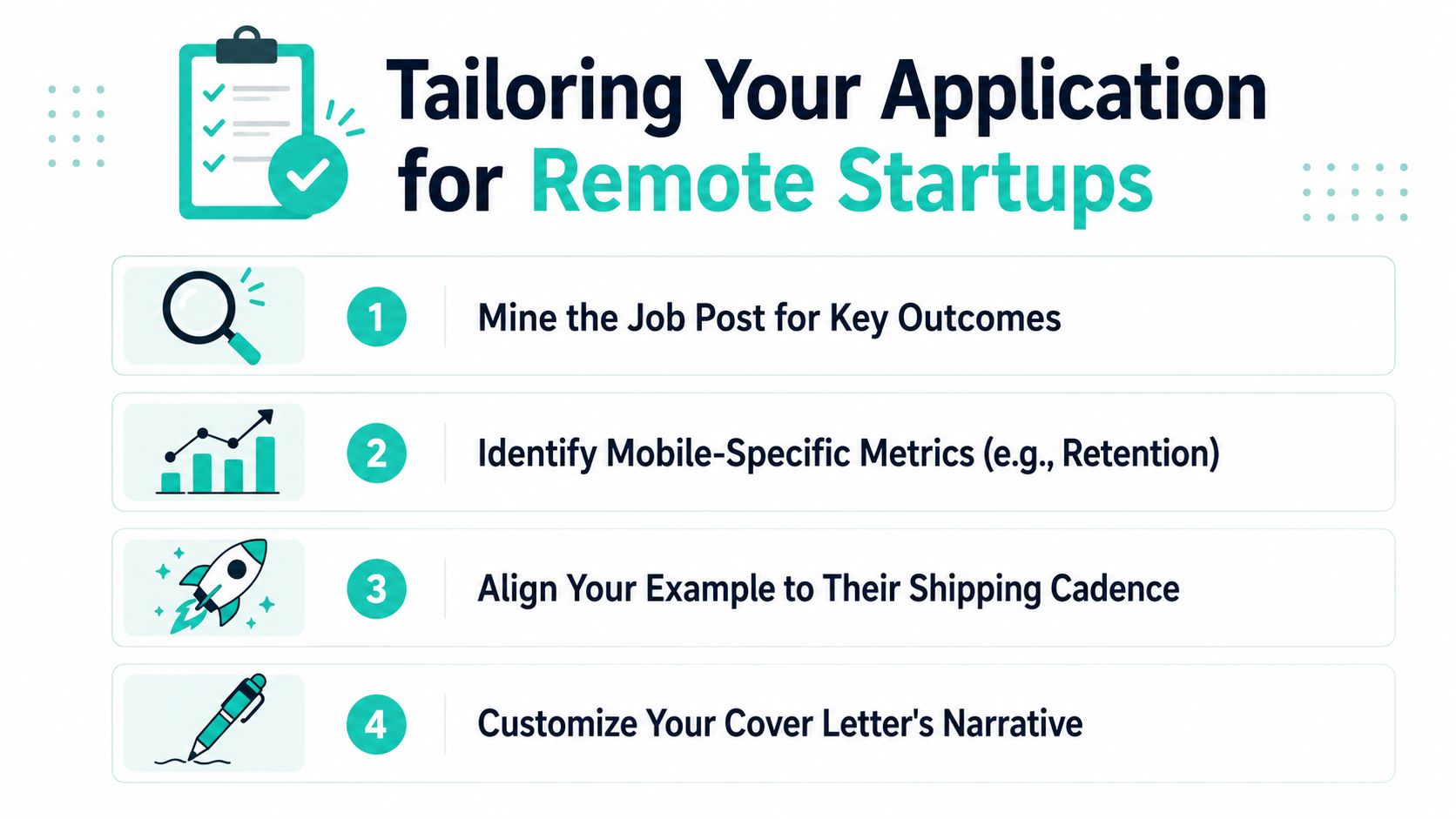
If the posting names Swift Concurrency, Combine, SwiftData, or Modular Swift Package Manager, use those terms where they accurately describe your experience. Don't add a framework because it appears in the job description. Instead, connect the technology to a result, such as a migration, a reliability improvement, or a testability decision.
Rewrite the summary line so the hiring manager sees the role reflected back immediately. “iOS engineer with experience shipping SwiftUI finance workflows and owning release quality” is more useful than “passionate software developer.”
Add a short role-fit paragraph that references a public product decision. If the company recently changed onboarding, payments, or a core user journey, explain what you noticed and how you'd investigate the next improvement. Keep it concrete and avoid pretending you know their internal metrics.
Before sending, run this checklist:
Remote readiness should appear in the application, not emerge as a surprise during the interview.
Remote iOS interviews should test whether you can deliver product work in a distributed team. Algorithm trivia can reveal some technical fundamentals, but it doesn't show whether you can diagnose a production issue, communicate a trade-off, or submit a maintainable feature.
Many remote startups use a sequence that includes an async written screen, a paired debugging or system-design session, a take-home project, and a final conversation about team habits. Prepare for the sequence as a work sample, not as a performance.
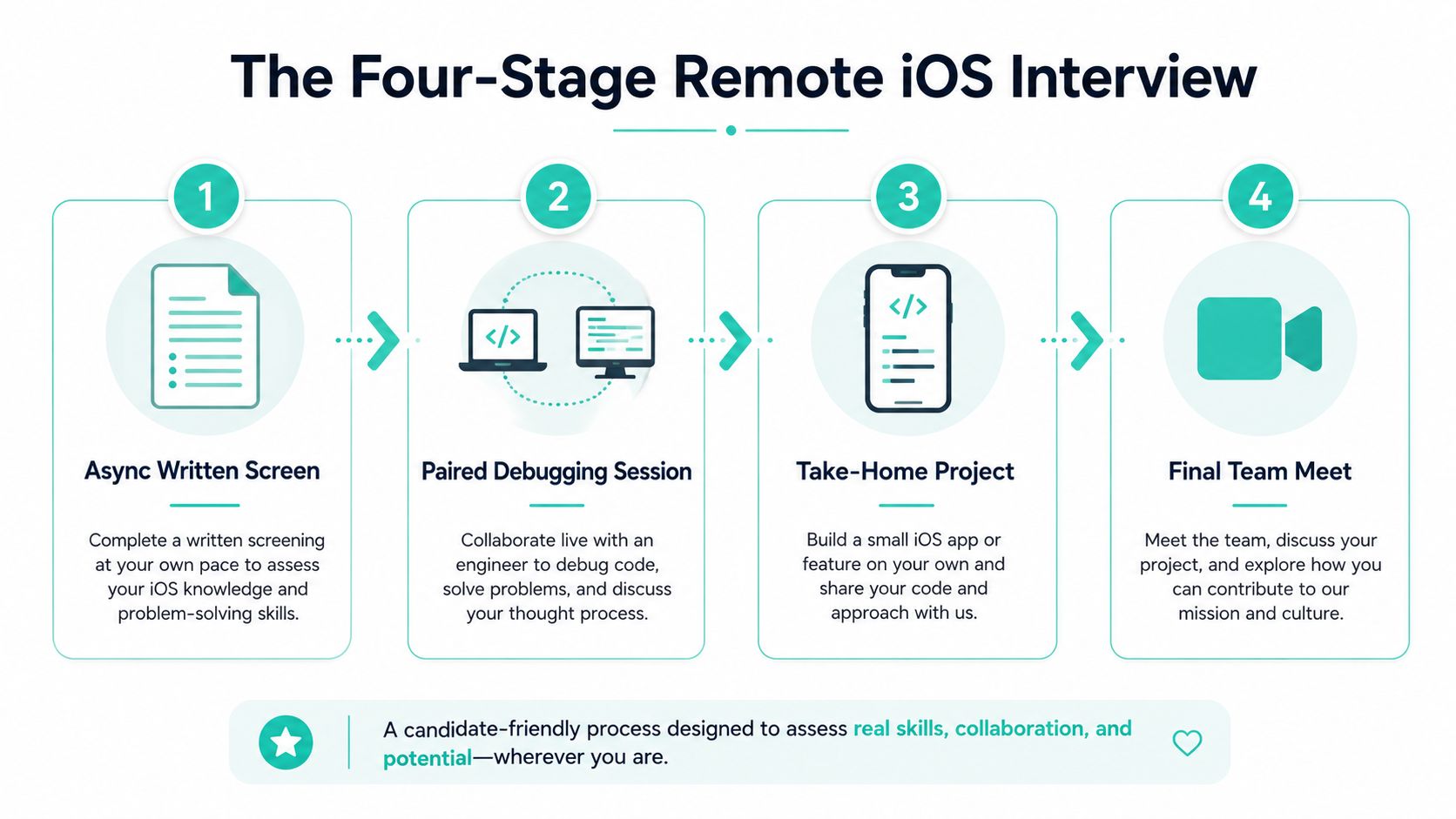
For the written screen, answer with compact STAR-shaped examples. Describe the situation, your ownership, the decision, and the outcome. A strong response explains why you chose a particular architecture, how you investigated a performance issue, and what you'd change after learning more.
During live debugging, narrate your process. Start by reproducing the issue, form a hypothesis, and use tools such as Xcode Instruments or MetricKit when they fit the problem. Explain the trade-off between a quick mitigation and a deeper fix. The interviewer needs to see your reasoning, not a memorized pattern.
Take-home submissions should be readable before they're ambitious. Include:
Don't hide unfinished work. A candidate who states that offline synchronization remains outside scope demonstrates better judgment than one who submits fragile complexity.
The async or values round deserves the same preparation. Write answers as you'd write a strong Slack update: lead with the decision, use bullets for alternatives, identify risks, and state what you need from the team. The guide to virtual interviews for remote hiring is useful for thinking through the communication environment, but your own written work remains the strongest preparation.
A remote interview is an audition for the documentation you'll produce after you're hired.
Don't negotiate remote iOS compensation as if every employer uses the same pay model. Established remote companies and early-stage startups can attach very different values to salary, equity, benefits, location, and risk.
Available U.S. data gives you useful reference points, but it also shows why one headline number isn't enough. ZipRecruiter reported an average annual salary of $123,994, with a typical range of $103,500 to $142,500 and top earners at $164,000 (remote iOS salary data). ZipRecruiter also reported average hourly pay of $59.61 for U.S. remote iOS roles as of July 2, 2026, with most workers between $49.76 and $68.51 per hour (hourly remote iOS compensation context).
Startup compensation can sit materially lower. Wellfound's startup-focused data reports an average remote iOS developer salary of $75,167, compared with an average remote startup salary of $97,167, a difference of 22.6% (startup remote iOS salary data). Another dataset reports a remote iOS median of about $125,000, a range from $70,000 to $180,000, and startup-specific average pay of $75,167 (salary dispersion by company type).
| Comp Lever | Established Remote Company | Early-Stage Startup |
|---|---|---|
| Base salary | Usually the central component, with structured levels and published or internally defined bands | Often more variable, with tighter cash limits |
| Equity | May use RSUs or established option programs | May offer options where the upside depends heavily on company performance |
| Risk | More predictable benefits, processes, and compensation administration | Greater uncertainty around runway, role scope, and future financing |
| Negotiation focus | Level, band placement, equity refresh, benefits, and remote support | Base versus equity, option terms, runway, cap table, and role breadth |
| Remote provisions | Hardware, home-office support, and written remote policy | Confirm every remote benefit because informal promises can change |
Before accepting options, ask for the strike price, current 409A valuation, post-money share count, vesting schedule, and exercise window. Ask whether early exercise is available and what happens to the options if you leave. You're not being difficult. You're pricing an asset whose value depends on terms, dilution, and company outcomes.
Anchor with a range rather than a single number. Explain the evidence behind your target, then ask the recruiter for the published band for the level. Trade base salary for more equity only when you understand the company's runway, cap table, product traction, and grant terms.
Remote-specific items belong in the offer too: home-office stipend, hardware refresh, coworking support, and a written async-work policy. Flexibility should be documented rather than left as a verbal promise.
Remote onboarding fails when progress stays invisible. Your manager can't casually observe that you're learning the codebase, so you need to make decisions, blockers, and completed work easy to find.
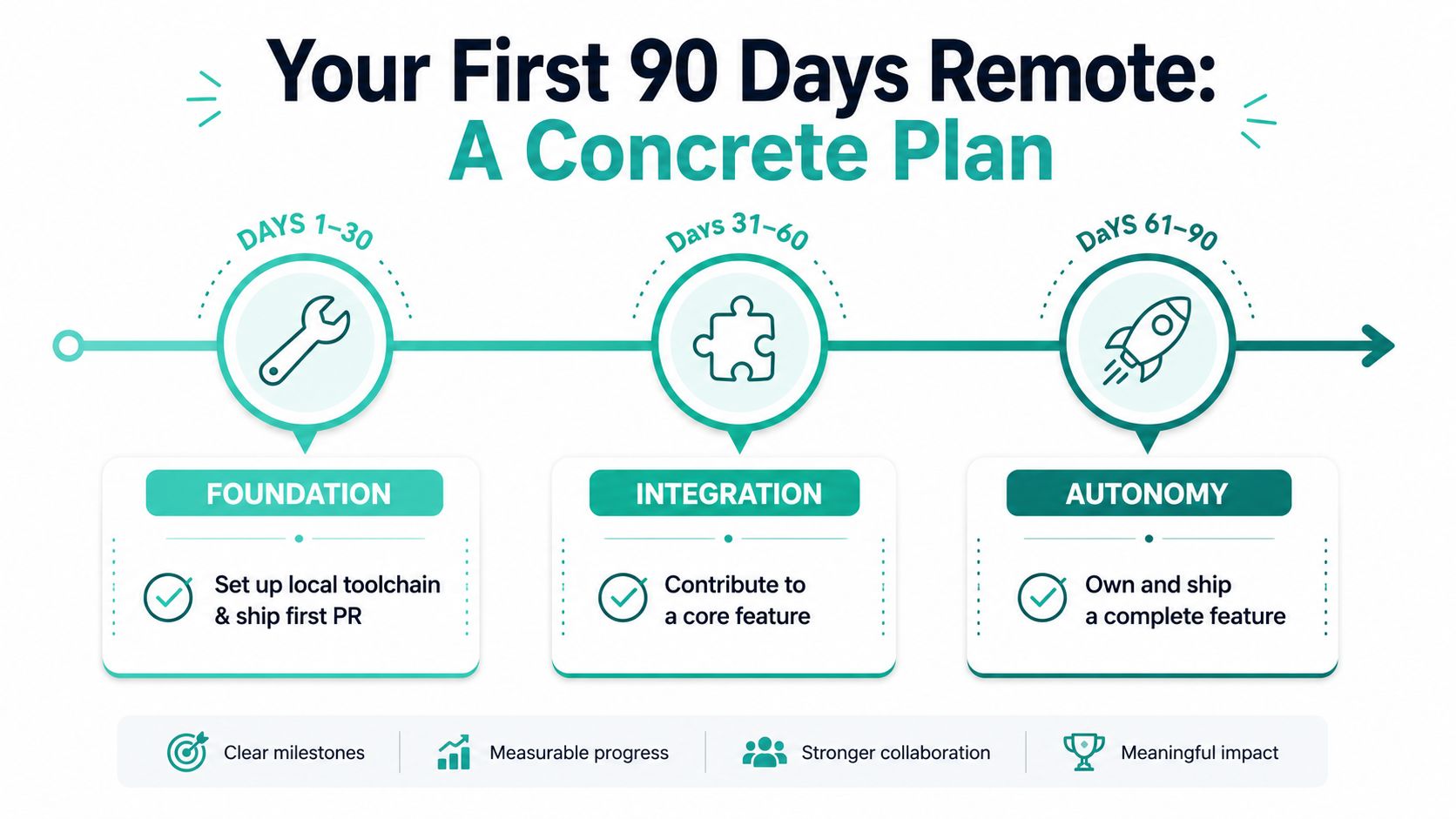
Match the team's Xcode and Swift versions before changing anything. Read the build documentation, run the test suite, install the app on a device, and identify how releases reach TestFlight. Ship a small documentation pull request early. It gives you a low-risk way to learn review conventions and shows that you improve the team's shared context.
Write a predictable async standup:
Reserve a consistent overlap window with teammates in other time zones. Use synchronous time for decisions, pairing, and feedback that benefits from conversation. Put status updates, research, and routine progress in writing.
Choose one bug or small feature that can move from investigation to release. Before coding, publish a short design note with the problem, proposed approach, alternatives, testing plan, and open questions. This gives reviewers a chance to correct direction before you spend days implementing the wrong solution.
Request pairing when the decision is difficult or the codebase is unfamiliar, not whenever you feel uncertain. After the session, summarize the decision in the pull request so future teammates don't need the same meeting.
Propose one measurable improvement, such as build time, crash-free rate, or test coverage. Share the result in a written demo with the baseline, change, evidence, and remaining limitations. Then help a junior teammate learn the team's async review norms by modeling useful comments and clear handoffs.
Run these weekly rituals:
Remote iOS hires earn trust through visible progress and reliable written communication. Technical skill gets you considered. Consistent delivery gets you renewed and promoted.
Underdog.io connects candidates with curated startup and high-growth tech opportunities, including remote preferences and mobile engineering roles. Create a profile at Underdog.io, present your shipped iOS work and remote-readiness signals clearly, and let relevant companies find you instead of relying only on cold applications.