A lot of candidates lose the GitHub review before the main review even starts.
A startup hiring manager opens your resume, sees a GitHub link, clicks it, and makes a rough judgment almost immediately. Not a final verdict, but a fast read on whether you look like someone who can join a small team, pick up ownership, and ship useful work without a lot of ceremony. That moment matters because startup hiring usually compresses everything. People don't have time to reverse-engineer your story from scattered repos and vague commit logs.
That's why GitHub works differently from a resume. A resume says what you've done. GitHub shows how you work. It reveals whether you finish things, document decisions, name things clearly, organize code sensibly, and leave behind artifacts another engineer can use effectively.
At a startup, nobody is looking at your GitHub as a museum of every line of code you've ever written. They're looking for a narrative. The question isn't “Does this person know React?” or “Have they touched Python?” The question is “What kind of engineer shows up if we hire this person?”
That story starts before anyone opens a repository. The profile itself tells me whether you understand presentation, judgment, and prioritization. Then the pinned repos tell me what work you want associated with your name. Then the README, commit history, and codebase tell me whether your judgment holds up once someone looks closer.
Strong GitHub profiles usually communicate a few things without saying them outright:
That last point matters more than many candidates realize. Curating a profile is part of the job. Startups need engineers who can decide what matters, not engineers who throw every experiment into the spotlight.
Your GitHub should answer a hiring manager's silent question: “If I dropped this person into our repo next week, what would working with them feel like?”
A personal site can help reinforce that narrative, especially if you're building your portfolio site around shipped projects, short project summaries, and links that make technical work easy to inspect. GitHub and your portfolio should support the same story, not compete with each other.
If you want a practical companion to that process, this guide on making your GitHub more impressive to employers is useful because it treats the profile as evidence, not decoration.
Hiring managers often treat a GitHub profile like a compressed portfolio and make an initial call in a very short review window. Recruiter-focused guidance says profiles are often scanned for only seconds, and strong pinned projects matter more than raw commit count because they show whether you can ship a complete, reviewable system, as noted in this GitHub profile review guidance for hiring managers.
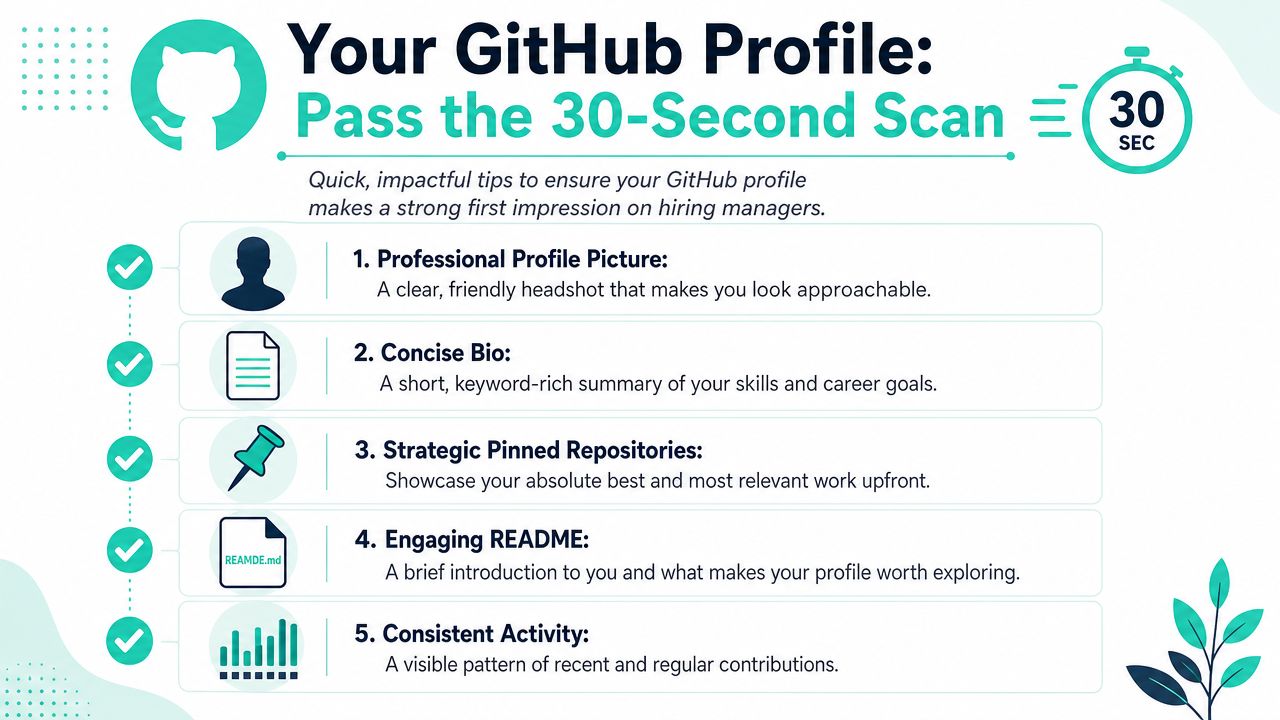
That short scan changes how you should set up the page. Don't optimize for completeness. Optimize for signal.
Your bio should read like a concise professional pitch, not a keyword dump. “Backend engineer focused on developer tools and distributed systems” tells me more than a list of languages separated by dots and emojis. If you're early career, say what you build and what kind of role you want. If you've worked in industry, mention your domain.
Then fix the basics that candidates often ignore:
A strong profile README can do a lot of work if it stays short. I don't want a manifesto. I want orientation.
Use a format like this:
| Element | What it should answer |
|---|---|
| One-line intro | What kind of engineer are you |
| Current focus | What are you building or learning now |
| Selected projects | Which repos should I click first |
| Contact path | How can I reach you |
| Optional note | Any context that changes how I should read the profile |
Custom status can help too if it adds real context. “Building a Go observability tool” is useful. “Grinding every day” is not.
Practical rule: If someone lands on your profile cold, they should know within half a minute what you build, what stack you work in, and which repo deserves the first click.
Pinned repositories are the centerpiece of that first impression, so choose them like a homepage editor, not like a collector. Four polished projects beat six random ones every time.
A pinned repository is your headline artifact. If your profile gets me to click, I then decide whether there's depth behind the presentation.
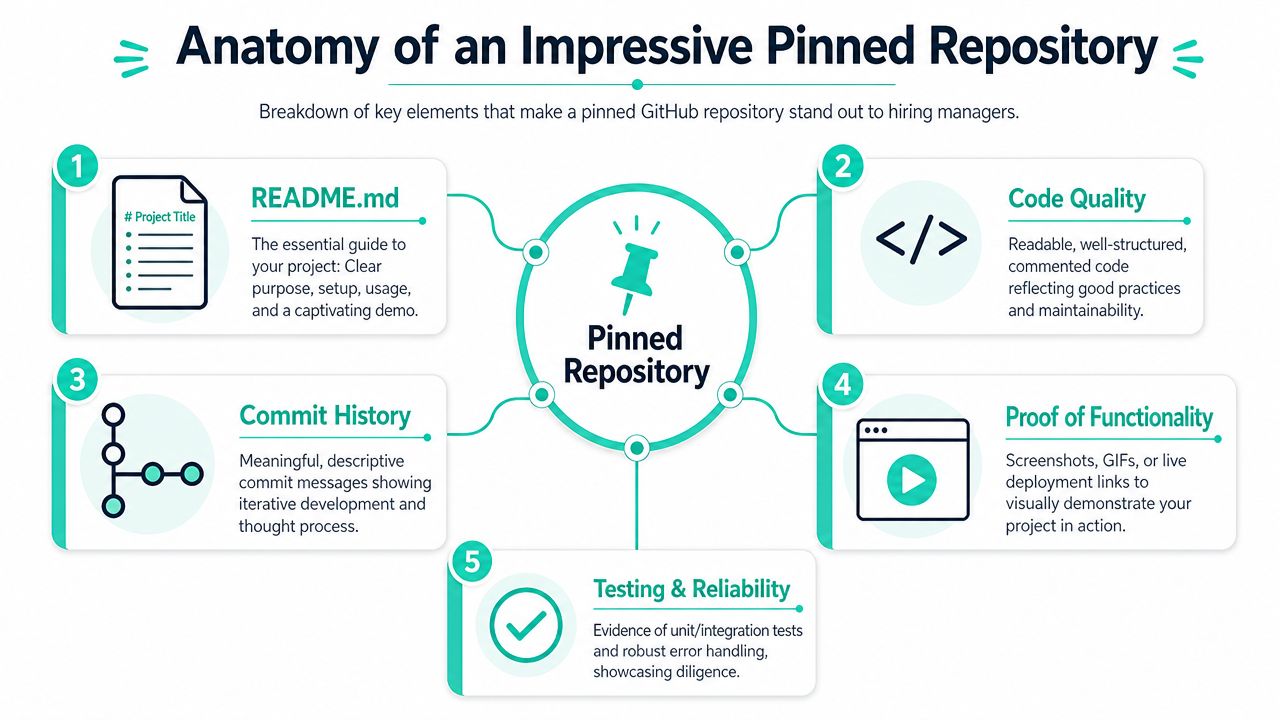
The mistake I see most often is candidates pinning ambitious but unfinished work. A smaller project with clear scope, a thoughtful README, and a working demo usually beats a sprawling repo with no setup instructions and half-built features. Startup teams care about shipping. A repository that proves you can package, explain, and present working software maps much better to day-to-day startup work than raw ambition does.
A weak README forces the reviewer to do detective work. Most won't. A strong README lowers the cost of understanding the project.
Good READMEs usually include:
A live demo is one of the highest-value additions you can make. If I can click and interact with the thing, I can evaluate scope and completeness much faster. That matters because startup hiring managers are usually looking for signs that you can turn code into a usable product, not just a technically interesting codebase.
The file structure matters. So does naming. So does whether the project starts cleanly. These aren't cosmetic details. They're clues about your habits under real delivery pressure.
Here's how different repo choices read from the hiring side:
| Repo trait | What it suggests |
|---|---|
| Clear folder structure | You can organize work so other engineers can navigate it |
| Useful environment setup docs | You think about handoff and onboarding |
| Screenshots or demo link | You finish and present work, not just write code |
| Chosen scope | You know how to cut features and prioritize |
| Archived experiments left unpinned | You understand curation |
The best pinned repos often look like one of these:
What doesn't work as well is a repository that expects the reviewer to admire effort. Effort is invisible if the project is hard to understand.
If your best project needs five minutes of explanation before it makes sense, it isn't ready to be pinned yet.
Once I'm inside the repo, I'm not only asking whether the code runs. I'm asking whether another engineer could work in this codebase tomorrow without hating you.
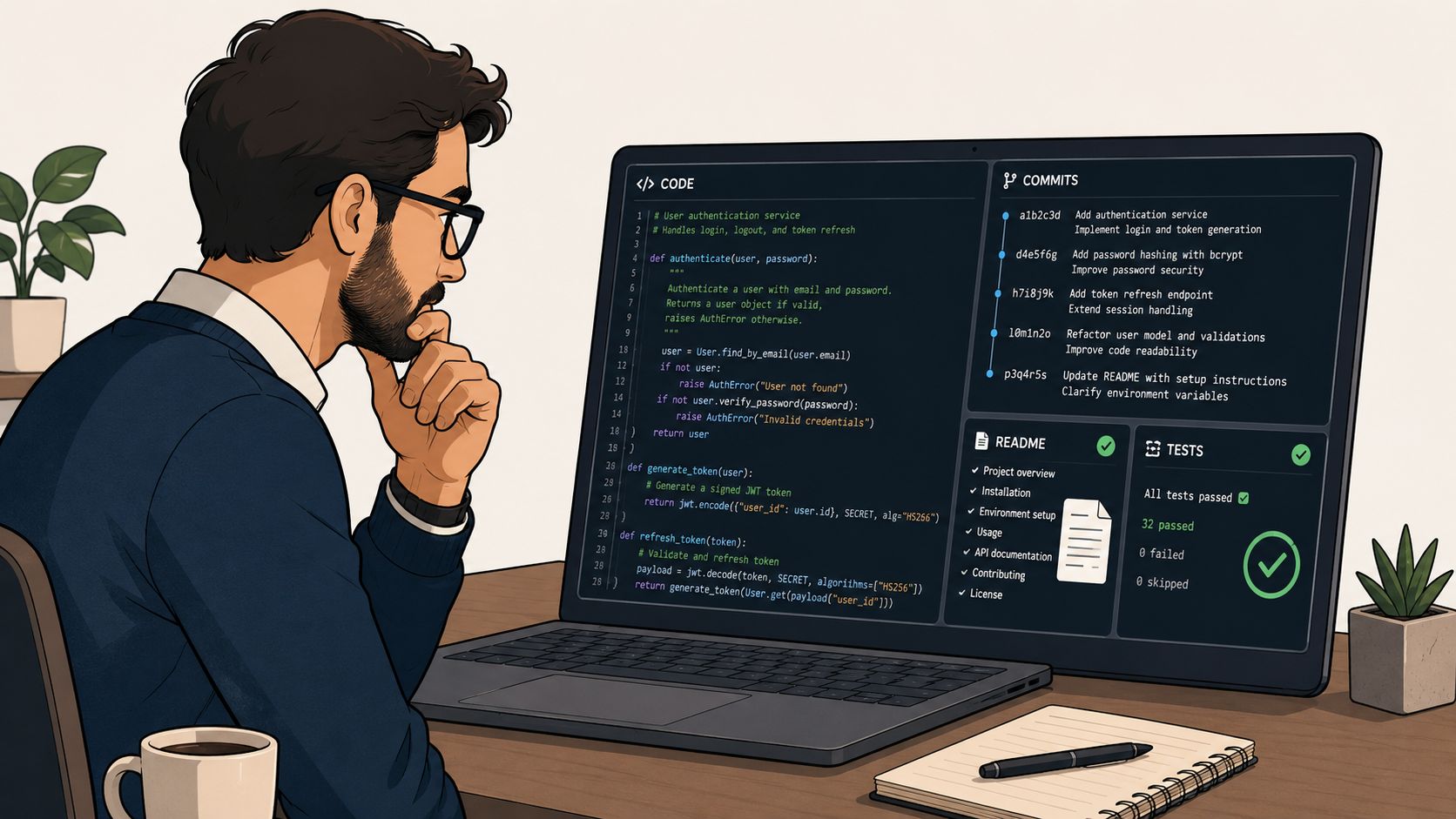
That's why readability and documentation are not “nice extras.” They're direct signals of whether you're ready for a team environment. In startups, ownership moves fast. The person who wrote the first version of a feature often isn't the person maintaining it three months later. Code has to survive handoff.
Readable code usually has a few traits in common:
What I don't want is “clever” code that compresses five decisions into one line. That can impress another candidate. It doesn't help a team moving fast under deadlines.
Documentation inside the codebase matters because it tells me you think about future readers. That includes docstrings, architecture notes, setup instructions, and even issue descriptions if they exist. Strong candidates leave behind context.
If your projects are geared toward startup roles, it also helps to understand how startups recruit differently. They usually value engineers who reduce ambiguity. Good documentation does exactly that.
Here's the simplest test. Open one of your repos after a week away from it. If you have to rediscover how it works, a hiring manager will struggle too.
The contribution graph gets attention because it's visible, but experienced hiring managers don't stop at the green squares. The more useful signals sit underneath them.
GitHub's own community guidance emphasizes quality over quantity. The guidance points managers toward meaningful contributions, quality code, project diversity, code review participation, clear commit messages, and recent, sustained work instead of raw commit totals or stars, as described in GitHub community hiring advice.
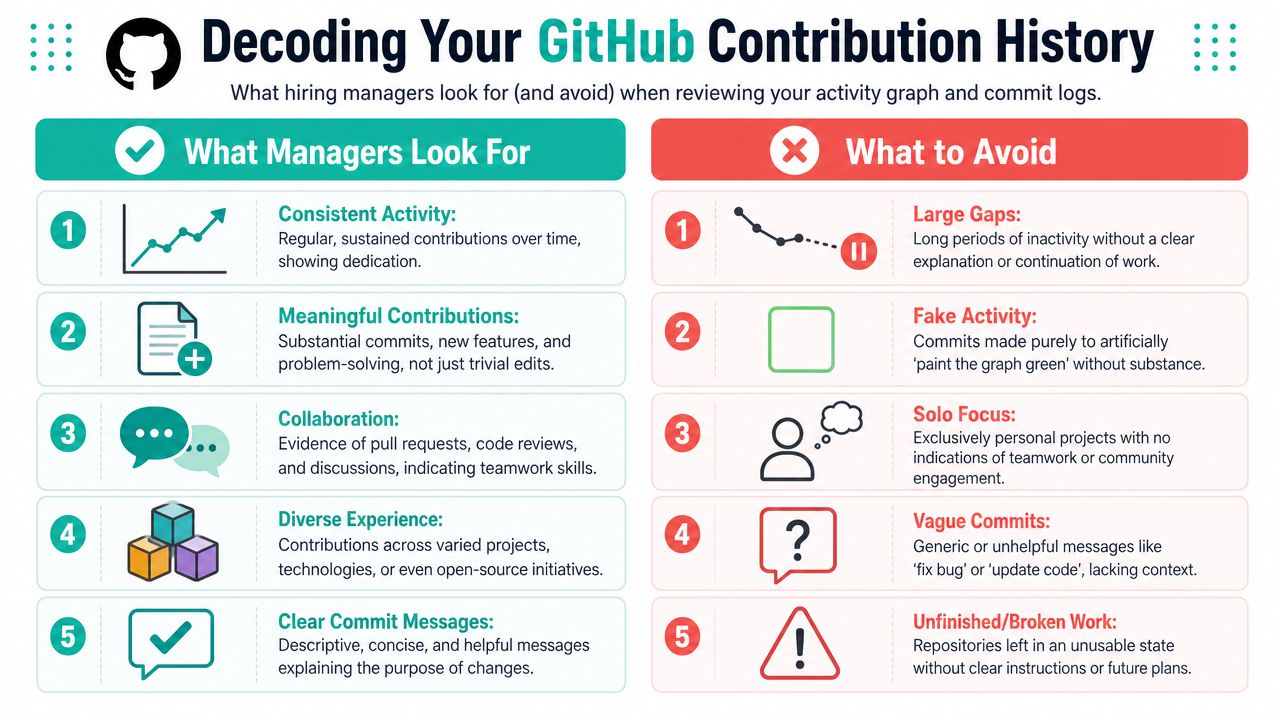
A clean commit history tells me you work incrementally and communicate changes clearly. That matters in real teams because commits become part of how people debug, review, and understand past decisions.
Compare these two patterns:
| Weak signal | Strong signal |
|---|---|
| “update code” | “add retry logic for webhook delivery failures” |
| One giant dump commit | A sequence of scoped commits |
| Messages with no context | Messages that explain intent |
| Rewrites with no explanation | Refactors accompanied by rationale |
A tidy history doesn't mean every repo needs perfect Conventional Commits. It means your history should be understandable to another developer.
When I can see pull requests or issue discussion, I learn more from that than from a streak. I can see whether you explain changes, respond to feedback, ask sensible questions, and refine your approach without getting defensive.
Useful evidence includes:
That's why teams that actively recruit on GitHub often treat public activity as a portfolio of engineering behavior. If you want to understand that lens from the company side, this piece on how startups hire on GitHub is worth reading.
Clear commit messages and thoughtful PR discussion often tell me more about team fit than a flashy side project does.
The broader pattern matters most. I'm looking for evidence that you can contribute in a way other humans can work with.
A profile gets stronger when it shows not just that you can build features, but that you understand what makes software reliable and maintainable.
One important constraint in GitHub-based hiring is that public work is only a partial view. One recruiting guide notes that 82% of contributions happen in private repositories, and the same source says GitHub has 180 million searchable profiles, which is why recruiters use it as a broad passive-candidate pool rather than just a portfolio site, according to this GitHub recruiting overview. That's exactly why your public repos need to carry more weight than you think. They may be the only visible sample of your engineering habits.
If you want to stand out on what hiring managers look for on GitHub, include proof that you know how software behaves after the first draft.
The strongest public signals are often practical rather than flashy:
.env.example, setup guide, or Makefile reduces friction and shows operational empathy.A repo doesn't need enterprise-level complexity to prove depth. A small app with tests, clean workflows, and a dependable setup often signals more than a big app with no reliability story.
Candidates sometimes ask whether they should show range or specialization. The answer depends on the job, but the profile should make the choice obvious.
A focused profile works well when:
A varied profile works well when:
If you need help packaging that work outside GitHub too, these developer portfolio templates for 2026 are a useful reference for structuring project summaries, live demos, and technical writeups in a way that reinforces the profile.
One practical note. If your strongest work lives in proprietary codebases, say that directly in your resume or profile context. Then make your public repos demonstrate the same standards you'd bring to private production work.
AI coding tools changed what public code can prove. They did not eliminate GitHub as a hiring signal. They changed which signals matter.
The weak signal is raw output. Boilerplate is easier to generate now, so quantity says less than it used to. The stronger signals are the parts AI doesn't hide well: architecture choices, trade-off notes, debugging discipline, code review behavior, naming, documentation, project framing, and whether the repo feels coherent end to end.
Startup hiring managers increasingly treat GitHub as a signal amplifier rather than a primary proof source, using it to corroborate domain fit and recent engagement while direct assessments handle actual ability, especially in startup hiring where shipped work may matter more than an extensive public history, as noted in this GitHub job search guidance from Flatiron School.
That's the right way to think about your profile too. Don't try to make GitHub prove everything. Make it prove the things that are hardest to fake:
If you audit your profile through that lens, most decisions get easier. Pin fewer repos. Tighten the README. Clean up commit messages. Add tests. Remove abandoned distractions. Replace volume with judgment.
If you're targeting startup roles and want companies to evaluate you beyond a cold application funnel, Underdog.io is one option to consider. It's a curated hiring marketplace for tech candidates and startups, where a single application can put your profile in front of vetted companies that are actively hiring.