Landing one of the many remote jobs machine learning offers is totally within reach, especially if you’re looking at the startup world. This guide is your playbook—a straight-up, actionable plan to cut through the noise and land a role in this competitive field. Forget the generic advice; we're diving deep into the specific strategies that actually work.
The demand for skilled machine learning engineers has absolutely exploded, and startups are leading the charge in building remote-first cultures. This isn’t just some passing trend. It’s a fundamental shift driven by a relentless need for specialized talent and the pressure to innovate at lightning speed.
Big names like Atlassian and Spotify have gone all-in on "work from anywhere" policies, proving that you don’t need a physical office to build high-impact tech. This has blown the doors wide open for engineers, giving you access to top-tier roles no matter where you live.
For startups, hiring remotely is a massive competitive advantage. It instantly unlocks a global talent pool, letting them find the best engineers on the planet, not just the best ones within a 30-mile radius. In a field as specialized as machine learning, finding that one person with the perfect expertise can make or break a product.
So, what's driving this? The move toward remote ML teams isn't just about flexibility; it's a cold, hard business decision. It lets startups scale faster, slash operational overhead, and pour more cash into what really matters: building game-changing products.
The table below breaks down the core reasons startups are so keen on hiring remote ML engineers.
This shift has huge implications for you as a candidate. It means that how you work is just as important as what you can do.
Startups aren't just hiring coders; they're hiring remote partners in innovation. Your ability to demonstrate autonomy, strong communication, and a product-focused mindset is every bit as critical as your technical chops.
As you navigate this new landscape, it helps to understand how these distributed teams actually function from the inside. Digging into the best practices for managing remote teams can give you a peek into the employer's mindset.
And when you’re ready to jump in, forget sifting through thousands of generic listings. Your best bet is to go straight to the source. Marketplaces that curate remote startup jobs are goldmines for finding high-growth tech companies that are actively looking for your exact skillset. This guide will show you how to stand out and grab their attention.
In the world of remote machine learning, your portfolio is your handshake, your elevator pitch, and your technical interview all rolled into one. It’s the single most powerful asset you have to prove you can deliver value from day one.
Startups aren't hiring you to re-classify iris flowers or predict Titanic survivors. Forget the standard academic projects. They need engineers who can build, deploy, and solve real business problems.
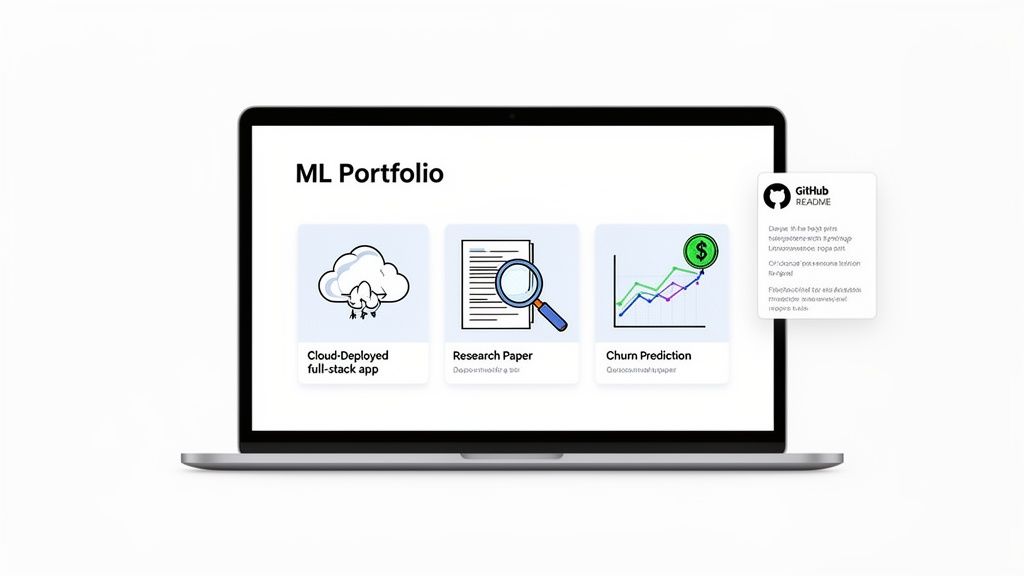
This means your portfolio must demonstrate three core competencies that startups crave: production readiness, a product-oriented mindset, and tangible business acumen. A project that just lives in a Jupyter Notebook is a non-starter. A project that solves an interesting but irrelevant problem won't get a second look.
Your goal is to build a small collection of projects that tell a compelling story about your ability to translate technical skills into business impact. This is how you grab the attention of a founder or hiring manager scrolling through dozens of applications.
To build a portfolio that truly stands out, you need to showcase projects that mirror the challenges faced by high-growth companies. This means demonstrating end-to-end capabilities, not just isolated modeling skills. Think about the entire lifecycle of an ML product, from data ingestion to a live, interactive endpoint.
Here are three project archetypes that will get you noticed:
A great portfolio project answers the "so what?" question. It's not enough to build a model with 95% accuracy. You need to explain why that accuracy matters and what business outcome it enables. For example: "Achieving 95% accuracy in fraud detection translates to preventing an estimated $1.2M in fraudulent transactions per year."
Choosing one or two of these archetypes and executing them well is far more effective than having a dozen half-finished projects. Quality and depth will always trump quantity.
An amazing project with a terrible README is like a brilliant movie with no trailer—no one will ever know it exists. Your GitHub repository is often the first and only thing a hiring manager will look at. It needs to be clean, professional, and easy to navigate.
Your README file is your narrative. It should tell the story of your project, from the problem you set out to solve to the results you achieved and the lessons you learned. A well-structured README should include:
pip install -r requirements.txt, and then uvicorn main:app --reload. An active endpoint can be tested here: [link to deployed app]."The visual presentation of your repository matters immensely. A well-organized GitHub profile with pinned projects and clear documentation signals professionalism and attention to detail. For a deep dive into optimizing your public profile, you can learn more about how to make your GitHub more impressive to employers and leave a lasting impression. Your code becomes a testament to your skill, making this a critical step in landing remote machine learning jobs.
Your online presence is your digital handshake, and for remote ML jobs, it’s what gets founders and hiring managers to even notice you. This isn't just about listing skills. It’s about building a narrative that proves you can ship code and deliver results in a fast-paced, scrappy environment.
Startups don’t hire based on keywords alone. They’re looking for signals that you’re autonomous, impactful, and can move fast. Your profiles on LinkedIn and specialized platforms need to ditch the passive language common in big corporate roles and adopt an active, results-driven story that speaks directly to a startup’s need for problem-solvers.
Corporate jargon is a huge red flag for startup recruiters. Phrases like "responsible for" or "participated in" are too vague and passive. They want to know what you did, what you built, and what impact it had. You need to reframe your experience from a list of duties into a showcase of tangible wins.
Let’s get practical. A lot of ML engineers have a profile summary that looks something like this:
Before:
"Experienced Machine Learning Engineer with a background in developing predictive models. Responsible for data preprocessing, feature engineering, and model validation. Familiar with Python, Scikit-learn, and TensorFlow."
This is technically accurate, but it's completely forgettable. It lists skills without context and, more importantly, without impact. Now, let’s rework it with a startup-centric focus on action and results.
After:
"Machine Learning Engineer who builds and deploys end-to-end AI solutions. I scaled a recommendation engine that boosted user engagement by 15% and shipped a churn prediction model that identified at-risk customers with 85% accuracy. I thrive on getting products to users quickly, from initial data exploration to deploying containerized models via FastAPI and AWS."
See the difference? This version is powerful because it highlights quantifiable impact, shows you know your way around production-level tools, and signals a proactive, product-focused mindset. This is the kind of language that gets a founder to click "Connect."
Your profiles across different platforms should tell one cohesive story. Each one serves a slightly different purpose, but they all need to align with the persona of a capable, self-sufficient remote engineer. A quick audit can expose gaps and easy opportunities for improvement.
Run through this checklist to make sure your profiles are ready for discovery:
"A huge mistake I see people make is treating their professional profiles like a static resume. Think of them as living documents. You should be updating them regularly with new project results, skills, and accomplishments. It sends a strong signal that you're actively growing and engaged in the field." Says Travis Lindemoen, founder of nexus IT group and CEO of Underdog.io.
By meticulously crafting your online presence, you're not just applying for remote machine learning jobs—you're building a magnet for them. A well-optimized profile works for you around the clock, attracting the right kind of opportunities from the innovative startups you actually want to work for.
Stop spraying your resume across the internet and praying for a response. That endless cycle of applying into a digital black hole is exhausting and, frankly, ineffective. Landing a great remote machine learning job, especially at a startup, requires a real strategy—not a shotgun blast of applications.
It’s about quality over quantity. The goal is to get surgical, targeting high-potential startups where your skills will actually move the needle. This means blending active searching with smart passive positioning, so you’re not just finding opportunities but letting them find you.
The market is on your side here. AI specialist roles are growing 3.5 times faster than the average job, and machine learning is the single most in-demand skill, showing up in 0.7% of all US job postings. Companies are competing for talent, and a focused strategy puts that leverage back in your hands. You can find more on these market trends to see just how hot the demand is.
Instead of getting lost on massive job boards, you need to become a startup detective. Your mission is to find promising, well-funded companies before their job postings get buried under a mountain of applicants. A little proactive digging gives you a massive advantage.
Here are a few tactics that work:
This is all about positioning yourself correctly. The key is to make sure your professional profiles are aligned and ready for when you make your move.
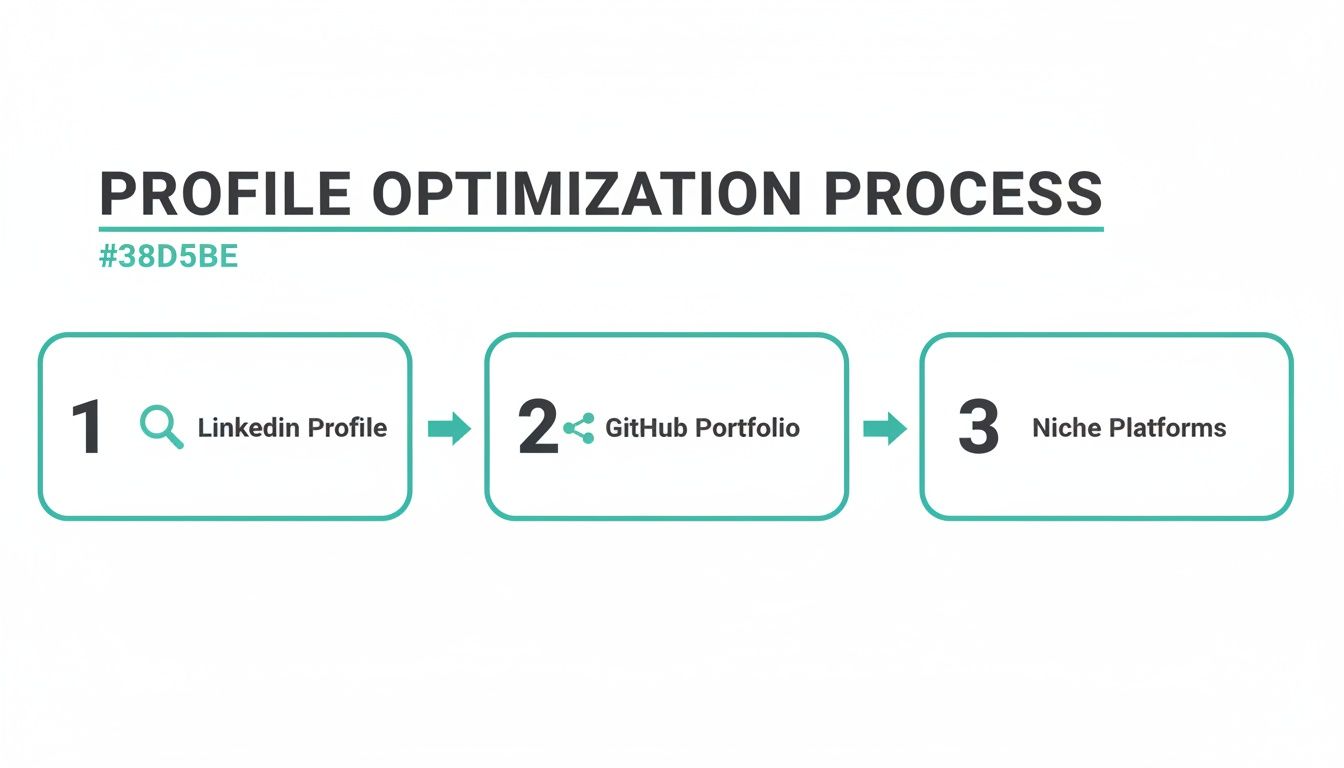
As the flowchart shows, it starts with building a compelling story on your LinkedIn, backing it up with hard proof on GitHub, and then getting that cohesive presence onto the niche platforms like Underdog where startups are actually looking.
The absolute best position to be in? When companies are applying to you. That’s the whole idea behind a passive job search. You optimize your profiles on curated platforms so that recruiters and founders come knocking on your door, completely flipping the usual power dynamic.
Platforms like Underdog.io are built for exactly this. You create one sharp, well-written profile, and it gets seen by hundreds of vetted startups. It’s infinitely more efficient than tweaking your resume for dozens of different applications.
A strong passive search strategy isn’t about being lazy; it's about being smart. You invest time upfront to build a magnetic profile, then let the opportunities come to you. This frees up your energy to focus on high-quality conversations with companies that are already interested.
When a founder or recruiter reaches out, your response is everything. A generic reply just won’t cut it. Whether you’re sending the first message or replying to one, it needs to feel personal and well-researched.
Here’s a simple, effective way to frame a warm outreach message after you've identified a target company:
"Hi [Hiring Manager Name],
I saw that [Company Name] recently [mention a specific achievement, like a funding announcement or product launch]. I was really impressed with how you're using ML to solve [specific problem].
My own work in [mention a relevant project, e.g., building a recommendation engine] seems to align directly with that. In a previous role, I drove a 15% uplift in user engagement by implementing a similar system.
I'm actively looking for my next remote machine learning role and think I could bring a lot of value to your team. Are you open to a quick chat next week?"
The interview process for a remote machine learning job is where all your prep work comes together. Think of it less like a test and more like a performance. You need to prove you can problem-solve, communicate clearly, and collaborate effectively—all through a screen. Acing this stage demands a strategy built for the virtual world.
Successfully navigating these interviews means showing you can think on your feet and explain complex ideas without the help of in-person body language. Startups aren’t just looking for brilliant engineers; they need effective communicators who can slide right into a distributed team.
The technical interviews for ML roles usually come in three flavors. Each one is designed to test a different part of your skill set, from hardcore coding to big-picture architectural thinking. You have to be ready for all three.
In a remote interview, your tech setup sends a strong signal about your professionalism and your readiness for remote work. A choppy connection or bad audio creates friction and distracts from your actual skills. Don't let a preventable glitch sink your performance.
Before you hop on any calls, do a full tech rehearsal. This is more than just checking your internet speed. It’s about creating a professional environment where you can shine.
Your Pre-Interview Checklist:
Your ability to run a smooth virtual interview is a proxy for how effective you'll be as a remote employee. A flawless setup tells them you’re organized, professional, and ready for the realities of a distributed team.
Getting comfortable presenting yourself in a virtual setting is a skill in itself. For some great pointers, check out this guide on how to excel in virtual interviews and hire remotely; it has valuable tips for any candidate.
At the end of the interview, when they ask, "So, what questions do you have for us?"—that's your opening. This is a golden opportunity to vet them, to figure out their ML maturity and what their remote culture is really like. Generic questions just won’t do. You need to dig.
Instead of asking something vague like, "What's the remote culture like?" ask questions that force a specific, revealing answer.
Insightful Questions to Ask:
The answers to these questions will tell you everything you need to know about their tech stack, their actual commitment to remote work, and whether you’ll be set up to succeed. This isn't just about showing you're interested; it’s about proving you're looking for the right remote job, not just any remote job.
So, you made it through the gauntlet of interviews and have an offer sitting in your inbox. Awesome. Take a moment to celebrate—that's a huge win. But before you rush to sign, remember this: the next conversation is one of the most important. It’s time to negotiate a package that truly reflects your market value.
Landing a remote role adds a few extra layers to the negotiation. You need to think way beyond the base salary. We're talking about the entire package—equity, signing bonuses, and all the remote-specific perks that can make a huge difference to your bottom line.
A great offer is more than just a big salary. Startups, in particular, love to balance a solid base with a meaningful slice of equity. Don’t sleep on the other perks either. A home office stipend, a budget for professional development, or killer health insurance can add thousands of dollars in real value.
The benchmarks for remote ML talent are seriously strong right now. We're seeing senior machine learning engineers pull in between $173,000 and $227,000 annually. This isn't a fluke; it's driven by a 25% wage premium for AI expertise, with machine learning leading the pack of high-demand skills. If you want to dive deeper, you can read up on the latest machine learning salary trends to get your numbers straight.
The most powerful tool in any negotiation is data. Walk into the conversation armed with industry salary reports, a clear understanding of your market value, and the specific business impact you demonstrated during the interview process.
When you counter, you’re not just asking for more money. You're making a business case for why you're worth it. The key is to tie your request back to the specific problems and projects you discussed in your interviews.
Here’s a simple script you can adapt to make it your own:
"Thank you so much for the offer. I'm incredibly excited about the opportunity to work on [mention a specific project or challenge] with the team. Based on my research into the market rates for remote machine learning roles with my level of production experience, and considering the impact I can have on [mention a company goal], I was expecting a base salary closer to [Your Target Number]. Is there any flexibility to meet me there?"
This approach keeps things collaborative. It’s not a demand; it's a data-driven conversation that connects your value directly to their needs. Whether the company pays based on location or has a single pay scale, a well-reasoned argument grounded in your unique skills and market data is your best shot at getting the compensation you deserve.
Look, I get it. The world of remote machine learning roles, especially at startups, is full of questions. You're probably wondering what companies really want, how to get your foot in the door, and what life is actually like on the inside.
Let's cut through the noise. Here are the straight-up answers to the questions I hear most often from engineers navigating this space. The biggest hurdle isn't just knowing the tech; it's proving you can ship real, production-ready solutions from anywhere.
Beyond the table stakes of Python and SQL, startups are practically begging for engineers who have touched production systems. This isn't about theoretical knowledge; it's about practical, hands-on experience.
Can you productionalize a model? That means you need to be comfortable with:
Having solid experience with large language models (LLMs) and deep learning frameworks like PyTorch is also a massive advantage right now. It shows you're not just keeping up, you're ahead of the curve.
If your resume is light on professional ML experience, your portfolio becomes your entire sales pitch. A dry list of skills won't cut it. You need to build something real.
My advice? Create an end-to-end application, even a small one. The key is to deploy it and then meticulously document the entire journey on GitHub. Show your thought process, the roadblocks, and the solutions. Another great move is contributing to open-source ML libraries or getting your hands dirty in Kaggle competitions. These activities showcase raw problem-solving muscle.
Don't forget to reframe your past work. Even if it wasn't a "data" role, talk about how you used data to make decisions. It highlights an analytical mindset, which is gold.
Travis goes on to say, "The key is to show, not just tell. An end-to-end project that someone can interact with is infinitely more powerful than a resume bullet point claiming a skill."
The difference is night and day. At a startup, you’re not just a cog in a machine; you’re a significant part of the engine. Expect to have a ton of ownership and work on a much wider range of problems. One day you might be building data pipelines, the next you're deploying a model. The pace is relentless, but you're incredibly close to the business impact of your work.
In contrast, big corporate roles are usually more specialized and structured. You'll likely have a narrower focus, working within well-established processes and on a smaller piece of a much larger puzzle. There's more of a safety net, but often less autonomy.
Ready to stop endlessly applying and let the best remote machine learning jobs find you? At Underdog.io, we connect top tech talent with innovative startups. Create one profile and get discovered by hundreds of vetted companies. Find your next role.