Your best engineer wants to move to Denver. Your customer success lead needs overlap with East Coast clients. Your designer does their best work late at night and hates commuting for a meeting that could've been a Loom. In a startup, those requests usually start as one-off exceptions. Then they become precedent. Then they become politics.
That's when founders realize remote work policies aren't HR paperwork. They're operating system decisions. If you don't write the rules down, people still follow rules. They're just inconsistent, manager-specific, and usually unfair.
Early-stage teams can survive on trust and hallway coordination for a while. Growth breaks that model. New managers interpret flexibility differently. candidates ask sharper questions. Employees compare treatment. Payroll, security, and performance issues show up all at once. The companies that handle this well don't avoid structure. They use structure to protect flexibility.
A lot of startups still treat remote work like a perk that can be negotiated in Slack. That works until it doesn't.
One team member gets approval to work from another state because they're hard to replace. Another gets denied because their manager prefers in-person collaboration. A founder says “we're flexible” in interviews, but nobody can explain what that means for travel, time zones, or meeting expectations. Soon the company has a culture problem wearing an operations costume.
The market has already moved. The shift to remote work is permanent, not a trend. In 2026, 52% of U.S. jobs are hybrid and 26% are exclusively remote, while 98% of workers want to work remotely at least some of the time (remote work outlook for 2026). If you're hiring startup talent, policy ambiguity doesn't feel scrappy. It feels like risk.
There's also a practical recruiting angle. Candidates don't just ask whether a role is remote. They ask how decisions get made. They want to know if relocation changes compensation, whether core hours exist, how often people meet in person, and whether remote employees get passed over. If your answer is “it depends,” they hear “we haven't thought this through.”
A clear policy also prevents the worst kind of startup drift, where culture gets defined by whoever speaks first in a meeting. The return-to-office debate hasn't settled cleanly either, which you can see in this look at why return-to-office still has unresolved problems. Teams are still figuring out coordination, trust, and fairness. A written policy doesn't remove those tensions, but it stops them from becoming random.
Practical rule: If a remote decision would create resentment when shared company-wide, it belongs in policy, not in a private exception.
Good remote work policies don't reduce autonomy. They define where autonomy starts and where it stops.
Before drafting clauses, decide what kind of company you are. Not what sounds modern. Not what your competitors say on their careers page. What your team can sustain.
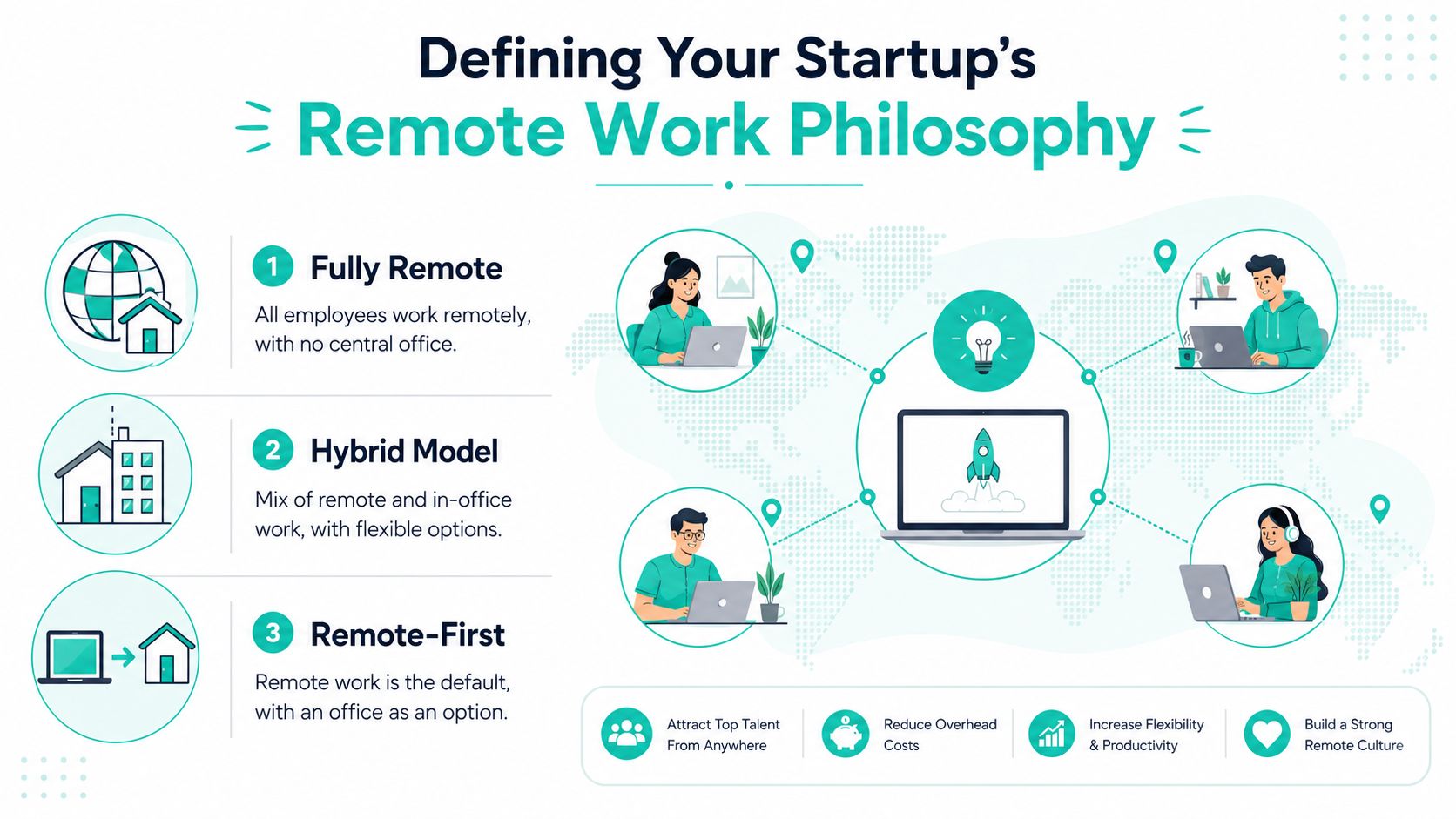
Hybrid is more common than fully remote. Data from 2023 shows 28.2% of U.S. employees worked under a hybrid policy, compared with 12.7% working exclusively from home (hybrid versus fully remote job statistics). That doesn't mean hybrid is automatically right for your startup. It means you should choose deliberately.
A fully remote setup is the cleanest model operationally. No one wonders where the “real work” happens because there is no headquarters gravity. Meetings happen on Zoom by default. Documentation matters. Hiring opens up geographically.
This model works best when the company is willing to build systems first. You need strong writing, async decision-making, good onboarding, and managers who know how to run teams without visual supervision. If you keep an office mindset inside a fully remote company, work slows down and decisions bottleneck around whoever's online first.
Hybrid sounds flexible because it is flexible. It also creates the most room for confusion.
A hybrid policy can work well if your company needs some in-person collaboration for product reviews, workshops, or customer-facing functions. It breaks down when leaders use the office informally as the place where trust, context, and promotions are built. Then “optional” turns into “career-limiting if skipped.”
Remote-first is often the best compromise for a startup that wants flexibility without pretending the office is irrelevant. In a remote-first model, the company designs communication, meetings, and documentation as if everyone is remote, even if some people occasionally use an office.
That distinction matters. Remote-friendly usually means remote workers are accommodated. Remote-first means they're included by default.
Use this test before you pick a model:
| Question | If the answer is yes | Likely fit |
|---|---|---|
| Do you want access to wider talent markets? | Geography matters for hiring | Fully remote or remote-first |
| Do teams need frequent in-person whiteboarding to move fast? | Real-time collaboration is central | Hybrid |
| Can managers evaluate output without seeing people work? | You trust documented execution | Fully remote or remote-first |
| Will office attendance quietly influence advancement? | Visibility risk is high | Avoid loose hybrid |
Don't choose a model because it feels employee-friendly. Choose the one your leadership team can run consistently.
A good philosophy fits your product cadence, customer needs, and management maturity. Everything else in your remote work policies flows from that choice.
Once the philosophy is clear, write the document your team will use. Keep it plain English. If employees need a lawyer to interpret it, the policy has already failed.
This visual checklist helps anchor the core sections.
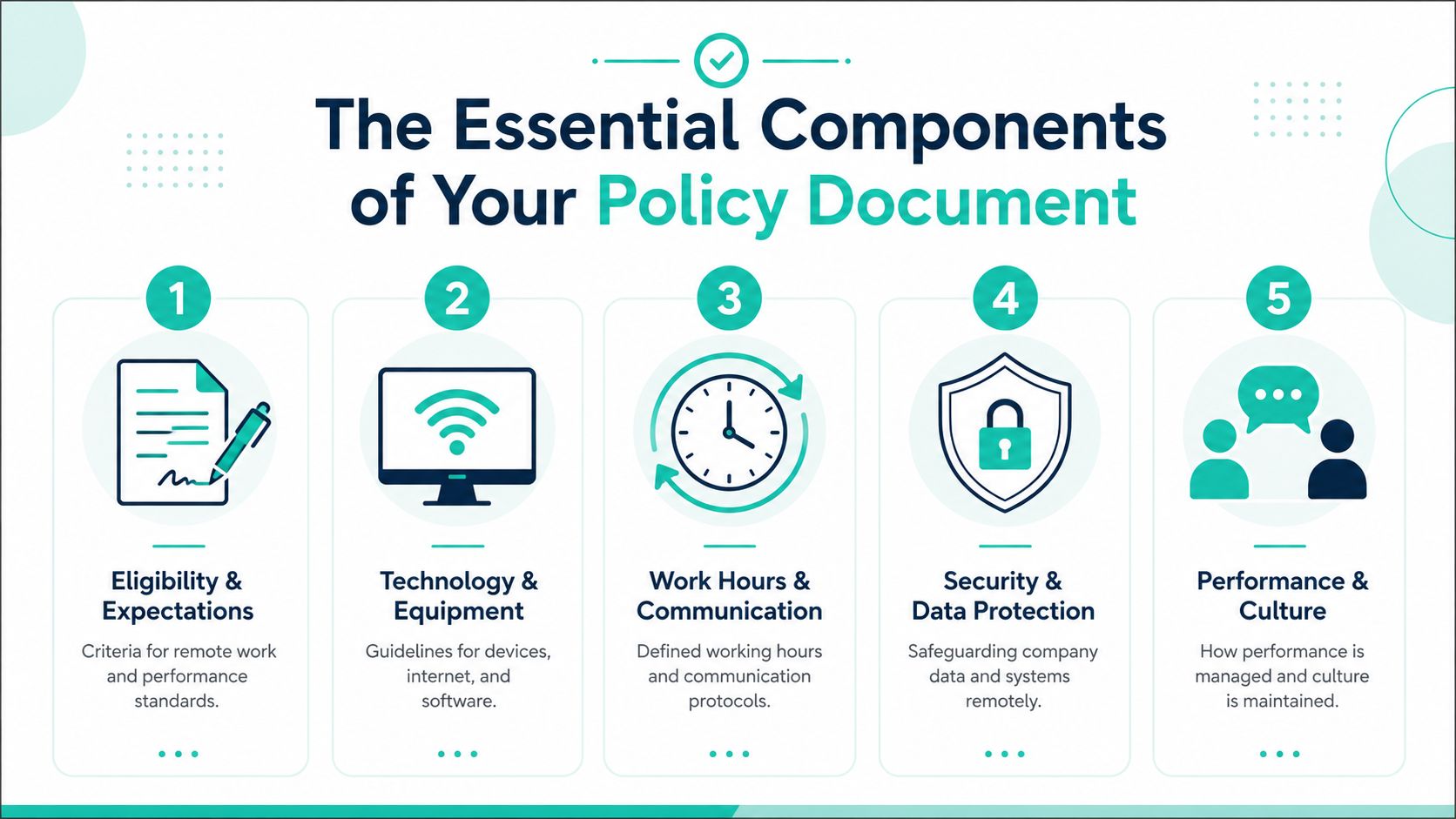
I like remote work policies that answer real day-to-day questions: Who can work where? When do I need to be available? What tools are required? What happens if I move? Who pays for equipment? If a policy doesn't resolve those points, managers will fill the gap with opinion.
For a useful starting structure, this sample work from home policy from Madeira Remote is helpful because it shows what a readable draft looks like before legal review turns everything into mush.
Spell out which roles are eligible for which arrangements. Don't hide behind vague language like “manager discretion” unless you also define the criteria.
Include points like:
A lot of startups overcorrect in this regard. They either track every minute or say nothing at all.
A better approach is to define core collaboration hours and separate them from independent work time. For example, a product team may need overlap for sprint planning, standups, and incident response, while engineering deep work can happen outside that window. Customer-facing teams usually need tighter coverage expectations than internal platform teams.
A policy should also answer:
The strongest remote policies don't require everyone to be online all day. They require everyone to be reachable when coordination matters.
You don't need a giant reimbursement program to be clear. You do need standards.
List the approved stack. In most startups that means tools like Slack for team communication, Zoom or Google Meet for meetings, Notion or Confluence for documentation, Jira or Linear for work tracking, and an MDM-managed company laptop for secure access. If you allow personal devices, say exactly when and under what controls.
Also define the work environment expectation. That doesn't mean demanding a Pinterest-perfect home office. It means requiring a place where someone can handle calls, protect confidential information, and maintain stable internet access.
A short policy table keeps this practical:
| Area | What to define |
|---|---|
| Devices | Company-issued laptop, approved peripherals, replacement process |
| Software | Required tools, licensing rules, admin access limits |
| Internet | Minimum reliability expectation, backup plan for outages |
| Workspace | Privacy expectations, noise management for calls |
| Support | IT help process, lost device reporting, offboarding return steps |
Don't leave performance for the manager handbook. Put the principle in the policy itself.
State that performance is measured by output, reliability, communication quality, and role-specific goals. State what won't count as performance evidence, like being visibly online for long stretches without meaningful results.
That one paragraph saves a lot of trouble later.
Security is where founders often swing between two bad extremes. One is denial. The other is surveillance theater.
The better answer is disciplined basics. Start with the assumption that distributed work increases the number of places where mistakes can happen. Then control the highest-risk behaviors instead of trying to watch every click.
A fundamental tension exists: 73% of executives view remote employees as a heightened security risk, yet nearly 50% of hybrid workers report activity monitoring, which erodes trust and contributes to burnout (security risk and monitoring data). If your remote work policy relies mostly on monitoring software, you're solving fear with a trust tax.
A startup doesn't need enterprise bureaucracy to improve remote security. It needs a few hard rules that people can remember and managers can enforce.
Use policy language that covers:
This is also a good place to think operationally about hardware lifecycle. Distributed teams ship more laptops, accessories, and replacements across more locations, which creates disposal and recovery issues. For a practical look at that side of operations, this piece on how remote work influences e-waste is worth reviewing when you build your equipment process.
The policy should state that employees must work from approved jurisdictions and must request approval before relocating, even temporarily if the move affects payroll, tax, or labor obligations. Most compliance mistakes happen because someone assumed a move was “basically fine” and told the company afterward.
Use a short ownership model:
| Topic | Primary owner | Policy stance |
|---|---|---|
| Payroll and tax registration | Finance or payroll lead | Work only from approved jurisdictions |
| Labor law requirements | People Ops and counsel | Review local requirements before approval |
| Workers' compensation | People Ops | Confirm coverage by work location |
| Data handling | Security or IT | Restrict access by device and tool controls |
A privacy notice matters too. If you use monitoring, logging, or device management, say what is collected, why it's collected, and where the limit is. Employees don't expect zero controls. They do expect honesty. A public-facing reference point like Underdog's privacy policy is a useful reminder that trust starts with clear disclosure, not hidden tooling.
Security training beats silent surveillance. People follow rules they understand and ignore rules they only discover after they trip them.
Monday morning, the product lead gets pulled into an office whiteboard session and leaves with the next launch project. The remote engineer sees the decision later in Slack, after the work is already staffed. That is how a two-tier company forms. Not through policy language, but through repeated access gaps that shape who gets context, mentorship, and promotion-ready work.
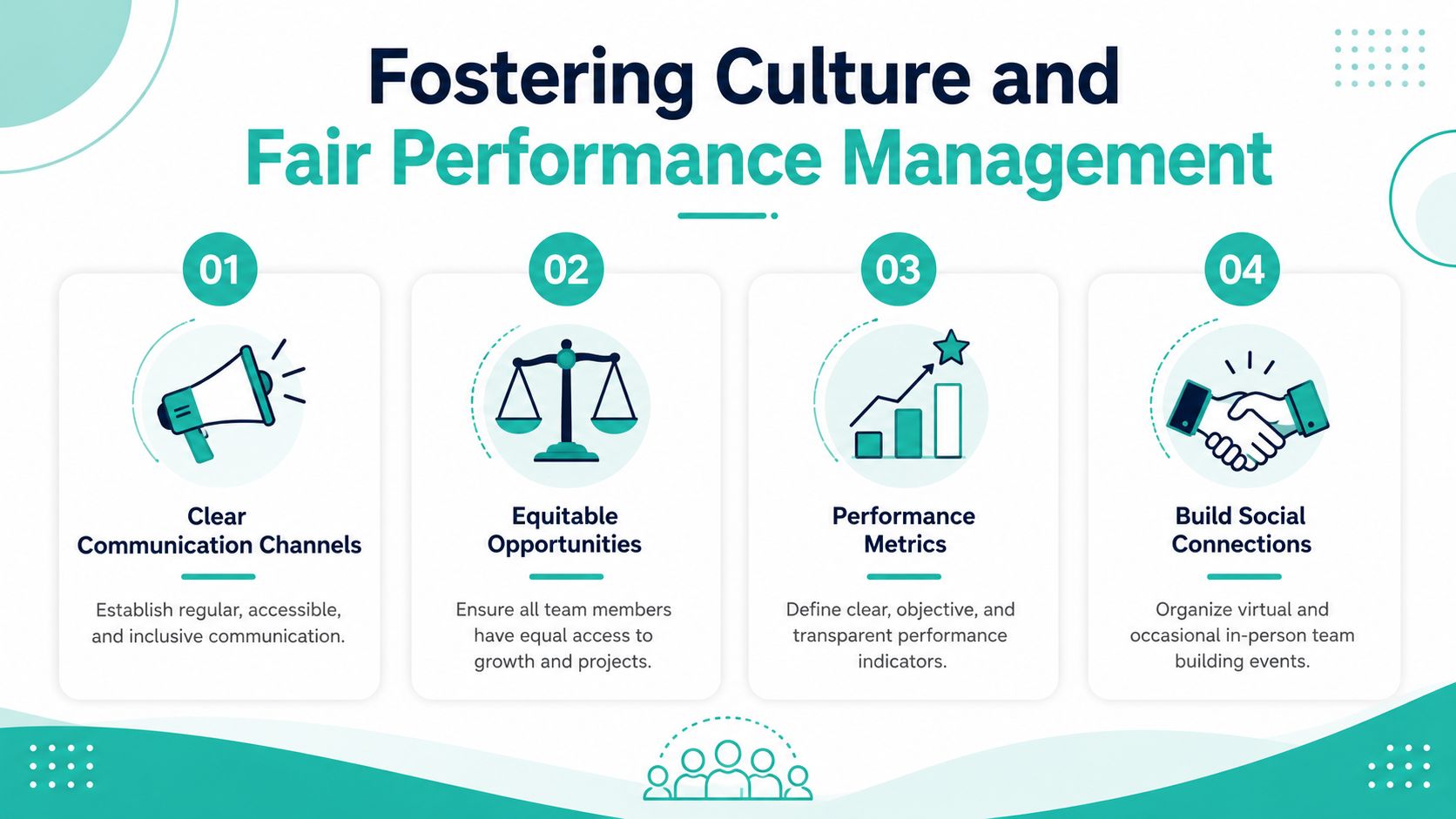
High-growth teams feel this fast. Headcount rises, managers get stretched, and informal habits start deciding who is visible. If your remote policy does not set rules for access, feedback, and advancement, office attendance will influence career outcomes whether leadership intends it or not.
Proximity bias is the failure mode to watch. Researchers at the Society for Human Resource Management outline how hybrid teams can favor the people managers see in person more often. Startups are especially exposed because work allocation happens quickly and manager judgment carries more weight than process.
Early-stage companies often say they reward impact, then run promotion discussions from memory. That breaks down in remote teams because memory favors the people seen most often.
Set a few hard rules in the policy and enforce them in management practice:
For a practical operating model, this guide on building remote company culture focuses on systems that create equal access instead of relying on good intentions.
Mentorship is usually the first hidden cost leaders miss.
Senior people still talk to each other. Newer employees do not absorb judgment, context, and company history by accident anymore. In an office, a lot of teaching happens in fragments. A founder thinking out loud after a customer call. A staff engineer explaining why a shortcut will create debt later. Remote teams lose those moments unless the company recreates them on purpose.
Policy can help here, but only if it gets specific:
These rituals help because they reduce randomness. They also cost time, which is the trade-off. In a startup, that can feel expensive. The bigger cost is slower ramp time, weaker decision-making, and junior talent that never develops into senior talent because nobody built the path.
Remote culture is not a perk program. It is a set of operating rules that decides who gets information, coaching, and career-defining opportunities.
Fair performance management follows the same principle. Review for outcomes, document the evidence, and make sure access to high-visibility work is designed rather than inherited from who happens to be nearby. If the policy protects that, remote work scales. If it does not, growth will expose the cracks.
Monday morning, a candidate asks whether your company is fully remote. A recruiter says yes. The hiring manager says, "mostly." The new policy says employees need approval to work outside their home state for more than two weeks. By Tuesday, Slack is full of edge-case questions, managers are improvising answers, and trust starts slipping before the policy has even had a full day in market.
That is what a weak rollout looks like in a startup. The document is rarely the failure point. Interpretation is.
A good launch does two jobs at once. It gives employees clear rules, and it forces the leadership team to prove they will apply those rules consistently. If either piece is missing, the policy turns into a debate instead of an operating standard.
Before the company-wide announcement, get managers in a room and test the policy against real cases. Use examples from your own business: a salesperson who wants to spend a month with family overseas, an engineer relocating to a new tax jurisdiction, a founder who expects in-person attendance during fundraising, or a high performer asking for an exception that others will notice.
This step usually exposes gaps. Terms like "occasional travel" or "reasonable overlap" sound fine in a draft and fall apart the moment three managers define them three different ways.
Manager prep should include:
A remote work policy is not live when the memo goes out. It is live when payroll, HRIS, security settings, job descriptions, recruiter scripts, and manager guidance all say the same thing.
That alignment matters more than the announcement itself.
A short pre-launch check catches the mistakes that create avoidable friction:
Employees do not need a polished manifesto. They need clarity.
Use one written announcement as the source of truth. State what the model is, when it starts, which roles are treated differently, and what employees need to do now. Then hold a live Q&A focused on practical concerns. Travel. taxes. equipment. team offsites. performance expectations. working hours. Keep the language concrete.
Founders often want to soften hard edges during rollout. That instinct is understandable and usually expensive. If leaders say "we'll stay flexible" without defining the boundaries, managers inherit the ambiguity and employees start testing the policy through private negotiations.
The first month tells you whether the policy can survive contact with daily work. Watch for repeated questions, manager exceptions, recruiting confusion, and teams creating side agreements that bypass the written rules.
Treat those signals seriously. They usually point to one of three problems: the policy is unclear, the process around it is too slow, or leadership is unwilling to live with the trade-offs it approved.
Update the document when needed. Keep a visible version history. Explain why the change was made. Stability comes from predictable governance, not from pretending version one was perfect.
If you're hiring for startup roles and want to reach experienced engineers, product managers, designers, and marketers who understand modern remote and hybrid work, Underdog.io is worth a look. It connects vetted tech talent with high-growth startups across New York City, San Francisco, and the broader U.S., which makes it especially useful when your remote work policy is strong enough to become a recruiting advantage.