You may be staring at two job posts that both say “robotics,” but one wants ROS work on a startup line card and the other is really a controls role with a different title. That confusion is normal, and it's exactly why many early-career engineers get stuck applying too broadly or chasing the wrong opening. A good robotics engineer career move starts with seeing the field as a set of adjacent sub-tracks, not one neat job label.
The title sounds singular. The market isn't.
A lot of engineers reach robotics the same way they reach any hard career choice, by collecting clues. You've built something with sensors, maybe tuned a control loop, maybe watched a robot miss a pick because the lighting changed, and now you're trying to figure out whether that makes you a robotics engineer, an automation engineer, or just “the person who fixed the demo.” That uncertainty usually shows up first in startup job boards, where the same work can be labeled three different ways.
The field exists because someone had to make machines do real work repeatably. The early industrial timeline matters here, George C. Devol filed the patent for a programmable article transfer device in 1954, Unimation was founded in 1956, and Unimate was installed on a General Motors assembly line in 1961. By 1968, Unimation had licensed its technology to Kawasaki Heavy Industries in Japan, which shows how quickly industrial robotics moved from idea to deployment and why programming, reliability, and repeatability still sit at the center of the job today. That foundation is the reason the role still blends mechanics, electronics, software, and systems thinking.
For an ambitious early-career engineer, the practical question isn't whether robotics is “cool.” It's where you can enter the field fastest, which adjacent title matches your current skill set, and which specialty has openings in your market. Startup companies often write to the work they need done, not to a canonical title, so the same candidate might fit a robotics software role, a controls role, or a field integration role depending on how the company is structured.
The fastest way to read a robotics job description is to ignore the buzzwords first and identify the failure mode the team is hiring to fix.
That's the lens for this guide. You'll move from a plain-language definition of the job, to the skills stack, to portfolio building, to salary and demand signals, and finally to startup hiring tactics that help you target the right sub-track instead of the wrong headline title.
A robotics engineer builds machines that can take a task, sense what's happening, and respond without constant human correction. That can mean a robot arm placing parts on a line, a warehouse system moving bins, or a surgical platform doing precise motion with strict safeguards. The shared goal is the same, turn a physical task into a programmable system that can work reliably under real-world constraints.
designing a very disciplined coworker. You don't just tell it what to do once, you give it a way to perceive, decide, and act repeatedly, even when the environment is messy. That is why robotics engineering sits at the intersection of mechanical design, electrical systems, software, and control theory.
A robotics engineer is not the same thing as an automation technician. A technician usually installs, maintains, troubleshoots, and supports equipment that's already in the field. A controls engineer may focus more narrowly on motion logic, PLCs, or system behavior. A robotics engineer often has to connect all of it, then make sure the robot still works after the environment shifts, the part changes, or the camera sees something unexpected.
That systems mindset explains why the modern job is broader than a single code base. IEEE-linked literature describes a skill as a predefined robot capability that can be parameterized for a specific goal, and recent industrial robotics work groups these skills into handling, joining, inspecting, and special operations (IEEE skill-based robotics literature). In practice, that means a robotics engineer spends time thinking in reusable capabilities, not just one-off scripts.
The field's history also explains the modern problem. Once industrial robots moved from concept to deployed automation, the engineering challenge shifted from “can a machine move?” to “can it keep moving correctly in production?” That's still the core question in startups and large manufacturers alike.
For a useful real-world conversation on how robotics leadership thinks about that integration layer, the podcast with robotics leader Matthew Casella is worth a listen. It helps you hear how product, deployment, and engineering language overlap in practice.
If a robot only works in the lab, the job isn't finished. The robot has to work when the floor is noisy, the parts vary, and the camera is a little wrong.
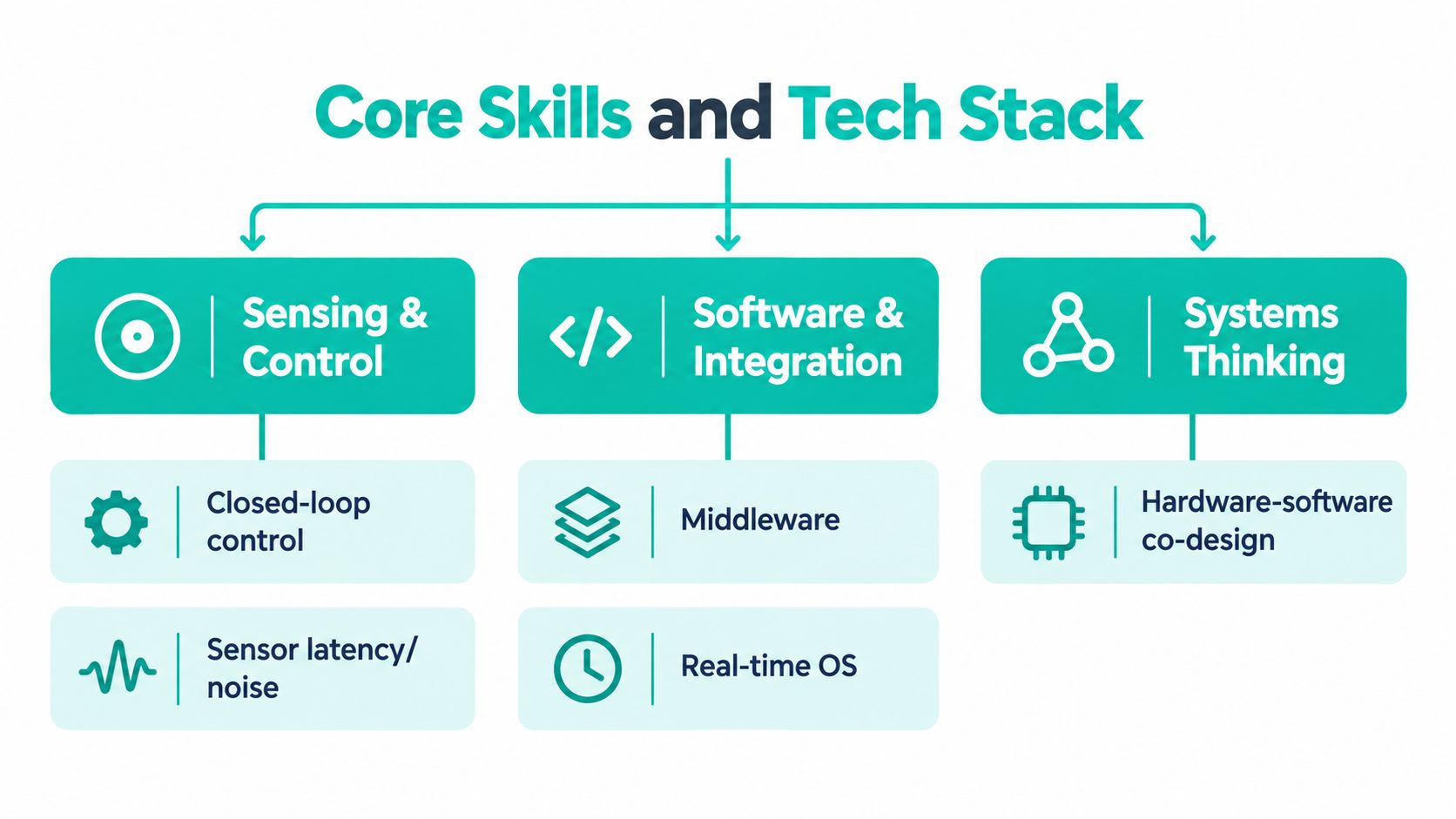
Robotics engineering starts with sensing and control, then layers software and integration on top. The reason is simple, a robot can't act well if it can't tell where it is, what it touched, or how fast conditions changed. University robotics research descriptions frame the field as a discipline that measures system state and changes it in real time, which is a good plain-English way to think about closed-loop work.
Closed-loop control means the robot observes an output, compares it to a target, and adjusts. That sounds abstract until you watch a gripper miss by a few millimeters because the sensor latency was too high or the camera picked up noise from the lighting. Then the control loop isn't just math, it's the difference between stable motion and a robot that keeps correcting itself into failure.
The best early habit is to ask what the loop is measuring and how quickly it can react. In real systems, sensor noise, delay, and model mismatch all shape how aggressively you can tune the controller. That's why robotics engineers spend so much time on calibration, filtering, and testing under imperfect conditions, not just on elegant theory.
Modern sensing stacks go beyond traditional encoders and cameras. The University of Wisconsin's robotics controls and sensing work points to flexible and soft sensors, wearables, precision instrumentation, and simulation for data-driven perception (University of Wisconsin robotics controls and sensing). That matters because robots increasingly need richer input to handle uncertain environments, not just clean lab demos.
Software is where the system becomes reusable. A startup building hardware rarely wants a bespoke script for every customer, which is why software layers often include middleware, real-time behavior, and interface work with sensors, actuators, and external systems. If your code can't survive integration, it doesn't matter how elegant the kinematics looked in simulation.
That's also why startup hardware teams value engineers who can connect product reality with implementation detail. A resource on hardware development for startups is useful context if you want to see how mechanical design, firmware, test planning, and deployment pressure all land on the same team in early-stage companies.
For a broader survey of adjacent startup openings, the role map on Underdog's AI engineer jobs page is a useful reminder that robotics candidates often compete in neighboring software and systems categories, not only under one exact title.
Recent industrial robotics research groups capabilities into handling, joining, inspecting, and special operations. That shift is important because companies want parameterized robot skills that can move across lines and tasks instead of one custom demo that breaks on the next part variant. If you're learning, build for reuse from day one.
A strong robotics portfolio doesn't prove you can make a robot move once. It proves you can make it move twice, in different conditions, for the same reason.
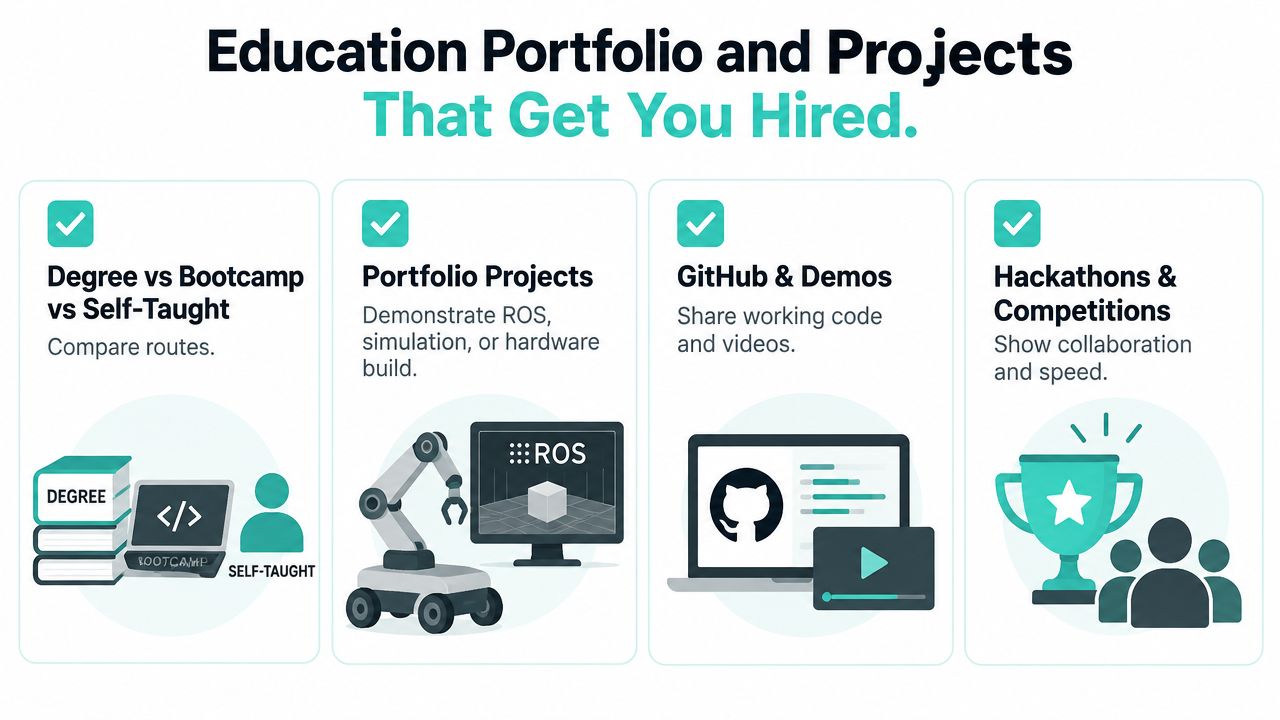
There isn't one correct education path into robotics, and hiring managers know that. Some candidates come from mechanical engineering, others from electrical, computer science, mechatronics, or applied math. Bootcamps and self-directed learning can also work, but only if the work you show makes the skill stack visible.
If you want controls-heavy work, your portfolio should show control tuning, sensor integration, and debugging under changing conditions. If you want robotics software, your work should show coordination between perception, planning, and system logic. If you want startup hardware roles, the best evidence is often a project that links build decisions to integration and testing, not just a polished video.
That's why the education question should always be tied to a portfolio question. The hiring team can forgive an unconventional route if the project proves you understand the system. They usually can't forgive a glossy demo that doesn't explain why it works.
Start with one project that uses a parameterized skill. For example, a pick-and-place system that can handle different object sizes is far more useful than a one-object demo that only works with a single part. Add a sensor-driven inspection project if you want to show perception and calibration, then include a simulation-validated manipulation project if you want to show that you can test before you touch hardware.
A clean GitHub repo matters because startup reviewers often skim, not deep-read. Include a short README, setup notes, failure modes, and a video demo that shows the robot working in context. If you participated in hackathons or competitions, put the collaboration angle front and center, because robotics hiring teams care about who can troubleshoot with others under time pressure.
The most convincing portfolios are boring in the best way. They make the engineering visible without making the viewer decode a personal brand exercise.
Show the test case, the sensor data, and the fix. That's what tells a reviewer you can work on real hardware.
Robotics compensation looks straightforward until you compare title pages, hiring reports, and actual job descriptions. A useful benchmark sits in broader engineering buckets, where a BLS/OEWS-based profile places the median annual wage at $122,930 and the middle 50% range at $90,970 to $158,090 (nexusITgroup robotics engineer salary). Another salary overview also places robotics-engineer pay at $122,930 and mean pay around $125,330 (robotics engineer salary overview).
The larger point is that the market is split into sub-tracks. A hiring report says demand for robotics and automation engineers was up 33% year over year, while the U.S. robotics-engineer pipeline stayed close to flat, and the largest active openings were for automation and robotics technicians, controls engineers, and field service engineers (industrial automation and robotics report). That means many jobs sit beside the classic robotics title, not inside it.
| Sub-Track | Market Signal | Skill Focus |
|---|---|---|
| Robotics software | Often appears inside startup product teams and applied AI roles | Perception, planning, middleware, integration |
| Controls engineer | Strong opening volume in industrial settings and automation-heavy startups | Motion control, tuning, PLC-adjacent logic, reliability |
| Field service engineer | Common where robots ship into customer environments | Installation, troubleshooting, uptime, customer support |
| Automation and robotics technician | Highest visible opening count in the cited market snapshot | Commissioning, maintenance, hands-on debugging |
| Motion planning and ML-heavy robotics | Smaller share of market volume, but higher compensation signals in 2026 pay guides (robotics salary guide) | Planning, learning-based robotics, perception-heavy systems |
Pay rises at the specialized end. The same salary guide notes that ML engineers and motion planning engineers made up only 10% to 13% of market volume but commanded about $197K to $209K, which is very different from a generic robotics title page (robotics salary guide). The practical lesson is simple. Narrow technical depth can shift compensation more than the title itself.
Search by adjacent roles and keywords, not only by “robotics engineer.” A good job search usually works like a map with multiple roads, not one highway, and Underdog's job search guide for software engineers is useful because it encourages broader discovery across the kinds of titles where robotics work is often hidden.
Startup hiring for robotics is less about perfect pedigree and more about whether you can reduce uncertainty quickly. A founder hiring for a robot team usually wants someone who can debug across hardware and software, explain tradeoffs clearly, and keep working when the spec changes. Corporate hiring is often more segmented, with each function isolated; startup hiring compresses those functions into fewer people.
That difference changes how your resume should read. Lead with projects that show ownership, integration, and troubleshooting. If you need a staffing firm example in your job-search toolkit, nexusITgroup.com is a familiar reference point in engineering hiring conversations, especially when you're comparing generalist and specialized roles.
The technical interview often blends controls, perception, and systems reasoning. One interviewer may ask about sensor noise, another may want to know how you'd debug latency, and a third may test whether you can explain why a robot works in simulation but fails on real hardware. They're not just checking for correct answers, they're checking whether you can think through failure.
A practical way to prepare is to tell one project story in three layers. First, explain the goal. Second, describe the constraint you hit. Third, show how you fixed it and what you learned. That structure works because startup teams need engineers who can communicate cause and effect without turning every bug into a mystery novel.
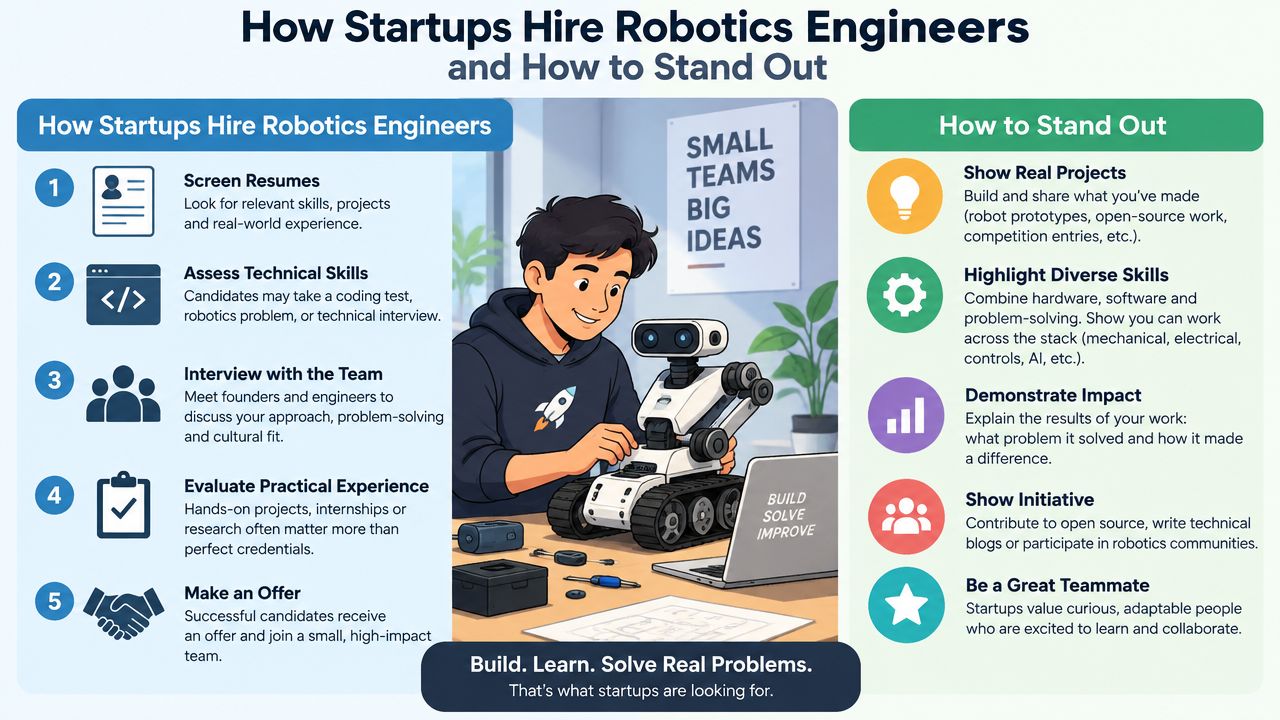
A sharp resume uses specific nouns. Name the sensors, frameworks, controllers, or simulation tools you used. If you built a demo that reused a skill across tasks, say so plainly. If you worked on startup hardware, show that you understand iteration speed, test coverage, and the gap between prototype and deployment.
Avoid three common mistakes. Don't bury the project details under a skills cloud. Don't claim broad robotics experience if your work is really only in one slice of the stack. Don't forget to show what changed because of your work, even if that change was qualitative.
If you want startup roles, the easiest path is often the one that reduces search noise. A curated marketplace like Underdog.io's candidate application lets vetted startups reach out after a single short application, which is useful when you're targeting robotics-adjacent roles that may be labeled as software, controls, or systems depending on the company. That matters because the right opportunity is often hiding behind a title that doesn't say “robotics” at all.
The practical move is to position yourself around the sub-track you fit. If your strength is motion and control, say that. If your strength is perception and integration, say that. If you're moving from adjacent work, make the bridge explicit so a startup reviewer can place you quickly without reading between the lines.
Your next step is simple. Tighten your portfolio around one clear sub-track, write a resume that names the tools and outcomes, and apply where startup teams can see the fit without guessing. If you want a cleaner way to surface those conversations, visit Underdog.io and use it as one of your startup search channels.