Navigating the world of Silicon Valley startup companies can feel like trying to find a specific coffee shop in a city with no street signs. It's a landscape teeming with innovation, but the sheer volume of new ventures makes it tough to know where to start. Generic job boards often mix high-growth opportunities with corporate roles, creating noise and confusion for software engineers, product managers, and other tech professionals seeking their next big move.
This guide cuts through that clutter. We've compiled a curated roundup of seven essential platforms, each serving a distinct purpose in your journey from discovery to offer letter. This isn't just a list; it's a practical toolkit with actionable insights to help you identify, research, and connect with the most promising startups in the Valley today. We'll show you not just what to use, but exactly how to leverage each platform to gain a competitive edge.
Instead of vague advice, you will get specific strategies for platforms like Underdog.io for curated job matching, Crunchbase for deep-diving into funding rounds, and the Y Combinator Directory for spotting the next breakout success. For those looking to understand the full journey, exploring insights on mobile app development for startups, from idea to MVP, can provide a comprehensive perspective on building a successful company. Each entry in our list includes clear instructions, screenshots, and direct links to help you find your ideal role within the dynamic ecosystem of silicon valley startup companies. Let's dive into the platforms that will define your job search.
1. Underdog.io: The Curated Marketplace for Top Startup Talent
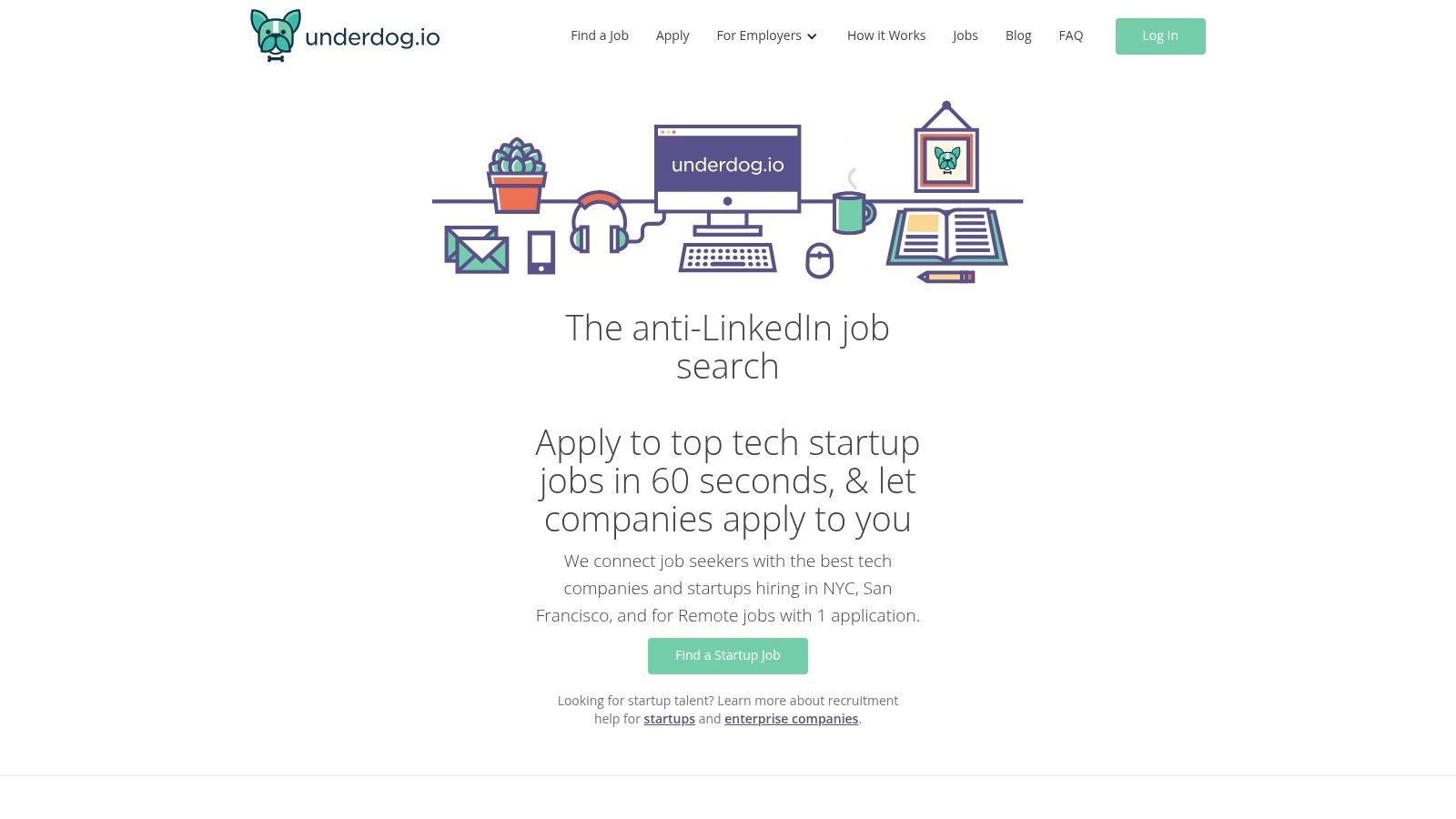
For candidates serious about finding their next role at high-growth silicon valley startup companies, Underdog.io offers a fundamentally different approach. It’s not a job board; it’s a highly curated, private marketplace that inverts the traditional application process. Instead of spending hours tailoring résumés and sending applications into the void, you create one confidential profile and let vetted companies apply to you.
This model is especially powerful for passively employed talent, who make up about 85% of the platform's user base. The platform's commitment to quality over quantity is its core differentiator. Underdog.io accepts only a fraction of both applicants and companies, ensuring that every connection is meaningful. This focus eliminates the noise and low-quality outreach common on larger, open platforms.
Why It Stands Out: The Human-in-the-Loop Advantage
Unlike algorithm-driven platforms that can lead to mismatched opportunities, Underdog.io employs human matchmakers. This team reviews candidate profiles and facilitates introductions to founders and hiring managers at companies that align with your skills, experience, and career goals. The result is a high-signal, low-noise experience where the introductions you receive are relevant and compelling.
Your profile remains anonymous until you express interest in an opportunity, giving you full control over your privacy and job search. This confidentiality is crucial for those currently employed but open to exploring the market.
Key Features and Practical Benefits
One-Time Application: The initial sign-up takes about 60 seconds. You provide your background, skills, and preferences, and the Underdog.io team takes it from there. This low-friction process is a massive time-saver.
Curated Company Roster: The platform focuses on early-stage through Series B startups, primarily in tech hubs like San Francisco and New York, as well as remote roles. This means you gain direct access to decision-makers at some of the most promising emerging companies.
Confidential and Candidate-Centric: Privacy is paramount. Your identity is only revealed to a company after you've reviewed their pitch and approved the introduction. This puts you in the driver's seat.
Completely Free for Job Seekers: There are no fees or hidden costs for candidates. The platform’s revenue comes from the companies that hire through it, aligning its success with yours.
Maximizing Your Underdog.io Profile
To increase your chances of acceptance and attract the best matches, follow these practical tips:
Highlight Quantifiable Achievements: Instead of just listing responsibilities, showcase your impact. For example, rather than "Managed user acquisition," use "Led a user acquisition strategy that increased sign-ups by 40% in Q3."
Be Specific About Your Ideal Role: Clearly articulate the types of companies, roles, and technologies you're interested in. This helps the human matchmakers find the most precise fits.
Keep Your Profile Updated: If you learn a new skill or complete a significant project, add it to your profile. Fresh information signals to the team that you're actively and thoughtfully engaged in your career.
Expert Insight: The true power of Underdog.io lies in its curated nature. By passing the rigorous vetting process, you are presented to top silicon valley startup companies as a pre-qualified, high-intent candidate, fundamentally changing the power dynamic of the job search.
Underdog.io has established itself as a premier destination for top-tier talent looking to make a significant impact at a startup. For those who want to bypass the noise and connect directly with innovative companies, it’s an indispensable tool. You can explore a broader comparison of job search platforms and see how it fits into the larger ecosystem. For more information, check out Underdog.io's list of the best websites for startup jobs.
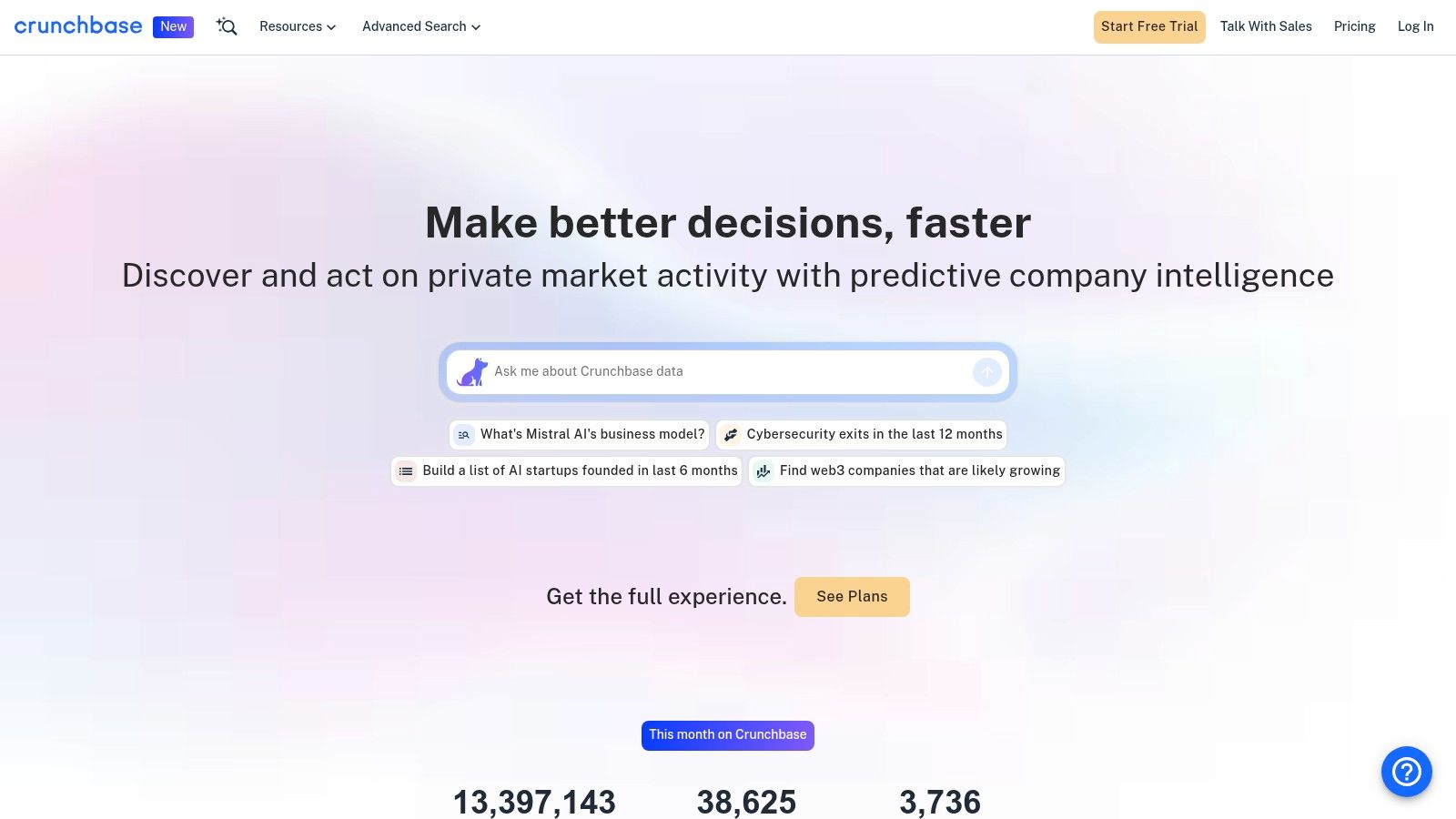
Crunchbase has solidified its reputation as the definitive database for private company intelligence. For job seekers targeting silicon valley startup companies, it's an indispensable tool for discovery, research, and due diligence. Think of it as the encyclopedia for the startup ecosystem, providing structured data on funding rounds, investors, leadership teams, and recent news.
While many platforms list companies, Crunchbase excels at helping you understand a startup's trajectory and financial health. This context is crucial for assessing risk and opportunity. For example, you can quickly filter for companies that have recently raised a Series A in the Bay Area, signaling a high-growth phase and an imminent hiring push for foundational roles.
Core Features & User Experience
The platform's strength lies in its powerful, multi-faceted search capabilities. The user interface is data-dense but relatively intuitive, allowing for precise filtering.
Advanced Search: Filter companies by location (e.g., San Francisco Bay Area), industry, funding stage, last funding date, and even specific investors. This granularity lets you create highly targeted lists.
AI-Powered Tools: Features like Crunchbase Scout and the AI Search Builder use natural language prompts to surface relevant companies, investors, or news, saving you hours of manual searching.
Lists & Alerts: You can save your search queries and create custom lists of target companies. Setting up alerts notifies you of new funding rounds or leadership changes, giving you a timely reason to reach out.
Pricing and Access
Crunchbase operates on a freemium model. Basic company profile viewing is free, but its true power is unlocked with paid subscriptions.
Starter Plan: Offers basic search filters and limited data exports.
Pro Plan: Unlocks advanced search filters, more CSV exports, alerts, and deeper data insights. This is the recommended tier for serious job seekers.
Enterprise Plan: Tailored for sales, recruiting, and investment teams with API access and large-scale data needs.
Actionable Tips for Job Seekers
To get the most out of Crunchbase, go beyond simple searches.
Target by Funding Events: Create a search for companies in the "San Francisco Bay Area" that raised a "Seed" or "Series A" round in the last 3-6 months. These companies have fresh capital and are actively hiring to scale. Save this search and set up weekly email alerts.
Follow the Investors: Identify top-tier VCs that invest in your domain (e.g., Andreessen Horowitz for software, Khosla Ventures for deep tech). Follow their portfolio companies—this is a strong signal of quality and potential growth. Check their recent investments to find newly funded startups.
Research Interviewers: Before an interview, look up your interviewers on Crunchbase. Understanding their past roles, board seats, and angel investments provides valuable context and talking points. It shows you’ve done your homework. For instance, you could say, "I saw your previous company was acquired by Salesforce—what was that experience like?"
While the most powerful features sit behind a paywall, a Pro subscription can be a high-ROI investment in your job search, providing the intelligence needed to find and vet the most promising silicon valley startup companies before they hit the mainstream job boards.
Wellfound, which evolved from the renowned AngelList Talent, is a premier job marketplace built specifically for the startup world. It's a go-to platform for directly connecting with founders and hiring managers at silicon valley startup companies, cutting through the noise of traditional job boards. Think of it as a specialized ecosystem where high-growth companies and ambitious tech talent converge.
Unlike generic platforms, Wellfound provides transparency into a startup's team, funding, and culture. Job seekers can create a rich profile that goes beyond a resume, showcasing their skills and preferences to attract inbound interest from relevant companies. This candidate-centric approach makes it a powerful tool for discovering roles that aren't advertised elsewhere.
Core Features & User Experience
The platform is designed to facilitate direct and meaningful connections. Its interface is clean, focusing on company profiles and role descriptions, making it easy to browse and apply.
Comprehensive Company Profiles: Dive deep into a company’s mission, see its current team size, view key employees, and understand its funding history. This information is critical for vetting potential employers.
Direct Messaging: Apply and communicate directly with hiring managers and founders, bypassing automated HR systems. This direct line often leads to a faster and more personal hiring process.
Advanced Job Search: Filter opportunities by role, location (including a strong focus on the Bay Area), keywords, remote work options, and even salary or equity ranges. This helps you find roles that precisely match your criteria.
Pricing and Access
Wellfound is largely free for job seekers, providing full access to search, apply, and message companies. The platform's revenue comes primarily from employers.
For Candidates: Free to create a profile, search, and apply for jobs.
For Employers: A freemium model allows companies to post jobs and see applicants for free. Paid tiers like Recruit Pro and Autopilot offer advanced sourcing tools, ATS integrations, and dedicated support for scaling their hiring efforts.
Actionable Tips for Job Seekers
To maximize your success on Wellfound, engage with the platform strategically.
Build a Compelling Profile: Your Wellfound profile is your pitch. Go beyond your work history by adding projects, a detailed "About" section, and specifying your ideal role and salary expectations. A complete profile gets prioritized by the platform’s algorithm.
Use the "Interested" Button Strategically: When you express interest in a company, it signals your proactive desire to join their team. Follow up with a personalized message referencing something specific about their product or mission to stand out. For example: "I was impressed by your approach to decentralized data storage and believe my experience in distributed systems could be a great asset."
Filter for Fresh Opportunities: Search for jobs posted in the "Last 7 days" to target the most active and urgent hiring needs. These roles often have less competition and a more responsive hiring team.
Wellfound remains one of the most effective platforms for discovering authentic opportunities at silicon valley startup companies, offering a direct and transparent path to your next role.
Find Your Role in the Silicon Valley Ecosystem
Ready to be part of the innovation? Underdog.io connects top talent with the most promising Silicon Valley startup companies. Apply once and let founders find you.
Y Combinator (YC) is arguably the world's most prestigious startup accelerator, and its public directory of companies serves as a high-signal, curated list for job seekers. For anyone targeting silicon valley startup companies, the YC Directory is a goldmine. It's a free, filterable database of over 2,000 publicly launched startups that have all passed through YC's rigorous selection process, which is a strong proxy for quality and potential.
Unlike broad databases, the YC Directory's value is in its curation. Every company listed has received investment and mentorship from YC, meaning they are well-vetted and often on a rapid growth trajectory. This pre-filtered quality makes it an incredibly efficient tool for discovering credible, early-stage opportunities without the noise of unvetted company listings. For an in-depth look at how YC shapes the local ecosystem, you can explore more about the startups in Silicon Valley.
Core Features & User Experience
The platform is designed for simple, effective discovery. The user interface is clean and minimalist, focusing on getting you to relevant company profiles as quickly as possible. Its power lies in its targeted, though simple, filtering.
Filterable Directory: You can easily sort and filter companies by industry, batch (e.g., W24, S23), company size, region, and, most importantly, hiring status.
YC-Backed Quality Signal: The primary feature is the list itself. Knowing every company has YC's stamp of approval saves you significant due diligence time.
Direct Access: Each company profile provides a brief description, key details, and direct links to the company's website and, if available, their careers page. This removes friction from the application process.
Pricing and Access
The Y Combinator Companies Directory is entirely free to access and use. There are no paid tiers or hidden features. This commitment to open access makes it an equitable and invaluable resource for all job seekers, regardless of their budget for job search tools. The trade-off for being free is that the data is less deep than on a platform like Crunchbase, focusing more on discovery than deep financial analysis.
Actionable Tips for Job Seekers
To leverage the YC directory effectively, think like an investor looking for the next breakout company.
Filter for "Hiring": Use the "Is Hiring" filter combined with "San Francisco Bay Area" as your first step. This instantly creates a high-quality list of active opportunities at vetted startups. Check this list weekly for new additions.
Explore Recent Batches: Filter for companies from the last two to three YC batches (e.g., W24, S23, W23). These are the freshest companies, often flush with seed capital and looking to make their first key hires beyond the founding team.
Research Founders and Problems: Don't just look at the company; look at the founders' backgrounds (often linked via their profiles). Strong founding teams are a leading indicator of success. Are they solving a problem you are passionate about? For example, if you're a healthcare software engineer, find YC startups in the "Healthcare" category and craft your outreach around your passion for solving problems in that specific space.
While it only contains YC-backed companies, the directory is an unparalleled source for discovering high-potential silicon valley startup companies that are actively building their foundational teams.
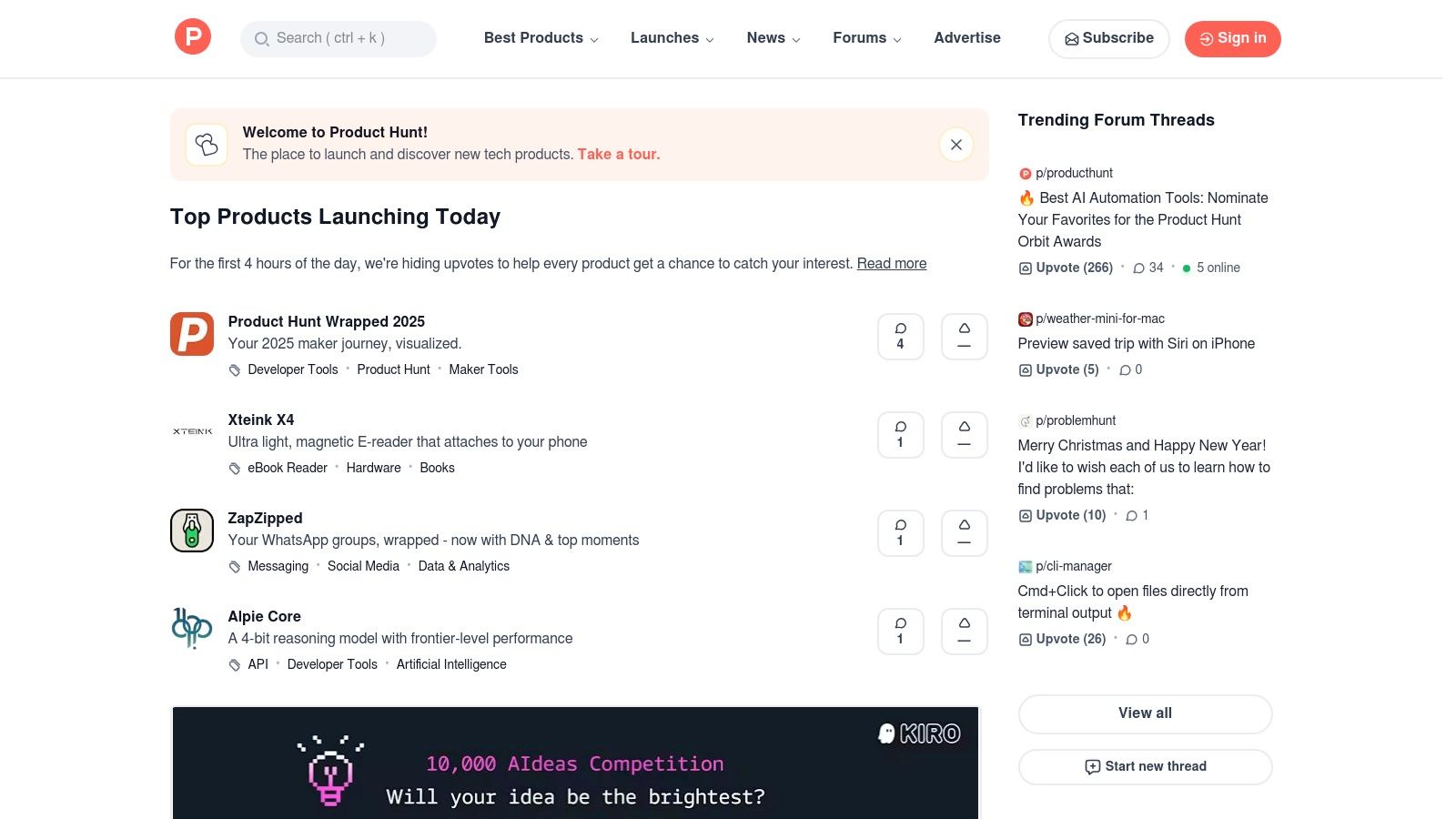
Product Hunt is the daily leaderboard for new tech products, serving as a real-time launchpad for many silicon valley startup companies. It’s a community-curated discovery platform where job seekers can get a ground-floor view of emerging startups the very day they go public with their product. Instead of tracking funding, it tracks market validation and user excitement, offering a different but equally valuable signal for identifying promising ventures.
While other platforms focus on company data, Product Hunt is all about the product itself. This provides a unique lens for assessing a company's vision, design sense, and engineering quality. You can see how the community reacts, read direct feedback from early adopters, and engage with the founders in the comments, offering a level of direct access rarely found elsewhere.
Core Features & User Experience
The platform is designed around daily discovery, with a clean, feed-style interface that's highly engaging and easy to navigate. Its core strength is the immediate, unfiltered look at what's new.
Daily Launches: The homepage features a ranked list of products launched that day, voted on by the community. You can browse by day, category (e.g., AI, Developer Tools, SaaS), or search for specific technologies.
Community Engagement: Upvotes, detailed comments, and reviews provide a powerful social proof mechanism. The "Maker" of the product (often the founder or CEO) is typically active in the comments, answering questions.
Direct Access: Every product listing includes direct links to the website, App Store, or sign-up page, allowing you to try the product instantly. It removes the friction between discovery and hands-on evaluation.
Pricing and Access
Product Hunt is a fundamentally free and open platform for discovery, which is a major advantage for job seekers.
Free Access: Browsing, upvoting, commenting, and following companies or makers is completely free.
Maker Features: Product creators can launch for free. There are paid options for promotional placements to boost visibility, but the core discovery engine is organic.
Actionable Tips for Job Seekers
Use Product Hunt to find hidden gems and demonstrate genuine product interest.
Track "Product of the Day" Winners: Pay close attention to the products that win "#1 Product of the Day." This is a strong signal of product-market fit and user excitement. Check their careers page or founder's LinkedIn profile for hiring signals, as this post-launch momentum often fuels hiring.
Engage with Founders: Find a product you genuinely admire. Sign up, use it, and leave a thoughtful, constructive comment on its launch page. Mention a specific feature you liked or offer a smart suggestion. This gets you on the founder's radar in a positive, value-add way. For instance: "Love the UX on the onboarding flow! Have you considered adding a Zapier integration? It would be a game-changer for my workflow."
Identify Hiring Patterns: Filter by categories that align with your skills (e.g., "Developer Tools" for back-end engineers, "Design Tools" for designers). Watch which companies in this space launch successfully. A successful launch often precedes a need for engineers, marketers, and community managers to handle the new influx of users.
Product Hunt offers an unparalleled, real-time pulse on the innovation happening within silicon valley startup companies. It helps you discover companies based on the quality of their product, not just the size of their funding round.
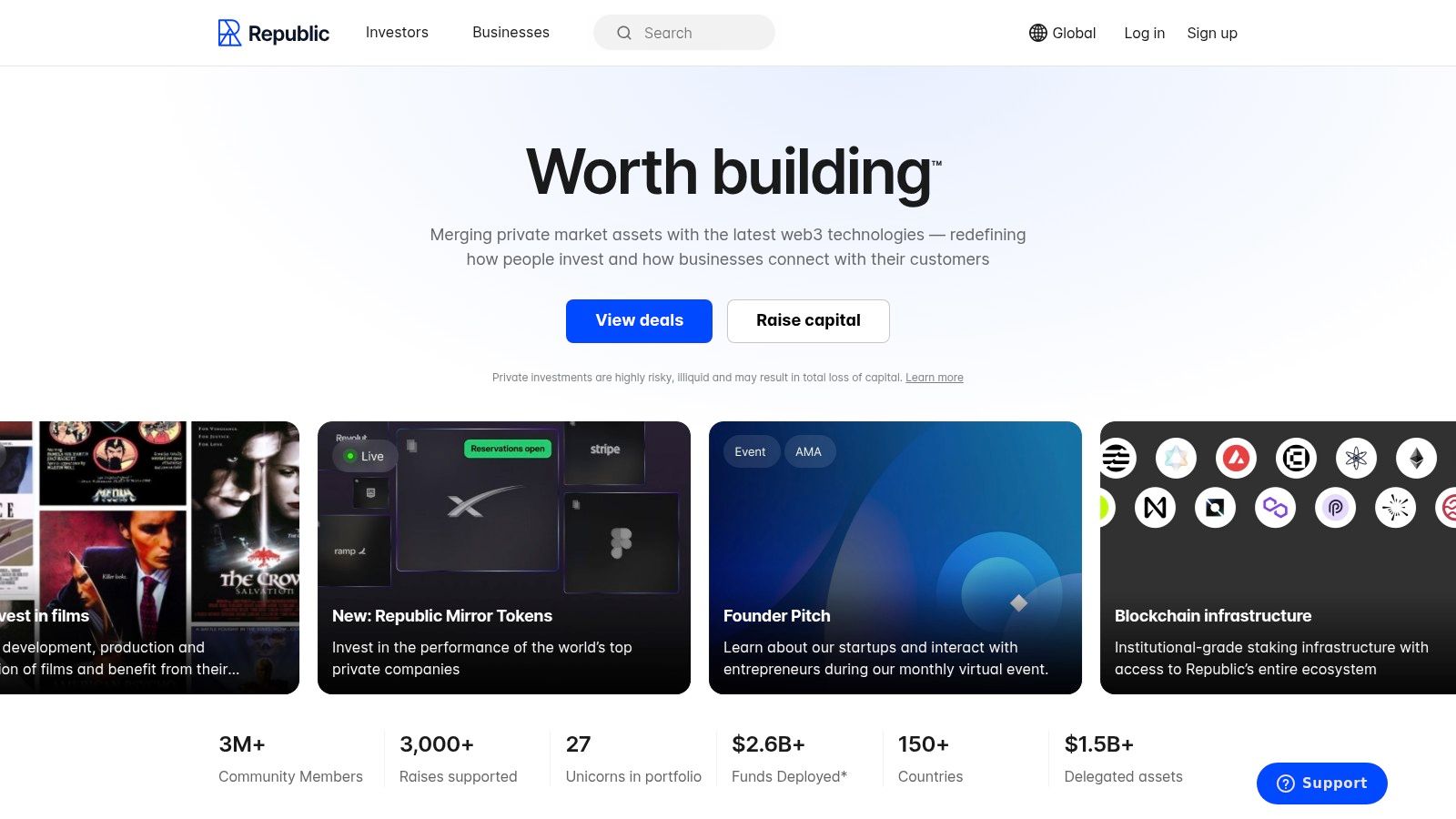
Republic has democratized startup investing, providing a platform where both accredited and non-accredited individuals can buy stakes in early-stage companies. For those looking to understand the next wave of silicon valley startup companies, Republic offers a ground-floor view of who is raising capital and gaining community traction. It’s less a job board and more a due-diligence platform, revealing companies with validated ideas and strong early-supporter networks.
While primarily for investors, the platform is a goldmine for job seekers who want to identify startups with significant momentum before they hit the mainstream. A successful crowdfunding campaign signals strong product-market fit and a community ready to champion the company's growth, which often precedes a hiring surge. For founders seeking capital, understanding the mechanics of these platforms is crucial; there are proven strategies to secure capital that align perfectly with Republic's model.
Core Features & User Experience
Republic’s platform is designed for investment accessibility, with a clean interface that clearly explains complex financial instruments. The user experience is focused on transparency and education.
Diverse Deal Types: The platform supports Regulation Crowdfunding (Reg CF), Reg A, and other deal structures, allowing a wide range of companies to raise capital.
Low Investment Minimums: Many offerings have minimums as low as $50 or $100, making it possible for almost anyone to build a diverse startup portfolio.
Transparent Documentation: Each campaign features a detailed profile, founder Q&As, and SEC filings. This provides a wealth of information for assessing a company's mission and potential.
Autopilot Program: For passive investors, Republic offers a program that automatically invests in a diversified portfolio of startups, often with reduced or waived administrative fees.
Pricing and Access
Investing through Republic is free for users to sign up and browse. The costs are associated with the investments themselves.
Investor Fees: Administrative fees may apply to certain investments, typically around 2.5% of the investment amount, with specific caps. These are clearly disclosed on each deal page.
Company Fees: Startups raising funds pay a percentage of their total raise to Republic as a platform fee. This does not directly affect job seekers but is good context to have.
Actionable Tips for Job Seekers
Use Republic as a forward-looking indicator for hiring trends.
Monitor "Trending" Deals: The "Trending" section on Republic highlights companies with the most investment velocity. High momentum often means the company is exceeding its funding goals and will need to hire aggressively to meet demand.
Filter by Industry: Use the platform’s filters to find companies in your specific domain (e.g., FinTech, HealthTech, SaaS). Analyze the pitch decks and founder videos to see if their mission aligns with your career goals.
Engage in the Discussion: Each campaign has a discussion or Q&A section. Observing the questions from potential investors and the founders' responses can provide deep insights into the company’s challenges, culture, and strategic priorities. This provides a source of "insider" information you can use in an interview, for example, "In your Republic campaign, you mentioned plans to expand into the European market. What are the key engineering challenges you anticipate with that?"
By treating Republic as a research tool, you can identify promising and well-vetted silicon valley startup companies that have already proven their ability to generate excitement and secure funding from a broad base of supporters.
PitchBook is the enterprise-grade private market intelligence platform used by the world's top venture capital firms, investment banks, and corporate development teams. For job seekers conducting deep due diligence on silicon valley startup companies, it offers an unparalleled level of financial data, competitive analysis, and investor mapping. While Crunchbase is the encyclopedia, PitchBook is the analyst's report, providing the granular data needed to truly understand a company's market position.
Where other platforms provide funding amounts, PitchBook dives deeper into valuations, deal multiples, and the intricate web of co-investors. This level of insight is invaluable for candidates targeting late-stage private companies or those who want to assess the financial sophistication and backing of a potential employer. It helps you answer not just "who funded them?" but "what was the valuation and who else was in the deal?"
Core Features & User Experience
The platform is built for financial professionals, meaning it's incredibly data-rich and powerful, though it may have a steeper learning curve than more consumer-focused tools. Its core strength is the quality and depth of its proprietary data.
Comprehensive Data: Access detailed information on private company financials, valuations, cap tables, deal history, and comparables. This is the gold standard for private market data.
Investor Mapping: Uncover not just a company's investors but also their complete portfolio, co-investors, and fund performance. This helps gauge the quality and influence of a startup's backers.
Integrated News & Analysis: PitchBook's own analysts provide market reports and news that are directly integrated with company profiles, adding critical context to the raw data.
Pricing and Access
PitchBook is a premium, enterprise-focused product, and its pricing reflects that. Access is typically secured through corporate licenses.
Free Profile Previews: Non-subscribers can view limited, high-level data on company profiles.
Platform Subscription: Full access requires a custom-quoted enterprise contract. It is not designed for individual job seekers, making it significantly more expensive than other tools.
Premium Connector: Offers integrations with tools like Excel and other enterprise systems for deep data analysis.
Actionable Tips for Job Seekers
While an individual subscription is often out of reach, you can still leverage PitchBook's power.
Check University Access: Many top business and engineering schools provide students and alumni with free access to PitchBook through their library resources. Check if your alma mater offers this significant perk.
Use Free Previews for Validation: Before an interview, use the free public profiles to get a high-level snapshot. Note the lead investors and the last funding valuation. Bringing up this specific data shows you're a serious candidate.
Analyze Competitor Valuations: If you're comparing offers, look up the key competitors of your target silicon valley startup companies on PitchBook. Understanding how their valuations and funding trajectories compare can provide powerful negotiation leverage and insight into market leadership. For example, knowing a competitor raised funds at a higher valuation can give you context for the equity portion of your offer.
PitchBook is the heavyweight champion of private market data. While its accessibility is limited, finding a way to tap into its insights can give you a decisive advantage in understanding the financial health and competitive landscape of any startup you're considering.
Navigating the vibrant and competitive landscape of Silicon Valley startup companies requires more than just a stellar resume; it demands a sophisticated, multi-pronged strategy. The tools and platforms we've explored throughout this guide are not just individual resources but components of a powerful job-seeking engine you can build for yourself. Moving beyond simply submitting applications is the key to standing out and landing a role that truly aligns with your career goals.
The journey from discovering an exciting company to accepting an offer is a process of strategic intelligence gathering and targeted action. By understanding the unique value of each platform, you can create a workflow that gives you a significant advantage over other candidates.
Synthesizing Your Toolkit for Maximum Impact
Think of these tools as layers in your research and application process. A common mistake is to rely on a single platform, but the most successful job seekers orchestrate a symphony of information to inform their every move.
Discovery and Early Vetting: Start broad with platforms like the Y Combinator Companies Directory and Product Hunt. These are your primary sources for identifying emerging startups and getting a feel for innovation trends. Your actionable goal here is to build a list of 10-15 companies that genuinely excite you.
Deep-Dive Due Diligence: Once you have a shortlist, it's time for in-depth analysis. Use Crunchbase and PitchBook to investigate funding rounds, key investors, and leadership teams. The practical step is to create a simple spreadsheet tracking the funding stage, key investors, and any recent news for each target company. A company that just raised a Series B is in a very different hiring mode than a seed-stage startup.
Assessing Early-Stage Potential: For those with a higher risk tolerance seeking ground-floor opportunities, Republic offers a unique lens. A quick check here can reveal if any of your target companies have a strong base of community support, which is a powerful, non-traditional signal of product-market fit.
Active Application and Direct Engagement: With your research complete, platforms like Wellfound become your primary channel for active applications. This is where you can see which of your target Silicon Valley startup companies are actively hiring for roles that match your skill set.
From Passive Applicant to Proactive Candidate
The ultimate goal is to shift from being a passive applicant in a sea of resumes to a proactive, informed candidate who engages with companies on a deeper level. A practical example of this strategic approach looks like this:
Identify: You discover a new AI-powered productivity tool on Product Hunt that has fantastic user feedback. You add it to your target list.
Investigate: You look up the company on Crunchbase and find it recently closed a $5 million seed round led by a reputable VC firm. You add this data point to your spreadsheet.
Monitor: You find the company on Underdog or Wellfound and see they have an open role for a "Founding Software Engineer."
Engage: Instead of a generic application, you craft a cover letter that starts with, "As an early user who discovered your app on its Product Hunt launch, I was incredibly impressed..." You are no longer just an applicant; you are a well-informed enthusiast who understands their business context.
This layered approach transforms your job search from a numbers game into a series of strategic engagements. It demonstrates initiative, business acumen, and genuine interest, qualities that are highly valued at any high-growth startup. The most compelling candidates don't just look for jobs; they identify opportunities and build a case for why they are the perfect fit to help that specific company succeed. Your strategy is your story.
Ready to cut through the noise and connect directly with hiring managers at top Silicon Valley startup companies? Instead of navigating multiple platforms, let Underdog.io bring curated opportunities directly to you. Our marketplace connects ambitious tech talent with innovative startups, streamlining your search and putting you in front of the right people at the right time. Sign up on Underdog.io today to build your profile and let your next great role find you.
Frequently Asked Questions
What truly makes Silicon Valley different from other tech hubs?
Its unique advantage is an unparalleled density of venture capital, top-tier engineering talent, and a deeply ingrained culture of risk-taking and iteration. The network effects are powerful, with a concentration of founders, investors, and tech giants that creates a continuous cycle of innovation, mentorship, and company formation.
How do Silicon Valley startups attract talent when competing with FAANG companies?
They compete on different dimensions: mission, autonomy, equity upside, and the pace of impact. Startups offer the chance to work on cutting-edge problems, wear multiple hats, and see your work directly influence the company's trajectory. They sell the vision of building something significant and the potential for outsized financial rewards compared to a corporate salary.
What are the dominant industry sectors for new Silicon Valley startups?
While software remains foundational, recent waves are dominated by artificial intelligence and machine learning, enterprise SaaS, fintech, biotech and health tech, and climate tech. The ecosystem excels at applying new platform shifts (like AI today, mobile or cloud previously) across all industries.
What should I know about the different funding stages (Seed, Series A, etc.)?
The funding stage is a key indicator of a company's maturity and risk profile. Seed-stage companies are validating their idea with a small team. Series A signifies product-market fit and a plan to scale. Series B/C+ are about hyper-growth and market expansion. Later stages involve scaling operations globally and preparing for an IPO or acquisition.
How important is physical location within Silicon Valley?
While remote work is more accepted, physical clusters still matter. Different areas have reputations: San Francisco for later-stage startups and consumer tech, Palo Alto and Menlo Park for venture capital and AI, Mountain View for deep tech. Proximity to investors, partners, and talent networks can significantly influence a startup's access and opportunities.
Our biweekly curated tech and recruiting newsletter.
Thank you. You've been added to the Ruff Notes list.
Oops! Something went wrong while submitting the form.
Looking for a startup job?
Our single 60-second job application can connect you with hiring managers at the best startups and tech companies hiring in NYC, San Francisco and remote. They need your talent, and it's totally 100% free.