Acing a software engineer interview isn't about a last-minute cram session; it’s about a deliberate, structured process. I've found that a three-month plan works best, giving you enough runway to methodically cover everything from foundational data structures to complex system design and behavioral skills. This approach helps you build real, lasting knowledge, not just a fragile memory of solutions.
Landing a great software engineer role, especially at a competitive startup, demands a well-paced preparation strategy. The real goal isn't just to spit out correct answers but to showcase a clear, logical thought process, even when the pressure is on. Thinking of prep as a three-month roadmap transforms what feels like an overwhelming task into a series of manageable, weekly goals, helping you build that muscle without burning out.
The idea is to front-load the concepts you're almost guaranteed to see. Your first few weeks should be all about mastering the fundamentals—these are the building blocks for nearly every technical challenge you'll encounter.
The first month is all about mastering the high-frequency topics. You’ll be drilling the data structures and algorithms that pop up in the vast majority of initial technical screens. Think of this as building your core toolkit.
Your main goals for this month should be:
From my experience guiding engineers through this, a dedicated plan is non-negotiable. Experts recommend at least three months of prep, committing around 11 hours weekly. This initial month is crucial because you're covering topics like arrays, strings, hash tables, and recursion that appear in 60-70% of coding screens at top tech firms.
To give you a clearer picture, here’s what your first four weeks could look like at a high level.
This structure ensures you build a strong foundation before moving on. For a more granular breakdown, you can dive into a comprehensive coding interview study plan that details daily tasks.
With a solid foundation in place, month two is for getting into more complex, multi-layered topics. This is where you graduate from solving isolated problems to truly understanding how different concepts connect. You’ll start recognizing patterns that apply across a whole range of problem types.
This timeline gives you a visual of how you'll progress from the foundational work in Month 1, to more advanced topics in Month 2, and finally pull it all together in Month 3.
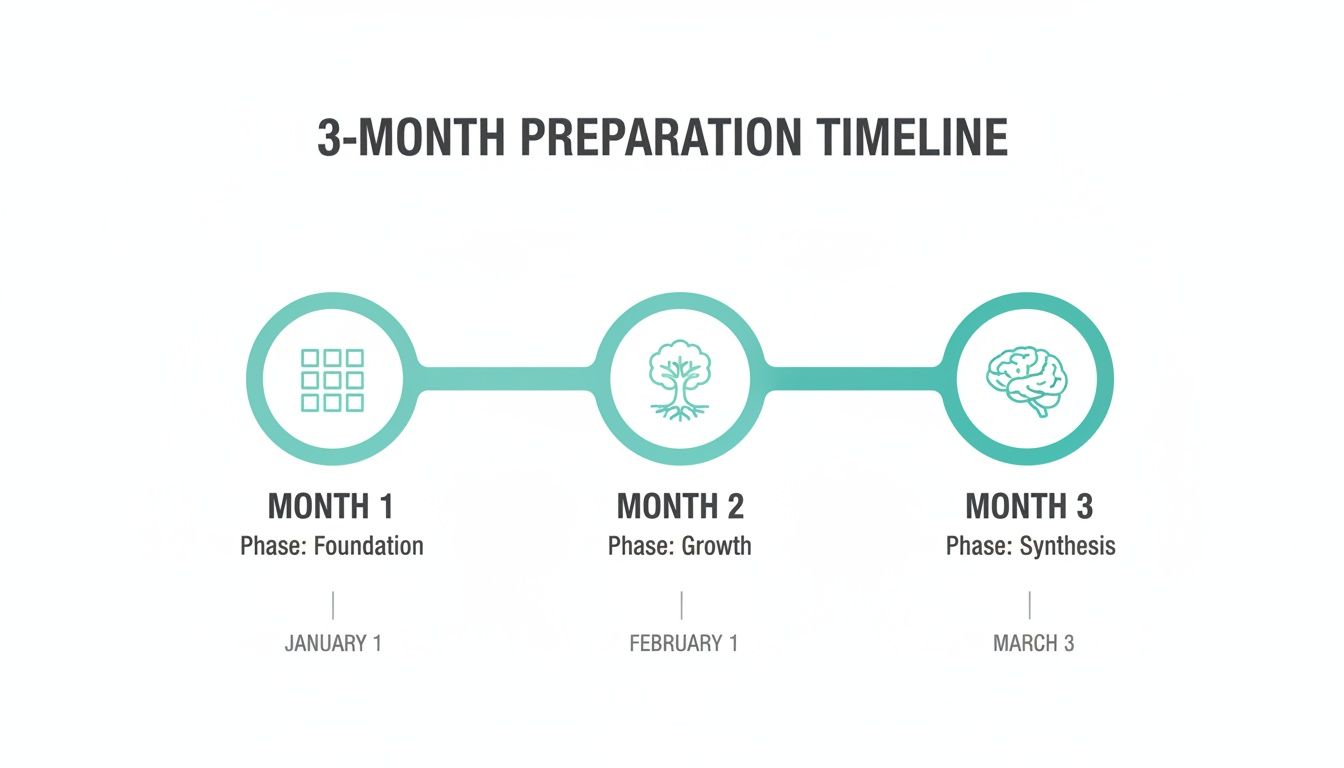
This phased approach is key. It ensures you’re building on a strong base before you start integrating all your skills for the real deal.
Your focus will shift to topics like:
Your final month is all about consolidation, practicing under pressure, and polishing your soft skills. The goal is to shift from learning new material to mastering its application in a simulated interview environment.
At this stage, your focus should be less on learning new algorithms and more on recognition and execution. Can you identify the right data structure for a problem within the first few minutes? Can you articulate your trade-offs clearly?
This period is all about mock interviews, getting the fundamentals of system design down, and prepping for behavioral questions. You've done the hard technical work; now it's about learning how to perform. That means practicing thinking out loud, managing the clock, and asking smart, clarifying questions—skills that are every bit as important as writing perfect code.
Acing a software engineer interview isn't about crushing just one part of it. The best startups aren't just looking for a walking algorithm encyclopedia or a system design guru; they're looking for the whole package. Modern interviews are designed to test you on three distinct, yet totally connected, fronts.
You’ve got to show your technical chops with algorithms, your architectural vision with system design, and the professional maturity to navigate the human side of software with behavioral questions.
This isn't just about jumping through hoops. Companies use this approach to find engineers who can solve immediate problems, contribute to a team, and help shape a product's future. Let's dig into how to conquer each of these pillars.
Listen, just getting the right answer in a coding challenge is table stakes. That's the bare minimum. The real magic—and what separates a "maybe" from a "hell yes"—is explaining the why behind your code. Your interviewer is way more interested in your thought process than whether you've memorized the perfect solution.
When a problem lands in front of you, don't just dive into the code. Pause. Talk through the requirements to make sure you're on the same page. Then, sketch out a brute-force solution. It shows you can deliver something that works, even if it's clunky, which is a valuable skill under pressure.
From there, the real interview begins. You need to pinpoint the bottlenecks in that first attempt. Is it a nested loop killing your performance with O(n²) time complexity? Are you eating up too much memory? This is your cue to bring in the right data structures to smooth things out.
The ability to talk through trade-offs is what screams "senior engineer." Just saying, "I'll use a hash map for O(1) lookups," is fine. But saying, "I'm choosing a hash map here for its average O(1) lookups to speed up this search, but I know it'll cost me O(n) in space," is what gets you the offer.
Take a classic problem like "Find the first non-repeating character in a string."
This kind of methodical, articulate problem-solving shows a level of maturity that interviewers absolutely love to see.
System design interviews are intentionally vague. A prompt like "Design a URL shortener" isn't a quiz with a single right answer. It’s a test of how you handle ambiguity and lead a complex technical conversation. Your first move should never be to start drawing boxes on a whiteboard.
Instead, your job is to become a detective and gather requirements. This signals that you're a product-minded engineer who thinks about users and business goals before even thinking about code.
For that URL shortener example, you absolutely have to ask clarifying questions:
Once you have those answers, you can start sketching a high-level design. Start simple and build up. You might begin with a single server and a database (e.g., PostgreSQL), then strategically introduce a load balancer, a caching layer like Redis for popular URLs, and discuss database sharding strategies to handle growth. That structured thinking is exactly what they're testing.
Behavioral questions are the glue that holds the entire interview process together. Your technical skills might get your foot in the door, but your ability to communicate, collaborate, and grow from your experiences is what seals the deal. This is where you prove you’re more than just a keyboard.
The STAR method (Situation, Task, Action, Result) is a tried-and-true framework for giving answers that are both concise and powerful. Don't just list facts; tell a compelling story that highlights what you specifically did.
Let's break down a common one: "Tell me about a time you had a conflict with a coworker."
A detailed, structured story like this showcases empathy, technical judgment, and a focus on getting good outcomes. For more tips on answering common interview questions confidently, it’s worth checking out resources that walk you through different scenarios. Your experiences are your biggest asset—the STAR method just helps you frame them in the most effective way.
The software engineer interview can feel like a black box from the outside. But once you've been through a few, you start to see the pattern. It's really just a series of structured conversations designed to test different parts of your skillset, from raw coding ability to how you collaborate on a tricky problem.
Knowing the purpose behind each stage—from that first recruiter chat to the final offer—is how you move through the process without getting blindsided. It’s less about passing one big test and more about consistently showing you can think, communicate, and solve problems like an engineer.
Think of every conversation and coding challenge as a data point for the hiring team. Your job is to give them strong signals at every step that you can code, yes, but also that you can think on your feet and would be a great addition to their team.
Most interview loops follow a predictable path. Each phase has a specific job to do, and understanding that lets you prepare for what really matters instead of just grinding away on random problems.
Here’s a secret that trips up a lot of engineers: interviewers care far more about your thought process than whether you get the "perfect" answer. Can you break down the problem? Can you talk through the trade-offs of different approaches? Can you listen to a hint and run with it? That's the good stuff.
The most impressive candidates aren't always the ones who solve the problem the fastest. They're the ones who can turn a coding challenge into a collaborative problem-solving session, clearly explaining their logic every step of the way.
They want to see how you think under a bit of pressure. A flawless solution written in complete silence is way less valuable than a slightly imperfect one that came with a clear, verbalized journey of how you got there.
While the core skills are the same, you'll often see a different style of assessment depending on the company's size. Big Tech companies are famous for their algorithm-heavy, LeetCode-style questions. They need a way to test computer science fundamentals at massive scale, and these abstract problems do the trick.
Startups, however, tend to lean toward more practical assessments. You're more likely to get a take-home project or be asked to build a small feature that mirrors something in their actual product. This gives them a much better signal on how you'd perform day-to-day in their codebase. It tests things like code organization, testing habits, and how you interpret product requirements—all critical skills on a small, fast-moving team.
This pragmatic approach is part of a larger trend. Today, technical interviews for software engineers are 80% code-focused, blending coding problems, SQL, system design, and behavioral questions into a process that averages 23.8 days from application to offer. You can discover more insights about the 2025 interview landscape on careerdevelopment.pittstate.edu.
That initial recruiter call isn't just a screening for them—it's your best chance to gather intelligence. Don't hang up until you understand the rules of the game you're about to play.
Here are the non-negotiable questions you need answers to:
Getting these details allows you to focus your software engineer interview preparation on what the company actually cares about. It’s a massive advantage over candidates who just walk in blind.
Knowing algorithms on paper is one thing. Performing under the microscope of a live interview, with an engineer you've never met evaluating every keystroke? That’s an entirely different skill set. This is where mock interviews become your single greatest advantage, turning theoretical knowledge into a practical, repeatable performance.
Simulating the real deal is the only way to build the muscle memory you need. It’s easy to solve a problem at your desk with no one watching. It’s much harder to articulate your thought process clearly, handle curveball questions, and manage the clock with someone on the other end of the line. Mocks are designed to expose the exact gaps that studying alone will never reveal.
The point of a mock interview isn't just to get the right answer. It’s about rehearsing the entire performance. This covers everything from how you introduce yourself and ask clarifying questions to the way you explain technical trade-offs before you even start coding.
A good mock session should force you to:
You don’t need a fancy setup to get value out of this. You can run incredibly effective mocks with peers, find a mentor, or use platforms that connect you with other engineers for practice. The key is to treat every session like it’s the real interview.
Set some ground rules to make it count. One person plays the interviewer, giving a realistic problem and asking probing follow-up questions. The other is the candidate, talking through the problem just like they would at a top startup. When you’re done, swap roles.
The most valuable part of any mock interview is the feedback session afterward. This is where you’ll uncover your blind spots—the verbal tics you didn’t know you had, the tendency to jump into coding too fast, or the moments where your explanations weren't as clear as you thought.
This process is critical. When hiring managers are asked about common candidate mistakes, a lack of preparation is a recurring theme. In fact, 70% of hiring managers name it as the single biggest issue they see. It’s a major reason why only about one in five interviewees actually gets an offer. Rigorous practice directly attacks this problem and helps you stand out. You can dig into more data in the full report on technical interviews on coursereport.com.
"You did great" is nice to hear, but it’s useless feedback. To actually get better, feedback needs to be specific, honest, and actionable.
Try using a simple framework like this when giving feedback:
This kind of structured feedback loop transforms a simple practice run into a powerful tool for improvement. And as you get comfortable with the format, you should also think about how modern tools can play a role; our guide on how to use LLMs in a coding interview offers some useful ideas on that front.
Let's be real: before you get a chance to wow anyone in an interview, your resume has to survive the brutal six-second scan from a recruiter who’s seen hundreds of profiles today. This is even more true for startups. They aren’t just looking for a checklist of skills; they’re hunting for signs of initiative, real-world impact, and a genuine builder's mindset.
Think of your profile as the very first product you ship. It needs to communicate your value proposition clearly and quickly, showing not just what you did, but why it mattered.
First thing's first: stop listing job duties. A startup hiring manager already knows what a software engineer does day-to-day. What they don't know is the tangible result of your work. The trick is to reframe every single bullet point on your resume to showcase impact.
It’s a simple formula, but it works wonders: Action Verb + What You Did = Quantifiable Result. This turns a bland statement into a powerful story about your contribution.
Check out the difference:
The second one is worlds apart. It uses strong, specific verbs and backs them up with hard numbers that prove your work moved the needle. For more on this, check out our deep dive into how to create a resume for startup jobs.
For startups, personal projects can sometimes speak louder than corporate experience. Why? They're pure signal. They show you have a genuine passion for building, can learn on your own, and possess the drive to bring an idea to life—all non-negotiable traits in a small, fast-moving team.
Don't just list them. You need to sell them. For every project, be sure to include:
Your GitHub profile is a direct extension of your resume. A clean, well-documented repo with a solid README is a huge green flag. It tells me you care about code quality and can communicate your work effectively.
This hands-on proof is often what separates the candidates who land an interview from those who get archived. It proves you can do more than just talk the talk—you can actually build things.
Your LinkedIn profile shouldn't just be a lazy copy-paste of your resume. It's your chance to build a personal brand and tell a fuller story. That summary section at the top? That's prime real estate. Use it to talk about your technical interests and where you want to go in your career.
And don't just stop at polishing your profile. Applying online is one thing, but exploring strategies to secure job interviews without applying online can be a game-changer, especially for competitive startup roles where networking and direct outreach make a huge difference.
Finally, make sure your profile is packed with keywords relevant to the jobs you're after (e.g., "React," "Node.js," "AWS," "distributed systems"). This is how recruiters find you. Start engaging with content, share what you're working on, and connect with other engineers at companies you admire. This shows you're plugged into the industry, not just waiting for a paycheck.
After weeks, maybe even months, of grinding away at prep, the big day is finally here. All that practice comes down to this moment, and your execution and composure are now just as important as your technical chops. Having a solid game plan for the day itself—and for the critical follow-up period—can absolutely make or break your chances.
This isn’t just about showing up. It's about setting the stage so you can perform at your absolute best, free from last-minute tech headaches or mental fog.
The morning of your interview should feel calm and focused. The last thing you want is a frantic scramble because your Wi-Fi is on the fritz or your webcam decides to take a vacation. Treat this like a pilot's pre-flight check to ensure a smooth takeoff.
Your immediate pre-interview setup should cover a few key areas:
Beyond the logistics, your presentation matters. Even on a video call, non-verbal cues are incredibly powerful. For a deeper look, our guide on the impact of body language in interviews offers practical tips for projecting confidence.
Remember, an interview is a two-way street. You’re evaluating the company just as much as they're evaluating you. Asking thoughtful, incisive questions shows you’re genuinely interested and helps you figure out if the role and culture are actually the right fit for you.
When it's your turn to ask, go beyond the generic questions about company culture.
The best questions reveal what's important to you as an engineer and show that you're thinking like a future teammate. Ask about the team's biggest technical challenges, their development processes, or what a successful first six months in the role looks like.
These kinds of questions get you real insight into the day-to-day realities of the job, which is far more valuable than some canned answer from an HR script.
Your job isn't done when you log off the call. A well-crafted thank-you note is a simple but surprisingly powerful tool that reinforces your interest and professionalism. It’s your last chance to make a strong impression.
Send a personalized email to each person you spoke with within 24 hours.
Here’s a simple, effective structure for your thank-you note:
This small gesture can help you stand out from other candidates and keeps you top-of-mind as the hiring team makes its final decisions. From here, the last steps are navigating the offer and potential negotiation, where all that market research and confidence will be your greatest assets.
Ready to put your preparation to the test? With Underdog.io, a single 60-second application connects you with hundreds of top startups and tech companies actively hiring engineers. Let the opportunities come to you. Sign up for free today.