You're a backend engineer in Houston, and your evenings have become a loop: open the same general job board, scroll past familiar listings, and apply to roles you can't tell are still open. You've adjusted your résumé, but you're still spending more time sorting results than talking to engineering teams.
Your Houston search is probably too broad. A startup looking for a product-minded backend engineer, an energy company hiring an embedded developer, and a consulting team filling a contract assignment require different search strategies.
Searching for software engineer jobs in Houston, TX works better when you give each platform a specific job. Use startup marketplaces for selective introductions, Houston-focused tech searches for local discovery, and broad boards for employers you might otherwise miss.
The sources below serve different purposes. Some help you explore confidentially. Others are better for contract work, employer research, or finding remote positions that allow you to work from Texas. You don't need to use all of them. You need a small combination that matches your experience, work preferences, and appetite for startup risk.
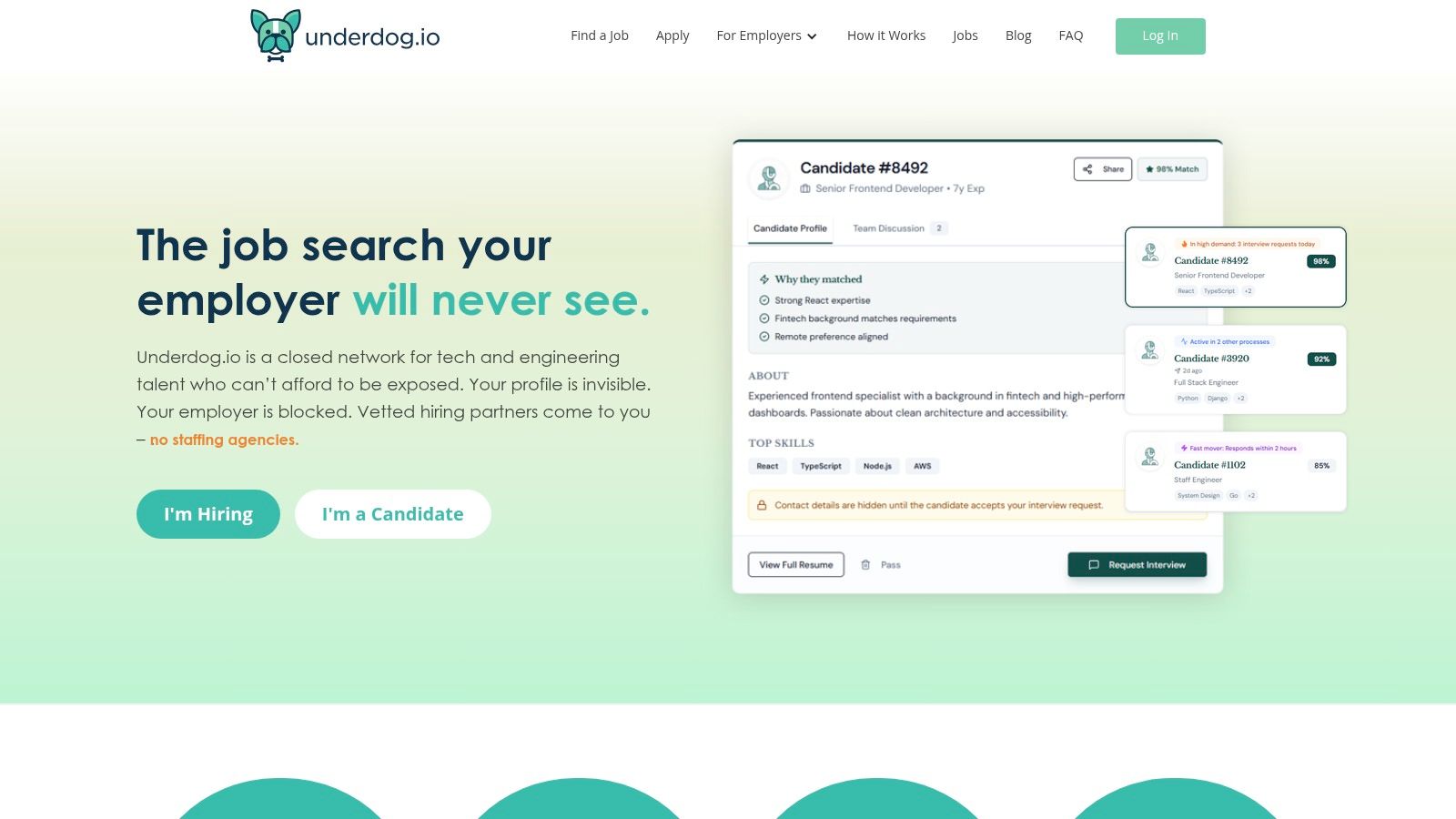
Underdog.io is the startup-only lane in this list. It fits experienced engineers who want confidential access to startups, including remote roles, without repeatedly applying to individual postings.
A single, roughly 60-second application puts accepted candidates in front of hundreds of vetted startups and high-growth technology companies. Employers reach out when your background fits their needs.
The network covers New York City, San Francisco, and remote-friendly roles across the United States. For a Houston-based engineer, that means national startup exposure, with limited dedicated Houston inventory.
Human review and personalized matching account for more than language and framework keywords. Production ownership, preferred company stage, seniority, and location requirements matter alongside your stack.
Hiring teams get tools such as stack-specific questions and Boolean search, plus a weekly cohort of active candidates. Job seekers get fewer, warmer conversations.
The trade-off is selectivity. The strongest fit is usually full-time candidates with meaningful experience, no recent bootcamp graduation, and no visa sponsorship requirement, though many partners also hire contract, remote, bootcamp, and visa candidates.
Your routine stays simple: describe what you have shipped, state that you are based in Houston, and separate remote-only interest from relocation or occasional travel. Keep another source active while introductions develop.
A startup title doesn't tell you much by itself. A backend opening could mean maintaining an established service or becoming the person responsible for the entire application.
Wellfound's Houston search is useful when you want to compare that company context alongside the job. Listings may include company stage, compensation, equity, and work arrangement, helping you assess whether the opportunity matches the kind of startup work you want.
It's more focused than a general employment site, but don't assume every result represents a Houston office. Remote and out-of-area opportunities can appear alongside local roles.
Start with your actual specialty, such as backend, full-stack, or infrastructure. Then read the responsibilities for clues about ownership: deployments, on-call participation, customer contact, architecture decisions, and collaboration with product managers.
Say you've built Python services and managed their deployment. A role asking for API development plus production ownership may fit better than a nominally senior position centered on a framework you haven't used.
Compare the work you'll own before comparing the title. Startup seniority isn't consistent across companies.
Wellfound works well for discovering smaller employers and comparing startup opportunities. Its limitation is local depth: Houston-specific engineering options may be narrower than on broad boards, and a promising listing still needs verification on the employer's careers page.
Save relevant companies as well as jobs. Revisit their hiring pages during your weekly review, and use our guide to the best sites for startup jobs when you need to expand beyond a single startup source.
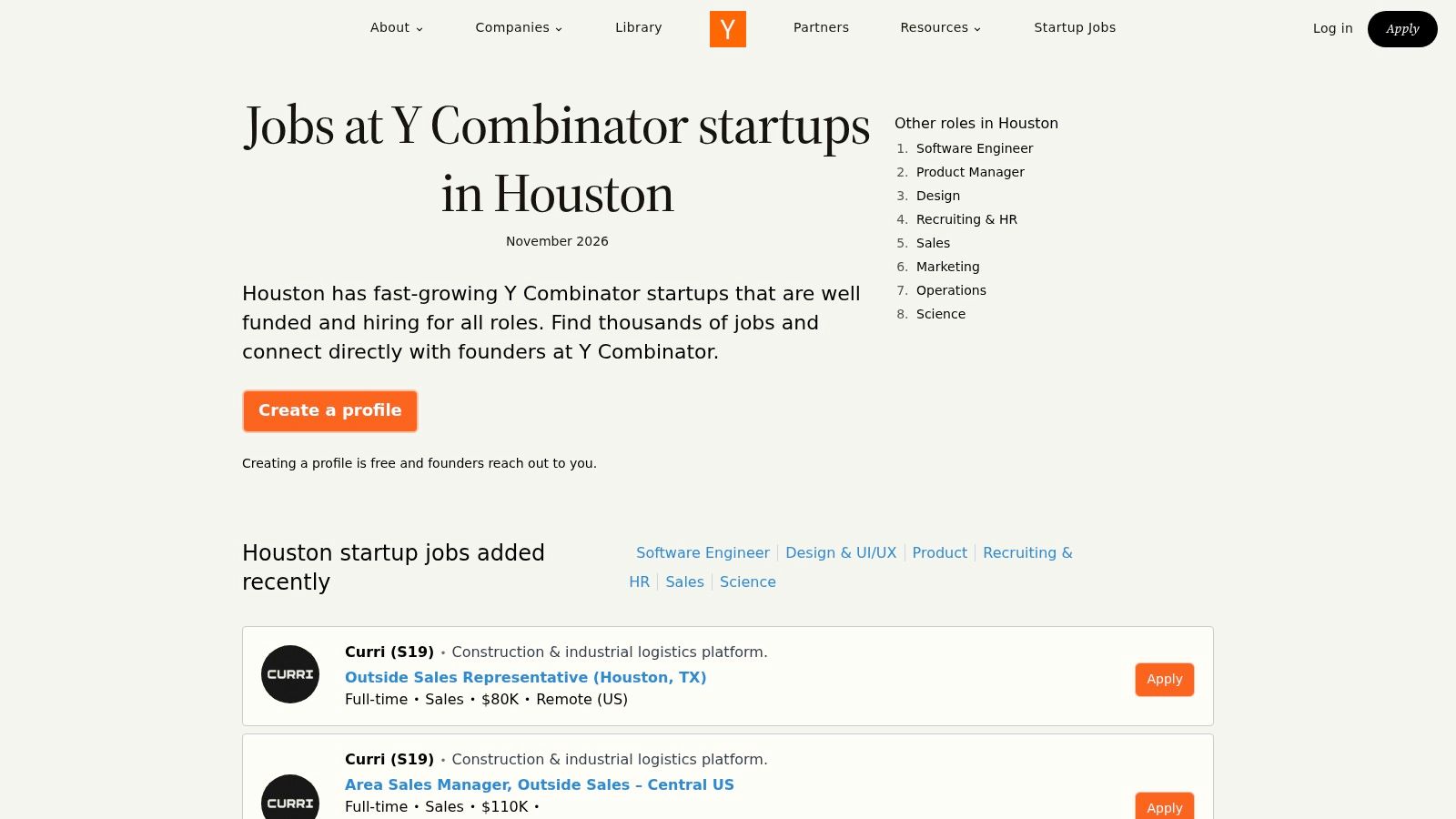
Y Combinator Jobs is a targeted option for engineers who specifically want to work at companies in the Y Combinator network. Candidates can create a free profile and use it across participating startups.
That narrow scope is both the advantage and the limitation. You can focus on startup teams without sorting through unrelated corporate vacancies, but you won't see the full Houston employer market.
Use the Houston location search for local or Houston-eligible opportunities. Search the broader board separately for U.S.-remote software engineering roles, then inspect the location requirements rather than trusting the remote label alone.
For example, an engineer who has built integrations should lead with API reliability, authentication, and debugging across external systems when approaching an integration-heavy startup. A generic statement about enjoying fast-paced environments adds little.
Some listings include compensation and work-location details, which can help you qualify opportunities before applying. Still, network membership doesn't establish a company's current financial stability, management quality, or engineering practices.
Ask about runway, customer traction, on-call expectations, and who sets technical priorities. Houston-only openings may be limited, so this works better as a focused startup channel than as your entire local search.
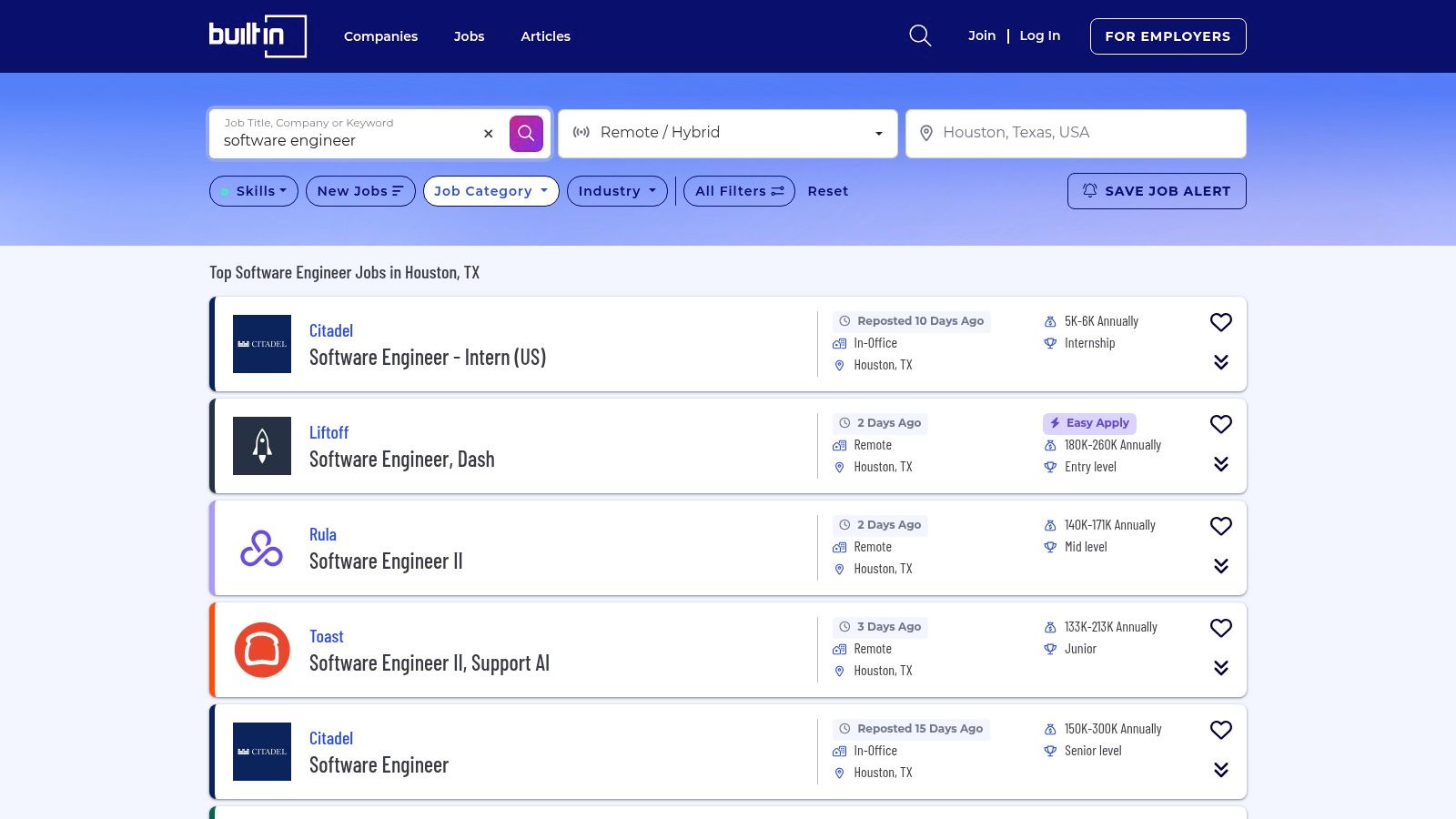
Use Built In's Houston engineering search when you want a technology-focused view of local employers. It puts company information alongside software, data, and related engineering openings, making it useful for discovery as well as applications.
The distinction matters in Houston. A relevant engineering team might describe an opening as platform engineering, data engineering, or application development rather than software engineering.
Built In helps you scan those neighboring specialties without moving entirely into a general employment feed. However, a technology-focused listing doesn't necessarily mean an early-stage startup.
Browse by engineering specialty, then save companies whose products and working arrangements fit your goals. Read their own careers pages before deciding which openings deserve a focused application.
This prevents a familiar mistake: applying because the language matches while overlooking that the actual job belongs to a different specialty.
Built In's strength is the combination of employer research and technical categories. Its Houston selection may be smaller than the largest general boards, and employer pages remain the place to confirm status and application instructions.
If you prefer direct matching over browsing company profiles, compare the approaches in our Built In alternative guide. Use the format that suits your search, not whichever produces the longest results page.
LinkedIn is most useful when you treat it as a job search connected to a professional network, not merely another application feed.
LinkedIn's Houston software-engineer search includes filters for location, experience level, employment type, and remote work. Saved searches and daily or weekly alerts reduce repeated manual searching, while company and recruiter profiles help you investigate who's hiring.
The breadth is valuable. It also creates noise from duplicate postings, older listings, contractors, and roles with heavy competition.
Create separate searches for local hybrid roles and remote positions. Within those searches, narrow by your level and specialty rather than combining junior, senior, backend, mobile, and infrastructure vacancies into the same feed.
When a role fits, inspect the employer's engineering team and the recruiter attached to the listing. If you reach out, reference the actual opening and explain your fit in concrete terms.
A useful recruiter message names the role, states your Houston location, and connects your experience to a specific requirement. It doesn't ask a stranger to figure out your entire search.
For example, mention that you've operated Java services in production and are open to the listed hybrid arrangement. Don't send a long autobiography or a résumé without context.
Basic search and alerts are available to members, while some features are paid. Start with the basic workflow before deciding whether additional tools solve a real problem.
For more detailed search tactics, use this guide to find jobs on LinkedIn faster. Verify the vacancy on the employer's site before investing time in an application.
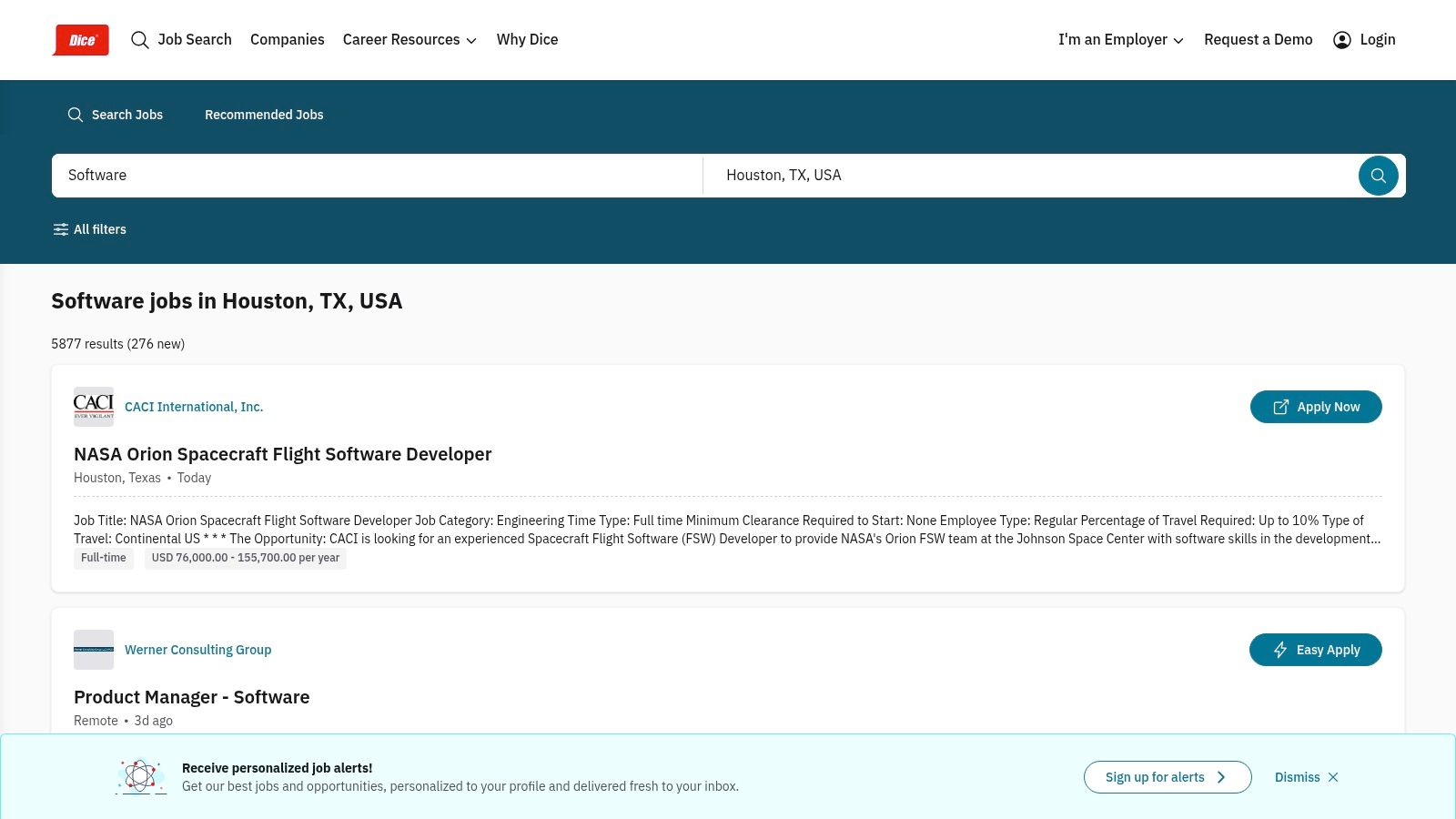
If you're open to contract work, Dice's Houston software-engineer search deserves a different role in your routine from the startup boards.
Its technology-focused inventory includes full-time and contract positions across software, embedded systems, and other engineering specialties. That makes it useful for engineers whose experience is more specific than a general product-development title suggests.
Search for the specialty directly. An embedded C++ engineer and a cloud application developer shouldn't rely on the same broad query.
Contract listings require questions that a permanent-role search can overlook. Establish the employment arrangement, project scope, expected duration, location requirements, and who employs you before discussing technical fit in depth.
Some results come from recruiters or staffing firms rather than the end employer. If you work with a staffing firm such as nexusITgroup.com, establish submission consent and communication expectations early.
Dice's trade-off is noise from reposted roles and overlapping recruitment efforts. It's less focused on startup culture than Wellfound or Y Combinator Jobs.
Use our best job boards for engineers guide to compare additional sources without assuming every technical board serves the same hiring model.
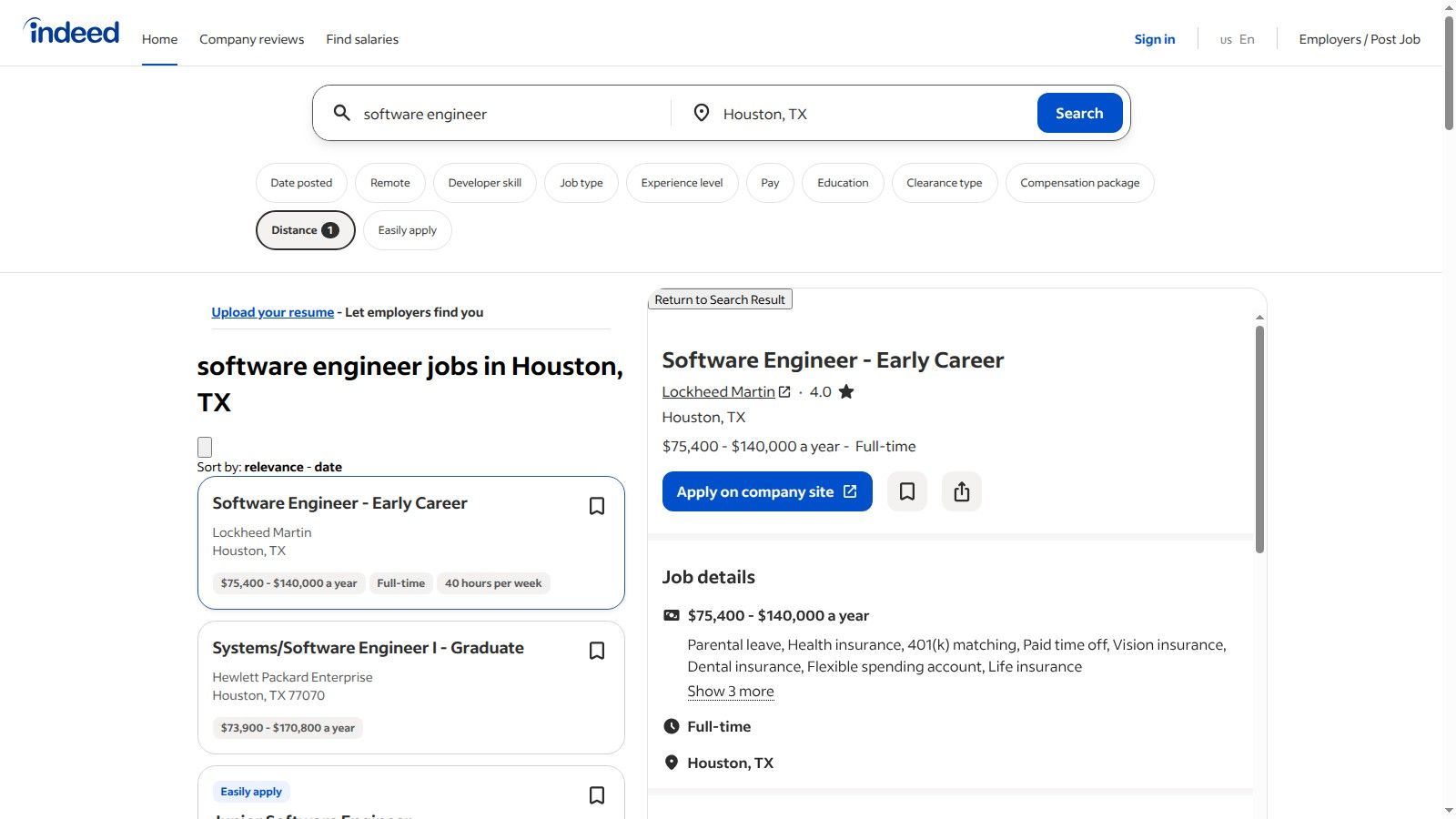
Indeed's Houston software-engineer search is useful for finding employers outside the startup circuit. Its broad inventory spans industries and employment types, including businesses that hire engineers without presenting themselves as technology companies.
That breadth complements a niche board. It also means you'll encounter adjacent roles, duplicate listings, and postings sourced from elsewhere.
Try related titles such as application developer, backend developer, and software developer. Pair them with relevant technologies, then read the responsibilities closely enough to distinguish software development from support, implementation, or systems administration.
Salary figures need the same scrutiny as job titles. Indeed's Houston salary estimate reports average annual software-engineer pay of $112,993, based on 192 salaries drawn from postings over the preceding 36 months.
That's a reference point, not a guaranteed offer or a senior-engineer benchmark. Ask for the actual base-salary band, bonus eligibility, equity terms, and attendance requirements.
Compare offers for the same level and working arrangement. A broad salary average can't tell you whether a particular senior backend offer is competitive.
For each promising result, record the employer, job title, requisition identifier, and original careers-page address. Merge duplicates instead of treating them as separate opportunities.
Indeed works best as a discovery source that widens your employer list. It works poorly when you apply indiscriminately to every result containing software engineer. Keep the breadth, but make your application decisions narrowly.
| Item | Best For | Startup Focus | Dedicated Houston Search |
|---|---|---|---|
| Underdog.io | Confidential, curated startup matching | Strong; vetted tech startups | No; offers U.S. remote roles |
| Wellfound | Finding startup and technology roles | Strong | Yes |
| Y Combinator Jobs | Exploring roles at YC-backed startups | Strong; YC companies only | Yes |
| Built In | Browsing technology and engineering roles | Partial; tech-focused, not exclusively startups | Yes |
| LinkedIn Jobs | Broad job search and professional networking | Broad; includes startups and large employers | Yes |
| Dice | Technical roles, including contract work | Limited | Yes |
| Indeed | Scanning a wide range of local openings | Limited | Yes |
Start with a startup-focused source, a dedicated Houston tech board, and a broad board for volume. Wellfound or Y Combinator Jobs can support startup discovery, Built In can help with local technology employers, and LinkedIn or Indeed can widen the search.
If contract work is a serious option, give Dice a defined place in the routine rather than adding it to an already crowded feed. A curated marketplace can run alongside these searches when you want selective introductions.
Set saved searches and alerts where available, then review new listings weekly. Keep local hybrid and remote searches separate so you don't repeatedly evaluate roles whose working arrangements you'd never accept.
For a local pay reference, City Salary Data's BLS-based Houston metropolitan estimate places the middle 50% of software-developer wages between $101,190 and $159,450 in May 2025. The estimate covers the metropolitan area and the occupation broadly, not a specific seniority or startup compensation package.
If you're applying without a degree, focus your materials on evidence of engineering ability. These no-degree coding roles in Houston can support discovery, but each employer's requirements still need individual review.
A focused routine gives you more time to investigate teams, prepare relevant examples, and follow up thoughtfully. The goal isn't to monitor every board. It's to find credible openings that fit, verify them, and enter conversations knowing why you belong there.
Underdog.io offers a free, confidential way to explore vetted startups and high-growth technology companies through a single application. If you're based in Houston and want remote-friendly startup opportunities alongside your local search, visit Underdog.io and share your engineering experience, location preferences, and next-role priorities.