Underdog.io is the better fit for most startup hiring. Fact-based human matching plus a response rate above 60% produces more real conversations than a larger pile of searchable profiles, and that difference is the whole decision.
The pull of the underdog is measurable. When U.S. students evaluated hypothetical Olympic swimming contests built from historical medal totals, 75% favored the team with the weaker record, including matchups such as Belgium versus Sweden, as the BBC's examination of underdog support reports. A challenger who looks constrained draws attention that a favorite has to earn.
The names themselves point in two directions. "Underdog" was first recorded in 1887 for the beaten dog in a fight, while the noun "wrangle" is documented by 1555 and carries the sense of quarrelling or hard negotiation, according to the Oxford English Dictionary entry for wrangle. One word marks a position in a contest. The other describes the arguing.
That is the honest frame for the underdog vs wrangle comparison. Wrangle is a strong search engine for people. Underdog.io is a vetted room where companies open the conversation. Which one you need depends on whether your bottleneck is finding names or getting a reply.
Underdog.io wins this comparison for anyone whose bottleneck is a reply. Matching is fact-based and reviewed by a person, the published marketplace response rate sits above 60%, and the company states a target of 65% or more. For most startup hiring that combination beats a bigger search pile, because the scarce resource is a conversation, not a profile count.
Underdog.io runs a curated reverse marketplace. Candidates submit one centralized application, approved profiles become searchable by employers, and hiring teams contact the people they want directly. Admission filters both sides of the market: reviewers clear candidates before profiles go live, and Underdog turns away more than 50% of the companies that apply to join.
Wrangle sits at the other end of the funnel. It is an AI sourcing and outbound system built for open-ended people search, repeated discovery, and ATS-connected outreach. Its published proof is retrieval quality, which is a different job from candidate engagement.
Underdog.io versus Wrangle on the decision criteria:
| Criterion | Underdog.io | Wrangle |
|---|---|---|
| Operating model | Curated reverse marketplace with human review | AI sourcing and outbound recruiting |
| Who starts contact | Employers reach out to approved profiles | Recruiters run search and outreach |
| Selectivity | About 5% of applicants accepted; more than 50% of companies turned away | Open-ended people search, not two-sided vetting |
| Response signal | Above 60%, with a company target of 65% or more | Not published as a candidate response rate |
| Retrieval metrics | Precision, recall, and Hit@1 not published | 91.1% macro precision and 98.9% recall at 10; 93.4% recruiting and 95.2% overall, vendor-reported |
| Best fit | Startups that want pre-screened, responsive talent | Teams that need repeatable ATS-connected sourcing |
Read the rows in order. The operating model row sets up everything else: one product qualifies people and then invites companies in, and the other gives a recruiter a search box and lets them decide who to approach.
Who starts contact is the row buyers skip past. In a reverse marketplace the employer moves first, but only after a reviewer has cleared the candidate. In an outbound system the recruiter moves first against a much wider universe of people who never asked to be contacted, and the reply rate on that cold outreach becomes the recruiter's problem to solve.
Selectivity cuts both ways. A pool that accepts a small fraction of applicants and rejects more than half of companies is quiet and pre-filtered, which is exactly what a two-person hiring team wants. It is also small. If your requirement is hundreds of net-new names every week, a curated pool is the wrong shape for the problem.
The last two rows show the core asymmetry. On response, only Underdog.io publishes a number. On retrieval, only Wrangle does. Both figures are company-reported rather than results from a controlled experiment, and neither vendor publishes the other's metric. Judge each platform on the job it was built for: Underdog on whether a real conversation happens, Wrangle on whether the right profile surfaces from a large index.
Underdog.io runs a closed, invite-only community, and the flow is inverted from a job board. A candidate fills in one short application, free, and never applies to individual roles. From that point, vetted startups decide who they want to talk to.
A person reviews every profile for relevant experience in product, engineering, design, data, or marketing, and for genuine startup fit. Only about 5% of applicants are accepted, as Underdog.io's comparison with broad job boards sets out. Companies get the same treatment, and we turn away 50% or more of them after checking funding status, team quality, and product viability.
Silence is part of the design here. Underdog.io only responds to candidates when they are selected for a cohort, so an inbox without automated rejection notices is the normal state rather than a fault. Approved profiles become searchable, and employers can filter by stack, run Boolean searches, apply tags, keep notes, and message candidates inside the platform.
Designers get one extra step before matching. We define the role in an onboarding conversation first, then match the person to the product, the stage, and the team structure, which is a different question from whether the portfolio looks good.
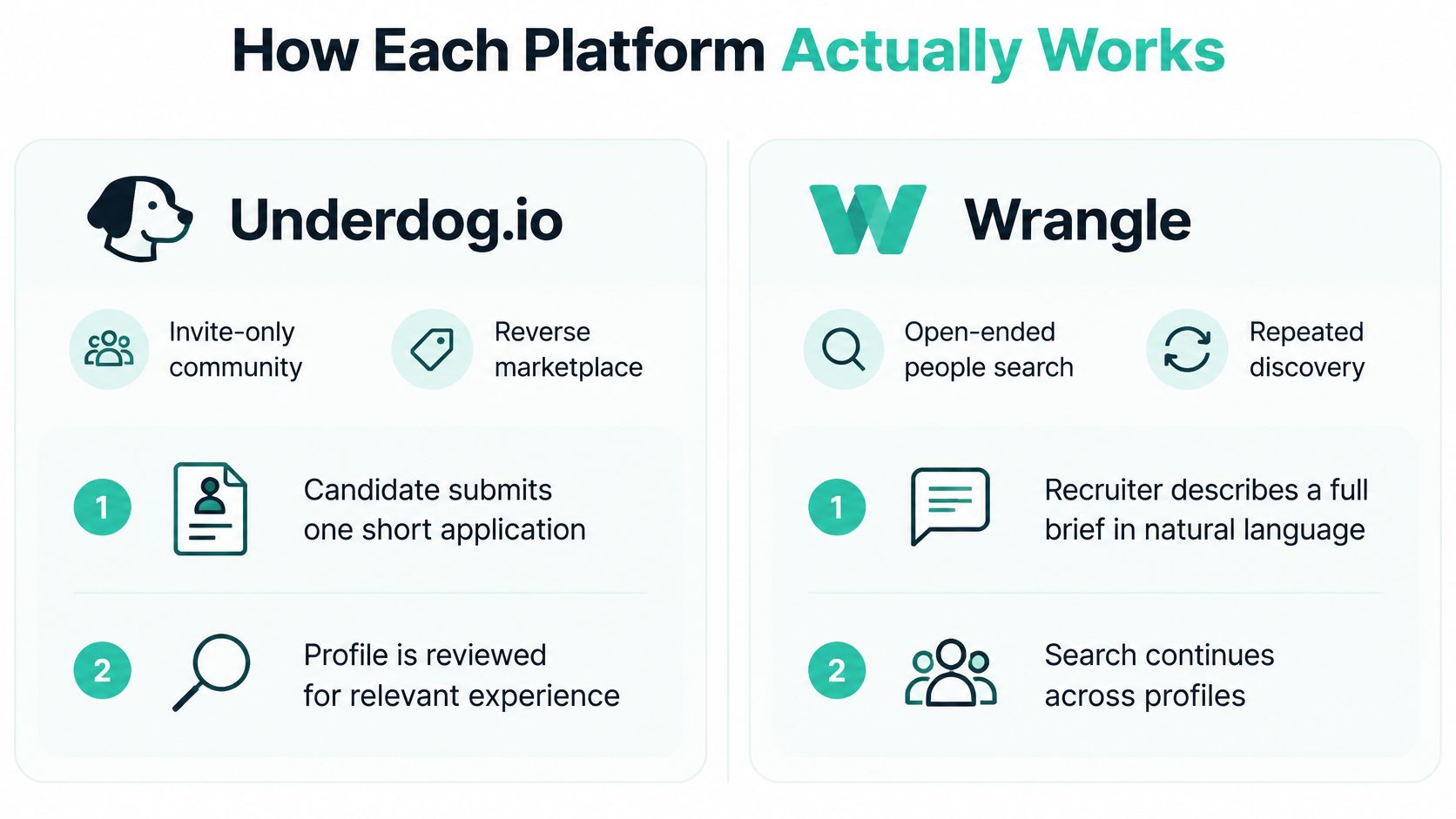
Wrangle is one-sided by design, and that isn't a criticism. A recruiter writes a full brief in natural language, can layer in company and funding signals, inspects the reasoning behind each result, exports the list, and schedules an agent to re-run the same search as the market shifts. Outreach lands inside Ashby, Greenhouse, Lever, or Recruit CRM instead of a separate spreadsheet.
What it doesn't have is a talent pool with an entrance exam. There's no candidate application, no profile for a job seeker to make searchable, and no published two-sided acceptance rate. Coverage comes from open people data, not from a queue of people who raised their hands.
The practical difference sits in where each product spends its effort. Underdog.io spends it before the introduction, so fewer people enter the funnel and most of them are relevant. Wrangle spends it on finding and re-finding people outside any shared application, which is the right investment when the people you need have never applied anywhere.
The right question isn't which tool has more people in it. It's which tool gets you to a human who answers before your requisition goes stale.
Response rate is the metric that decides whether a hiring tool worked. Underdog.io reports a response rate above 60%, and one published figure puts the marketplace response rate at 65%+, per Underdog.io's breakdown of candidate sourcing tools. That's a measure of employer interest landing on a real person, not of applications received.
The design makes the number plausible. Companies initiate contact only after a reviewer has read the profile, so a message arrives with context attached and a shorter list of reasons to ignore it. Candidates are hidden from current and past employers, which removes the single biggest reason a passively employed engineer doesn't reply. Every interview request carries the actual salary range, which kills the most common stall in the first exchange.
Rule to apply: Judge any matching system by how often a qualified person gets a substantive employer reply. Job count and profile count are inventory. A reply is the product.
Volume is deliberately low. Registered users typically see a handful of introductions in a month rather than a daily blast, and Underdog sends designers no spam. That matters more than it sounds, because a platform that trains candidates to ignore its messages has already lost the response rate it advertises.
The honest limit: these are marketplace operating figures, not a controlled test of time to fill. They tell you how often people engage. They don't promise a hire by a specific date.
Wrangle optimizes retrieval, and it publishes that proof in detail. Whether a sourced person writes back is a separate question it doesn't report on, and no sourcing tool can guarantee it. A team can run a precise people search and still hit the ordinary outbound wall, where most passive candidates never respond to a first touch.
A pay-per-hire or subscription marketplace can therefore cost less per conversation than a large sequence with a low reply rate, even when the per-seat math looks worse on paper. Fewer introductions that land beat more names that don't.
Wrangle's case is strong where coverage is the problem. Its published architecture supports natural-language full-brief searches, company and funding signals, scheduled agents that re-run searches, visible reasoning, exports, and integrations with Ashby, Greenhouse, Lever, and Recruit CRM, as Wrangle's platform documentation describes. Reported benchmark results are 91.1% macro precision and 98.9% recall at 10 on the Exa People Search benchmark, plus 93.4% recruiting-category performance and 95.2% overall on PeopleSearchBench.
Treat those as vendor-reported and situation-dependent. Query design, data freshness, geography, and profile coverage all move the number, and a benchmark run against a defined people-search task isn't the same as your req in a thin market.
Search and workflow tools by platform:
| Workflow need | Underdog.io | Wrangle |
|---|---|---|
| Finding people | Search approved profiles with stack filters and Boolean | Natural-language full-brief search with company and funding signals |
| Keeping search current | New vetted candidates enter the pool as they are accepted | Scheduled agents re-run the same search |
| Team collaboration | Review, tagging, notes, and in-platform messaging | Visible reasoning and exports |
| ATS connection | Email relay between registered users | Ashby, Greenhouse, Lever, and Recruit CRM |
| Proof offered | Vetting and response metrics; no precision, recall, or Hit@1 | 91.1% macro precision and 98.9% recall at 10; 93.4% recruiting and 95.2% overall on PeopleSearchBench; no candidate response rate |
The ATS row is the one that decides a lot of purchases. A search that ends in a spreadsheet creates a second system to maintain, and most recruiting teams already own the first one. Wrangle handing results to Ashby or Greenhouse keeps the work where the requisition lives.
Underdog.io gives a hiring team a different toolkit for a role that's already defined: stack-specific filters, Boolean search, team review, tagging, notes, in-platform messaging, and an email relay between registered users. It doesn't publish retrieval benchmarks, so if your problem is finding net-new names at scale, this isn't the tool that will prove it can. If you want the details of how the pool is built and screened, Underdog.io's curated tech marketplace guide walks through the model.
The situational line is sharp. Use Wrangle to build and refresh an outbound list. Use Underdog.io when the list is the wrong problem and what you need is a small set of people who already cleared a human screen and are likely to answer.
Separate the two buyers before discussing price. Applying to Underdog.io costs candidates nothing, designers included, and stays free after acceptance. The revenue comes from companies, which choose between pay-per-hire pricing and a subscription. The subscription includes unlimited seats on the platform plus a full year of unlimited hires, which suits a startup expecting several technical hires in the same twelve months. Pay-per-hire fits a team with one open role that doesn't want a platform fee committed before anyone starts.
Wrangle publishes no rate card for its search and outreach tooling. Ask for a current quote before you model cost per reply.
Who pays what on each platform:
| Buyer | Underdog.io | Wrangle |
|---|---|---|
| Candidate or designer | Free to apply and free to use | Not a candidate-facing platform |
| Employer with one open role | Pay-per-hire | Subscription; not published, quote on request |
| Employer hiring repeatedly | Subscription with unlimited seats and unlimited hires for a full year | Subscription priced on search and outreach volume; not published, quote on request |
| What the fee buys | Curated introductions and a responsive pool | AI search, scheduled discovery, and ATS-connected outreach |
| Cost per conversation | Judged against the 65%+ candidate response rate Underdog targets | Judged against sourcer time and outbound reply rates |
Two details are worth pricing into the Underdog.io side of that table. The pool it sells access to turns away more than half of the companies that apply, and every interview request a candidate receives carries the actual salary range, so the conversations an employer pays for start further along than a cold outbound reply.
Compare conversations, not seats. A plan priced per hire can cost less per real exchange than a large outbound sequence that mostly goes unanswered, and a coverage tool can be cheaper than either when you need hundreds of fresh names. If you're also weighing an outsourced leadership hire to cover the gap while you build a team, what an outsourced VP of Sales does breaks down that cost model, which follows different logic from a marketplace subscription.
For agency or contingent search pricing as a benchmark, the recruitment agency cost breakdown is a fair comparison point, because a retained search fee is usually a percentage of salary while a marketplace is a flat model.
One line candidates should hold onto. You should not pay either platform for the privilege of being searchable.
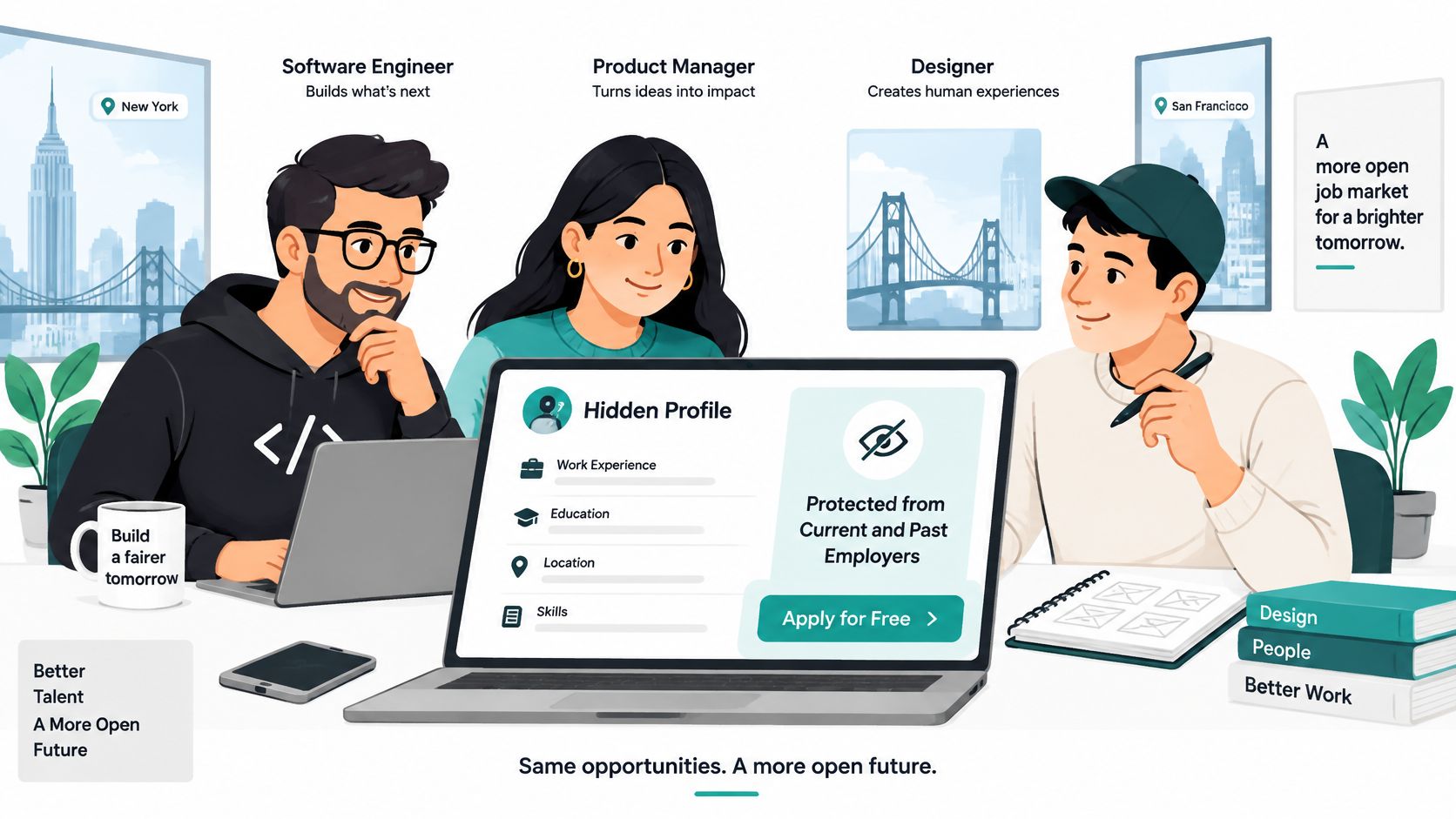
Use Underdog.io. A software engineer, product manager, or designer in New York, San Francisco, or working remotely submits one free application, stays hidden from current and past employers, and hears from companies instead of chasing postings. The trade-off is real. The community is closed and invite-only, and candidates only get a response when they are selected for a cohort, so treat it as one channel alongside your own network rather than a pipeline you can pump.
Wrangle has no candidate side at all. There is no application to submit and no profile to make searchable.
A job seeker gains nothing from creating an account.
A founder hiring a founding designer, senior product designer, design lead or head of design, AI product designer, design systems engineer, or UX and research-led designer should start with Underdog.io. Those six profiles are the ones the platform recruits against, and matching weighs product, stage, and team structure rather than keywords. The same applies to a seed-through-Series-C company building AI-native products, developer tools, infrastructure, consumer and creator apps, fintech, or healthtech. Bland, Capital RX, Onboard AI, Gemini, MoneyLion, Teamshares, GC AI, Parachute Health, True Link Financial, Yogi, Roo, Mira, J2 Health, Zest, and Cove are already in the network, so a startup-fluent candidate pool exists before you post anything.
If you are still deciding which category of tool your team needs, MyCulture.ai's software selection framework sets out how to score options against each other before you commit to a category.
Use Wrangle. An in-house recruiter with a live req in Ashby, Greenhouse, Lever, or Recruit CRM who has to rediscover passive people every week gets more from scheduled searches than from a curated pool, because the job is coverage and the ATS is already the system of record. Run the search, decide who is worth contacting, then work the replies.
That is the opposite advice from the marketplace case, and deliberately so. A recruiter who already has a defined funnel does not need someone else's screening. They need names flowing into the top of it.
Enterprise talent acquisition teams should pick by the gap. If the shortfall is startup talent, Underdog.io gives you curated startup supply without building an outbound list. If the shortfall is outbound coverage across many roles, Wrangle scales where a small vetted pool cannot.
For contract or retained search, do not bend either marketplace into an agency; keep the platforms for what they were built to do. For a broader view of how these tools sit alongside an ATS, recruiting software for startups covers the surrounding stack.
A precise search is not a conversation. Buy the conversation if that's what's missing.
Candidates should apply once at Underdog.io and wait for a cohort decision rather than reapplying.
Underdog.io gives startups a curated pool where every profile has passed a human review and companies start the conversation, which is why the marketplace response rate sits above 60% instead of producing a pile of unread outreach. If your bottleneck is a real conversation with startup-ready talent rather than a longer list of names, that's the tool built for it. Apply once as a candidate, or talk to us as a hiring team, at Underdog.io.