You're probably in one of two places right now.
You've got an offer from a startup that sounds exciting on paper, but you can't tell whether the pace is energizing or just disguised chaos. Or you're building a company and realizing that “we want a great culture” is not a plan. It's a slogan.
I've seen both sides of this. Two engineers can join startups at the same stage, with similar equity, similar salaries, and similar titles, and end up with completely different careers a year later. One gets sharper because the team debates hard problems, documents decisions, and treats mistakes as part of the work. The other burns out because everything is urgent, nobody defines ownership, and the founder's mood becomes the roadmap.
That gap is startup company culture.
Culture is often discussed as if it's soft. It isn't. It changes who joins, who stays, who ships, who speaks up, and who starts looking elsewhere. For candidates, culture shapes your learning curve and your health. For founders, culture shapes retention, trust, and execution quality.
Two backend engineers accept roles in the same month. Both join venture-backed startups. Both get equity. Both are told they'll have “tons of ownership.”
Six months later, their outcomes look nothing alike.
At the first company, ownership means clear goals, fast feedback, and a manager who trusts engineers to make technical calls. Product debates are direct, but not personal. Incidents turn into postmortems, not finger-pointing. The engineer grows fast because the team gives context, not just tickets.
At the second company, “ownership” means cleaning up everyone else's mess with no authority to fix the root cause. Priorities change daily. Slack pings show up late at night. Leaders call the culture ambitious, but what employees experience is confusion plus pressure. The engineer stops taking risks because every mistake gets remembered.
That difference matters more than most candidates admit at offer stage. In 2024, 88% of workers globally said corporate culture is more important than salary when choosing where to work, according to company culture statistics compiled by Ujji. That shift tracks with what many startup recruiters already see in practice. Strong candidates don't just ask what they'll build. They ask who they'll build it with and how decisions get made.
Early startup years exaggerate everything.
A healthy culture compounds quickly because small habits repeat. Engineers review code with care. PMs surface trade-offs early. Founders explain why priorities changed. People learn faster because they aren't spending energy decoding politics.
A bad culture compounds just as fast.
Practical rule: A startup will teach you its real values through conflict, missed deadlines, and mistakes. Not through the values page.
For candidates, startup company culture is often the biggest predictor of whether a role becomes a launchpad or a recovery period. For founders, it determines whether hiring momentum turns into a durable team or a revolving door.
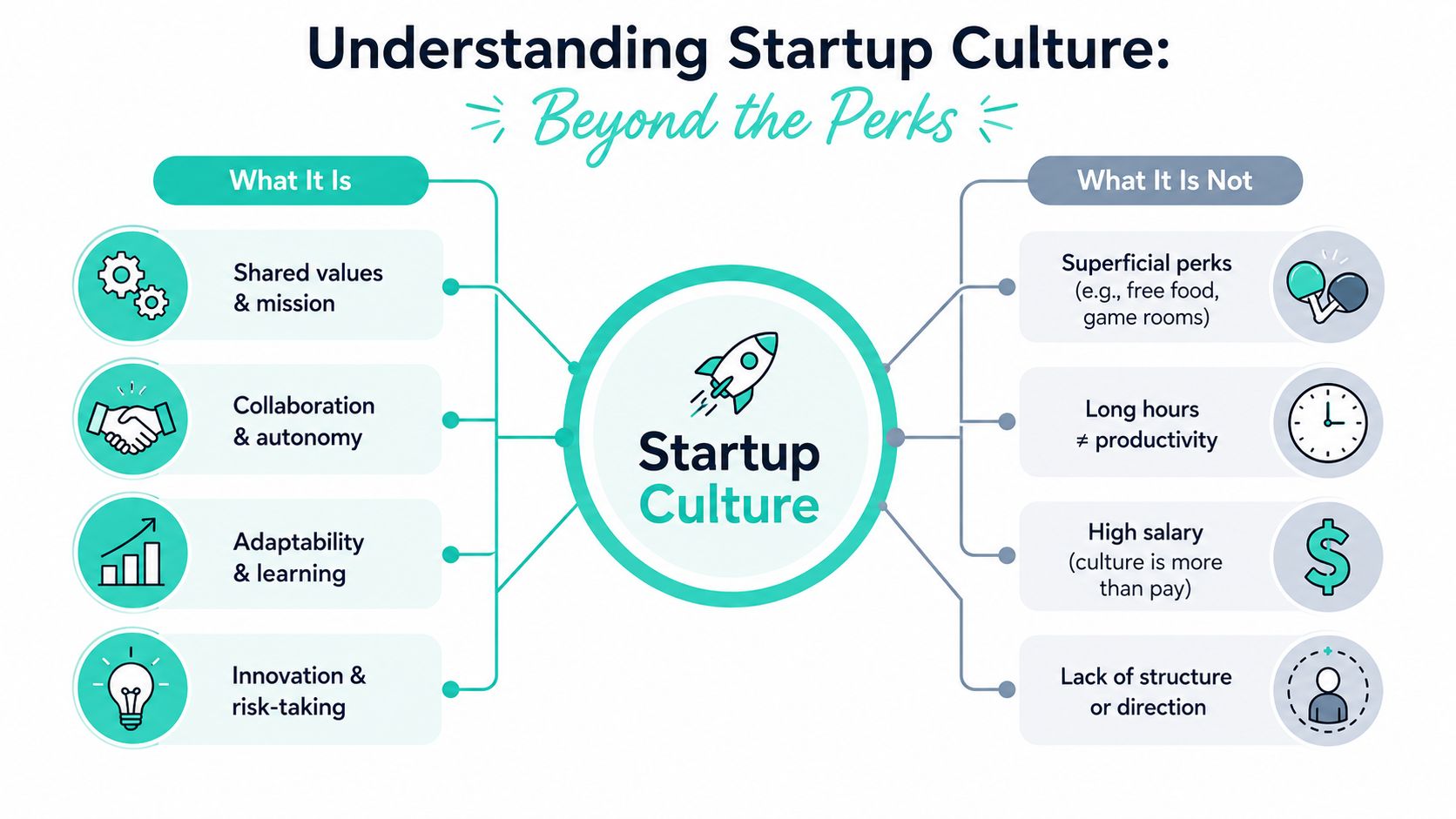
Startup company culture is the operating system of a team. It's the set of defaults people use when no one is watching closely. How they disagree. How they escalate risk. How they treat deadlines. How leaders respond when a launch slips or a customer is angry.
It is not free lunch, a nice office, offsites, or a meme-heavy Slack.
That doesn't mean perks are useless. They can reinforce a culture. A thoughtful remote stipend supports distributed work. Team rituals can strengthen trust. But perks don't create trust on their own. They often distract from the harder question, which is whether the company has a coherent set of behaviors that people can rely on.
Candidates often interpret visible energy as healthy culture. Founders often confuse intensity with alignment.
That's how teams end up celebrating signs that don't tell you much:
Here's the part founders don't usually notice about themselves. They often recreate the very environment they once complained about.
A HEC Paris study on startup culture found that the longer founders worked at another organization, the more likely they were to transfer its culture into their new startup. That's a useful corrective to the usual mythology. Startup culture isn't automatically fresh or creative just because the company is new.
That pattern shows up constantly in hiring conversations. A founder says they want a transparent, low-ego team, but they copy old habits without realizing it. They hold information tightly because their previous employer did. They glorify speed over clarity because that was rewarded in their last role. They confuse polished confidence with leadership because that's what they saw modeled.
Most unhealthy startup culture isn't designed. It's inherited.
That's why candidates should evaluate the founder's behavior, not just the employer brand. And it's why founders need to audit their defaults before they start hiring around them.
Not all startup company culture problems are the same. Some teams are intense but coherent. Some are warm but indecisive. Some are metric-heavy and crisp. Others run on charisma and improvisation.
You need a vocabulary for what you're looking at. These archetypes help.
This is the team that celebrates speed, responsiveness, and visible effort. Slack is always active. Founders prize stamina. Work expands to fill every gap in the day.
What works: Teams can move fast, especially in a narrow problem space with a strong founder who can make hard calls quickly. People who love immersion can find the pace motivating.
What breaks: Hustle cultures often stop distinguishing between urgent work and unmanaged work. If every request is high priority, nobody learns to prioritize. The first sign of trouble is usually not missed output. It's lower judgment quality.
Watch for language like “we need killers,” “we're built different,” or “we don't do balance here.” Those phrases usually tell you more than the job description does.
These companies attract people through belief. The mission is clear, and employees want their work to matter beyond salary or title. Founders often talk about users, impact, and long-term purpose.
That can be powerful. Mission-driven teams often endure hard stretches better because people understand why the trade-offs exist. But mission can also become a shield. Weak leaders use purpose to excuse weak process. They ask people to absorb chaos because “the work matters.”
A good mission-driven culture pairs conviction with discipline. A bad one turns sacrifice into identity.
A data-driven culture replaces opinion-heavy decision making with shared definitions, baselines, and recurring measurement. According to Software Secured's explanation of data-driven startup culture, this usually depends on a stack that includes ETL tools, transformation tools, a data warehouse, and BI dashboards, plus leadership that clearly defines metrics such as ARR and explains how those metrics connect to company health.
This archetype can be excellent when leaders use data to improve decisions rather than silence debate.
What healthy versions look like:
| Trait | Healthy expression | Unhealthy expression |
|---|---|---|
| Metrics | Shared definitions and regular review | Cherry-picked dashboards |
| Accountability | Teams understand what they own | Data used to blame |
| Decision making | Numbers plus context | Numbers without judgment |
The failure mode is obvious. Teams start measuring what's easy instead of what matters. People optimize dashboards while product quality or team trust slips underneath.
Everything runs through one or two founders. This can create speed early because the company has a strong center of gravity. Candidates sometimes love it because communication feels direct and vision feels sharp.
The upside is coherence. The downside is fragility. If culture depends entirely on one person's energy, attention, or approval, scale gets messy fast. Teams wait instead of deciding. People learn to manage the founder rather than solve the problem.
These teams care intensely about the work itself. Engineers argue over architecture. Designers care about polish. PMs defend user experience. Standards are high.
At their best, craft cultures produce teams that improve each other. At their worst, they become exclusionary or slow. Perfectionism starts masquerading as rigor.
A good question for candidates is simple: does this team have standards, or does it have status games?
Most candidates don't miss toxic culture because they aren't smart enough to spot it. They miss it because toxic teams can look impressive in an interview loop. The founder is charismatic. The roadmap sounds ambitious. Everyone says they care greatly.
The truth usually shows up in smaller signals.
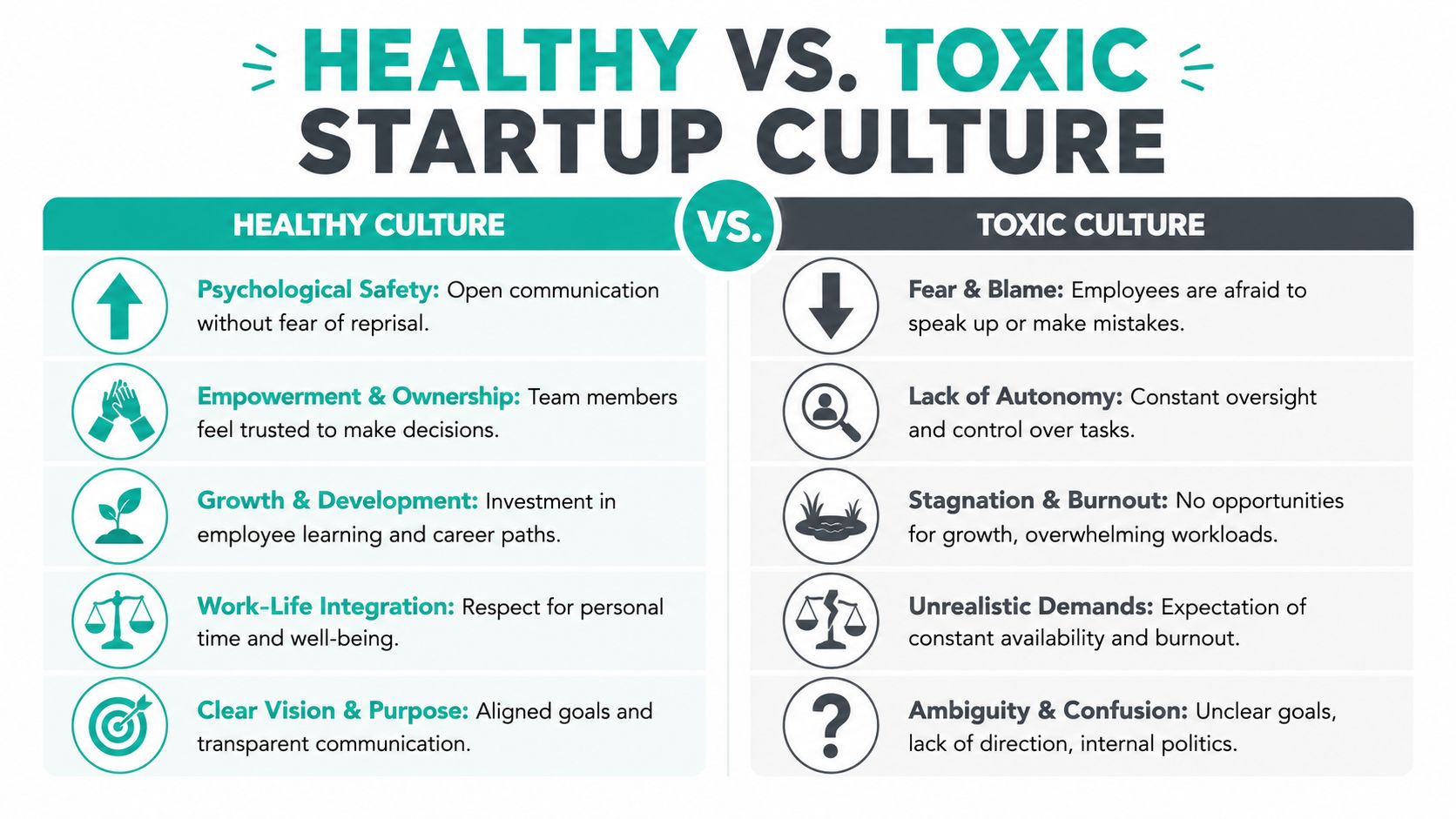
Healthy startup company culture doesn't mean easy. It means predictable in the right ways.
Look for these signs:
A healthy environment also tends to measure itself. Innerlogic's framework for measuring company culture highlights tools such as eNPS, engagement, turnover rate, absenteeism, DEI metrics, promotion rates, communication frequency, and the Culture Index. Founders don't need every metric at once, but serious teams track something beyond intuition.
Toxic cultures rarely introduce themselves as toxic. They call themselves high-performance, founder-led, intense, or candid.
Here's what often sits underneath that branding:
If people can't describe how decisions get made, politics is already filling the gap.
The hiring consequence is straightforward. Toxic cultures leak talent. In 2025, 44% of workers globally reported quitting a job because of a toxic workplace, a 33% relative increase from the previous year, according to Gable's company culture statistics. You don't need to be in HR to feel the effect. It shows up in missed handoffs, brittle teams, and candidates who decline offers after backchanneling employees.
| If you hear this | It may mean |
|---|---|
| “We're like a family” | Boundaries may be weak |
| “We only hire A players” | Standards may be real, or empathy may be absent |
| “We move fast and break things” | Experimentation, or repeated avoidable mess |
| “There's no bureaucracy here” | Flexibility, or no decision structure |
Healthy culture has friction. Toxic culture has drag. One sharpens the work. The other drains the people doing it.
Candidates who assess startup company culture well don't ask vague questions like “How's the culture?” They run a due diligence process. Before the interview, during the interview, and after it, they look for evidence.
That's the only way to separate a polished story from a stable team.
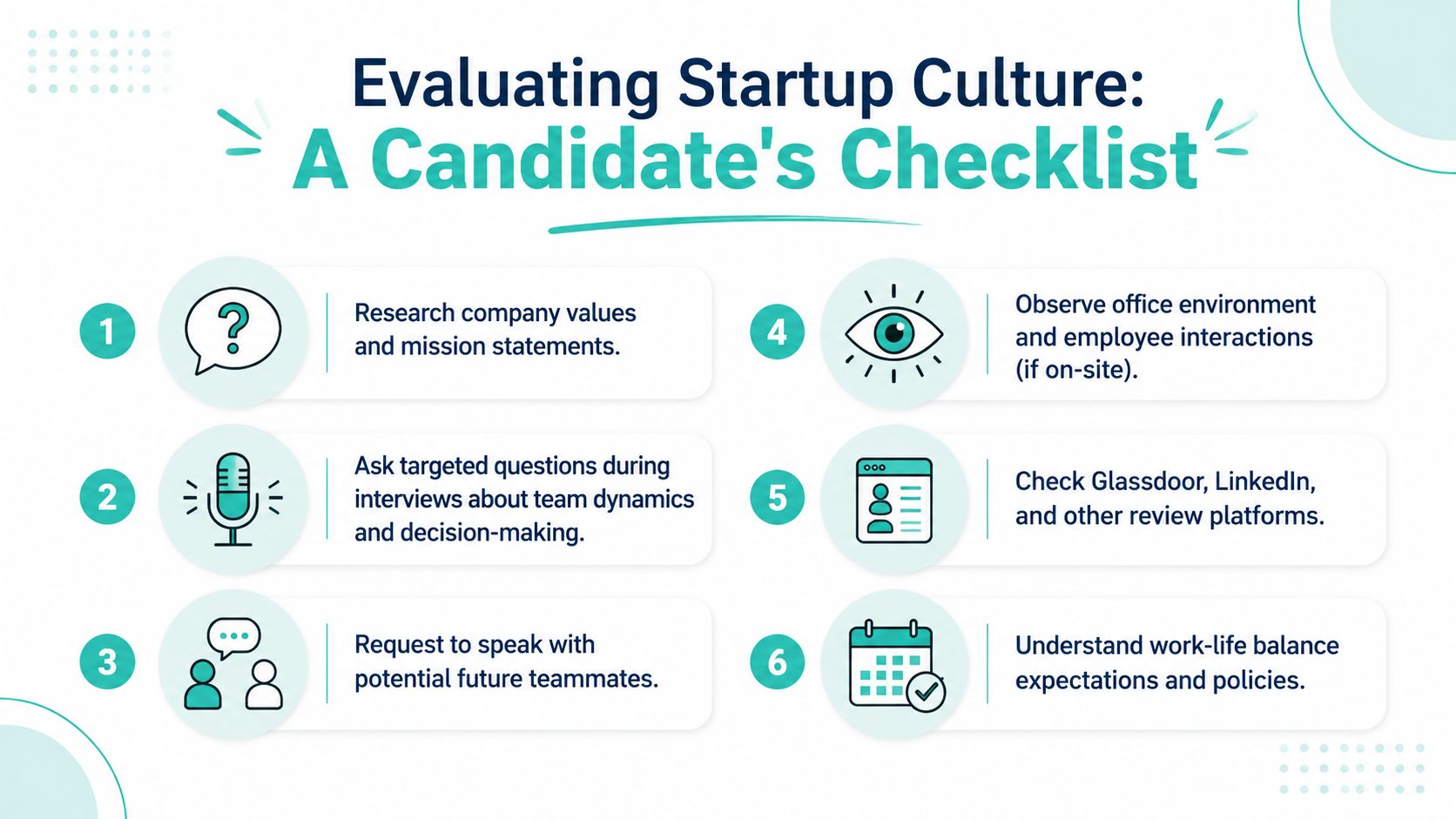
Start with what the company publishes, but read it skeptically.
Check the job description. Is it clear about outcomes, or stuffed with startup clichés like “wear many hats” and “thrive in ambiguity”? Read founder posts, engineering blogs, product updates, and team pages. You're not looking for polished values. You're looking for consistency.
Use review sites and LinkedIn carefully. One angry review doesn't prove much. Patterns do. If several former employees mention weak leadership, chaotic priorities, or poor communication, pay attention. This guide on how to vet startup culture is a useful companion if you want a tighter checklist before you start interviews.
Ask behavioral questions that force specifics. Good teams can answer them cleanly. Weak teams drift into abstractions.
Try questions like these:
If you're talking to future peers, ask what they wish they'd known before joining. That question often produces the most honest answer in the process.
Ask for one recent example, not a philosophy. Examples are harder to fake.
Most candidates only ask themselves whether they liked the people. That's too shallow.
Use a short post-interview scorecard:
If you visited an office, observe interactions more than décor. If the company is distributed, ask how decisions are documented and how remote employees stay included. That matters because Flair's workplace culture data found that only 58% of on-site employees hold a positive view of workplace culture, compared with approximately 70% of remote and hybrid workers. Different working models need different cultural habits.
A strong interview loop should leave you with fewer fantasies and more facts.
Founders often say culture should emerge naturally. It does emerge naturally. That's exactly the problem.
If you don't design startup company culture deliberately, the company will still get one. It will just be a mix of your habits, your stress responses, your first hires, and whatever behavior got rewarded during the first difficult quarter.
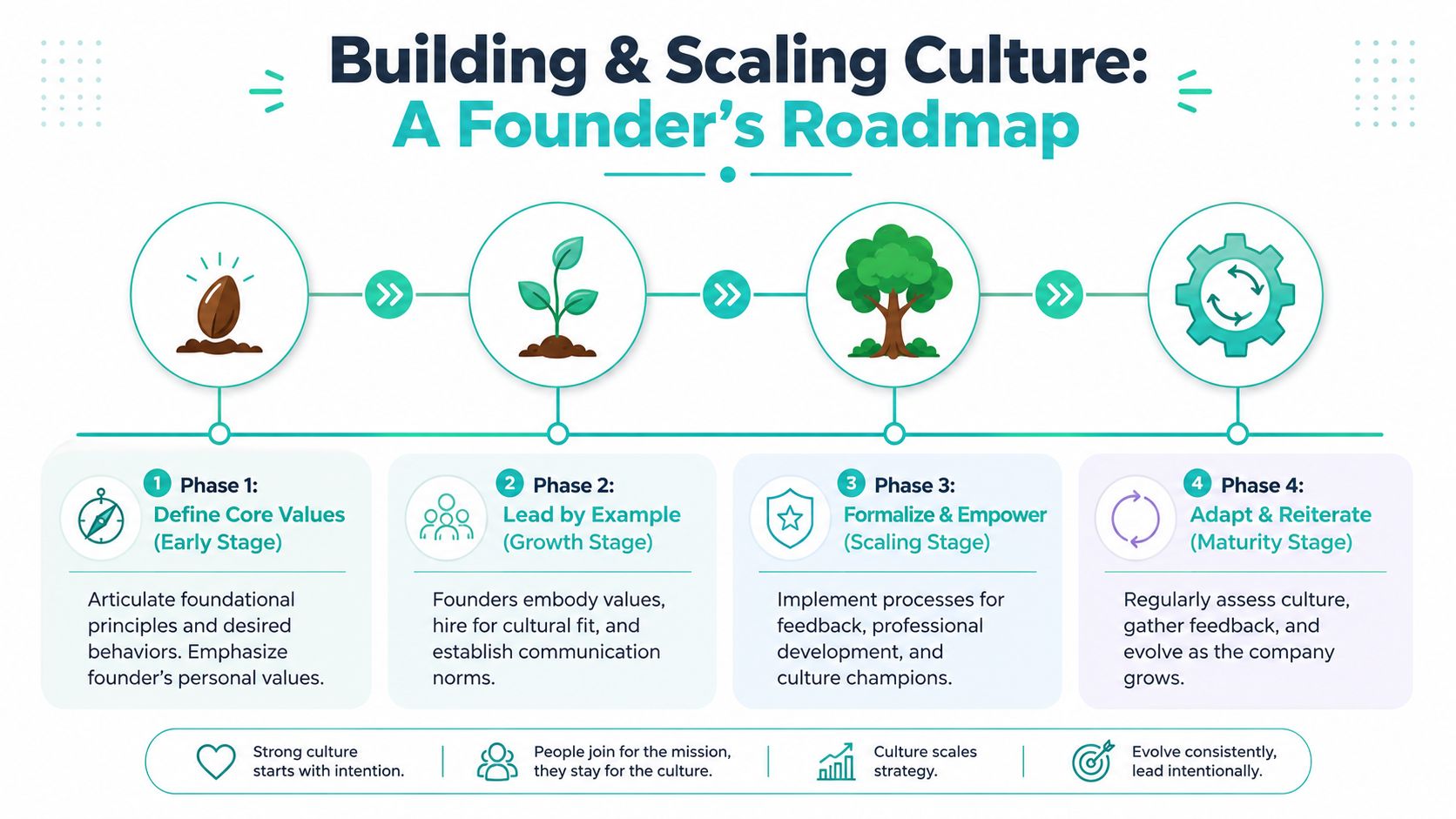
Many cultural problems often trace back to foundational elements. Qualitative research confirms that founder leadership qualities, values, and vision are the primary determinants of startup culture, as shown in Pepperdine University research on founder leadership and startup culture.
That finding matches what operators see every day. Employees don't learn culture from the values slide. They learn it by watching what the founder tolerates.
If a founder says they value candor but punishes dissent, the actual culture is caution. If they say they trust people but approve every detail, the actual culture is dependence. If they say they care about well-being but celebrate nonstop availability, the actual culture is performative sacrifice.
A value without a corresponding behavior is decoration.
Translate values into practices your team can recognize:
Some founders also need a better feedback loop than instinct. A practical resource on understanding team feedback for culture improvement can help leaders gather input without turning every issue into anonymous venting.
Culture work starts before the new hire signs.
Interview for behaviors that reinforce the team you want. If your company needs calm under ambiguity, ask for examples of how candidates handled shifting priorities. If your culture depends on collaboration, test how people share credit, not just how they present wins.
Then use onboarding to make the culture legible. A new hire should know:
| Moment | What to make explicit |
|---|---|
| First week | Decision norms, communication channels, and what “good” looks like |
| First month | How priorities are set and how to escalate blockers |
| Early feedback cycle | How performance feedback works in practice |
Teams that skip this end up asking employees to infer norms by trial and error. That's expensive, especially when errors can be costly.
Culture isn't too soft to measure. It's too important not to.
Start with a small set of signals. Turnover rate tells you whether people are staying. eNPS gives you a read on commitment. Pulse surveys can reveal whether employees feel psychological safety, clarity, and belonging. Communication frequency can expose whether leaders are going silent during hard periods.
You don't need a bloated people-ops function to do this. You need consistency. Review the same signals regularly, discuss them openly, and make changes that employees can see. If your culture needs a reset, this guide on how to change company culture offers a practical framework for making those shifts deliberately.
The key trade-off is simple. Formalizing culture too early can feel stiff. Waiting too long means your worst habits become tradition.
The best way to think about startup company culture is as a product.
Products don't improve because the team says the right words. They improve because someone defines what good looks like, studies friction, listens to users, and iterates. Culture works the same way. It needs design, maintenance, and clear feedback loops.
For candidates, that means acting less like a hopeful applicant and more like a careful buyer. Ask how the company works under pressure. Test whether the founder's behavior matches the company's story. Look for evidence that the team can support your growth, not just your output.
For founders, it means accepting that culture isn't the vibe left over after work gets done. It is part of how work gets done. If people can't trust each other, goals stay muddy, or feedback feels risky, the product, hiring, and retention all weaken together.
A strong culture also becomes part of your hiring narrative. Your values, expectations, and working style shape your employee value proposition examples, whether you define them clearly or not.
The founders who build durable teams usually do one thing well. They stop treating culture as branding and start treating it as infrastructure.
If you want to explore startup roles where team quality and company fit matter as much as the job title, Underdog.io is built for that. Candidates can apply once and get introduced to vetted startups and high-growth tech companies, with a process designed to surface stronger matches from the start.