You're in the interview, your laptop is open, and the recruiter has already told you this round is “more hands-on than usual.” The interviewer isn't asking you to whiteboard a balanced tree or recite a sorting trick. They want to watch how you work with AI, how you steer it, and whether you can still think like an engineer when the code is coming back at you faster than you can type it.
That's vibe coding interviews for engineers, and it's already a real hiring format, not a novelty act. The shift makes sense when you look at how developers build now. One 2025 industry summary says 92% of U.S. developers use AI coding tools daily, 82% of developers worldwide use them at least weekly, 41% of global code is now AI-generated, and 256 billion lines were written in 2024 alone, which is why interviewers are moving toward prompt design, verification, and debugging judgment rather than pure syntax recall. It also says 87% of Fortune 500 companies have reportedly adopted at least one vibe coding platform, which tells you this interview style isn't going away any time soon. vibe coding statistics
You open the laptop, share your screen, and start working with an AI coding tool while the interviewer watches the whole loop. The task is small enough to finish in a live session, but real enough to force tradeoffs, not just surface-level code. The strong candidate sounds calm, names assumptions early, and keeps the work moving. The weak candidate drifts, over-explains, and spends too much time reacting to the tool instead of directing it.
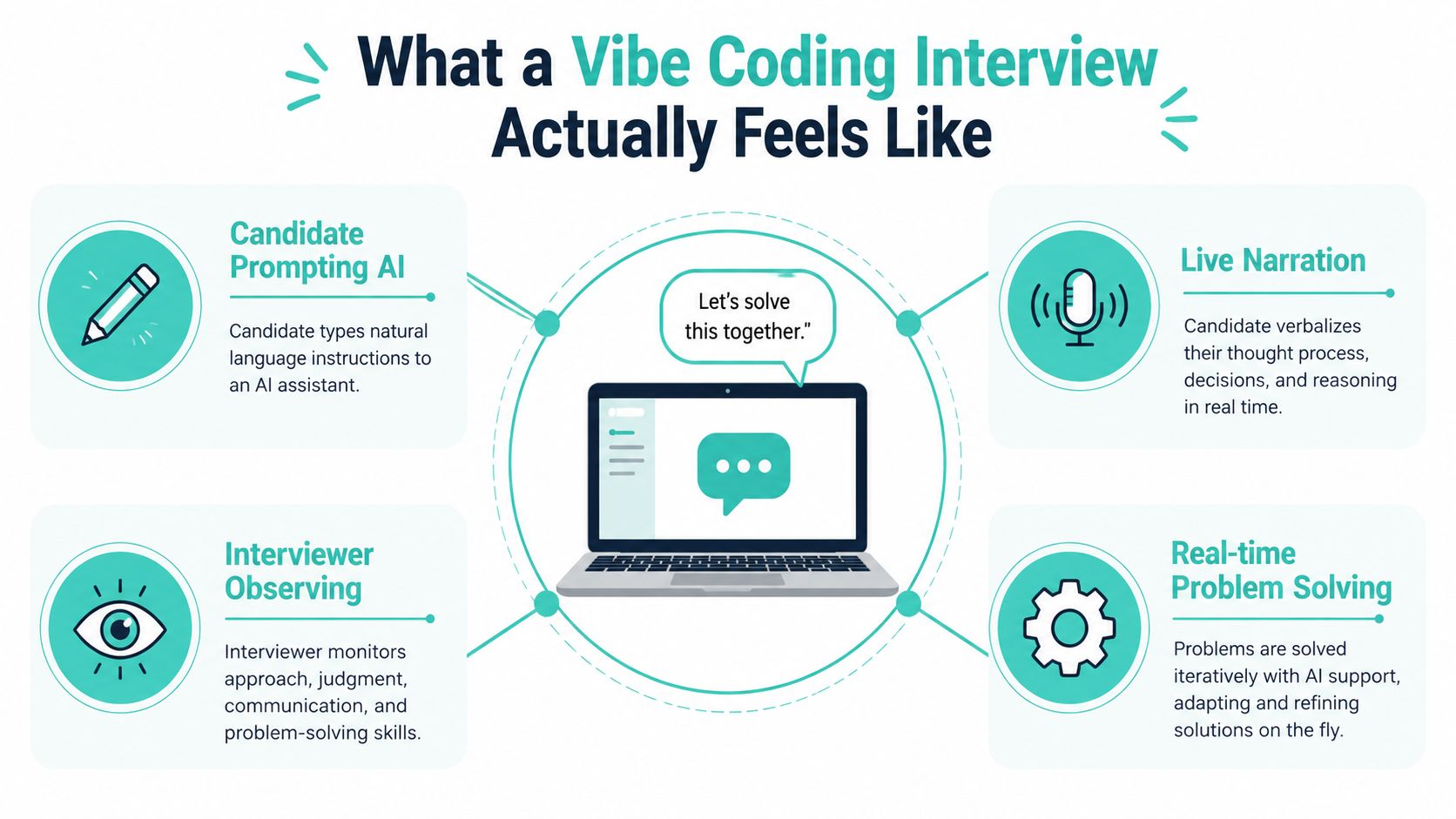
A whiteboard interview mostly measures recall and decomposition under pressure. A vibe coding round measures whether you can turn a messy prompt into a workable plan, then verify the output before you trust it. The interview reflects the job rather than a museum version of it, because AI-assisted code is already part of daily engineering work.
The interviewer is not grading typing speed. They are grading control, judgment, and whether you can keep the model on a short leash while still moving fast.
Traditional pair programming still gives a useful signal, but it is a different one. In pair programming, the human teammate usually shares context and catches misunderstandings in real time. In a vibe coding interview, the AI gives you speed and also adds noise, and the candidate has to filter that noise without drifting. The company wants to see whether you can supervise generated code and verify it, not just accept it because it looks polished.
A vibe coding interview is a timed, live session where a candidate uses an AI coding tool to solve a realistic product problem while narrating decisions, validating output, and handling tradeoffs in real time. The point is not to replace engineering judgment with automation. The point is to see whether you can move quickly without losing correctness, ownership, or clarity.
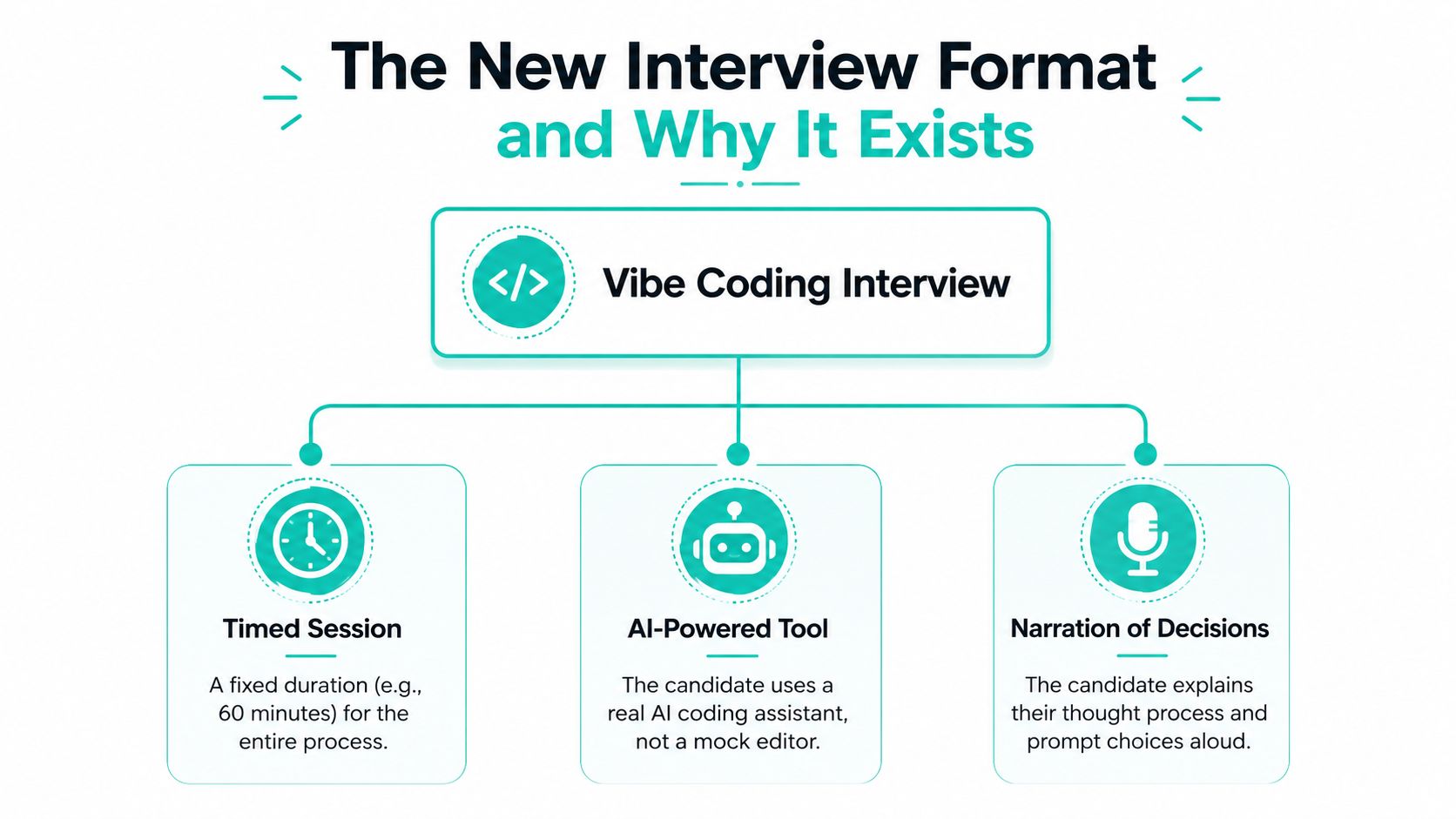
LeetCode rounds still tell you whether someone can reason under constraints, but they don't show how that person uses tools on a real product problem. Whiteboard system design still reveals architectural thinking, but it often strips away the day-to-day reality of iterating in a codebase. Take-homes show independence, yet they hide the live decision-making that hiring teams care about when they need someone who can ship and defend the result in one sitting.
A vibe coding round combines those signals in one session. It tests whether the candidate can decompose a problem, guide the AI, and spot when the output is wrong or incomplete. That's why this format shows up in startup interviews first, then spreads upward. It matches how teams now work, with AI inside the loop instead of outside it.
Hiring managers want a simple answer to a hard question. Can this engineer use AI to go faster without turning review into a cleanup job? That's why the session usually feels less like “solve this puzzle” and more like “show me how you work when the pace is high and the margin for sloppiness is low.”
A useful comparison is the way good teams think about maintainable naming and structure. A candidate who has a habit of writing readable identifiers and keeping code conventions tight will usually do better here, because the AI will only amplify the habits already in the room. If you need a refresher on that discipline, the coding conventions for maintainable code piece from RewriteBar is a practical reference.
The scoring is more explicit than most candidates realize. A hiring-manager guide on these interviews says candidates are scored on verification, prompt quality, ownership, and orchestration, and those criteria go beyond basic coding ability or framework knowledge. Strong candidates make those four signals visible without being asked.
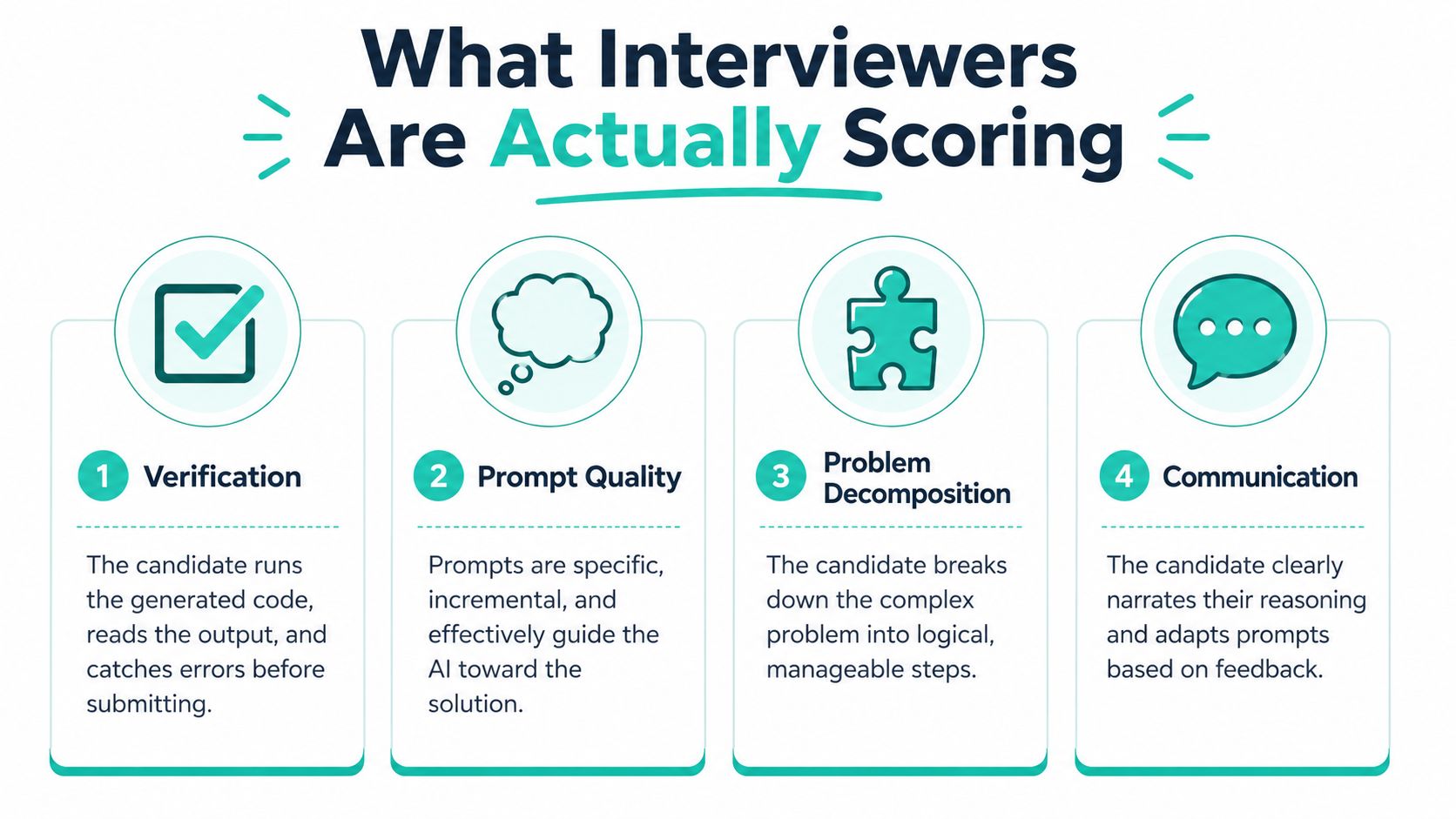
Verification means you run the code, inspect the output, and catch AI-generated mistakes before you hand anything over. If the model produces shaky edge-case handling or a broken import, you notice it quickly and say so out loud. Candidates tank this score when they trust the first answer because they confuse fluency with correctness.
Prompt quality is disciplined prompting. Strong prompts are scoped, specific, and iterative. They do not dump the whole problem on the model and hope for magic. They narrow the task, ask for a manageable slice, then refine based on what the output shows.
Ownership means the candidate drives the problem. The interviewer wants to hear decisions in your voice, not a chain of copied suggestions. If the model proposes a design choice, you should be able to accept, reject, or modify it with a reason.
Orchestration is the highest-signal behavior in the room. It means knowing when to prompt, when to write by hand, when to slow down, and when to ask the interviewer a clarifying question. That matters because industry analysis cited in another source says 38–47% of professional developers now use natural-language prompts to generate non-trivial code at least weekly, and 12–18% report writing less than half of their production code manually. The same analysis estimates AI-assisted coding can reduce median greenfield feature completion time by 20–45%, but code review time can increase by 25–40% when reviewers did not iteratively guide the AI output. vibe coding interview guide
If you cannot explain why the AI's answer is safe, your speed does not matter.
Code shape still matters. Clear identifiers, consistent structure, and readable boundaries make it easier for the interviewer to trust the result. That is where coding conventions for maintainable code become part of the signal, because sloppy naming reads as future review pain, not engineering judgment.
Early-stage startups use this format to answer a blunt question, can you ship a thin slice of product with minimal hand-holding? Growth-stage companies use it to see whether you can extend an existing system without trampling their review norms. Enterprises often use it more selectively, usually beside older rounds, because they want proof that AI fluency exists without making it the only signal.
| Stage | Main Goal | Top Scoring Dimension | Typical Setup |
|---|---|---|---|
| Early-stage startup | Ship a narrow feature fast | Ownership | Live build of a thin product slice |
| Growth-stage company | Extend existing systems safely | Orchestration | Session inside an established codebase |
| Enterprise | Confirm AI fluency without losing rigor | Verification | Vibe coding paired with older technical rounds |
The company's stage changes what “good” looks like. A startup interviewer is often less interested in perfection and more interested in whether you can carry ambiguity, make a decision, and get to a useful result. A larger company cares more about compatibility with existing processes, especially code review and maintainability.
If you're interviewing through a curated marketplace like Underdog.io, that context matters even more because the roles are already filtered toward startup environments. The guide to no code websites from own.page is a useful adjacent read if you want to understand how non-traditional builders think about shipping fast with fewer manual steps.
Don't give the same answer to every company. With a startup, talk about speed, ambiguity, and ownership of the outcome. With a larger company, talk about safeguards, code quality, and how you'd integrate generated work into their process without making reviewers miserable.
Your goal isn't to sound like an AI enthusiast. Your goal is to sound like someone who knows exactly where AI helps and where it creates risk.
The cleanest workflow starts with five minutes of clarifying questions and edge cases. You should ask what the happy path is, what data shape matters, and what failure modes the interviewer cares about most. Then ask the AI for a one-page plan with up to five milestones, because that forces the problem into a shippable shape instead of a foggy wish.
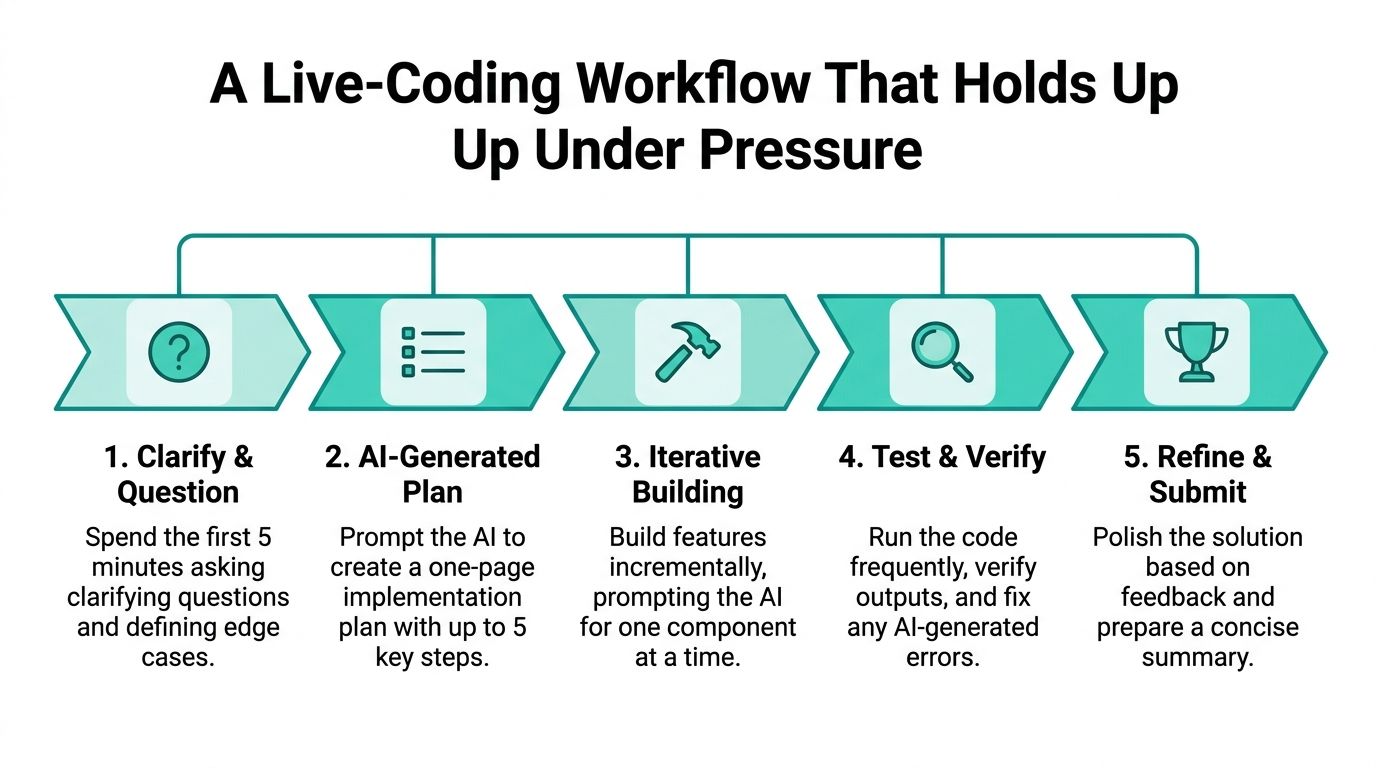
A strong candidate sounds like this. “I'm going to clarify the edge cases first. Then I'll ask the model for a short implementation plan, and I'll commit after each milestone so we can catch mistakes early.” That tells me they're not waiting for the AI to define the work.
Then they start building in small pieces. They keep state local where possible, verify continuously, and adjust as soon as the output drifts. If the AI gives them something wrong, they don't fight it emotionally. They say what's wrong, why it's wrong, and what they're changing next.
The worst move is to keep prompting the same bad direction and hope the model recovers. That's how candidates burn time and lose control. If the answer looks off, cut the task down, reset the context, or take the keyboard back for the critical section.
Use the interviewer as a source of truth when the prompt is underspecified. Ask a precise question instead of assuming. A live session is not a solo performance, it's a test of judgment under feedback.
The coding challenge in Python piece is a good reminder that even classic technical work rewards small, testable increments. That principle doesn't disappear just because AI is in the loop.
A realistic prompt might be to build a small URL shortener with rate limiting. The weak response begins by blasting a broad prompt into the model, accepting the first answer, and moving on without much inspection. The strong response narrows the scope, asks for a minimal design, and treats the AI output like draft code, not finished truth.
The weak candidate says, “Build the whole thing,” then stares at the screen while the model generates a blob of code. They accept the structure, maybe rename a few variables, and move on because the output looks plausible. They don't verify the rate limiter edge cases, and they can't explain why the database choice fits the workload.
That candidate usually sounds busy, not decisive. Their narration is mostly status updates, not engineering judgment. If the interviewer asks why a specific failure path is safe, the answer turns vague fast.
The strong candidate starts with, “I'll scope this to create, redirect, and rate-limit paths, then I'll ask for a one-page plan with database and storage tradeoffs.” They prompt the AI for the smallest useful implementation, run it, and then test the limiter behavior under repeated requests. When the code miscounts requests on a boundary condition, they catch it and explain the fix.
That same candidate doesn't just patch the bug. They can explain why one storage option is fine for a live interview but may not scale the way a production service would. That's the difference between generating code and owning a result.
For broader technical prep, the engineer interview questions article from Underdog.io is useful because it forces you to think in terms of choices, not trivia.
Startup hiring managers care about signal density. They want to know whether you believe in the product, whether you're comfortable with ambiguity, and whether you'll own a thin slice without needing a process manual. Those signals matter because in a small team, a hire who is technically fine but disengaged creates drag immediately.
The cleanest way to show mission alignment is to tie your work to a real product outcome. If the company builds tooling for developers, talk about reducing friction for teams. If the product serves customers directly, talk about reliability, speed, or clarity in user-facing behavior. Don't force a speech about passion. Connect your engineering choices to the user value the company is chasing.
Ask about equity with the same seriousness you'd bring to technical scope. Ask what kind of ownership this role has, how the team structures product decisions, and how often engineers get direct customer feedback. Those questions tell the interviewer that you understand the tradeoff between autonomy and chaos.
If you want to explore roles in a curated startup marketplace, Underdog.io is one place where that style of hiring shows up, because the platform is built around startup and high-growth tech companies rather than generic job-board traffic. That doesn't matter if you're looking for a huge enterprise seat, but it matters a lot if you want a role where your interview performance maps directly to ownership expectations.
In a startup interview, curiosity about the company is part of the technical signal. If you can't ask smart questions about the business, the interviewer assumes you won't ask smart questions about the code either.
Your prep should be boring and repetitive. Practice one mock prompt per day, time yourself, rehearse the think-aloud narration, and collect three stories about tradeoffs or blockers from your past work. Those stories matter because interviewers listen for whether you've handled ambiguity before, not whether you've memorized a polished script.
The fastest way to improve is to simulate the live loop. Open an editor, use an AI tool, and force yourself to stop after each milestone to verify the result. If you can't describe what changed, why it changed, and what you'd test next, you're not ready yet.
How long does the interview last? It varies by company, but you should prepare for a timed session and keep your pace tight from the start.
Should I mention that I'm using AI? Yes. Pretending you aren't using the tool makes you look evasive, and the whole point of the round is to see how you use it.
What if the AI is wrong? Treat it as expected, not embarrassing. Call out the flaw, test the output, and correct the path quickly.
How do I follow up afterward? Send a short note that restates the problem you solved, the tradeoff you made, and the part of the implementation you'd improve with more time.
For more grounding on the basics of interview prep, the software engineer interview preparation guide is a practical reference. It's especially useful if you want to remove avoidable friction before a live session.
If you're serious about this format, spend the next seven days doing the same routine until it feels normal: clarify, plan, prompt, verify, and explain. That rhythm is what interviewers are really listening for, because it shows you can work with AI without surrendering judgment.
If you're targeting startup roles and want your interview performance to match the kind of hiring companies do, Underdog.io gives you a curated path into those conversations. Create a profile, see which startups reach out, and use Underdog.io to put yourself in front of teams that already value AI-fluent engineers.