You've got three years of Spring Boot services behind you and a React frontend you shipped. You type "full stack" into a job board and get three listings back. One is a Node backend with React on top. One is Java, but the frontend belongs to a separate team in another time zone. Only the third is the job you thought you were searching for.
That ratio is normal, and it's why the source matters as much as the keyword. A curated startup marketplace filters for company stage and stack before you ever see a listing. A broad aggregator hands you volume and makes you do the filtering yourself. Both can produce an offer, but they cost you different amounts of time. Career changers coming through programs that work with adult learners online hit the same screen earlier. Below are seven places to look for full stack Java developer jobs, each with the thing to verify before you apply: whether Java sits in the backend or only in the legacy service nobody touches, whether the frontend is yours, and whether you're talking to an employer or a recruiter.
Underdog.io flips the usual direction of a job search. You submit one application, and if you're accepted, hundreds of companies can see your profile and apply to you. The network covers startups and high-growth tech firms in New York City, San Francisco, and remote roles across the US, and most hiring partners hire in multiple cities with remote flexibility.
Profiles stay confidential until interest is mutual, and your current employer is blocked from seeing you. That matters when you're employed and looking. Every candidate profile is reviewed manually, roughly 5% of applicants get in, and companies are screened for funding status, team quality, and product viability before they join. It's free for candidates; companies pay when they hire.
A curated network still contains backend-heavy roles with a thin frontend attached. Read the stack line, not the title. Job-posting analysis published by Skillenai found Java in 89.3% of indexed postings and Spring Boot in 63.0%, with SQL at 43.2%, so that backend trio is table stakes rather than a differentiator.
Practical rule: if you can't point to a deployed application you own end to end, close that gap before you apply anywhere on this list.
Two constraints decide whether this marketplace fits your search. The candidates who get the most traction are looking for full-time roles, haven't recently finished a coding bootcamp, and don't need visa sponsorship. Timing matters too: we share a new curated cohort of active job seekers with our network every week, so build your profile when you're ready to take calls. If you're still assembling the frontend half of your skill set, our guide on how to become a full stack developer covers the gaps worth closing first. The trade-off is honest: selective admission and a startup-only inventory mean fewer total listings than a general board, and you don't control when introductions arrive.
Say you open a Wellfound listing titled "Full Stack Engineer" at a seed-stage fintech. The stack line reads React, TypeScript, PostgreSQL, and Node. Your Spring Boot experience is irrelevant to that team, and nothing in the title warned you. Wellfound's inventory skews startup, so the default backend is often Node or Python, and Java appears where a company has scaled past its first architecture or inherited an enterprise integration.
Search on Wellfound's full stack developer role page and read the requirements section before the responsibilities section. Requirements list the languages. Responsibilities describe aspirations.
The compensation fields are a clear advantage here. Many startup posts disclose salary range, equity, location, and experience level, which lets you compare a Series A offer against a growth-stage one without a screening call.
Java's presence in enterprise stacks is broader than startup job boards suggest. Oracle's 2025 Java developer research with VDC found 56% of enterprise developers use Java within their organizations, up from 53% in 2023, and 84% of Java users said the language helps them build cloud-native applications efficiently.
When a startup does want Java, it usually wants Java plus containers and a cloud platform, not Java plus JSP pages.
The limits: fewer traditional enterprise roles, uneven employer response rates, and listings that sit open after a role is filled. Apply directly through your profile, then follow up with the founder or engineering lead if the company is small enough that one person owns hiring.
Company stage is the variable you can't screen for on a general board, and it's the whole point of this one. Y Combinator's job board lists openings at YC-backed companies, searchable by role and location, including US cities and remote. Profiles and browsing are free.
The YC network in a job search context:
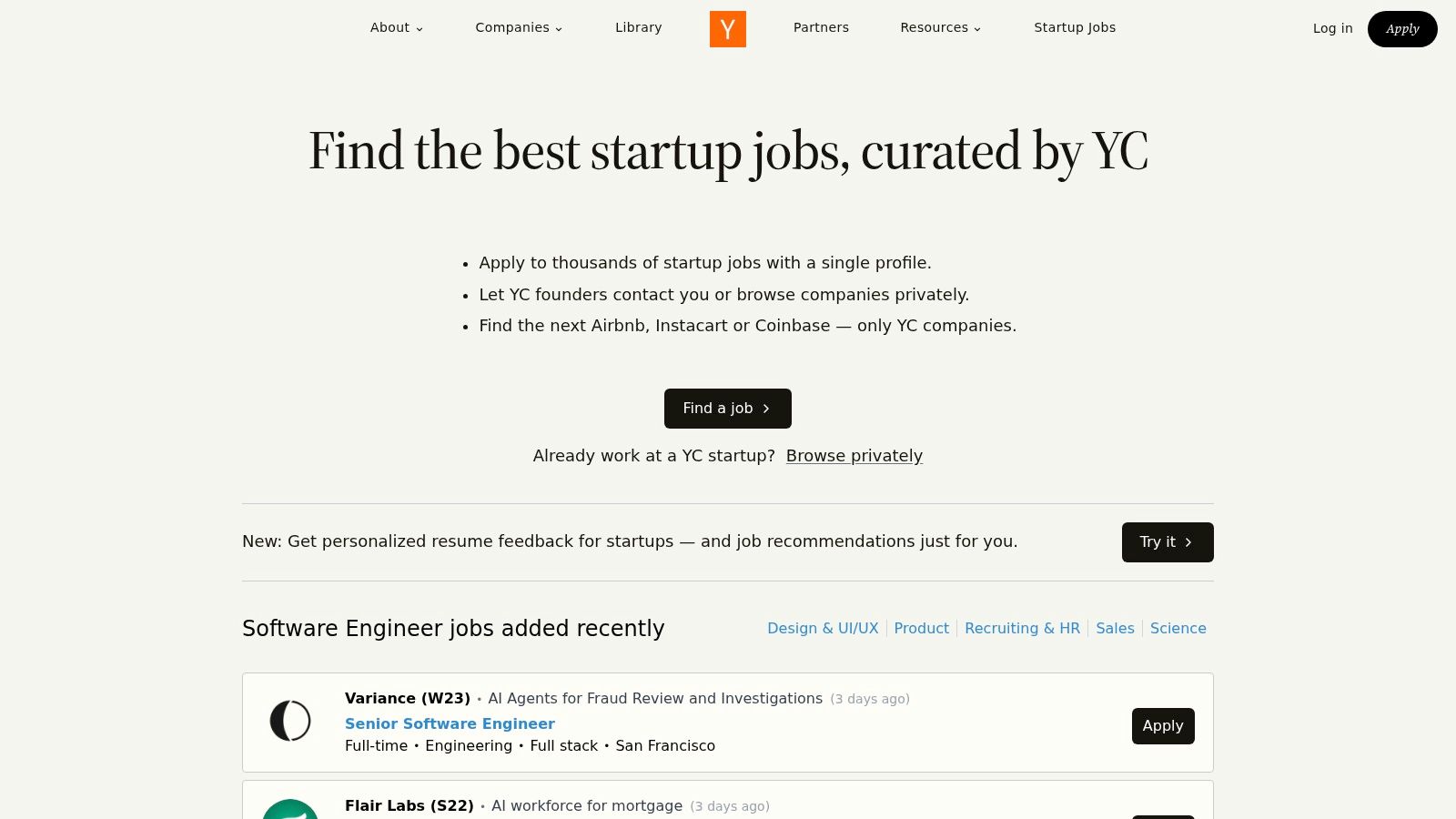
Java openings here fluctuate with the current batch's needs. Some cohorts are heavy on AI infrastructure in Python; others include B2B companies building on Spring because their buyers are banks. You won't find a steady stream of Java roles, so treat this as a targeted channel rather than your primary one.
Hiring appetite across the Java ecosystem has tightened, which is useful context when a startup goes quiet after a strong first call. A 2025 survey of 731 Java developers, leads, and executives reported by InfoWorld found 51% of organizations planned to add Java developers during 2025, down from 60% in 2024, with 32% uncertain.
What to verify before applying:
Built In earns its place because it separates Java from full stack as two different filters, and you need both. The Java engineering jobs page on Built In surfaces Java roles at technology companies across US markets, with local pages for individual cities and filters for remote and full stack titles.
Two results, same search, different jobs. One reads "Senior Java Engineer, Payments Platform" with Kafka, Kubernetes, and no mention of a browser. The other reads "Full Stack Java Engineer" with Spring Boot, React, and AWS. Only the second matches your skill set, and the first will still show up in your results.
Built In alongside a typical Java search:
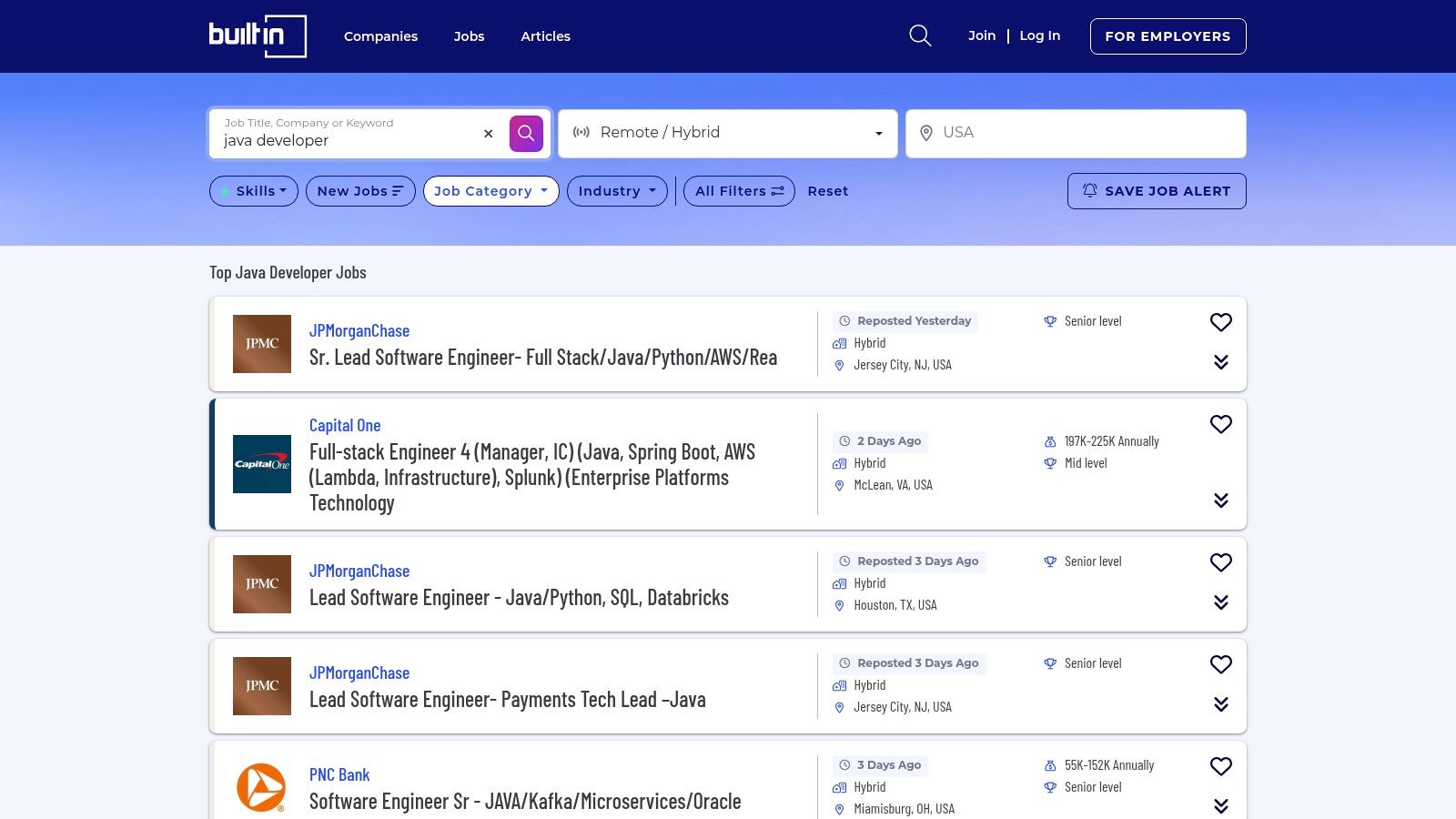
That skew toward backend is structural, not a quirk of one site. An analysis of 35,466 employer-hosted postings requiring Java published by Alion found 46.4% were backend roles, and Java was paired with Python in 47% of those postings.
Built In puts employer context next to vacancies, which is its real edge over aggregators. Use it. Check the engineering team size, the product, and whether the company's other open roles suggest a platform team or a product team. A company hiring three backend engineers and one full stack engineer is telling you where you'd sit.
Coverage and freshness vary by region and employer, so confirm the details on the employer's own application page before you invest in a cover letter. If the posting has been live for months and the company page shows no recent activity, deprioritize it.
Dice is where contract Java work lives, and that changes what you verify. The Java full stack developer search on Dice returns full-time, contract, hybrid, and remote listings, some with pay ranges or hourly rates attached. Results come from direct employers and from staffing firms, and the difference isn't always obvious in the title.
A Java full stack search in the wild:
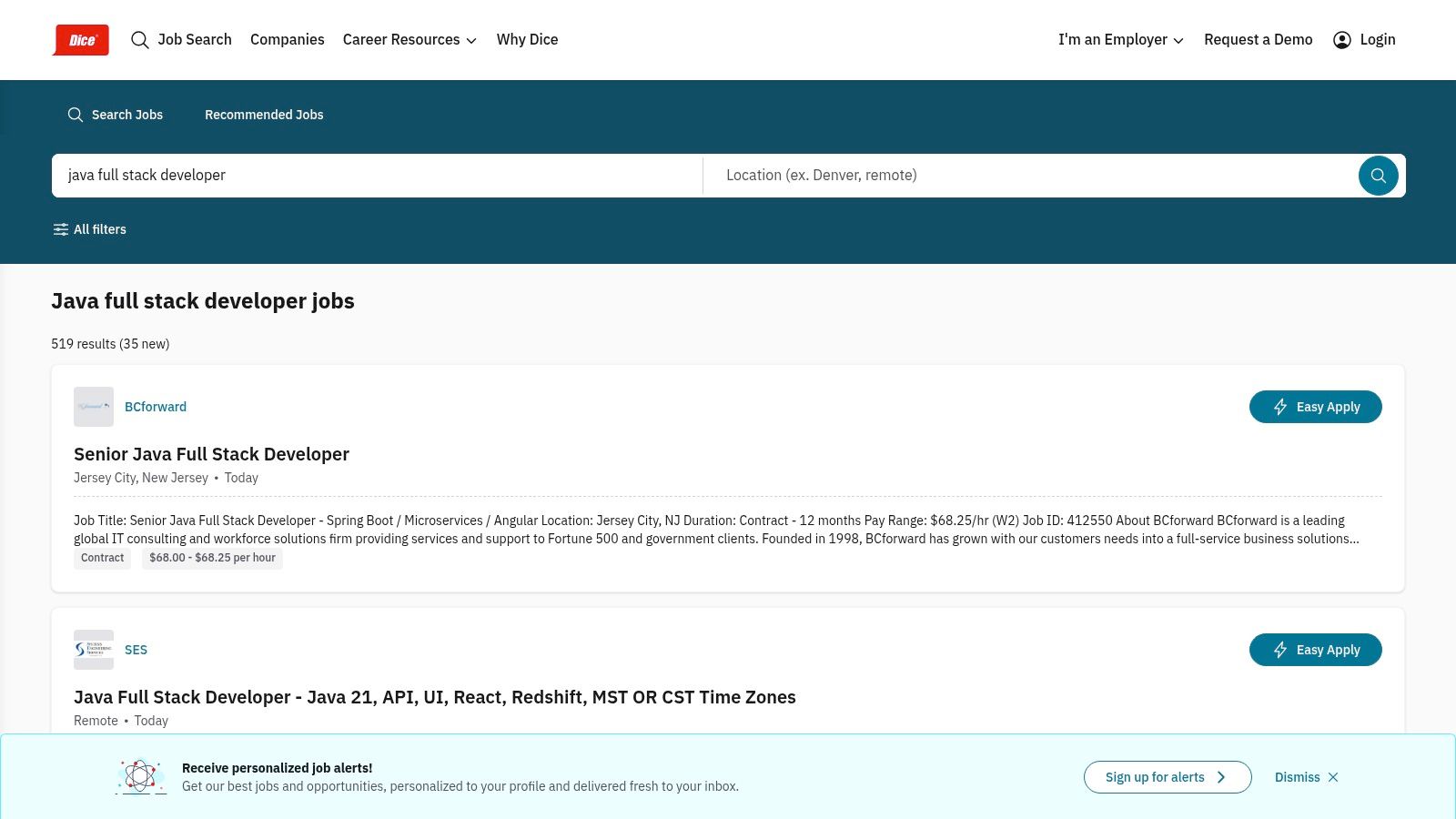
When a posting comes through a staffing firm such as nexusITgroup.com, you're talking to an intermediary with a client you may not be allowed to name until later. That's workable, but ask about the end client's industry, the contract length, whether it converts, and whether the rate is W2 or corp-to-corp before you share your résumé.
For a benchmark, ResumeVera's compilation of Bureau of Labor Statistics data reports a median annual wage of $135,980 for US Java developers in May 2025. Our own breakdown of Java developer salary is a useful cross-check when a recruiter's number looks low. Expect duplicates and loosely matching titles here, and set alerts rather than re-running the same search daily.
LinkedIn's value isn't the listing. It's the two clicks from the listing to the person who posted it. The Java full stack developer search on LinkedIn Jobs gives you filters for US location, remote status, seniority, and employment type, plus alerts and company pages. Some roles accept applications without leaving the site.
The screening problem is volume and staleness. Reposts, roles filled weeks ago, and "full stack" listings that mean Salesforce configuration all show up. Sort by date posted and ignore anything older than a couple of weeks unless you have a referral inside.
What the stack lines tell you: one dataset of 919 Java postings tracked by Jobs Every Hour reported Spring in 50% of listings, AWS in 42%, and CI/CD in 42%, so a posting that names none of those is either unusually specific or unusually vague.
A LinkedIn message to the engineering manager who posted the role beats a cold application almost every time, and it costs you five minutes.
Use the company page to find someone on the target team, then ask one concrete question about the stack rather than requesting a referral outright. If you're filtering for distributed teams, our notes on remote full stack developer roles cover what to confirm about overlap hours and on-call expectations. The downside is competition: popular listings attract heavy applicant volume, so treat LinkedIn as a research and outreach channel first and an application channel second.
Indeed covers more ground than any other source on this list, and it demands the most filtering. The Java full stack search on Indeed pulls employer and staffing postings across insurance, healthcare, logistics, and government contractors that never show up on startup boards. Keyword and location searches are free, so set an alert and let the roles come to you.
Indeed's aggregate view of Java full stack openings:
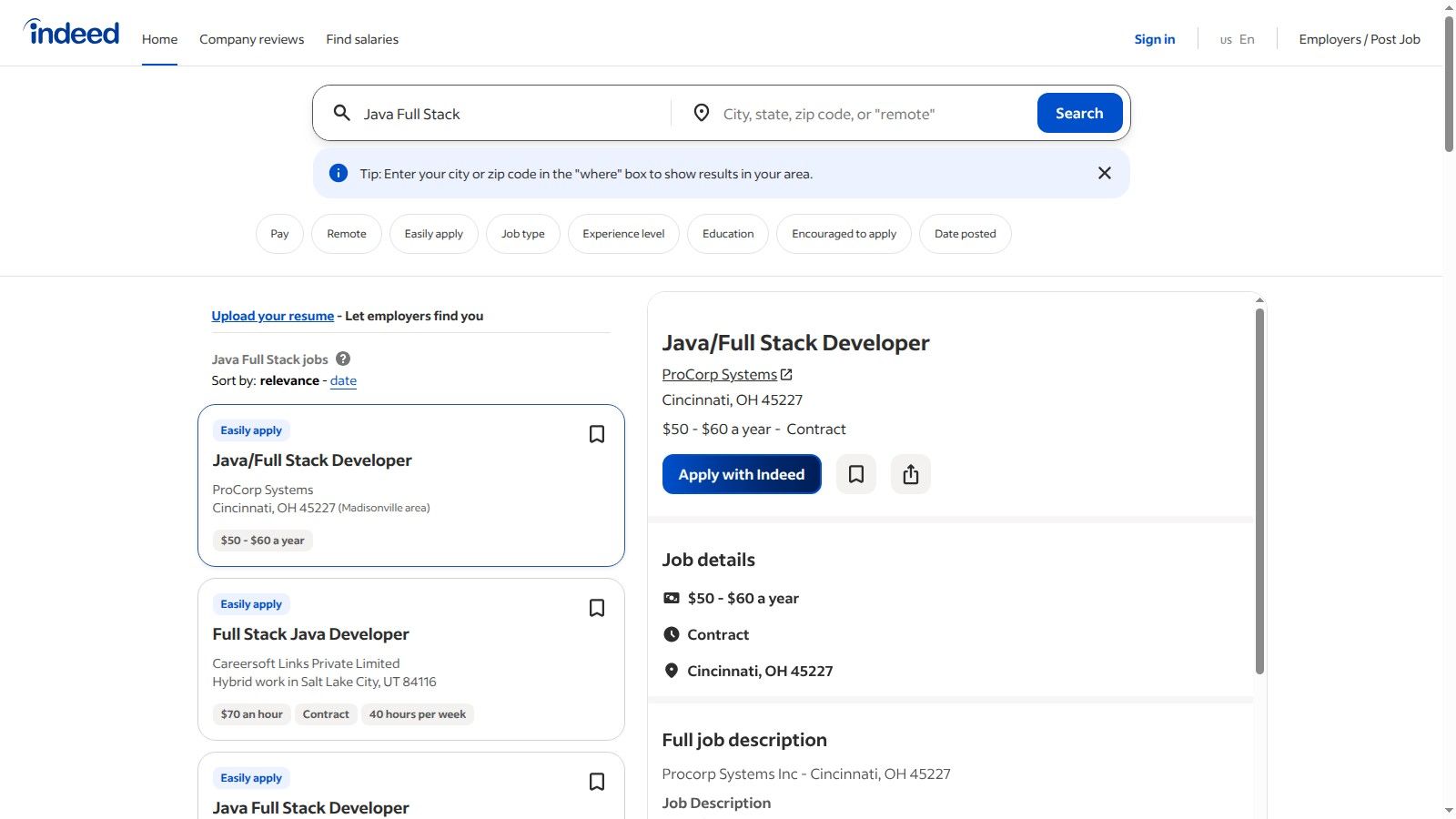
Older Java stacks concentrate on Indeed, which makes version verification a real screening step rather than trivia. Oracle's Java SE support roadmap lists Java 8, 11, 17, 21, and 25 as Long-Term-Support releases, with extended support for Java 17 running through September 2029 and Java 21 through September 2031.
A posting that says "Java 8" with no migration plan deserves one question before anything else: what is the upgrade path? The answer tells you whether the team has a roadmap or whether you would be maintaining a frozen codebase, and both answers are useful.
Screening habits that save time here:
Employer reviews are available for many companies, and application flows vary widely. Expect some postings to route you to a separate careers portal, so verify who owns the role before you spend twenty minutes on a form.
| Item | Cost for Candidates | Java-Specific Search | Best For |
|---|---|---|---|
| Underdog.io | Free for candidates | No dedicated Java search stated | Candidates seeking curated startup opportunities |
| Wellfound | Free job searching | Search full-stack roles; check listings for Java | Startup roles with salary and equity details |
| Y Combinator Work at a Startup | Free profiles and job browsing | Java openings vary by company | Opportunities at YC-backed startups |
| Built In | No candidate fee stated | Dedicated Java search with full-stack filters | Tech-company roles with company information |
| Dice | No candidate fee stated | Search tailored to Java full-stack roles | Technical roles, including contract opportunities |
| LinkedIn Jobs | No candidate fee stated | Search by Java full-stack keywords | Broad job search, networking, and company research |
| Indeed | Free keyword and location searches | Search for Java full-stack openings | Broad coverage across industries and regions |
Pick two or three channels, not seven. If you want a startup where you own features end to end, a curated marketplace plus one startup board covers most of the relevant inventory. If you're open to contract work or enterprise scale, add Dice or Indeed and accept the extra screening time. Spreading yourself across every board produces more applications and fewer conversations.
Verify two things in every listing before you apply. First, that Java is the backend you'd write, not a system you'd integrate with once a quarter. Second, that the frontend is in your scope, with a named framework. If either is unclear, ask before the technical screen rather than after two rounds of interviews.
Then track outcomes by channel. A simple spreadsheet with source, date applied, response, and stage reached will tell you within a month where your effort converts. Most developers discover one channel produces interviews and the rest produce silence, and they keep applying to the silent ones out of habit.
The broader market supports persistence. The Bureau of Labor Statistics projections reported in its analysis of occupations typically requiring a bachelor's degree estimate an average of 115,200 annual openings for software developers from 2024 through 2034, with a 2024 median annual wage of $133,080. Those figures span every stack, so they describe the market you're competing in rather than Java-specific vacancies.
One application on Underdog.io can put you in front of hundreds of vetted companies, which changes the math on how much time you spend per application. Be realistic about fit, though. Candidates who have the most success with us are looking for full-time positions, haven't recently graduated from a coding bootcamp, and don't require visa sponsorship. Many of our companies do hire contract, remote, bootcamp, and visa candidates, so that's a tendency rather than a wall.
Spend your preparation on evidence, not keywords. A deployed Spring Boot service with a React frontend, automated tests, a CI pipeline, and one honest write-up of something that broke in production will outperform a longer tool list in every channel here.
If you'd rather have startup hiring managers come to you than send another résumé into a queue, submit one 60-second application at Underdog.io and let vetted companies in New York City, San Francisco, and remote roles across the US reach out. Your profile stays confidential until interest is mutual, your current employer is blocked, and it's free for candidates. Bring your Spring Boot and React work, name the stack you want to build in, and see which full stack Java roles come back to you.