You send a strong résumé into a startup's application form and hear nothing. At the same time, a founder with a real engineering opening is sorting through applicants who don't match the role. Both sides are busy, but neither is getting a useful conversation.
A startup matching platform should fix that mismatch through curation, not by sending more applications. The useful question isn't how many profiles a service can circulate. It's whether it can assess both the candidate and the company, then make a relevant introduction with enough information for each side to decide.
A startup matching platform is a curated, two-sided hiring marketplace. It screens candidates and companies before introducing them, then focuses on fit rather than maximizing the number of applications or résumés exchanged.
That distinction matters because early-stage hiring carries real uncertainty. Firms two years old or younger accounted for only 2.4% of employer-business employees in 2021, while establishments less than one year old generated 90% of U.S. employment growth in 2019. Those figures show why a startup-focused marketplace needs to assess employers, not just build a large candidate pool. (Congressional Research Service data on startup formation and employment)
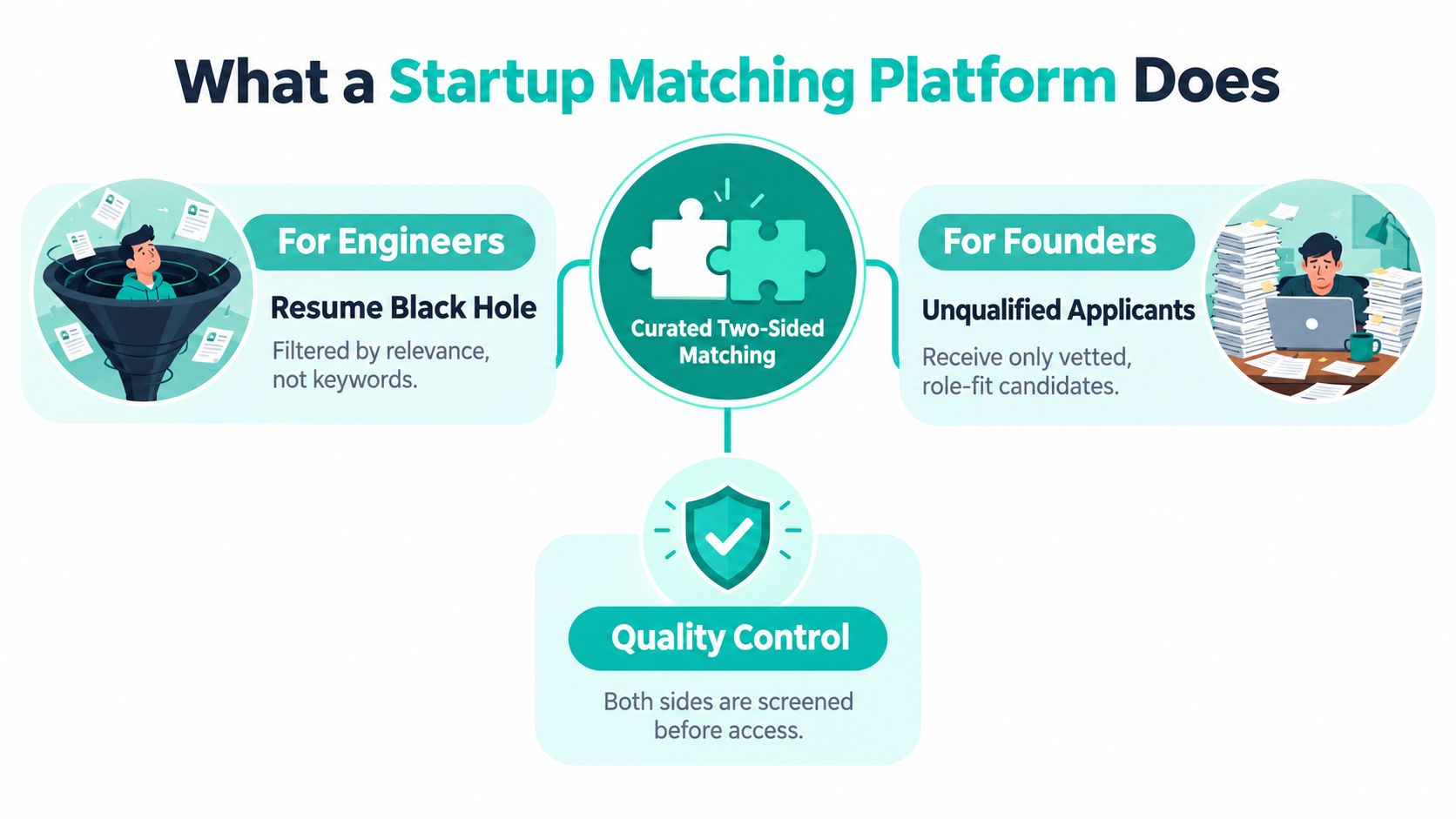
First, the platform vets both sides. Candidate review can consider relevant work, role scope, and preferences. Company review should look beyond a polished job description to questions such as whether the role is funded, what the team needs, and whether the company can explain why it's hiring.
Second, it favors selective, high-intent introductions over volume. A founder should see people who plausibly fit the role, not an inbox full of loosely related résumés. A candidate should be able to assess a specific opportunity rather than repeatedly submitting the same profile into a void.
Third, it can preserve candidate anonymity until there's mutual interest. That makes it easier for someone who's employed to explore without broadcasting their search to their current workplace or professional network.
Job boards help people find openings, and recruiters help companies search for candidates. A curated marketplace is different: it screens both parties and coordinates introductions around a particular fit. In one sentence, that's a startup matching platform: a hiring marketplace that qualifies the candidate and the startup before connecting them.
Choosing between a job board, a recruiter, and a curated marketplace isn't a matter of which label sounds modern. It comes down to what you need: reach, discretion, speed, or selectivity.
| Dimension | Job boards | Contingency recruiters | Startup matching platform |
|---|---|---|---|
| Curation depth | Low. Candidates search and apply | Recruiter screens for a specific client search | Candidate and company are assessed for fit |
| Who pays | Usually the employer pays to post or promote roles | Employer pays on a successful hire | Typically company-funded, check each platform's model |
| Intro volume per candidate | Candidate controls application volume | Varies by recruiter and search | Intentionally selective |
| Anonymity | Usually limited once you apply | Depends on recruiter and process | May keep profiles anonymous until mutual interest |
| Incentive alignment | Optimized around listing visibility and applications | Tied to the employer's hire and fee agreement | Depends on how the platform earns revenue and measures outcomes |
A broad job board gives you reach. Indeed, LinkedIn, and Wellfound can surface a wide range of openings, but the candidate has to sort through them and the founder still has to screen the inbound pile. That's a reasonable trade when breadth matters more than personal curation.
A contingency recruiter can take on sourcing and initial screening for a particular search. The commercial terms deserve close attention: contingency recruitment commonly charges 15%–25% of a hire's first-year salary, with 20% as a common midpoint. On a $150,000 hire, that would mean a $30,000 employer-paid fee at the midpoint, payable on placement. (Overview of contingency recruitment fees) Ask what counts as a placement, what the guarantee covers, and whether the fee calculation includes anything beyond base salary.
Choose the channel that solves your bottleneck. If you need maximum reach, start with job boards. If a specific role needs active sourcing, consider a recruiter. If you want fewer, more relevant introductions, assess a curated marketplace.
Founders planning to grow with external specialists may also benefit from this guide for entrepreneurs scaling with outsourcing from Kushan Business Solutions LLC. It's a useful reminder that hiring isn't the only way to add capability, especially when the work doesn't require a permanent employee.
A serious platform shouldn't treat a submitted résumé as an automatic introduction. The work between application and conversation is where useful matching happens: reviewers identify role requirements, screen for eligibility, compare evidence against consistent criteria, and check whether both sides want to proceed.
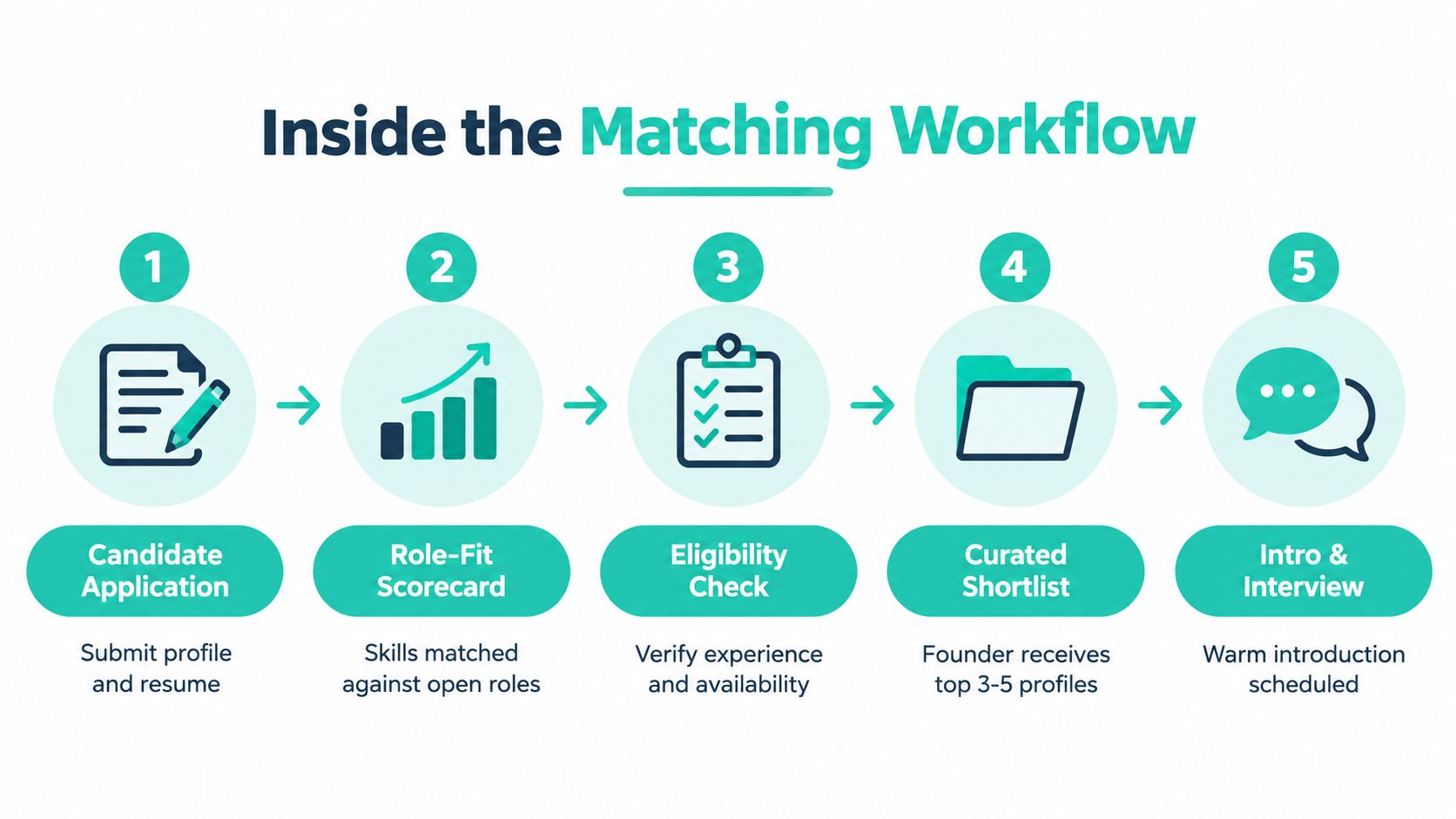
For candidates, a role-fit scorecard can capture relevant technical scope, product or business impact, adaptability, communication, and ownership. For companies, reviewers should assess the actual work, team context, manager expectations, and constraints that affect whether a candidate can succeed.
The platform should separate eligibility from preference. Eligibility means the candidate meets essential requirements, such as the role's location or core experience needs. Preference helps sort otherwise eligible candidates by factors such as industry interest, working style, or appetite for ambiguity. Mixing the two can hide strong candidates behind arbitrary rankings.
A structured approach also makes reviewers more consistent. The cited interview guidance reports predictive-validity coefficients of approximately 0.51 for structured interviews and 0.38 for unstructured interviews, where the coefficient describes correlation with subsequent job performance. (Guide to structured interviews) The practical lesson is straightforward: reviewers should use shared criteria and record evidence, rather than relying on an unstructured impression.
Raw application volume is a weak measure of marketplace quality. A more useful metric is qualified-introduction precision: whether introductions lead to relevant interviews, offers, and hires. Platforms can also calibrate reviewers by comparing how they score the same evidence, then adjust criteria using outcomes such as post-hire performance and retention.
Limiting introductions can be a strength. Research on referrals found that referred workers were 10%–30% less likely to quit and performed better on some rare, high-impact measures; the authors attributed the advantage primarily to better job fit through selection. A randomized field experiment summarized by the University of Toronto's Rotman School found referral-program stores had about 15% lower turnover and up to 3% lower labor costs over 13 months. (Study on the value of hiring through referrals) Those findings don't mean every referral is good. They support the value of job-specific information and selection, not indiscriminate reliance on personal networks.
Platforms should track outcomes by relevant candidate groups and check for adverse impact before using referrals or network proximity in ranking. A curated process earns trust when it can explain what it screens for and whether those choices produce better matches.
Don't judge a platform by its landing page or a vague claim that its companies are “high quality.” Ask what it verifies, what it shares with candidates, and how it handles information you don't want your current employer to see.
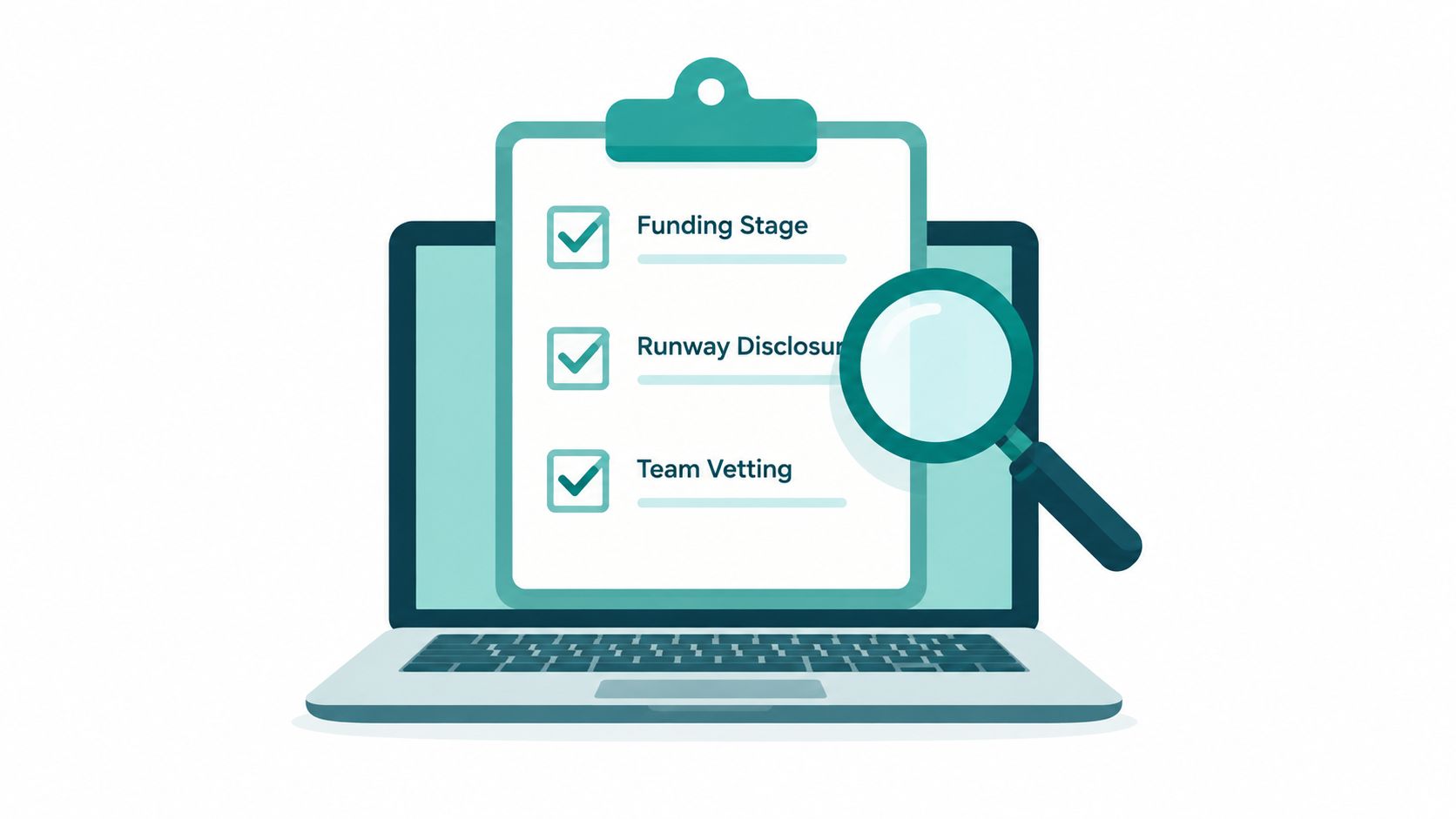
A mission statement won't tell you whether a role is funded or how the company expects the hire to contribute. Ask whether the platform shares the company's funding stage, hiring rationale, team structure, manager context, and what success in the role looks like. Funding stage can help you anticipate the kind of work involved: an early company may need someone to build an initial product, while a more established startup may need someone to expand a functioning system. It's a useful filter, not a guarantee of job quality.
Team size is another reality check. U.S. startups raising seed funding during the first half of 2024 averaged 5.3 employees, down from 6.9 three years earlier. Series A companies averaged 15.6 employees, down from 17.6. (Axios reporting on startup hiring and team size) At a small company, an engineer may own infrastructure and customer-facing debugging along with their main specialty. Ask who handles adjacent work and what the role's first deliverables are.
A headline equity figure isn't enough to compare offers. Ask what kind of award you'd receive, how vesting and exercise work, what valuation date the company uses, how dilution affects your ownership, and what you might owe before a liquidity event. A 2025 academic study found that employees frequently misinterpret equity signals, while a separate 2025 survey reported that 19% of respondents received no equity education, 66% said their company offered no educational resources, and fewer than 40% negotiated their equity package when hired. (Academic research on employee understanding of equity)
Use a quick onboarding checklist:
Keep your professional presentation current, too. If you're preparing a profile photo and want to understand the options, this LinkedIn headshot generator guide from AiHeadshots offers practical context. For a broader look at sourcing methods and how they differ, review this guide to candidate sourcing tools for startups.
The case for a curated marketplace isn't that human reviewers never miss. It's that they can assess context that a keyword search cannot, and that selective introductions give both sides more reason to pay attention.
Underdog.io focuses on early-stage through Series B technology companies and candidates across engineering, product, design, data, and related roles. It manually reviews candidate profiles and screens companies for funding status, team quality, and product viability. Its candidate acceptance rate is approximately 5%, and candidate profiles remain anonymous until there's mutual interest. (How Underdog.io works)
Those choices address familiar hiring frustrations. A broad job board can expose a candidate to many openings but leaves much of the screening to them. A recruiter can run a targeted search, but the recruiter's client is the employer. A curated marketplace instead needs to make the candidate's experience useful enough that they'll participate, while giving employers a credible shortlist rather than an unfiltered stream.
Introductions are typically limited to 1–3 per month, which makes the service a poor fit for someone who wants to apply to every plausible opening. It may suit a candidate who prefers a smaller number of relevant conversations and needs discretion while employed. The platform is free for candidates, with companies paying on a success basis, so candidates don't pay to explore through the marketplace.
That setup still leaves questions worth asking. A company's funding status doesn't guarantee durable employment, and an anonymous introduction can't replace a direct conversation about runway, equity, role scope, or management. OECD cross-country evidence found that firms five years old or younger represented approximately 21% of total employment but accounted for 47% of job creation. (OECD evidence on startup dynamics) That concentration makes screening the growth-capable minority a sensible design choice, but candidates should still investigate each opportunity.
A marketplace is more than a job board with a “curated” filter when it evaluates employers as well as candidates, protects candidate confidentiality, and measures what happens after an introduction. Decide whether those mechanics match your search before signing up.
A mid-level product designer is employed and curious about early-stage work, but doesn't want a public job-search signal. A curated platform can let the designer explore anonymous opportunities, then reveal their identity only when both sides want to talk. Before agreeing to an introduction, the designer should ask about the company's stage, why it's hiring, who sets product priorities, and what the equity offer means.
A Series A founder needs a data engineer but doesn't want to spend weeks sorting through applicants who don't match the role. The founder should start by naming the work the hire owns, the systems they'll work on, the team they'll join, and what success looks like. A small startup team can't afford a job description that lists every technology the company has ever touched. Early-stage opportunities merit distinct filters: the 2024 State of European Tech report found pre-seed employment grew from 36,000 to 111,000 between 2015 and 2024, while seed-stage employment grew from 78,000 to more than 250,000. (State of European Tech talent findings)
For candidates:
For founders:
A matching platform isn't the right tool for every search. If you're only exploring the market, hiring for a highly specialized senior role, or filling a position in a regulated industry, direct networking or a targeted contingent search may make more sense. For employers weighing that route, nexusITgroup.com is a staffing-firm alternative to assess; put the fee basis, candidate ownership, payment trigger, and replacement terms in writing. Candidates can also use this guide to getting recruited by startups to prepare for employer conversations.
Underdog.io gives tech candidates a single application for consideration by vetted startups, with anonymous profiles and selective introductions. If you're exploring startup roles or hiring for one, visit Underdog.io and decide whether its curated approach fits your search.