About 5% of applicants pass the manual review described in Underdog's startup hiring materials. That's a more useful starting point for an Underdog vs Pin.com comparison than database size: are you buying access to a selectively admitted talent pool, or software that helps your recruiters search and contact a broader market?
For selective startup hiring, Underdog is the clearer choice. Its fact-based matching addresses candidate relevance before outreach begins. Pin serves a different operational need: helping an active recruiting team discover people and execute outbound workflows. The right comparison measures qualified conversations, candidate exposure, and recruiter effort, not features checked off a list.
The U.S. Bureau of Labor Statistics projects software developer employment to grow 15.8% from 2024 through 2034, adding approximately 267,700 jobs. Meanwhile, Robert Half reported that 76% of surveyed U.S. technology leaders identified a departmental skills gap in its 2025 findings, based on a survey conducted in October and November 2024.
Those pressures explain why a recruiting lead might consider both products. But they don't make the products interchangeable.
Underdog provides a curated candidate network; Pin provides employer-side sourcing and recruiting automation. Say a startup needs a senior backend engineer who wants an early-stage environment. The immediate problem might be finding interested, relevant candidates, not generating another search result.
Contrast that with an established sourcing team recruiting across a broad technical portfolio. Those recruiters may already know how to evaluate profiles and personalize campaigns. Their constraint might be the time required to research contacts, manage replies, and schedule interviews.
Choose the hiring model before comparing the software bill.
For the first team, selective introductions are the stronger starting point. For the second, outbound automation can be useful infrastructure. Cost, confidentiality, and workflow fit should follow that distinction.
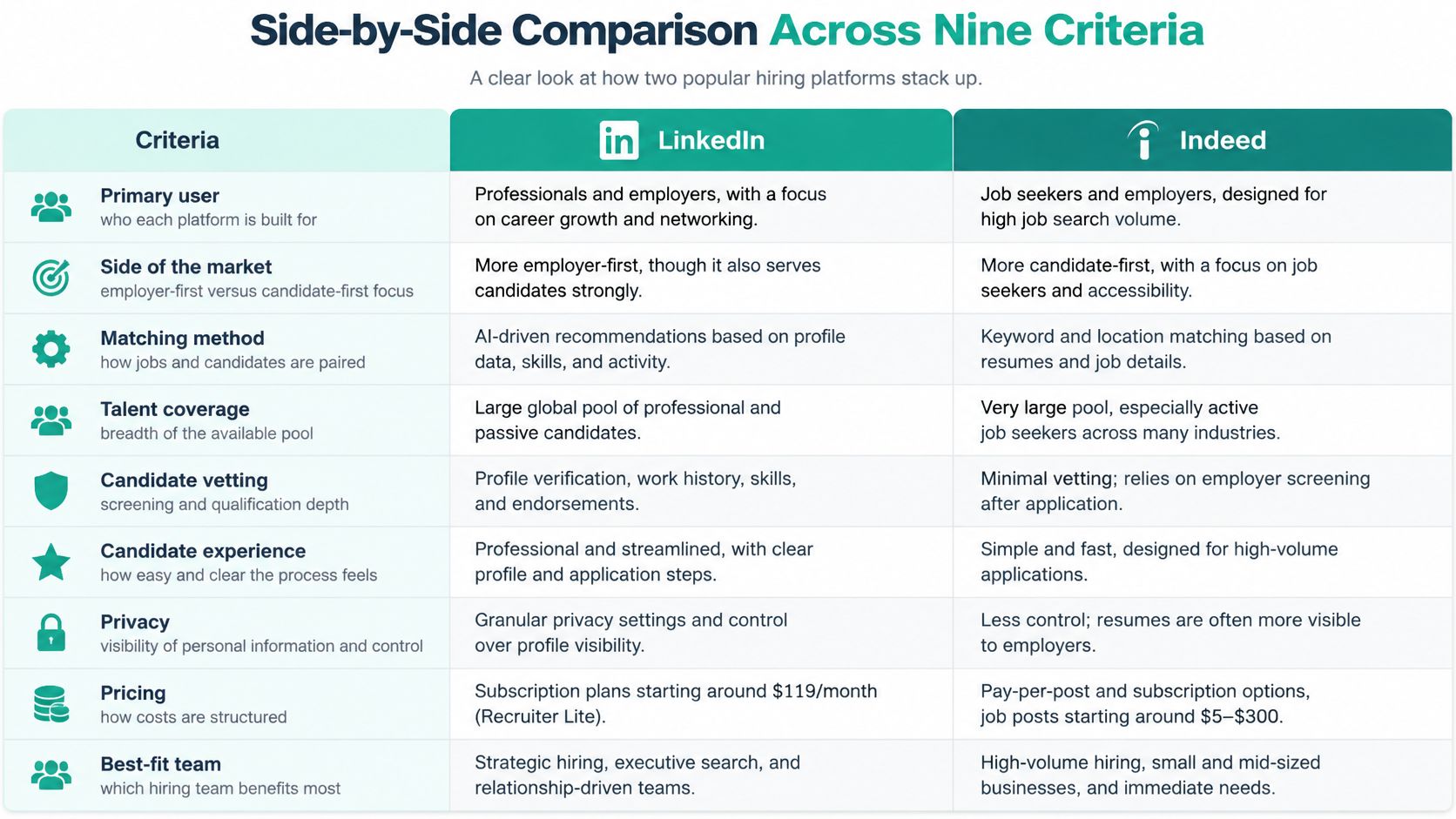
| Criterion | Underdog | Pin.com |
|---|---|---|
| Primary user | Candidates seeking startup roles and companies hiring from a curated pool | Recruiters and hiring teams running outbound sourcing |
| Side of the market | Candidate-side, closed, invite-only network | Employer-side AI sourcing and workflow |
| Matching method | Human-reviewed matching on role requirements, product, stage, and team structure | AI search, match explanations, and generated outreach |
| Talent coverage | US-based product designers at NYC and San Francisco Bay Area startups, seed through Series C | More than 850 million candidate profiles |
| Candidate vetting | Top 5% of applicants accepted, with portfolio and craft verified; over half of applying companies turned away | No admission gate described; recruiters evaluate returned profiles |
| Candidate experience | Always free for designers; hidden from current and past employers; startups reach out directly | Recruiter-initiated contact; candidate-facing controls require confirmation |
| Privacy | Current and past employers blocked | Contact lookup and connected-inbox outreach; employer blocking not described |
| Pricing | Employer pay-per-hire or subscription; candidates pay nothing | Obtain current plans, usage limits, and commercial terms |
| Best-fit team | Selective, confidential hiring of product designers for startups | Sustained outbound run by an active recruiting team |
Pin's platform description states that it searches more than 850 million candidate profiles and integrates with more than 120 applicant-tracking systems. It also describes match explanations, outreach sequences sent from the recruiter's inbox, reply handling, and interview scheduling.
Nine rows invite a scorecard. Resist it. A searchable profile rarely equals an interested applicant, and an integration count says nothing about whether a candidate clears the hiring manager's bar.
Read the Underdog column as a candidate-exposure question: how selectively are people admitted, and how many qualified, interested designers will see the role? Read the Pin column as a capacity question: how much outreach can your recruiters generate, verify, and convert?
For a curated network, measure qualified introductions, candidate acceptance, and interview conversion. For an outbound platform, measure coverage, recruiter effort, deliverability, and progression from contact to interview. Both ultimately need to produce hires who perform and stay.
Check role categories and locations before shortlisting a curated marketplace. A concentrated pool is acceptable when it matches the requisition and a constraint when it doesn't.
If your reporting system can't preserve source attribution through interviews and offers, KeenVerdict's resource to find tools for tracking applicants can help frame an ATS shortlist. Select the reporting workflow before launching the comparison, not after recruiters have built incompatible spreadsheets.
Underdog's matching is done by real people who assess fit against concrete role requirements, company stage, and team needs. Keyword overlap alone is weak evidence.
Pin uses AI search and profile-level match explanations, then supports outreach execution. Its usefulness depends on whether the recruiter can verify the explanation against the candidate's actual experience.
Consider a backend requisition requiring production ownership of distributed systems. A profile mentioning infrastructure is not enough. The reviewer needs evidence of what the candidate built, operated, and owned, plus whether the working environment fits their next move.
Underdog's admission model narrows the pool before matching starts. It is a closed, invite-only network where startups reach out directly to vetted designers. Candidate admission is selective, with portfolio and craft verified. Company admission is controlled too: Underdog reviews Company Content and publicly available information during registration, may accept or reject a company's registration at its sole discretion, and turns away more than 50% of companies.
The how-it-works overview shows why that matters: matching is bilateral. A designer can meet the technical requirements and still reject an employer whose product, stage, or expectations do not fit.
A selective admission process is a quality-control mechanism, not a substitute for your hiring rubric.
For your test, separate missing evidence from negative evidence. An incomplete profile might require clarification; documented experience below the role's bar warrants rejection. Combining those categories makes both the vendor's matching and your own evaluation harder to diagnose. Run the same requisition through both models, then compare how often each one produces a profile your hiring manager would interview.
| Channel or platform | Reported rate | Basis |
|---|---|---|
| Automated recruiting email | 4.96% | Pin benchmark, message replies |
| Recruiter one-off email | 6.31% | Pin benchmark, message replies |
| LinkedIn message | 17.08% | Pin benchmark, message replies |
| Underdog candidate response | Target of 65% or more | Platform-stated goal |
Pin's recruiting outreach benchmark reports average reply rates of 4.96% for automated recruiting email, 6.31% for recruiter-written one-off email, and 17.08% for LinkedIn messages, drawing on more than 4,000,000 messages from over 1,500 recruiting organizations. Our comparable figure works differently: the candidate-response target of 65% or more is a stated goal for engagement inside the network, so it belongs in your model as a hypothesis to verify in a pilot.
These aren't equivalent denominators. Pin's benchmark counts replies to recruiting messages across participating organizations. Our target concerns responses inside a curated pool of admitted candidates, so even if both figures were measured identically, the populations would still differ.
The practical advantage for selective hiring is access to people positioned to engage instead of people whose contact details are merely available. Applying to join our network is free for candidates, and admission remains selective, which concentrates the pool before outreach begins.
A response is not necessarily interest.
A decline, an opt-out, a request for compensation details, and an agreement to interview can all register as engagement unless your reporting distinguishes them. Use separate statuses for delivered outreach, human reply, positive reply, scheduled screen, and completed qualified screen. Keep automated replies and delivery failures outside the human-response count.
The decision metric should be qualified screened interviews per contacted candidate, accompanied by recruiter hours. That lets you distinguish an efficient channel from one that generates friendly replies without relevant interviews.
More messages can generate more conversations, but volume alone doesn't guarantee that outcome. Likewise, the benchmark's higher one-off email reply rate doesn't establish that manual writing caused the difference; role mix and recipient selection could also matter.
A curated-pool response target above 65% and a cold-outreach reply rate below 7% describe different machines solving different hiring problems. Run the same requisition through both, score interviews per contacted candidate and recruiter hours on each side, and let that comparison, rather than either published number, set your forecast.
Underdog's confidential-search description states that profiles are hidden from current and past employers. Profiles also stay anonymous until interest is mutual, so an employed designer can review inbound interest before becoming identifiable to a company.
Underdog.io's network is closed and invite-only, and startups reach out directly to vetted designers. It sends designers no spam.
Underdog's startup recruiting overview describes one to three personalized introductions per month and states that approximately 85% of candidates are employed. Those limits make privacy part of the matching model: exposure is paced through selective introductions and governed by mutual interest.
Pin's publicly described workflow centers on discoverable professional information, contact lookup, recruiting CRM functions, and outreach through a connected Gmail or Outlook account. Those capabilities support proactive sourcing. The public description does not specify whether a candidate can suppress a current employer, control pre-match visibility, or withdraw consent after contact data is imported.
Ask any provider:
A tool can meet one requirement and fail another. Opt-in outreach can coexist with weak suppression after a list import, while employer blocking can leave retention and deletion practices unresolved. Ask for a demonstration that covers a recruiter changing teams, an imported existing contact, an opt-out, and a deletion request.
For candidates, our guide to searching without your employer knowing addresses the practical side of discreet exploration.
For hiring teams, privacy changes what response data means. A searchable work history shows that a recruiter can find someone; it does not show that the person is looking, available, or comfortable having their information circulated. When the target slate is employed designers exploring cautiously, Underdog's anonymous profiles and employer blocking fit that exposure model more directly.
| Cost item | Underdog | Pin.com |
|---|---|---|
| Candidate fee | Free to candidates; designers pay nothing | Employer-side tool, not a candidate application service |
| Employer pricing model | Pay-per-hire or subscription | Current plans require a vendor quote or confirmation |
| Subscription terms | Unlimited seats and a full year of unlimited hires | Confirm seats, usage allowances, integrations, and renewal terms |
| Main cost driver to model | Platform charges and recruiter time per qualified slate | Platform charges, sourcing time, reply handling, and deliverability |
Our pricing information distinguishes employer-paid access from the free candidate experience. Companies can choose pay-per-hire pricing or a subscription; don't apply success-fee assumptions to the subscription model.
Pin's current price isn't established by its cited product descriptions. Without a confirmed quote and usage allowances, a numerical price comparison would be speculation.
Use this formula:
Cost per hire = (platform charges + recruiter hours × loaded hourly cost) ÷ hires who started
For a hypothetical example, a platform fee of $4,000 plus 60 recruiter hours at $60 per hour produces a total cost of $7,600. Across two starts, that's $3,800 per hire. These are illustrative inputs, not either vendor's prices or performance.
For broader budgeting context, HR cost research from Rankozo can provide a starting point for questions about labor-cost assumptions. Use your finance team's actual loaded recruiter cost in the final model.
A cheaper subscription can produce a more expensive hire if recruiters spend the savings screening unsuitable profiles.
Track sourcing, profile review, outreach preparation, reply management, and scheduling separately. Otherwise, automation may appear to save time while moving work into another stage.
Also record interview quality, delivery failures, consent handling, and hiring conversion. Don't force every item into an artificial dollar estimate, but don't omit operational costs because they're harder to price.
A higher platform charge can be justified if it reduces total work and produces more starts from the same requisitions. Until hires start, report cost per qualified screen and accumulated spending rather than presenting an unfinished funnel as a completed cost-per-hire result.
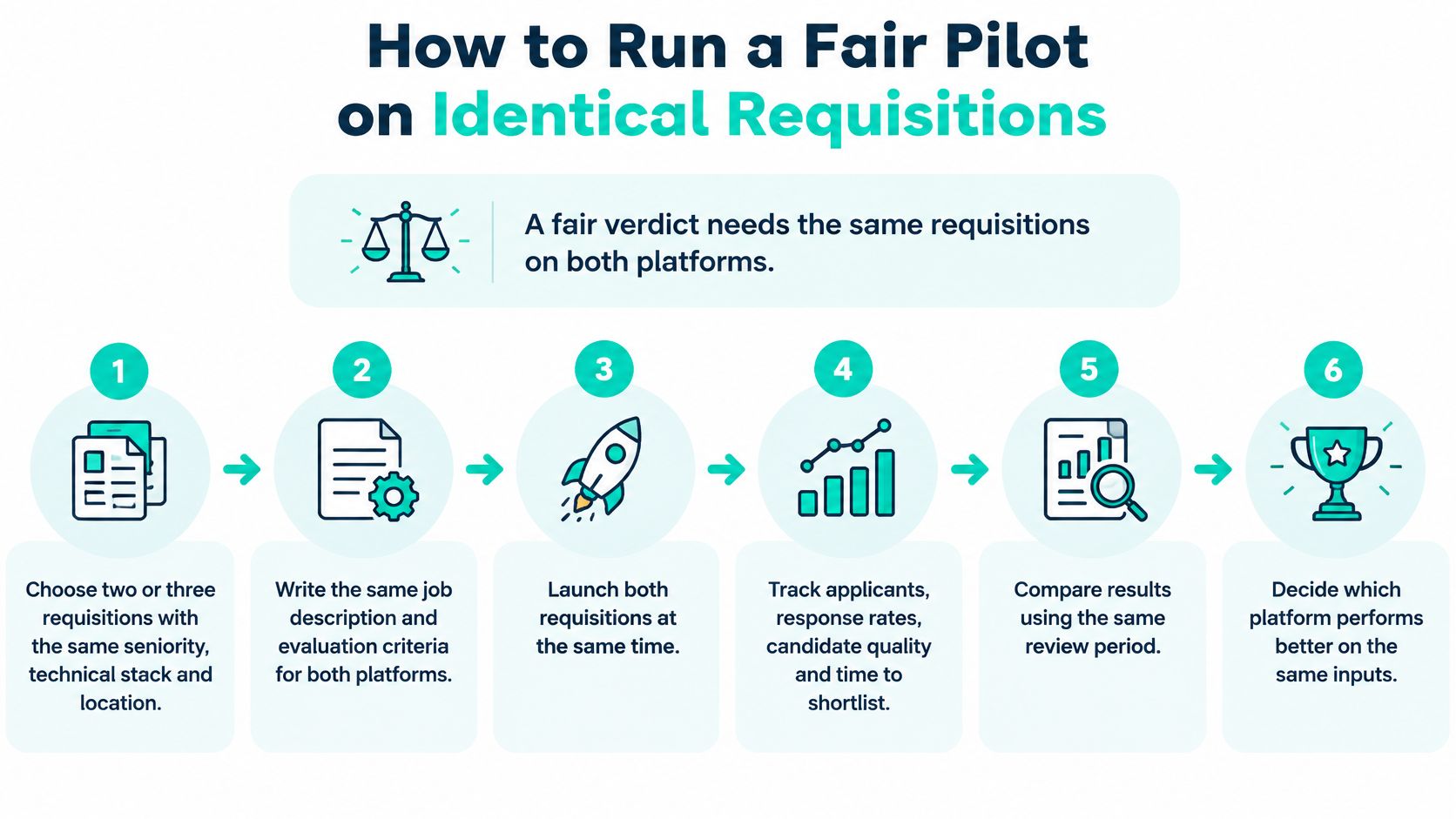
A fair verdict needs the same requisitions on both platforms. Keep compensation, location rules, interview availability, and evaluation standards consistent so that internal differences don't masquerade as vendor performance.
The pilot should preserve both the operational steps and the final hiring outcomes.
Pin's recruiting-team materials publish vendor-reported figures of 14-day average time-to-fill, 35% fewer interviews per hire, 12 recruiter hours saved per week, and 83% match acceptance; its engineering-focused claim is that 91% of users reduced or eliminated LinkedIn Recruiter spending.
Those claims aren't independently audited experimental results. Request cohort size, baseline values, confidence intervals, role mix, geography, and the precise meaning of match acceptance before using them in a business case.
Our manual review and selective admission specify an upstream quality-control process, but the cited materials don't establish a comparable public time-to-fill benchmark. Your pilot must generate that evidence.
Don't declare victory from a fast first interview alone. A platform that produces an early screen but no acceptable offer hasn't solved the requisition, and a retained hire is a different outcome from an accepted introduction.
Underdog is the stronger recommendation for selective, confidential startup product-design hiring. Its closed, invite-only network, manual review, and controlled candidate exposure address the central problem: finding relevant designers willing to explore the actual opportunity.
Pin solves a different problem. An in-house sourcing team that needs broad discovery and connected outbound execution gets more from its workflow capabilities, and its outreach benchmarks measure something different from curated-network responses.
| Hiring situation | Better fit | Reason |
|---|---|---|
| One or two urgent Founding Designer or Senior Product Designer searches | Underdog | Candidates have passed portfolio and craft review; confirm role availability before relying on timing |
| Confidential search for an employed product designer | Underdog | Profiles stay hidden from current and past employers, with introductions only on mutual interest |
| Employed product designer exploring startup roles | Underdog | Selective introductions limit distribution rather than maximizing exposure |
| Recurring product-design hiring across startup roles | Underdog | Repeatable curated access with pay-per-hire or subscription options |
| High-volume outbound with an in-house sourcing team | Pin.com | Broad discovery and recruiter-inbox sequencing support sustained outreach |
| Teams needing ATS-connected execution | Pin.com | Published integration coverage supports an existing recruiting workflow |
| Teams without sourcing capacity hiring startup design talent | Underdog | Human-curated matching removes the need to build outbound lists |
Underdog's network covers companies building AI-native products, developer tools, infrastructure, consumer and creator apps, fintech, and healthtech, from seed through Series C. It accepts the top 5% of designer applicants, turns away more than half of the companies that apply, and lists six hireable profiles from Founding Designer to UX / Research-Led Designer. Matching accounts for the client's product, stage, and team structure.
That specialization matters when the hiring manager needs a designer suited to the company's operating environment. It matters less when a recruiting organization primarily needs market mapping across unrelated functions.
The decision rule: choose curated access when relevance, willingness to engage, and confidentiality are the constraints. Choose outbound automation when your team already owns candidate evaluation and needs help executing a sustained sourcing program.
If both models fit, run identical requisitions through each and let qualified screens, starts, retention, and total effort determine the allocation. A large database is no substitute for candidate interest. A strong response claim is no substitute for demonstrated hiring quality.
Underdog.io is a closed, invite-only network where vetted startups reach out directly to product designers, free for candidates and priced for employers per hire or by subscription. Visit Underdog.io to explore the network and bring a concrete requisition, including product area, seniority, location, and company stage, to your evaluation.