Team-related issues contribute to 23% of startup failures according to this breakdown of startup organizational structure and failure patterns. That should change how founders think about org charts and how candidates read them.
Structure is often treated like admin work. Something you clean up after the next fundraise, after the next hire, after the product launch. In practice, structure decides who owns decisions, where work gets stuck, who gets context, and whether your best people spend their time building or untangling confusion.
A good startup organizational structure doesn't need to look corporate. It needs to make responsibility obvious. In a five-person company, that might mean everyone still touches product, support, and recruiting. In a fifty-person company, it means people know who can say yes, who breaks ties, and who owns a miss.
For candidates, this matters just as much. The same title can mean wildly different jobs depending on the shape of the company. A “Head of Product” in a flat team may be a player-coach who writes specs and runs customer calls. The same title in a more functional company may spend most of the week aligning engineering, design, and GTM leads. If you don't understand the structure, you don't understand the role.
Founders often delay structural decisions because early teams survive on hustle. That's normal. But the moment hiring starts, structure stops being optional. It becomes the operating system behind communication, accountability, and speed.
Organizational decisions carry significant weight, often underestimated. Team-related issues account for a meaningful share of startup failures, and the same source notes that founders with co-founders tend to have higher success rates because leadership is distributed rather than concentrated in one person. That's not a reason to copy someone else's org chart. It's a reason to design one that spreads judgment, ownership, and context in a way your team can effectively use.
An org chart isn't just a reporting diagram. It's a map of how decisions travel.
When founders say, “We want to stay lean,” what they usually mean is they don't want bureaucracy. Fair. But lean and unclear aren't the same thing. A startup can be lightweight and still define who owns hiring, roadmap tradeoffs, customer escalation, and budget approvals.
Practical rule: If two people think they own the same decision, nobody really owns it.
This gets even harder once teams go hybrid or remote. A messy structure in one room is frustrating. A messy structure across time zones becomes expensive. If you're managing a team across locations, this guide to addressing distributed team challenges is useful because it focuses on communication and accountability problems that org design often creates or exposes.
Founders sometimes talk about culture as if it's separate from reporting lines. It isn't. Your structure teaches people what behavior wins.
If every decision routes through the founder, the prevailing culture is dependence. If product managers, engineers, and recruiters all hear different priorities from different leaders, the resulting culture is confusion. If managers can't explain scope, growth, or tradeoffs, people invent their own rules.
That's why structural work often overlaps with cultural repair. When a team says it has a “culture problem,” there's a good chance it also has an ownership problem. If you're working through that kind of reset, this piece on how to change company culture is a strong companion because it connects behavior change to the systems around it.
Most startup teams don't need an exotic design. They need to understand the few models that show up in real companies, then pick the one that fits their stage and work.
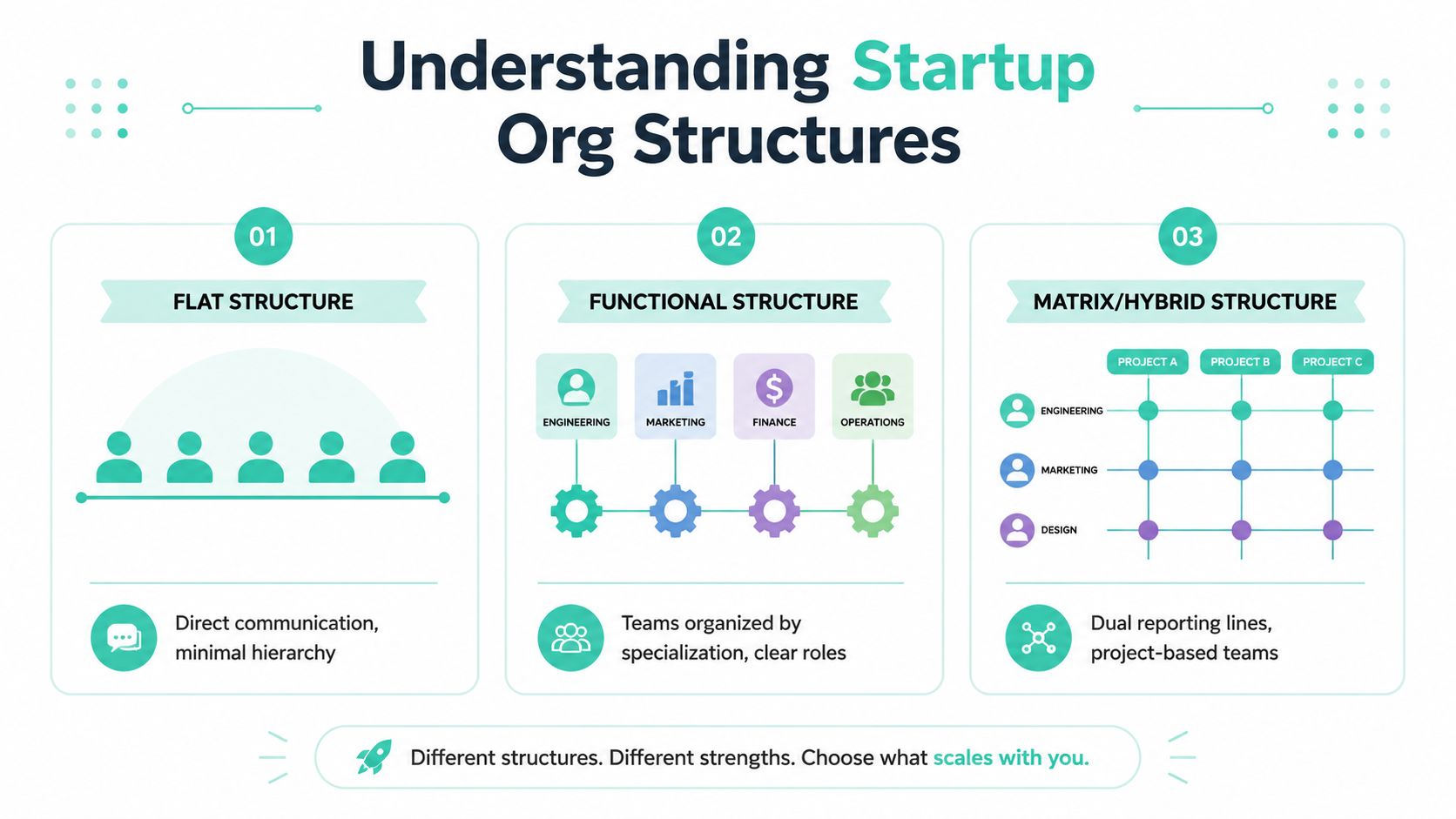
A flat structure is the startup version of a jazz band. Everyone listens closely, improvises, and adjusts in real time. Titles exist, but hierarchy is light. Founders talk directly to engineers, designers talk directly to customers, and decisions often happen in the same Slack thread or standup.
This is common in very small teams because it removes delay. There are fewer handoffs and fewer meetings needed to get something done. A product engineer can hear a customer complaint in the morning and ship a fix that week.
That speed is real. So is the downside.
When everyone can weigh in on everything, the company starts to confuse access with ownership. Debate expands. People step on each other's scope. New hires struggle to tell whether a suggestion is a request, whether a founder comment is final, or whether anyone is accountable for follow-through.
Flat structures work best when:
They fail when the company keeps the same habits after complexity rises.
A functional structure is more like a film crew. Different specialists own different domains. Engineering reports into engineering leadership. Marketing runs marketing. Sales runs sales. Product sits where product can coordinate effectively with the rest of the company.
This is the first real step toward repeatability. Instead of every person doing a bit of everything, teams begin to specialize. Recruiters can source properly. Engineers can focus on architecture. Operators can clean up the business systems that founders usually duct-tape together in the first year.
A functional model brings clarity:
It also introduces new friction. Functions can become silos. Engineering may optimize for technical elegance while sales pushes for speed. Marketing may promise what product hasn't staffed for. The fix isn't to abandon specialization. It's to define who resolves cross-functional conflict.
A matrix or hybrid model is closer to a special ops team. People still belong to a function, but they also work across projects, pods, or business priorities. A designer may report to a design lead while working day to day with a product squad. An engineer may have a functional manager for development and a project lead for delivery.
That complexity exists for a reason. According to Stanford Graduate School of Business research on startup structures, the traditional tech startup org structure is hierarchical, but many companies adopt flat, holacratic, or matrix structures where power is distributed across functional and project managers, sometimes through self-organized project teams called “circles.”
Used well, a hybrid structure gives startups range. It preserves craft standards within a function while letting the business organize around products, customers, or missions.
The moment your company has to balance specialization and speed at the same time, you're already flirting with a hybrid model whether you've named it or not.
The catch is managerial maturity. Dual reporting lines only work when expectations are explicit. If a product squad lead thinks an engineer is fully allocated while the engineering manager thinks they're available for platform work, that engineer absorbs the confusion.
| Structure | Best fit | What works | What breaks |
|---|---|---|---|
| Flat | Very early teams | Fast decisions, broad ownership | Unclear accountability |
| Functional | Growing teams with repeatable work | Clear roles, better hiring, stronger coaching | Silos and slower cross-team decisions |
| Matrix or hybrid | Companies balancing craft and cross-functional execution | Flexibility, project focus, resource sharing | Confusion if reporting lines aren't explicit |
For founders, the practical question isn't “Which structure is best?” It's “Which failure mode can we handle right now?”
For candidates, the same question helps decode risk. Flat teams can offer huge range but vague support. Functional teams can offer clearer growth but narrower scope. Hybrid teams can be energizing if leadership is strong, and exhausting if it isn't.
The biggest mistake teams make is treating startup organizational structure like a one-time choice. It isn't. It's a sequence.
A company with six people needs one kind of clarity. A company with thirty needs another. The teams that scale cleanly usually change structure before the pain becomes obvious.
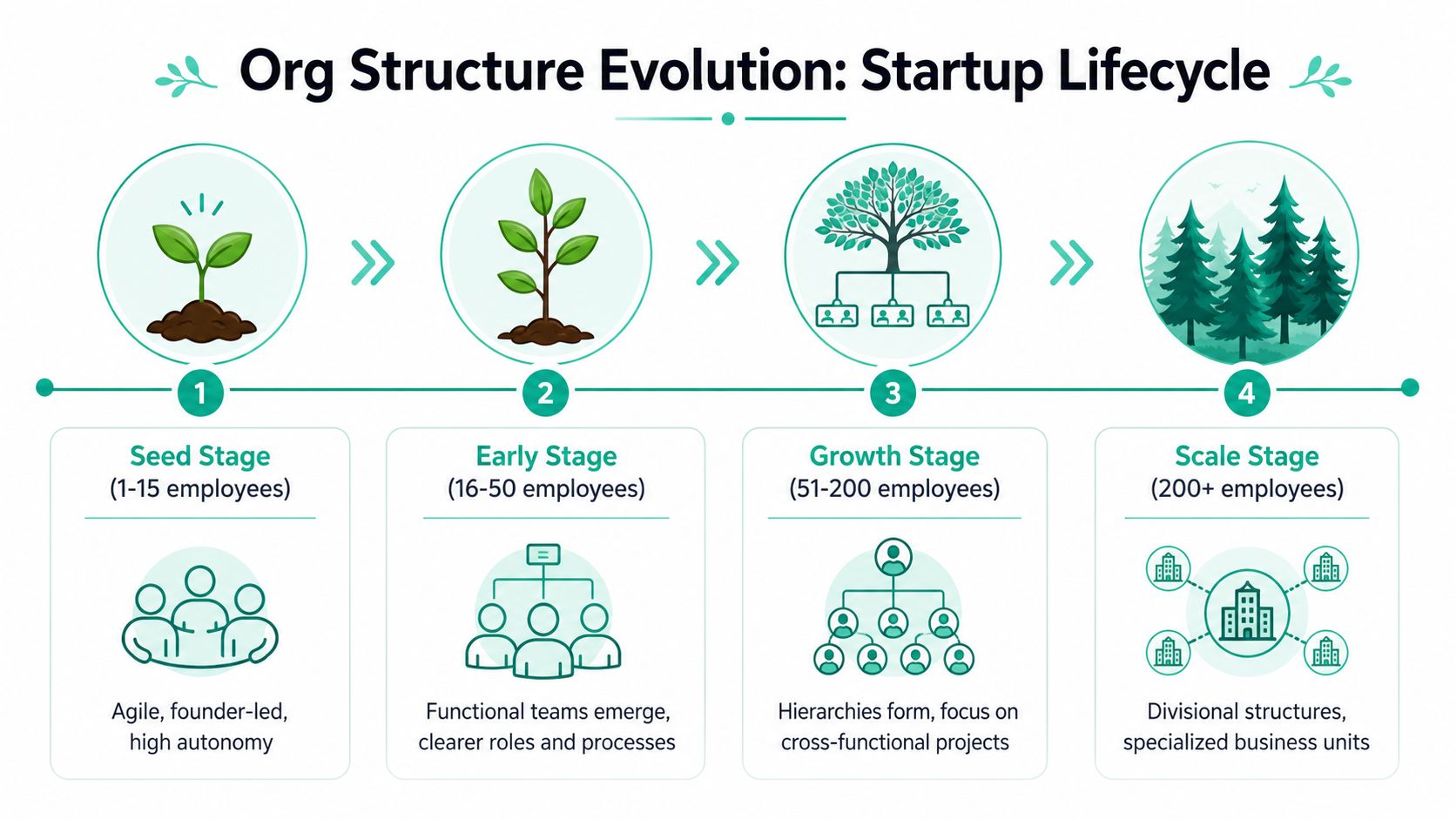
At seed, the company is mostly a founder organism. One person handles recruiting in the morning, customer support at lunch, and fundraising updates at night. Engineers bounce between infrastructure and product. The designer may also own research and brand.
That's fine. Early-stage startup teams in the 5 to 15 employee range are typically flat, but once teams exceed 10 to 15 people without a defined structure, coordination costs balloon because of duplicated work and unclear ownership, often pushing companies to divisional or matrix layers by Series A at 20 to 50 employees.
You can usually spot the warning signs before the headcount chart catches up:
Now imagine that same startup after some traction. There are more customers, more inbound candidates, and a roadmap with actual dependencies. Suddenly “everyone does everything” isn't a badge of honor. It's a bottleneck.
I usually tell founders to stop hiring for generic horsepower and start hiring for structural gaps. The first dedicated product manager matters because they absorb roadmap coordination. The first recruiting owner matters because hiring can no longer be a side quest. The first engineering manager or tech lead matters because headcount without technical leadership creates drift.
If you wait until the org feels obviously broken, you're already late.
A light functional layer often works well here. You don't need a heavyweight executive bench. You do need named owners for product, engineering, go-to-market, and operations, even if some roles are still held by founders or player-coaches.
If you're trying to map these changes to company maturity, this explainer on venture capital funding stages helps anchor structure to the realities of seed, Series A, and growth expectations.
By Series A, the company has to make a tougher shift. Product complexity rises, hiring accelerates, and coordination can no longer depend on founder memory. This is often the point where teams split frontend from backend, or separate platform work from product delivery, because one engineering blob can't serve every priority well.
A more layered model doesn't mean becoming bureaucratic. It means setting up enough structure so people can move without constant rescue.
A practical stage view looks like this:
| Stage | What the team needs most | Structure that usually fits |
|---|---|---|
| 1 to 15 employees | Speed, flexibility, founder access | Flat or lightly divided |
| 20 to 50 employees | Ownership, specialization, faster coordination | Functional with some hybrid elements |
| Beyond early growth | Cross-functional execution, manager leverage, planning discipline | Functional plus matrixed teams or pods |
Candidates should pay attention here. A company in transition can be a great place to join if leadership knows what it's fixing. It can be miserable if leaders still describe obvious structural debt as “startup chaos.”
Most founders draw the org chart they need this month. That's understandable and usually shortsighted. The better move is to design for the company you'll be six months from now.
That doesn't mean building a fake enterprise hierarchy. It means hiring and naming roles in a way that leaves room for growth, scope changes, and stronger future leaders.
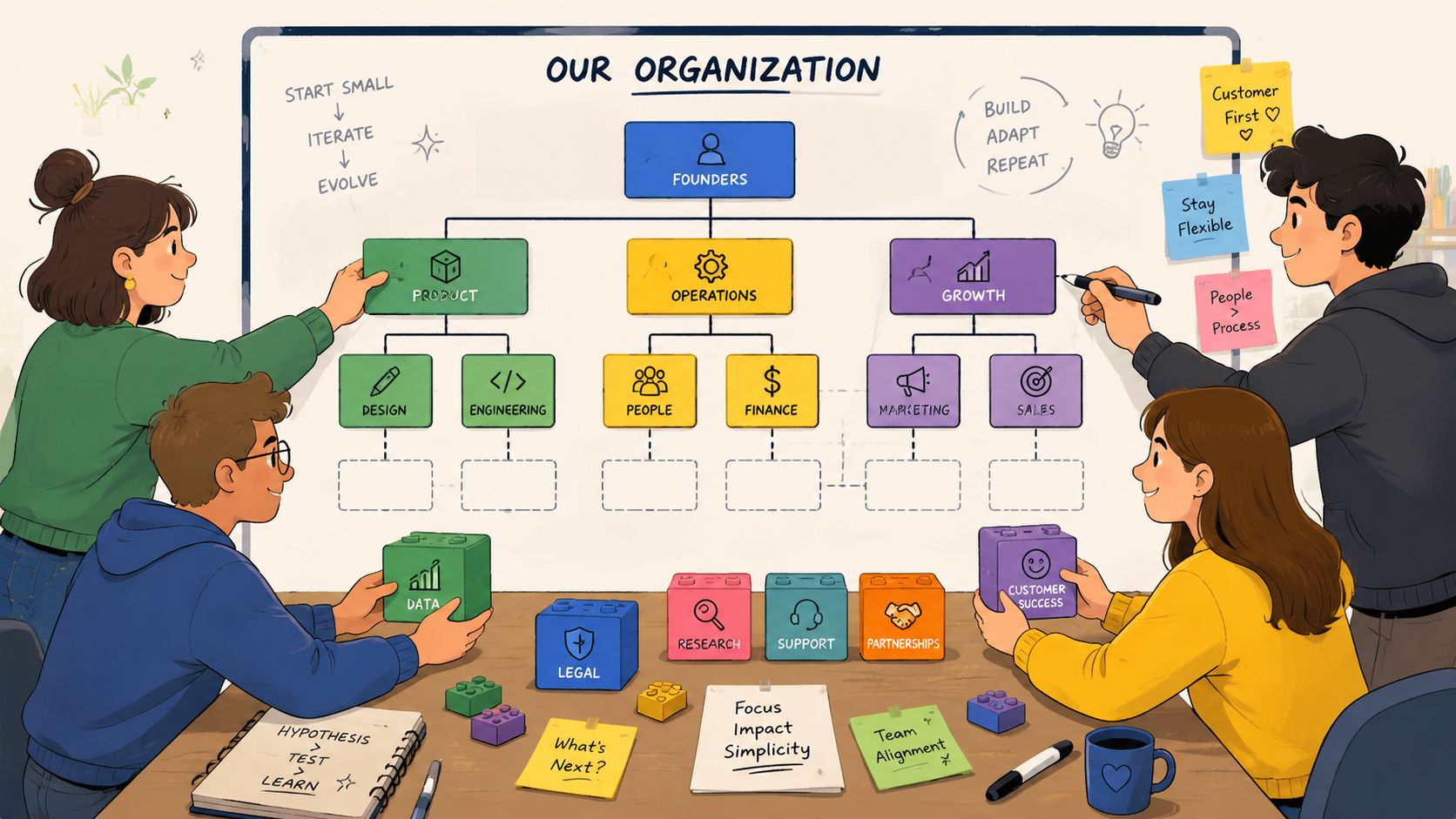
Founders often jump straight to seniority labels. VP. Head of. Director. That feels efficient because it signals seriousness to candidates. Sometimes it's a trap.
According to Functionly's analysis of startup org design, a smarter approach is often to use titles like “Lead” instead of “Director” early on. The same source says 85% of Series B+ firms use that strategy to reduce micromanagement and preserve room for growth.
This matters for two reasons:
A clean startup organizational structure answers a few plain questions:
Notice what's missing. Fancy boxes. Long title ladders. Theater.
A practical design pass usually looks like this:
Operator's note: Titles are cheap. Clear decision rights are expensive, and they matter more.
Reorgs fail when leaders spring them on the team after months of visible dysfunction. A structural change works better when leaders can explain what problem they're solving, what won't change, and how decisions will work next week.
If you're planning that kind of transition, this Acheloa Wellness change management guide is worth reading because it focuses on how people absorb operational change, not just how leaders announce it.
Candidates should listen carefully during these moments. A startup that can explain why it's changing structure usually has stronger internal judgment than one that says, “We're just formalizing things.”
The most romanticized startup design is the perfectly flat team. It sounds modern, fast, and founder-friendly. It also breaks in predictable ways.
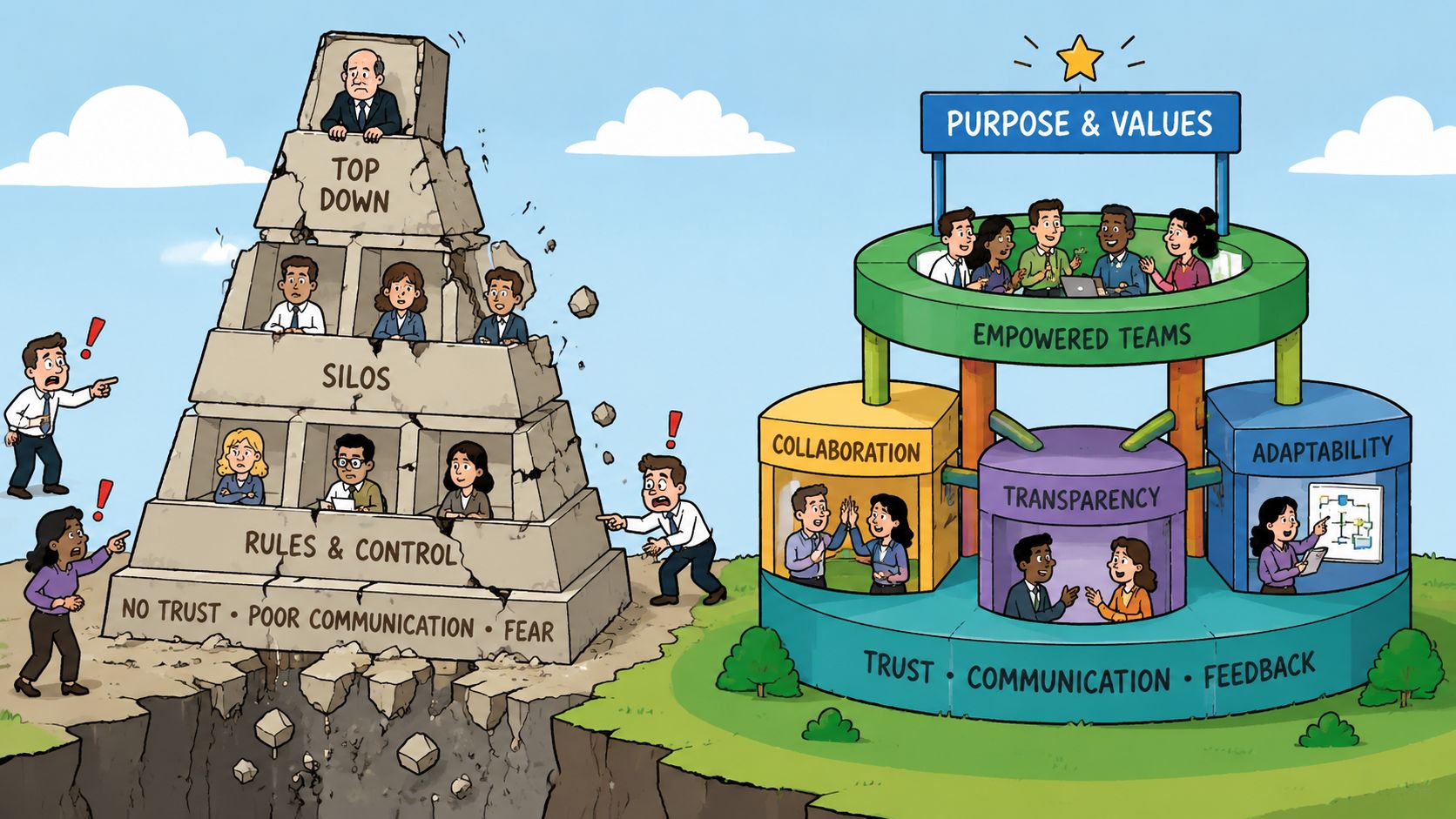
Flatness can help early. It can also hide problems until the company has real complexity. Founders Shield's analysis of startup team structure notes that companies with no defined managers can see 40% lower decision velocity, and 60% of startups with flat structures struggle to scale beyond 50 employees because role definitions stay unclear.
The lesson isn't “build bureaucracy.” It's “define management before ambiguity becomes cultural.”
Red flags include:
This is the classic “VP of Nothing” problem. A startup hires a big-title operator because the company wants credibility. Then the person arrives to a team too small, a function too immature, or a roadmap too undefined for that title to make sense.
The result is frustration on both sides. The leader feels underused. The team feels managed from above without getting real influence.
A better approach is usually narrower and clearer. Hire the person who can build the function at its current size, not the person you'd need two rounds from now.
Startups love to say “everyone contributes.” That's healthy until shared contribution replaces direct accountability.
When product owns roadmap but sales promises custom work, when engineering owns velocity but not production reliability, or when recruiting owns pipeline but nobody owns closing, conflict isn't a people issue. It's a design issue.
A simple prevention checklist helps:
Some startup messiness is normal. Chronic confusion isn't.
Candidates can use these pitfalls as interview filters. Ask who you'd report to, how priorities get set, and what decisions belong to your manager versus a cross-functional partner. Strong teams answer quickly. Weak teams answer politically.
A startup organizational structure tells you what kind of company you're building or joining. It shapes pace, autonomy, management quality, and career growth more than most job descriptions ever will.
For founders and hiring managers:
For candidates:
If you're evaluating a role that's intentionally cross-functional, it's also worth looking at what a chief of staff hire can signal about startup maturity and execution needs. That kind of role often appears when founders know they need more execution capability, but haven't yet solved every structural gap with traditional functions.
The strongest teams don't have perfect org charts. They have honest ones. That's what helps founders hire better and helps candidates choose with their eyes open.
Underdog.io helps startup candidates get in front of vetted high-growth tech companies with one application, and it helps hiring teams reach talent that already understands startup trade-offs. If you're exploring your next startup role or trying to make a key hire, Underdog.io is a practical place to start.