Most candidates still prepare for software engineer interview questions like they're fighting a pure LeetCode contest. That's the wrong game in 2026, especially for startups where interviewers want to see how you think about production constraints, not just whether you can finish a pattern from memory. Modern prep guides still center data structures and algorithms, but they also emphasize explaining patterns, communicating under pressure, and handling questions that drift into system design, behavioral judgment, and even AI-assisted coding review (DataCamp on software engineer interview questions, Wiz Academy on AI-era interview questions).
That shift matters because startup hiring rarely rewards sterile problem solving. A good interviewer wants to know whether you can move from a clean algorithm to a messy service, a brittle cache, or a half-documented take-home without getting lost. It also explains why prep needs to cover five buckets, algorithms, data structures, system design, behavioral, and take-home execution, rather than flooding your brain with random problems and hoping one sticks. The strongest candidates also prepare for the interview narrative itself, because a short, clear answer often beats a clever one when the room is trying to judge signal quickly.
For a practical baseline on coding prep, it helps to remember the classic advice around arrays, linked lists, stacks, queues, trees, graphs, and hash tables, plus repeated timing drills that build consistency under pressure (DataCamp). If you want a broader preparation lens after this list, a startup-specific track and curated marketplaces like Underdog.io can be useful for turning practice into live conversations. For broader hiring context and visibility tactics, many teams also care about whether your portfolio and site can support the same story, which is why resources like boost rankings with website builders sometimes show up in the final polish stage.
Two Sum looks simple until a candidate explains it in a way that hides the underlying trade-off. The weak answer jumps straight to code, skips the reasoning, and misses that startup interviewers usually care as much about how you think as they do about the final result.
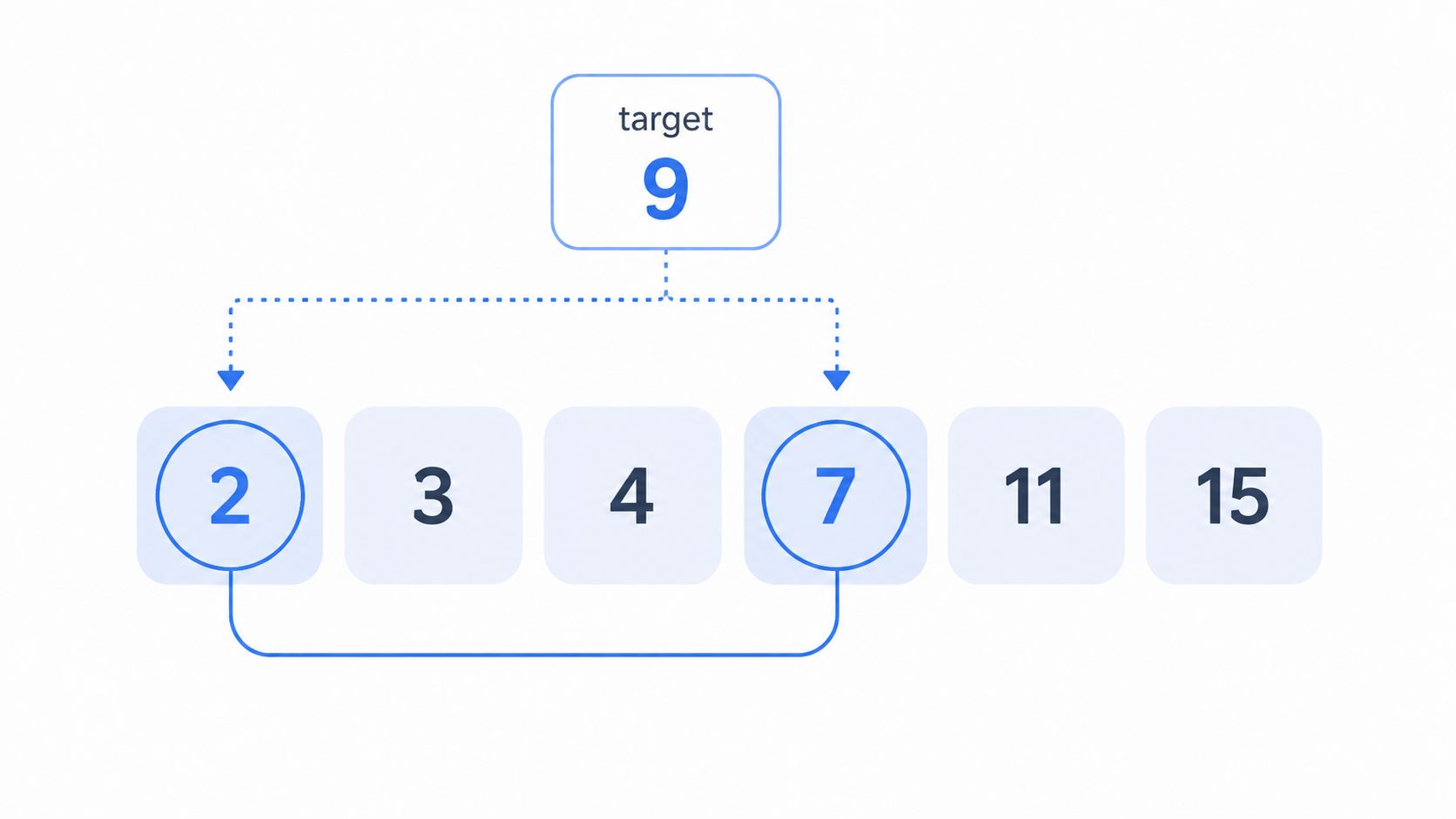
The strongest response starts with brute force, then moves to the hash map approach. That shows you understand why the O(n²) version is easy to verify, and why the O(n) version is the better production-minded choice when the input can grow. In an early-stage company, that distinction matters because you are often choosing between a solution that is easy to write now and one that will still behave well once real usage starts to grow.
Practical rule: say the brute-force answer out loud first, then optimize only after the interviewer has confirmed the constraint.
For example, with [2, 7, 11, 15] and target 9, the indices are [0, 1] because 2 + 7 = 9. With [3, 2, 4] and target 6, the answer is [1, 2] because 2 + 4 = 6. Those examples sound basic, but they give you a clean way to show that you notice duplicates, negative values, and empty arrays before the interviewer has to pull those edge cases out of you. That habit reads as careful engineering, which is exactly what hiring managers want to see when they are trying to separate memorized patterns from real problem solving.
A startup-friendly answer also sounds practical. If you say, “I'd keep the code straightforward, use a hash map for lookups, and avoid a one-liner that future teammates won't want to touch,” you are speaking the language of teams that ship quickly and maintain code under pressure. For a closer look at how this style of practice shows up in a coding challenge in Python, that guide is a useful next step.
Linked list reversal is one of those questions that instantly reveals whether a candidate understands pointers or just memorized the pattern. In a startup backend interview, that matters because the same thinking shows up in queue processing, stream handling, and other sequential workflows where node relationships matter.
The clean answer is iterative, using prev, current, and next. That structure is easy to narrate on a whiteboard, and it makes the pointer movement obvious, which is exactly what interviewers want when they're checking whether you can stay precise while thinking aloud. Recursive reversal is valid too, but it can sound elegant without being as operationally clear, especially when a team cares about stack depth and maintainability.
For a list like 1→2→3→4→5→null, the result should be 5→4→3→2→1→null. Single-node lists, two-node lists, and empty lists are the cases that separate real understanding from pattern recitation. If you forget to save the next pointer before rewiring the current node, the whole structure collapses, and that's exactly the kind of bug a rushed interview solution can expose.
A strong answer also ties the pattern to real systems. Undo and redo flows, cache invalidation queues, and any service that rewrites sequential records all use this same mental model in different clothes. Iterative reversal is O(n) time and O(1) space, while recursion costs O(n) space, and if you say that clearly, you sound like someone who can choose the right tool rather than just the fashionable one.
Validate Binary Search Tree is a test of whether you can carry constraints through a recursive structure instead of checking only what's directly in front of you. That distinction matters in backend systems, where a local check can still let corrupted data slip deeper into the tree.
The common mistake is comparing each node only to its immediate parent. That fails on trees where a value violates the rule farther down the branch, which is why the better approach is to propagate min/max bounds through the recursion. A helper function that carries allowed limits is the cleanest way to show you understand the invariant, not just the traversal.
A simple valid case is 2 with children 1 and 3. A classic invalid case has root 10 with a left subtree containing 15, because 15 is on the wrong side of the root even if it sits under a left child. Those examples are useful because they expose whether you understand the tree globally or only node by node.
In a startup interview, this question often reads like data integrity under pressure. The interviewer is checking whether you can keep a rule intact while the structure branches in multiple directions.
The practical answer should include boundary cases too, like a single node, all-left chains, all-right chains, and very deep trees. Time complexity is O(n) because you visit each node once, and space is O(h) for recursion depth. In a real system, the same logic appears in stream processors, validation pipelines, and other workflows where one bad branch can poison downstream state.
This is the question that introduces the sliding window pattern to a lot of candidates, and it's one of the most transferable patterns in the entire interview canon. For startup teams that deal with logs, user sessions, or stream events, the mental model is immediately useful.
The right way to explain it is simple. Keep a left and right pointer, move right to expand the window, and move left only when you see a duplicate that breaks the rule. A hash map helps you remember the last position of each character so you can jump the left boundary efficiently instead of shrinking one step at a time.
For "abcabcbb", the answer is 3, because "abc" is the longest non-repeating substring. For "bbbbb", it's 1, and for "pwwkew", it's 3, from "wke". Those examples are useful because they show how the window expands and contracts in different ways, which is exactly what interviewers want to hear described out loud.
A good startup answer connects the pattern to actual products. Log analysis, user session tracking, and packet inspection all involve scanning ordered data while preserving a local constraint. If you can explain that the same technique works on strings, event streams, and time-series segments, you're showing the kind of pattern fluency that startup interviewers value.
Merge K Sorted Lists is where a candidate has to prove they can think beyond one input at a time. Startup teams use this kind of reasoning when they aggregate API responses, combine shards, or unify sorted streams from different services.
The simplest route is a heap or priority queue that keeps the smallest current element from each list in play. That approach is clean, and it gives you the familiar O(n log K) time profile, where n is the total number of elements and K is the number of lists. You can also talk through divide and conquer, which merges lists in pairs until only one remains.
The examples are straightforward, but they matter. Three lists, [1,4,5], [1,3,4], and [2,6], should become [1,1,2,3,4,4,5,6]. Single-list inputs and empty lists help you prove that you're not hiding behind the happy path.
Trade-off to name clearly: heaps are usually easier to explain for K-way merging, while pairwise merging can feel simpler when the lists are small and the implementation needs to stay compact.
In startup terms, this is the same problem as merging data from multiple database shards or API endpoints. The interviewer wants to know whether you can reason about both performance and implementation friction. If you speak plainly about those trade-offs, you sound like someone who can build systems that don't fall apart when the data source count grows.
Word Ladder looks like a word game, but interviewers use it to see whether you can spot a graph before you get lost in the vocabulary. In startup hiring, that matters because the same habit shows up when you design similarity search, route requests, or prune a large search space under time pressure.
The right core approach is usually BFS, because you need the shortest transformation sequence, not just a path that eventually works. Treat each word as a node, connect words that differ by one letter, and generate neighbors by changing letters directly instead of comparing every pair in the dictionary. For bigger dictionaries, bidirectional BFS is worth bringing up, since it trims the number of states you explore and keeps the search practical.
For "hit" to "cog", a valid path is hit → hot → dot → dog → cog, which uses 5 words and 4 steps. A similar prompt might ask about "cold" to "warm", where the available intermediate words decide whether a path exists at all. That variation matters because it shows how the graph can be sparse, dense, or partly disconnected.
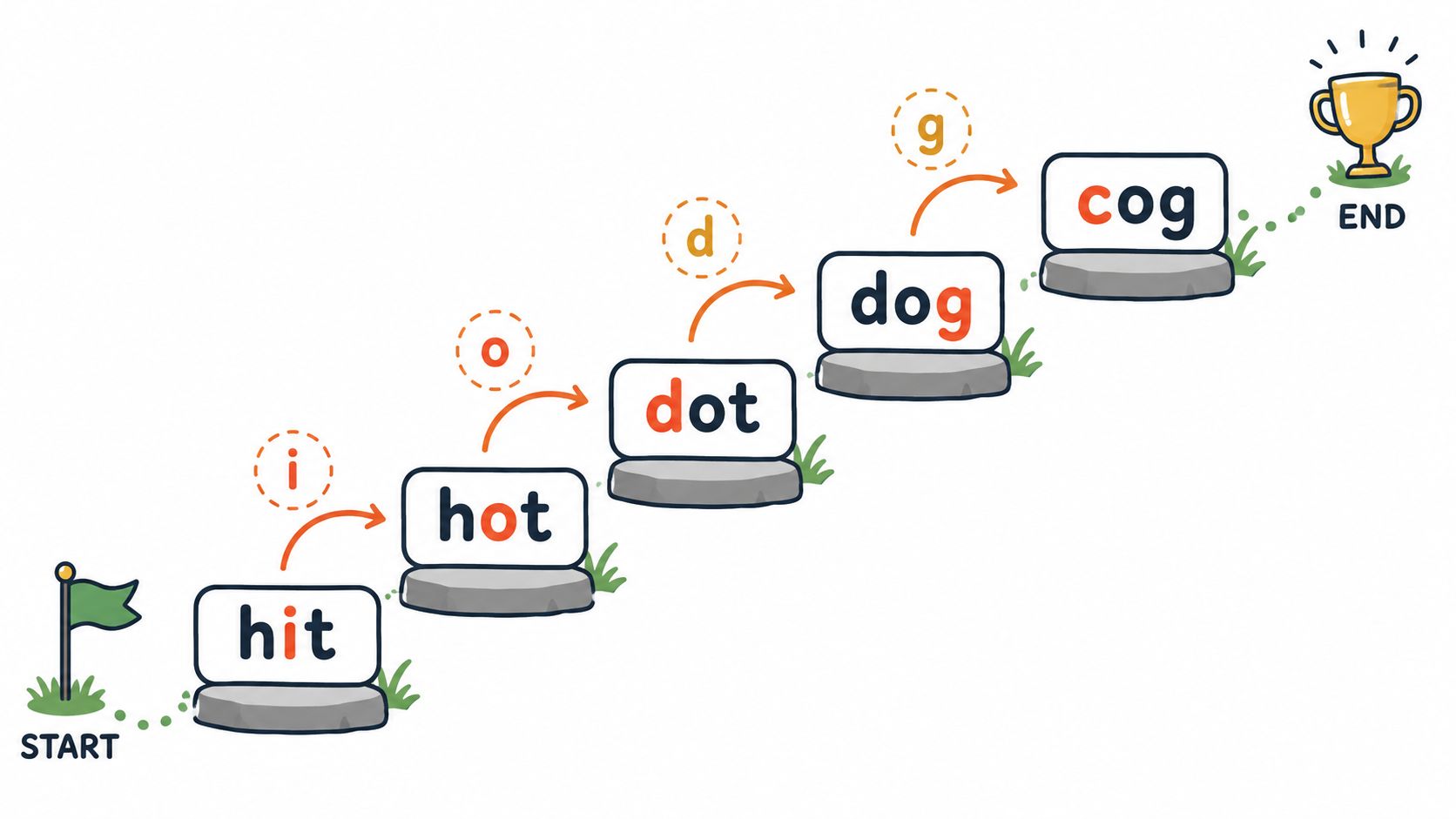
Interviewers like this question because it tests search thinking in a product-shaped setting. The same reasoning can show up in spellcheck, search auto-correction, and recommendation systems, where candidate words or items are filtered through similarity and path cost. If you mention preprocessing the dictionary or caching repeated queries, you show that you can connect algorithm choice to production pressure instead of treating it as a pure puzzle.
If you want a prep resource that sits closer to the full interview loop, the internal guide on software engineer interview preparation fits naturally here.
Serialization questions sit at the border between data structures and system design, which is why they show up so often in stronger interview loops. They force you to think about how a structure leaves memory, travels across a boundary, and comes back intact.
A solid answer starts by choosing a format and defending it. Preorder with explicit null markers like # is common because it keeps the reconstruction logic simple and preserves structure without requiring parent pointers. For example, the tree [1,2,3] can serialize to "1,2,#,#,3,#,#", which is compact enough to parse while still being unambiguous.
Deserialization should mirror the same order. If you read the serialized stream in the same sequence you wrote it, and rebuild nodes recursively while consuming markers, the tree comes back correctly. That symmetry is what interviewers care about more than any one specific delimiter choice.
A useful way to talk about trade-offs is this.
For startups, the real signal is whether you can explain how the format behaves in a cache, a replicated datastore, or an API contract that needs to survive version changes.
That last point matters because serialization isn't just an interview puzzle. It's what makes distributed caches, database replication, and versioned APIs work in the actual world. Candidates who can discuss correctness and compactness in the same breath usually stand out.
LRU Cache is one of the clearest examples of how interviewers test whether you can combine two simple data structures into a system that behaves like a product feature. The question sounds small, but it's really about performance, ordering, and eviction policy.
The clean design uses a hash map for fast lookup and a doubly linked list for fast reordering. Every get should move the accessed node to the most recent position, and every put should either insert a new node or evict the least recently used one from the tail when capacity is exceeded. That's the kind of explanation that makes an interviewer relax, because they can hear that you understand both the algorithm and the operational behavior.
A standard example helps anchor the logic. With capacity 2, if you call put(1,1), put(2,2), then get(1), you should get 1, and put(3,3) should evict 2. A later get(2) should return -1. That sequence proves you understand recency tracking, not just storage.
The implementation details matter too. You need helper methods for adding to the head and removing from the list, and you need to handle capacity of 1, repeated accesses, and the single-item case without breaking the structure. In startup interviews, this question often turns into a larger discussion about distributed cache consistency, which is where the trade-offs begin.
Number of Islands is one of the cleanest graph traversal questions on the board, and it's also one of the easiest places to see whether a candidate can avoid double-counting work. The setup is simple, but the reasoning is useful in mapping and spatial systems.
The standard approach is to scan the grid cell by cell. When you find an unvisited 1, trigger DFS or BFS, mark everything in that connected component, and keep going. That's the whole trick. The interviewer usually wants to hear that you know why the visited marking matters, because without it, you'll count the same island multiple times.
For the grid [[1,1,0],[1,0,0],[0,0,1]], the answer is 3. That example is small, but it captures the point that islands are defined by horizontal and vertical adjacency, not diagonal contact. Single-cell grids and all-zero grids are worth mentioning because they show you're thinking about boundary behavior, not only the main traversal.
A good answer should include the complexity story. Visiting each cell once gives you O(m*n) time, and the visited tracking or recursion depth can also cost O(m*n) space depending on the implementation. If the interviewer asks about Union-Find, it's fair to compare it as an alternative for connected-component detection.
For startups, this problem maps neatly to geospatial clustering, map tiles, and other location-based features. If you can explain that the same logic groups connected regions in a grid and neighboring points in a product surface, you've turned a textbook problem into an engineering signal.
Median of Two Sorted Arrays is the kind of question that separates routine interview prep from deeper algorithmic comfort. It's also a good reminder that some software engineer interview questions are really tests of whether you can optimize a naive idea without losing correctness.
The natural first answer is to merge the arrays and compute the median directly. That baseline is fine, and it shows you understand the problem. The stronger answer is the binary search partition approach, which works on the shorter array and aims for O(log(min(m,n))) time instead of a full merge.
For [1,3] and [2], the median is 2. For [1,2] and [3,4], the median is 2.5. Those examples are useful because they show both odd and even total lengths, which is where partition logic often trips people up.
The key idea is that the left and right halves must be balanced correctly around the median. Once the partitions satisfy the boundary conditions, you can compute the median directly from the edge values. If you explain why the shorter array is the right place to binary search, you're demonstrating practical judgment rather than memorization.
This question also maps cleanly to startup analytics work. Percentile calculations, dashboard summaries, and real-time stats all depend on getting the center of a distribution efficiently and reliably. For a deeper interview-prep companion, the internal guide at engineer interview questions fits naturally beside this one.
| Problem | Implementation Complexity | Resource Requirements | Expected Outcomes (What it tests) | Ideal Use Cases | Key Advantages |
|---|---|---|---|---|---|
| Two Sum Problem: Finding Pairs in an Array | Low, hash map or two-pointer | O(n) time, O(n) space (hash map); O(1) for sorted two-pointer | Hash maps/two-pointer use; time-space trade-offs; basic algorithmic thinking | Quick screening; baseline CS knowledge for general engineering roles | Fast to implement and grade; clear correctness and efficiency metrics |
| Reverse a Linked List: Understanding Pointer Manipulation | Low–Medium, pointer handling (iterative/recursive) | O(n) time; O(1) space iterative, O(n) stack for recursion | Pointer manipulation; list traversal; edge-case handling | Backend systems, stream processing, low-level data structures | Demonstrates low-level data-structure mastery and visualizable steps |
| Validate Binary Search Tree: Testing Recursive Constraints | Medium, recursion with propagated constraints | O(n) time, O(h) recursion space | Recursive thinking; constraint propagation; full-tree correctness | Data integrity, indexing, search-related backend logic | Distinguishes deep from superficial tree understanding |
| Longest Substring Without Repeating Characters: Sliding Window Technique | Medium, sliding window mechanics | O(n) time, O(min(n, charset)) space | Sliding window pattern; window expansion/contraction; string processing | Log/stream analysis, session/windowed analytics | Teaches a reusable pattern applicable to many stream problems |
| Merge K Sorted Lists: Divide and Conquer Strategy | Medium–High, heap or divide-and-conquer | O(N log K) time (N total elements), O(K) extra space for heap | Heaps/priority queues; scalability with K; merge strategies | Aggregating sorted feeds, merging API results, distributed merges | Multiple valid approaches; tests scalability and trade-offs |
| Word Ladder: Graph Search and Shortest Path | Medium, graph construction + BFS (or bidirectional BFS) | Potentially high memory/time with large dictionaries; BFS complexity | Graph modeling from strings; BFS shortest-path; preprocessing | Autocorrect, spell-check, recommendation engines | Connects graph algorithms to practical text-transformation problems |
| Serialize and Deserialize Binary Tree: System Design Thinking | Medium, format choice + parsing logic | O(n) time and space for serialization/deserialization | Encoding/decoding strategies; null handling; format trade-offs | Caching, persistence, network transfer, API design | Bridges algorithms with system and format design considerations |
| LRU Cache Implementation: Design Pattern Application | Medium–High, combined DS (hash map + doubly-linked list) | O(1) get/put; O(capacity) memory | Eviction policies; O(1) data-structure design; consistency concerns | Caching layers, performance-critical services | Highly production-relevant; demonstrates systems and data-structure design |
| Number of Islands: Connected Components and DFS/BFS | Low–Medium, grid traversal via DFS/BFS or Union-Find | O(mn) time, O(mn) visited or recursion depth | Connected components detection; grid traversal patterns | Spatial clustering, geographic or image-based analysis | Multiple solution techniques; natural progression to advanced grid problems |
| Median of Two Sorted Arrays: Binary Search Optimization | High, non-obvious binary search partitioning | Optimal O(log min(m,n)) time; careful edge-case handling | Advanced binary search; partition math; senior-level algorithmic reasoning | Analytics, percentile calculations, high-scale stats processing | Strong differentiator for senior candidates; tests deep optimization skills |
Two weeks is enough to improve if you treat preparation like a system, not a mood. Start with daily LeetCode blocks that rotate between arrays, linked lists, trees, graphs, and caches, because the fastest gains usually come from repeating canonical patterns until your explanation sounds calm instead of rehearsed. Keep each block focused on one problem family, then force yourself to narrate the approach before you touch the keyboard.
Use the weekly rhythm to build the other dimensions that startup interviewers care about. Run one mock interview with a peer or coach each week, and don't let it stay at the code level. Ask for pressure on your assumptions, your edge cases, and your trade-offs, because the best interviews are rarely just about a correct answer, they're about whether you stay coherent when someone challenges your plan.
Take-home work needs time boxing, or it will eat your whole week. Set a hard boundary for scoping, implementation, testing, and a final pass on readability, then stop. A polished but incomplete project with clear judgment often reads better than an overbuilt submission that wanders into scope creep and never gets finished.
The final week should be a signal-building week. Tighten your narrative around the problems you solve best, refresh the projects you'll talk through, and rehearse one or two examples where you handled ambiguity, debugged a hard issue, or made a trade-off under pressure. That's especially important for startups, where interviewers often want to know whether you can learn fast, communicate clearly, and stay useful when the plan changes.
If you want a live market where that preparation can turn into actual conversations, Underdog.io is built for startup hiring. Its 60-second application lets vetted startups reach out to candidates instead of making you chase every opening, which is a better fit for engineers who'd rather spend time sharpening interview performance than fighting a resume black hole.
Underdog.io connects tech job seekers with vetted startups and high-growth tech firms, so the same interview prep you've just worked through can lead to real conversations with teams hiring for engineering roles. If you're ready to turn stronger answers into active opportunities, visit Underdog.io and see how a single application can put your profile in front of startups that value technical depth and startup readiness.