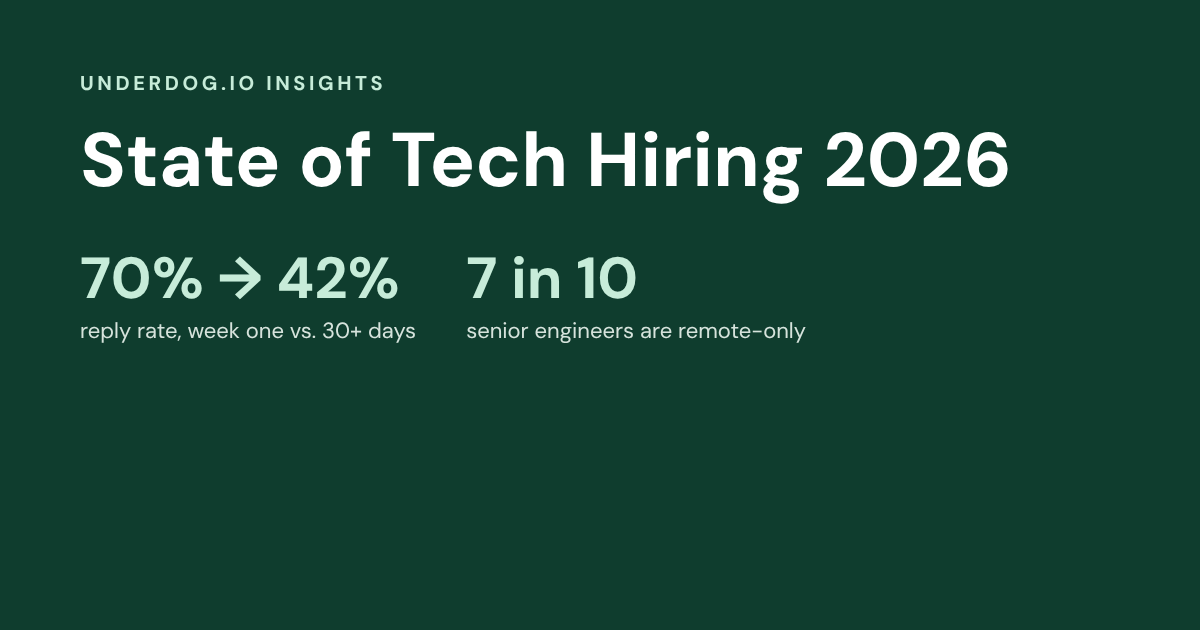
Underdog.io Insights
State of Tech Hiring 2026: Message in Week One or Lose Them
Across 30,385 first messages from hiring companies on Underdog.io, engineers and other tech candidates replied 70% of the time when contacted in their first week on the market, and 42% after 30 days. Every function follows the same curve. On remote work, 71% of technical applicants with 8+ years of experience will only work remote, and that share has held near 70% every year since 2023, through every return-to-office wave.
Most hiring data tells you what roles pay. Almost none tells you how candidates actually behave once they're on the market: when they stop answering, and what they'll refuse. LinkedIn and job boards don't publish that. We can, because every introduction on Underdog.io happens on-platform and is timestamped.
This report covers two findings from Underdog's own marketplace data. The first is about speed. The second is about remote work and seniority.
Finding 1: Message in week one or lose them
When a company messages a candidate in their first week live on Underdog, 70% reply. Wait one to two weeks and it's 63%. Two to four weeks, 56%. After 30 days, 42%. That's a 41% drop in replies with no change except timing.
Reply rates fall from 70% to 42% after the first month
Share of first messages from hiring companies that got a candidate reply, by time since the candidate's profile went live.
Source: Underdog.io marketplace data · 30,385 first messages · 2018–2026
View the data table
| Time since profile went live | Reply rate | First messages |
|---|---|---|
| Under 1 week | 70.3% | 17,429 |
| 1–2 weeks | 63.4% | 3,954 |
| 2–4 weeks | 56.0% | 5,202 |
| 30+ days | 41.8% | 3,800 |
Every function goes quiet after week one
This isn't an engineering quirk. Product managers, designers, data and AI candidates, business and go-to-market candidates, and software engineers all follow the same curve. Product candidates start highest (81%) and still fall to 48%. Software engineers, the largest group, go from 68% to 39%, losing 43% of their replies.
Every function loses replies after week one
Reply rate to first company messages: week one vs. 30+ days after the candidate went live, by the candidate's primary target role.
Source: Underdog.io marketplace data · 2018–2026 · function = candidate's #1 target role
View the data table
| Function | Under 1 week | 1–2 weeks | 2–4 weeks | 30+ days |
|---|---|---|---|---|
| Product | 81.2% (n=1,261) | 77.0% (n=331) | 67.0% (n=485) | 47.9% (n=311) |
| Design | 79.9% (n=632) | 71.5% (n=193) | 69.0% (n=268) | 58.5% (n=147) |
| Data & AI | 76.9% (n=680) | 67.7% (n=195) | 61.1% (n=275) | 44.7% (n=253) |
| Business & GTM | 73.7% (n=1,153) | 69.3% (n=398) | 58.0% (n=572) | 49.6% (n=401) |
| Software Engineering | 68.2% (n=13,703) | 60.1% (n=2,837) | 52.9% (n=3,602) | 38.7% (n=2,688) |
Why does it decay? Good candidates don't stay available. A candidate who went live three weeks ago has had three weeks of other companies' messages, recruiter screens, and onsite loops. By day 30, many are deep in someone else's process or already signed. A late message isn't worse copy. It's arriving after the decision.
Finding 2: Senior engineers didn't come back to the office
We ask every technical applicant where they'll work: which cities, and whether they're open to office, hybrid, or neither. "Remote-only" means not open to office or hybrid in any city they listed.
Seniority is the biggest divider. Across 2025 and 2026 applicants, 72% of engineers with 8–15 years of experience are remote-only, roughly double the 36% of engineers with 2–4 years.
Senior engineers are twice as likely to refuse the office
Share of technical applicants open to remote work only, by years of experience in their target role. 2025–2026 applicants.
Source: Underdog.io applicant data · 52,803 technical applicants · Jan 2025 – Nov 2026
View the data table
| Experience | Remote-only | Applicants |
|---|---|---|
| 0–2 yrs | 48.7% | 10,696 |
| 2–4 yrs | 35.7% | 11,313 |
| 4–8 yrs | 42.9% | 17,330 |
| 8–15 yrs | 72.3% | 10,704 |
| 15+ yrs | 64.5% | 2,760 |
RTO mandates moved juniors, not seniors
The return-to-office push showed up in our data in 2024, but only for less-experienced engineers. Remote-only share among engineers with 0–4 years fell from 40% in 2023 to 30% in 2024. Mid-career engineers (4–8 years) slid from 56% to a low of 40% in 2025. Engineers with 8+ years never moved: 68%, 68%, 71%, 70%.
Senior engineers held at ~70% remote-only through every RTO wave
Share of technical applicants open to remote work only, by year they applied and years of experience.
Source: Underdog.io applicant data · 169,992 technical applicants · 2023–2026 YTD
View the data table
| Experience | 2023 | 2024 | 2025 | 2026 |
|---|---|---|---|---|
| 0–2 yrs | 39.2% (n=26,162) | 27.3% (n=12,247) | 34.0% (n=4,566) | 59.6% (n=6,130) |
| 2–4 yrs | 42.6% (n=16,671) | 31.8% (n=12,341) | 30.4% (n=6,589) | 43.0% (n=4,724) |
| 4–8 yrs | 56.0% (n=16,924) | 45.7% (n=15,056) | 40.3% (n=10,456) | 46.8% (n=6,874) |
| 8–15 yrs | 67.9% (n=6,979) | 67.7% (n=7,021) | 72.4% (n=6,798) | 72.0% (n=3,906) |
| 15+ yrs | 70.1% (n=2,123) | 67.0% (n=1,665) | 66.9% (n=1,781) | 60.1% (n=979) |
Get the full report (PDF)
The forwardable version for your hiring team: every chart, the data tables, and a one-page outreach playbook.
- Reply-rate decay by function
- Remote-only demand by seniority, 2023–2026
- Benchmarks to hold your team to
Work email required. No candidate newsletter, no spam.
Why this data exists
Underdog.io is a curated marketplace where pre-vetted engineers and other tech candidates search quietly and hiring partners reach out to them directly. Because the first message, the reply, and the candidate's stated preferences all live on the platform, we can measure behavior that job boards and LinkedIn can't see or don't publish. We'll update this report as the market moves.
Methodology
- Reply rate: first messages sent by hiring companies to candidates on Underdog.io from 2018 to November 2026 (30,385 messages). A message counts as replied if the candidate sent any later message in the same conversation.
- Time since live: time between the candidate's most recent profile publish to hiring partners and the company's first message.
- Function: the candidate's #1 target role. Data & AI = data scientist, data engineer, data analyst, ML engineer, AI engineer. Software Engineering = all other engineering roles.
- Remote-only: technical applicants not open to office or hybrid work in any location they listed. Experience = the level they selected for their #1 target role. Year = the year they applied. 2026 runs through November.
- Limits: these are correlations, not controlled experiments. 2026 early-career figures rest on smaller samples than 2023 and may shift as the year closes.
FAQ
What is a good reply rate for recruiting outreach to engineers?
On Underdog.io, vetted engineers and tech candidates reply to 70% of first messages sent in their first week on the market and 42% of messages sent after 30 days. Use those numbers as a benchmark for your own outreach: these candidates asked to hear from companies, so timing, not copy, is the main variable.
How fast should you contact a candidate after they start looking?
Within seven days. Reply rates fall about 7 points by week two, 14 points by weeks two to four, and 28 points after a month. The drop happens in every function we measured, from software engineering to product and design.
Are return-to-office mandates working for engineering hiring?
For senior engineers, no. About 7 in 10 technical applicants with 8+ years of experience will only work remote, and that share has held steady since 2023. Early-career engineers became more open to office and hybrid work in 2024 and 2025, but remote-only demand rose again in 2026.
Do senior engineers prefer remote work more than junior engineers?
Yes. In 2025 and 2026, 72% of engineers with 8–15 years of experience were remote-only, compared with 36% of engineers with 2–4 years and 43% with 4–8 years.
Where does this data come from?
Underdog.io's own marketplace: tens of thousands of company-to-candidate messages and more than 160,000 technical applications since 2023. All figures are aggregated, and no individual candidate or company is identifiable.