Your inbox has forty resumes that all list React, TypeScript, and Next.js near the top. Two candidates breezed through your last trivia screen, yet when you paired with the finalist on a real bug, they stared at a stale closure in a custom hook and couldn't explain why the page re-rendered on every keystroke. Meanwhile, your product roadmap is sliding, and every week spent guessing costs another sprint.
That gap isn't a talent shortage. It's a measurement problem, and AI coding assistants have made it sharper. Banning AI during interviews tests unaided syntax recall, which is a skill your team rarely uses once someone joins.
Effective React developer hiring measures engineering judgment inside an actual repository. You want to know whether a candidate can work through unfamiliar components, spot risky state decisions, verify AI-generated code, and ship accessible, tested interfaces without hand-holding. The hiring loop below gives startup engineering leads a repeatable sequence, concrete scorecards, and clear cutoffs you can run inside a single two-week sprint.
Say you're an engineering lead at a seed-stage startup with one two-week sprint to hire a product-focused React engineer and zero interview docs ready. Without a fixed sequence, Monday disappears into ad-hoc phone calls, Wednesday turns into a vague whiteboarding chat, and by Friday nobody agrees on whether the front-runner is mid-level or senior.
A disciplined five-stage sequence keeps every conversation connected and cuts wasted engineering hours. Before you write a single outreach message, map the flow from role definition to signed offer.
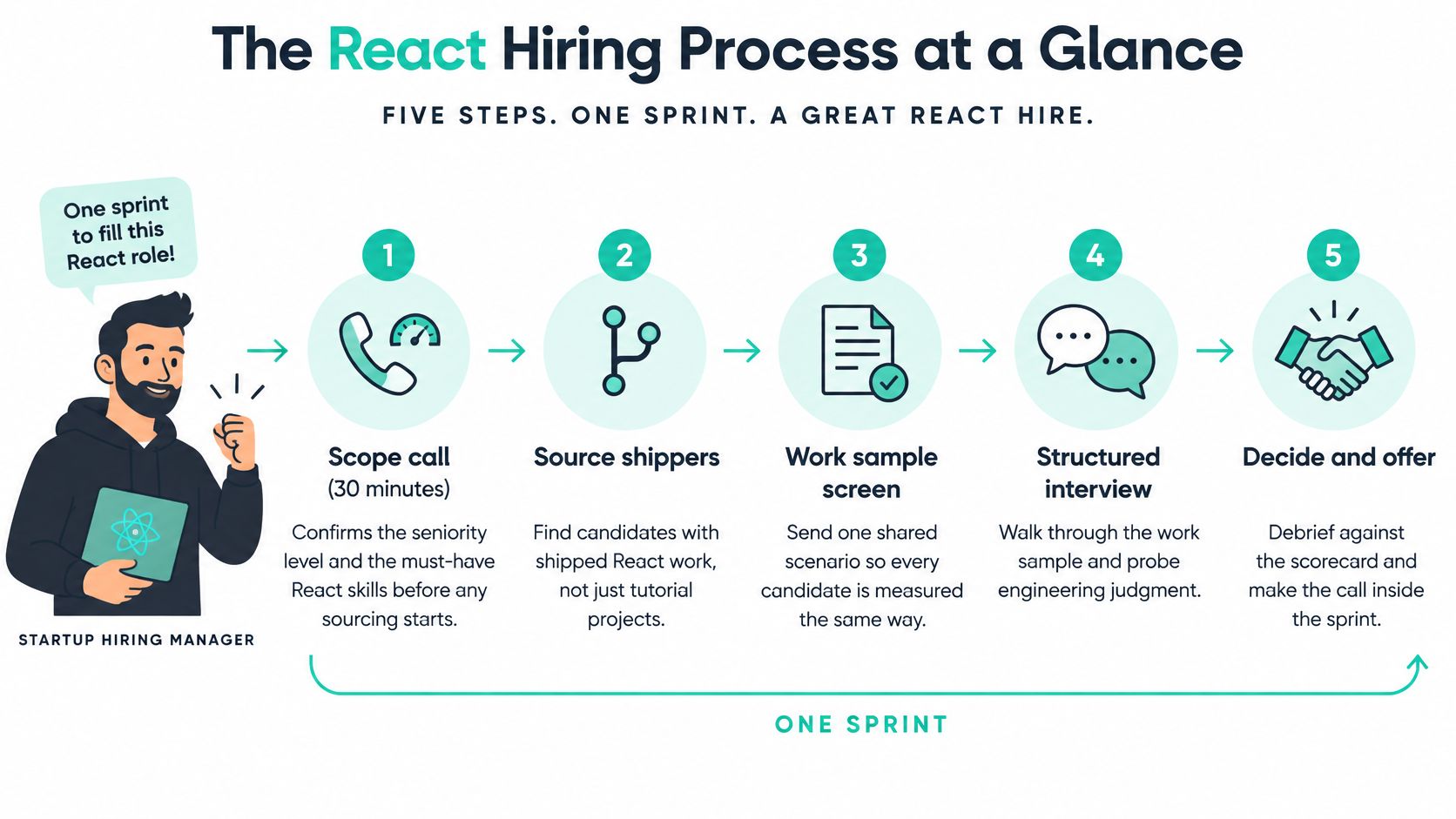
Everything starts with a 30-minute scope call between the hiring manager, the founding engineer, and whoever owns product delivery. That meeting locks the seniority band and names the essential skills for the first six months, which directly determines what your work sample will test later.
Next comes a 15-minute portfolio and resume review per candidate focused strictly on named production projects and exact ownership. You're looking for what the engineer built, debugged, or refactored, not which frameworks appeared on a team's wider tech stack.
Candidates who pass move to a 30-to-45-minute architecture conversation grounded in a real feature from their past work. You probe how they modeled state, separated server and client data, and weighed trade-offs when specs changed mid-sprint.
The fourth stage is a 60-to-90-minute work sample inside a small existing React codebase that tests debugging, testing habits, and component design against a shared rubric. Finally, a 45-to-60-minute structured panel evaluates collaboration and communication using identical behavioral anchors for every applicant, and that scorecard decides the offer.
Demand for software engineers remains steep across the broader labor market. The U.S. Bureau of Labor Statistics employment projections forecast 17.9% growth for software developers from 2023 through 2033, compared with 4.0% across all occupations, adding roughly 303,700 jobs alongside an average of 125,100 annual openings and a 2023 median annual wage of $132,270. While those government figures cover software developers overall rather than isolating React specialists, they explain why experienced frontend engineers rarely sit idle.
Strong React candidates almost always juggle two or three active processes at once, so any pipeline that drags past two weeks loses your best prospects to faster teams. When your engineering schedule is already stretched, whether you're shipping web releases or working with mobile teams to resubmit rejected builds faster, a bloated interview loop taxes both your current roadmap and your close rate.
Copy the working timeline below directly into your hiring doc so every interviewer knows the exact boundaries of their round.
| Stage | What It Tests | Time Box | Evidence to Record |
|---|---|---|---|
| Scope call | Role fit and seniority level | 30 minutes | Must-have skills confirmed or dropped |
| Portfolio review | Shipped production React work | 15 minutes per candidate | Named projects and the candidate's exact ownership |
| Architecture conversation | State, data flow and trade-offs | 30 to 45 minutes | Reasoning on a real scenario from past work |
| Work sample | Debugging, tests and component design | 60 to 90 minutes | Rubric scores on correctness, maintainability and tests |
| Structured panel | Collaboration and communication | 45 to 60 minutes | Behavioral answers scored on the same anchors |
Lock three numbers before your first candidate call: five stages, roughly 3 to 4 hours of total candidate time across all time boxes, and one shared scorecard that every interviewer fills out.
Setting those guardrails early stops interviewers from freelancing extra rounds mid-sprint. Every conversation either gathers a missing piece of evidence or gets cut from the calendar.
Write your job description around the first six months of shipped work, not a sprawling glossary of frontend buzzwords. Too many startup listings copy a senior staff checklist for a mid-level budget, which scares off honest mid-level engineers and attracts candidates who pad their profiles with every library they touched for an afternoon.
Current labor-market data reinforces why clarity beats buzzword checklists. The U.S. Bureau of Labor Statistics Occupational Outlook Handbook reports roughly 1.7 million software-developer jobs in 2025, with sustained demand tied to AI-enabled applications, automation, robotics, and security software. Connecting your frontend role directly to your product's actual technical goals, like building responsive AI-assisted workflows or low-latency customer dashboards, attracts engineers who care about product impact.
A mid-level React engineer should arrive ready to build reusable components with hooks, handle local state and effect cleanup cleanly, write fluent JavaScript and TypeScript, add unit tests with React Testing Library, and ship responsive layouts across viewports. They can own well-scoped features end to end while leaning on a lead for cross-app architecture calls.
A senior React hire takes on a wider blast radius. Beyond clean components, they own data-flow boundaries across the application, define the testing strategy, enforce performance budgets and accessibility standards in code review, and mentor teammates through tricky debugging sessions.
Market adoption helps you separate baseline skills from genuine differentiators. A 2025 analysis of 1,000 React job postings found TypeScript in 87% of postings and Next.js in 71%. Based on that distribution, I would treat TypeScript as a must-have at both levels, and list Next.js as a strong nice-to-have unless your production app already runs on the App Router.
Similarly, Stack Overflow's 2025 Developer Survey reported React usage among 46.9% of professional developers and Node.js among 49.1%, which means a React and Node combination is a broad-market baseline rather than proof of seniority. Use the matrix below to calibrate what interviewers should check at each level.
| Competency | Mid-Level Evidence | Senior Evidence | Interview Check |
|---|---|---|---|
| Component design | Reusable components with hooks | Shared patterns used across several teams | Extend an existing component in a small app |
| JavaScript and TypeScript | Typed props and clear data types | Typed API boundaries and shared types | Review a typed component for weak spots |
| State and effects | Correct local state and effect cleanup | Data-flow decisions for the whole app | Explain where state should live and why |
| Testing | Unit tests with React Testing Library | Testing strategy and integration tests for critical flows | Write a test for a broken user flow |
| Accessibility | Keyboard and label basics | Accessibility standards enforced in review | Fix a keyboard navigation defect |
| Performance | Spots an obvious slow render | Sets budgets and measures bundle and render cost | Identify a costly re-render in a sample |
Most React hiring guides obsess over hooks syntax while ignoring whether the candidate can keep a live app fast, inclusive, and observable. In the CoderPad and CodinGame 2025 State of Tech Hiring report, React appeared in 33.7% of developer references and 34.3% of recruiter references, confirming high demand across hiring teams. Yet framework familiarity alone tells you almost nothing about production reliability.
Build your screen around four concrete production-ownership signals:
Keep Next.js, GraphQL clients, and shared design-system experience in your nice-to-have column unless they're central to quarter-one deliverables. A strong JavaScript and TypeScript engineer who understands browser rendering can pick up GraphQL caching or Next.js route handlers far faster than a framework specialist can learn disciplined debugging.
Drop two legacy filters immediately: memorized API trivia and raw years of React experience. Neither predicts whether someone can untangle a flaky async race condition, and both routinely screen out capable engineers who spent two years shipping complex TypeScript apps in another UI library before switching to React.
Before publishing your listing, fill in this one-paragraph role summary and drop it at the top of the job post:
Over your first six months, you'll own [core product area, e.g., our billing and analytics workspace] built in React and TypeScript, shipping [two specific deliverables, e.g., real-time filtering and self-serve reporting] alongside two backend engineers and one product designer. You'll be responsible for component architecture, integration tests on critical user flows, keyboard accessibility, and frontend performance budgets, with [nice-to-have, e.g., Next.js App Router or design-system ownership] as a helpful bonus rather than a hard gate.
Sourcing React engineers isn't a volume challenge; it's a filtering challenge. According to Stack Overflow's 2024 Developer Survey of more than 65,000 developers, including 48,503 professional developers, 41.6% of professional developers reported using React, ahead of Angular at 19.4% and Vue.js at 16.6%, while 62.3% of all respondents had used JavaScript in the previous year. Because framework exposure is so widespread, broad job-board blasts bury your team under tutorial portfolios and lightly maintained bootcamp clones.
The goal is to bias your top of funnel toward engineers with verifiable production history. Compare five practical channels side by side before splitting your recruiting hours.
| Channel | Best For | Signal to Check | Watch For |
|---|---|---|---|
| Referrals from React engineers | Experienced, often passive hires | Outcomes on previous teams | Warm but narrow pools |
| GitHub and open-source work | Hands-on component builders | Merged pull requests and tests | Tutorial-only repositories |
| Job boards with boolean search | Volume and fast screening | Recent React work in the résumé | Keyword-stuffed profiles |
| Curated talent marketplaces | Vetted and passive candidates | Verified shipped work | Limited supply for niche skills |
| Staffing partners such as nexusITgroup.com | Contract-to-hire and surge hiring | Pre-screened candidates | Fees and fit with your team |
Every channel carries a distinct failure mode, so pair each source with a fast verification habit before booking calls.
With engineer referrals, never accept a vague "they're great" endorsement. Ask the referrer one pointed question: what messy production problem did this person own and fix on your team? That single answer tells you far more than a shared company name.
When sourcing directly from repositories, skip cloned todo lists and look for merged pull requests, thoughtful code-review comments, and passing test suites in maintained projects. If you want a structured way to read commit history and maintainer signals quickly, our walkthrough on how to hire developers on GitHub breaks down what separates active shippers from tutorial followers.
For boolean searches on job boards, filter out resume stuffing by checking whether React and TypeScript appear inside the candidate's last two dated roles with concrete outcomes attached. If you need short-term surge capacity or a contract-to-hire bridge, specialized staffing partners such as nexusITgroup.com can deliver pre-screened candidates quickly. Treat partner selection with the same rigor you'd apply when choosing a development partner in Indiana or any other market: verify fee terms, replacement guarantees, and how well their screening mirrors your actual day-to-day codebase.
Curated marketplaces serve startups that want pre-vetted, often passive talent without sifting through hundreds of cold applications. On Underdog.io, employers start with Post & Search, defining the role with stack-specific questions and boolean logic to surface vetted engineers who fit the stack. Because we focus on passive talent who are currently employed and open to a better opportunity, you reach engineers who never browse public job boards, and many hiring teams on the platform also source contract, remote, bootcamp, or visa candidates depending on role requirements.
Treat a curated network as one measurable channel alongside referrals and targeted outbound rather than a magic single source. Measure reply rate and work-sample pass rate per channel so your budget follows evidence.
Generic recruiter templates ("We're an exciting AI startup looking for a rockstar React ninja") get archived unread. Write a four-sentence note from the hiring manager that names one specific component, library contribution, or product detail the candidate shipped, and tie it directly to a problem your team needs to solve next quarter.
For example: "I saw the virtualized table component you maintained in your open-source grid repo and how you handled keyboard cell navigation. We're rebuilding our live customer analytics grid in React and TypeScript this quarter and need an engineer who cares about render performance at that level."
Set a disciplined weekly pace of roughly 30 targeted messages across your active channels, log every reply and technical-screen pass in a simple spreadsheet, and cut the lowest-performing channel after two weeks so your time stays on sources that produce finalists.
Unstructured chats feel friendly and fast, yet they consistently reward charismatic storytellers over reliable builders. Meta-analytic selection research cited in technical interview validity guidance estimates predictive validity around 0.54 for work-sample tests and 0.51 for structured behavioral interviews, compared with roughly 0.38 for unstructured interviews. Treat those numbers as meta-analytic estimates rather than guarantees for your specific team, and measure whether your own interview ratings predict performance once new hires join.
The checklist below lays out a repeatable, candidate-friendly structure you can put into practice in your next hiring round.
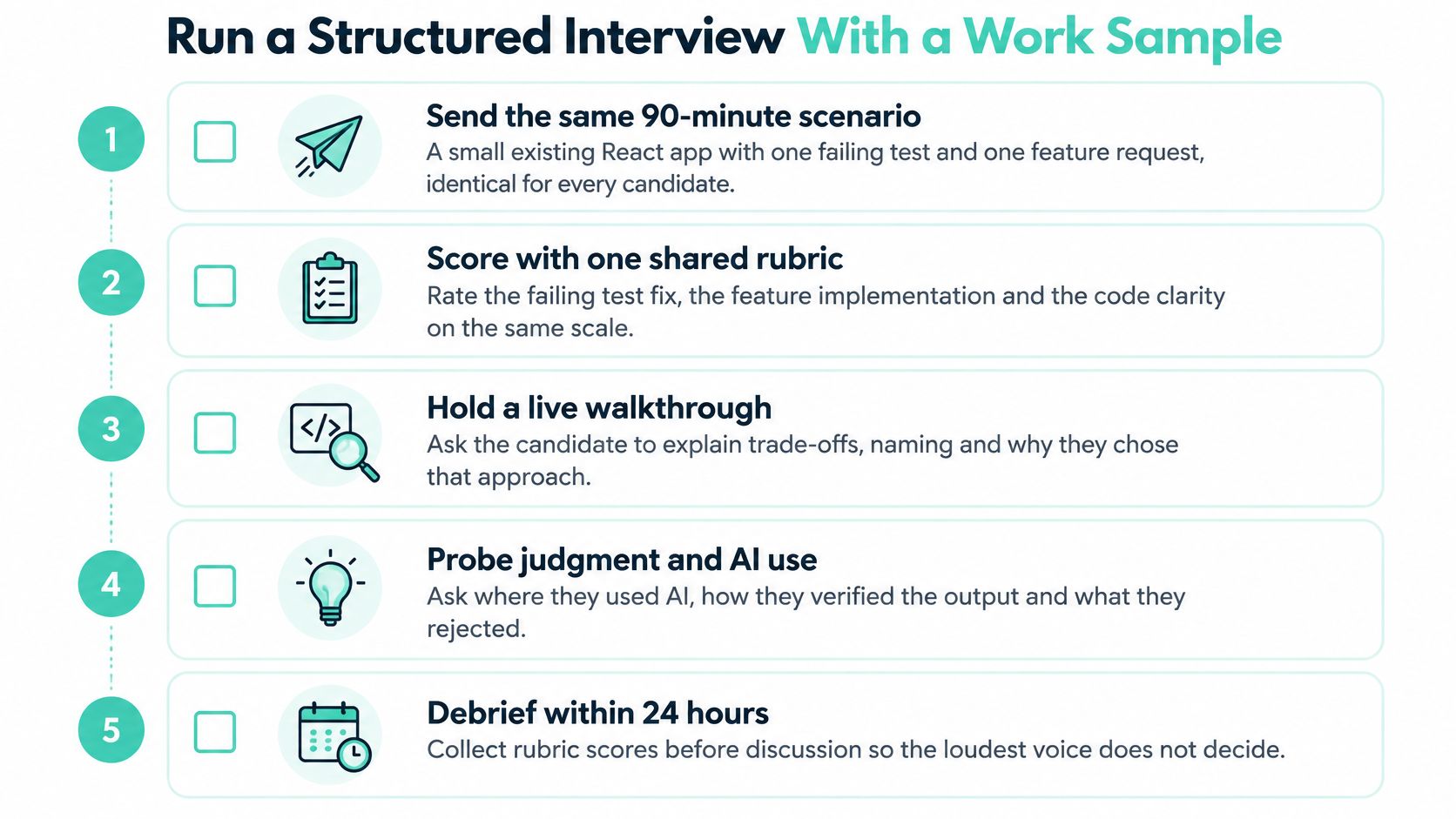
Send every candidate the exact same 90-minute scenario. Give them a small, pre-configured React repository with mocked API fixtures, one failing test caused by a realistic state or rendering defect, and one small feature request to extend. State the 90-minute cap clearly in the invite so no one burns a full weekend trying to over-polish.
Ask identical behavioral questions in every structured panel. Cover three concrete moments: a shipped feature with messy requirements, a technical disagreement where they had to weigh trade-offs, and a missed deadline or production bug they helped recover from. Keeping the prompts identical lets you compare answers cleanly across candidates instead of chasing tangents.
Require independent scoring across five dimensions before anyone talks. Each interviewer rates correctness, maintainability, debugging reasoning, test quality, and communication separately right after their session. Independent scoring prevents a senior founder's early enthusiasm or skepticism from anchoring the rest of the panel.
Anchor your 1-to-5 rubric with observable behavior rather than adjectives. Write down what a 1, 3, and 5 look like on each dimension. For instance, on test quality, a 1 means zero tests or tests that only assert a component mounts; a 3 means passing tests covering the fixed defect and primary flow; a 5 means clean integration tests that cover edge cases, loading states, and error recovery without brittle mocks.
Collect written evidence before opening the debrief. Every score needs a concrete artifact attached, such as the exact hook bug the candidate isolated, a snippet from their test file, or a direct quote explaining why they chose local state over Context. No evidence means the score doesn't count.
Calibrate the rubric against a reference solution your own team built. Have two internal engineers complete the 90-minute repo before any external candidate sees it. If your own senior engineer needs two hours just to get tests running, fix the setup friction immediately and save their solution as your scoring baseline.
Audit your process six months after hire. Compare your interview rubric scores against actual code-review quality, delivery reliability, and six-month manager ratings. If high scores on one dimension never correlate with strong on-the-job execution, tighten that rubric prompt before your next hiring sprint.
For deeper templates on structuring fair technical assessments alongside modern tooling, our guide on how to test IT candidates in the era of AI covers practical prompt and scoring adjustments across engineering roles.
Even well-intentioned teams sabotage good candidates by copying big-tech interview habits that don't fit startup frontend work. Watch for these three traps and swap in the direct fix.
First, heavy algorithm puzzles and framework trivia reject pragmatic product engineers. Asking a React candidate to invert a graph on a whiteboard or recite Fiber internals measures interview prep, not whether they can clean up a leaking useEffect subscription or design clean loading and error states. Replace puzzles with realistic component work inside a real editor.
Second, oversized take-home apps skew your funnel toward whoever has the most unpaid free time. A prompt asking candidates to build a full-stack dashboard with authentication, pagination, and custom CSS from scratch routinely takes ten hours, causing employed senior engineers to drop out immediately. Keep the repo pre-scaffolded and strictly capped at 60 to 90 minutes.
Third, informal post-interview huddles let the loudest speaker override weak evidence. When panels skip written scorecards and jump straight into "so, what did everyone think?", hiring decisions drift toward gut feel and similarity bias. Enforce a strict rule: nobody joins the debrief call until their written scores and evidence are submitted in the scorecard doc.
A 90-minute work sample inside a real repo respects employed candidates' schedules while exposing far more about code quality than a four-hour whiteboard gauntlet.
A candidate opens your React repo, turns on an AI assistant, and asks it to fix a failing test. Three minutes later, the test passes. The UI looks fine. The pull request still may be worthless if the developer cannot explain the state bug, the effect dependency, or why the generated tests assert nothing useful. HackerRank's report on the AI hiring crisis underscores the scale of the shift: 56% of developers admit using AI during coding assessments. A strict no-AI rule mostly tests whether someone can type unaided, which is a poor proxy for production React work.
Treat AI use as a measurement design problem. Allow disclosed assistants such as Copilot, Cursor, or Claude on the same small React repository, then evaluate how the candidate directs, checks, and corrects the output. The question is no longer whether code appeared quickly. The question is whether the engineer understands what shipped.
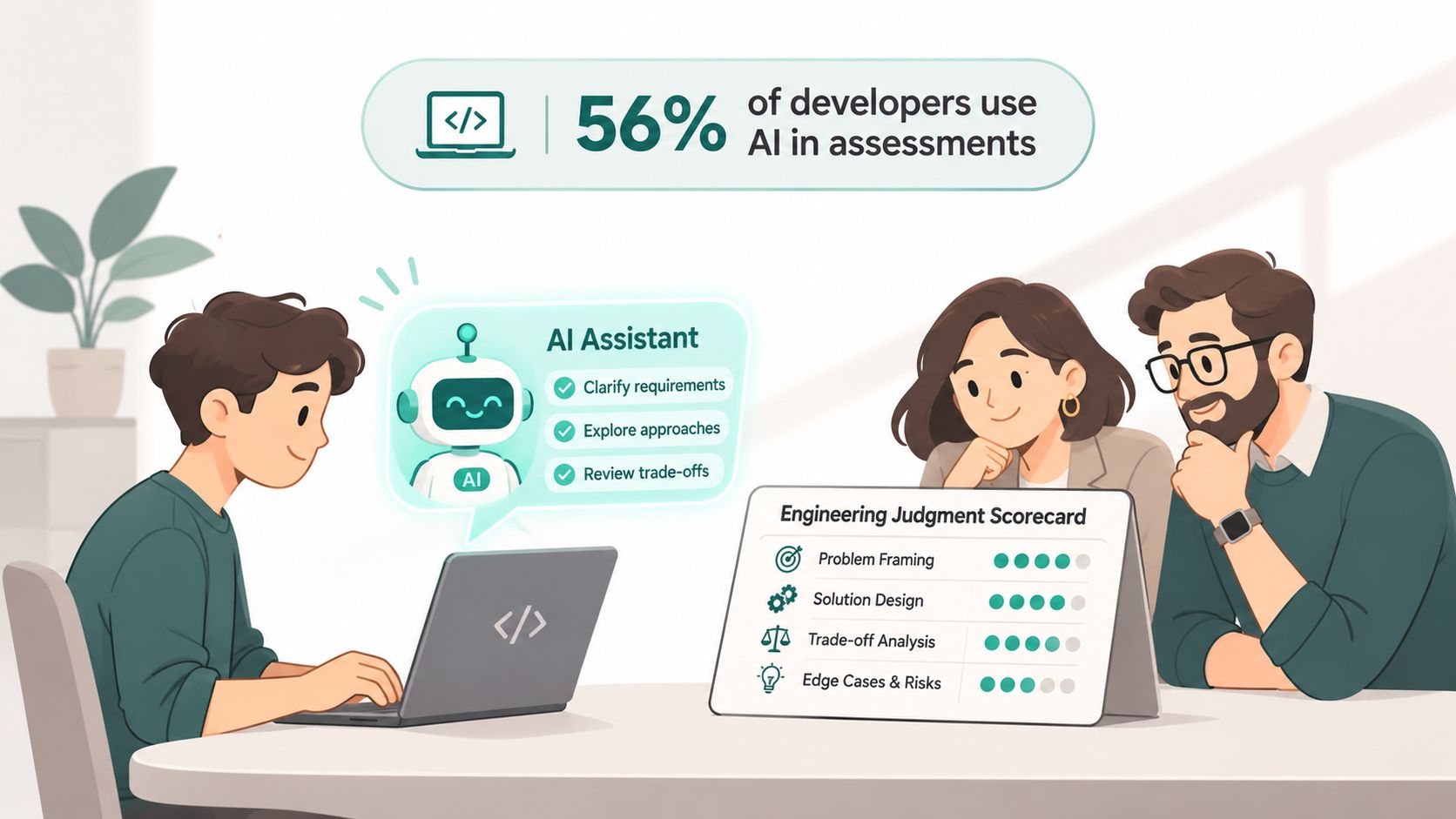
You do not need a new testing platform to evaluate AI-assisted React engineers. Keep the 90-minute repository with one planted defect and one feature extension. Tell candidates they may use their normal AI tools openly, then score four judgment areas during the review and live walkthrough:
useEffect, or split a component boundary the way they did.The practical trade-off is clear. Allowing AI makes raw code generation less useful as a signal, so the interview must put more weight on codebase reading, problem decomposition, and verification. That is closer to the job. A React developer who can steer an assistant through an unfamiliar repository, reject a bad effect, and test a modal with a keyboard will create more value than one who can reproduce boilerplate from memory.
Reserve fifteen minutes of the live walkthrough for questions that AI cannot bluff through. Ask the candidate to show one AI suggestion they rejected during the exercise and explain why. Experienced React developers usually have concrete examples ready: an assistant introducing a redundant useEffect to sync derived props, adding useMemo around a cheap primitive calculation, or suppressing a TypeScript union error with as any. Candidates who blindly accepted every completion often stall here because they never formed a technical opinion about the output.
Then pick one generated function or hook from their submission and ask them to modify its behavior live while talking through the change. Ask how they would cancel an in-flight fetch when the user changes a search filter quickly, or how they would extract a shared error boundary. The point is not speed. Editing code they did not type character by character shows whether they own the logic or merely imported it.
Used together, these prompts expose the decision layer. Rejecting a suggestion shows taste. Modifying generated code under discussion shows whether the candidate can hold the system model in their head while changing it. Both matter more than polished syntax.
Watch for three failure patterns during code review and the live walkthrough:
useEffect dependency array, or why removing an ESLint rule to silence a warning introduces a stale closure.At a startup, one React engineer frequently owns ambiguous product features without a dedicated QA department or a staff architect checking every pull request. That makes unverified AI output a real cost center. A developer who accepts a plausible component without checking focus behavior, loading states, or stale data may hand the team weeks of cleanup disguised as velocity.
The signal that protects your codebase is whether someone can spot subtle defects in code they did not write from scratch. AI changes the source of the code. It does not change the need for engineering judgment.
Great interview loops still fail when teams hesitate at the finish line. After the structured panel wraps, skip endless consensus debates and apply a clear, pre-agreed decision rule directly to the submitted scorecards.
Extend an offer when a candidate demonstrates clear, documented evidence in at least two of your three must-have competencies (component design, testing, and production ownership) and the panel averages at least a 3 on production ownership on your 1-to-5 rubric. If a candidate clears that bar, don't hold them in limbo for ten days hoping a mythical unicorn appears in next week's batch.
Move from final panel to verbal offer within 48 hours. When an engineer has already invested three to four hours in your loop and delivered a clean work sample, fast follow-through signals an organized engineering culture and beats slower competitors still scheduling executive coffee chats.
Decisiveness is a recruiting advantage. If a candidate clears your pre-set rubric bar, waiting a week to "see a few more profiles" usually costs you the hire you already vetted.
Before making the call, calibrate your compensation band against current market reality rather than last year's spreadsheet. Treat broad federal median wages for general software developers only as a rough floor, because government occupational averages pool every developer specialty together and don't isolate React engineers or startup equity splits.
Benchmark your base salary and equity mix against live React postings in your target cities and remote tiers. Reviewing current startup compensation benchmarks before your scope call prevents the costly mistake of running a tight two-week loop only to lose your top finalist over an outdated offer band.
You can put this entire React developer hiring workflow into motion this week without buying new software or rewriting your company handbook:
If referrals and cold outbound aren't filling those five work-sample slots fast enough, companies at pre-seed, seed, Series A through C, and high-growth tech stages use Underdog.io to staff up and make key hires. Run it head-to-head against your referral and staffing channels for two weeks, then double down on whichever source delivers finalists who pass your rubric.
Before Monday morning hits, finish your anchored scorecard and get the first five work samples on the calendar.
If you're ready to skip noisy job-board piles and meet pre-vetted, often passive React engineers who match your startup's stack and stage, explore how we connect high-growth engineering teams with production-tested talent directly. Visit Underdog.io to define your role requirements and start building a stronger shortlist for your next hiring sprint.