A capable candidate opens a system design interview by choosing PostgreSQL. Within the first minute, they've committed to a database, a cache, and perhaps a queue. The rest of the round becomes a defense of an architecture nobody asked for, built on assumptions nobody confirmed.
That approach stalls strong engineers because system design interviews don't reward memorized diagrams. They reward structured thinking, clear trade-offs, and calm communication when the requirements change. Startup interviewers also weigh judgment differently from large-company interviewers. They want to know whether you can move quickly without creating avoidable operational risk, and whether you can keep a small team productive while the system grows.
These nine system design interview tips focus on the decisions behind the architecture. You'll learn how to scope the problem, estimate demand, evolve a simple baseline, explain failure modes, and validate the final design. Each tip ends with a short drill you can run before the interview.
The first decision is whether to spend a few minutes understanding the product or rush toward implementation. Choose understanding. A short scoping conversation prevents you from solving the wrong problem and gives the interviewer evidence that you can work with product and engineering uncertainty.
Ask questions in three groups. First, clarify behavior. What can users create, read, update, or delete? Which actions must happen immediately? Which actions can finish later? For a social media system, ask whether friend lists require strongly consistent reads or whether temporary divergence is acceptable. For a payment system, clarify the availability objective and what happens when a payment provider is unavailable. For a cache, ask whether stale data is safe.
Next, establish workload assumptions. Separate registered users from active users and peak concurrent users. Ask about the read-to-write ratio, payload sizes, data retention, geographic distribution, and latency expectations. A service with a large user base may still have modest concurrency, while a read-heavy feed may need caching and replication before it needs sharding.
Use software engineer interview questions as practice prompts, but don't turn the conversation into a questionnaire.
Practical rule: Ask only questions that can change your architecture. Then state reasonable assumptions for everything else.
A startup may prefer a simple system that a small team can operate over a globally distributed design with more theoretical headroom. Make that trade-off visible. Confirm privacy requirements, deletion behavior, and regional constraints before selecting storage or replication.
Timeboxed drill: Choose a social feed or payment prompt. Spend three minutes writing functional requirements, nonfunctional requirements, workload assumptions, and two unanswered questions. Then explain which architectural decision each answer could change.

A startup interviewer often weighs speed of delivery against future scale. Start with the smallest architecture that satisfies the stated requirements, then add machinery only when a measured constraint justifies it. This approach gives you a design you can explain and a credible path for evolution.
Begin with a single application server, a monolithic database, and a clear API boundary. For an Instagram-like product, you might start with PostgreSQL for users, posts, and relationships. If repeated reads for popular content create pressure, add Redis for carefully selected hot data. If notifications begin delaying user requests, introduce a message queue and separate consumers.
The order matters because every component adds ownership work. A queue creates retry and replay behavior. A cache creates invalidation rules. A microservice creates deployment, observability, and network-failure concerns. None of those mechanisms is free.
For ride sharing, a relational database may support the first version. When location matching becomes the limiting operation, add a geo-indexed component rather than splitting every domain into services. For e-commerce, keep product data and checkout simple at first, then isolate payment processing when security, reliability, or team ownership makes that boundary useful.
The software engineer interview questions guide can help you practice explaining a baseline before discussing scale-out mechanisms.
Timeboxed drill: Pick an e-commerce prompt and draw three versions in ten minutes. Show a single-server baseline, one bottleneck-driven improvement, and a later scale-out design. Label the reason for every new component.
There is no perfect system design. An interviewer is listening for the decision behind each component, especially when consistency, availability, partition tolerance, latency, and cost pull in different directions.
The CAP history gives you a precise way to discuss distributed trade-offs. Eric Brewer introduced the CAP conjecture in the late 1990s. It was published in 1999 and presented at the 2000 Symposium on Principles of Distributed Computing. Seth Gilbert and Nancy Lynch formally proved it in 2002, turning the conjecture into the CAP theorem. Their result says that a shared-data system can't simultaneously guarantee consistency, availability, and partition tolerance during a network partition. Brewer's CAP paper provides the original reference.
Don't repeat the popular “pick any two” slogan without context. In a geographically distributed service, partition tolerance is generally unavoidable. During a partition, you choose whether to preserve consistency by rejecting or delaying some operations, or preserve availability while replicas temporarily diverge.
For payments, a CP-oriented choice may prevent duplicate charges even if some operations fail temporarily. For a social feed, an AP-oriented choice may keep reading responsive while replicas converge later. SQL can be a sensible fit for strongly consistent financial transactions. A NoSQL store may fit a high-throughput feed when eventual consistency is acceptable.
Use a sentence pattern that exposes your reasoning:
A strong answer doesn't hide the cost of a decision. It names who experiences that cost and how the team will detect it.
Timeboxed drill: Take three architecture choices, SQL versus NoSQL, synchronous versus asynchronous work, and cache versus direct database reads. For each, speak for one minute using choose, sacrifice, and control.

Estimation turns an architecture discussion into an engineering discussion. You don't need false precision. You need assumptions that expose whether a database, cache, queue, or network path could plausibly handle the workload.
Start with requests per second, read and write ratios, average payload size, storage growth, bandwidth, and latency objectives. Write the arithmetic where the interviewer can follow it. If you assume a certain number of daily actions, divide by 86,400 seconds to estimate average queries per second, then apply a stated peak factor qualitatively if the prompt doesn't provide one. Keep the calculation tied to the product, not to memorized infrastructure folklore.
Google's large-system-design guidance recommends beginning with the problem statement and requirements, then refining the architecture through capacity planning, component isolation, graceful degradation, and operational review. Its highly available software material describes the challenge of evolving a conventional LAMP-style service to support 100 million users, while covering monitoring, capacity planning, and design reviews. That marker isn't an interview target. It shows why workload estimates should precede technology selection. Google's design guidance explains the broader approach.
For storage, multiply record count by average record size, then account for indexes, backups, and replication. For a read-heavy product, estimate how much traffic targets hot data before proposing a cache. For video, calculate encoded bitrate multiplied by concurrent viewers and explain why content delivery infrastructure becomes central.
Avoid presenting invented assumptions as facts. Say, “I'll assume,” show the equation, and invite the interviewer to adjust it.
Timeboxed drill: Select a URL shortener or media service. Spend five minutes estimating request volume, storage, bandwidth, and the dominant read or write path. Circle the assumption most likely to change your design.
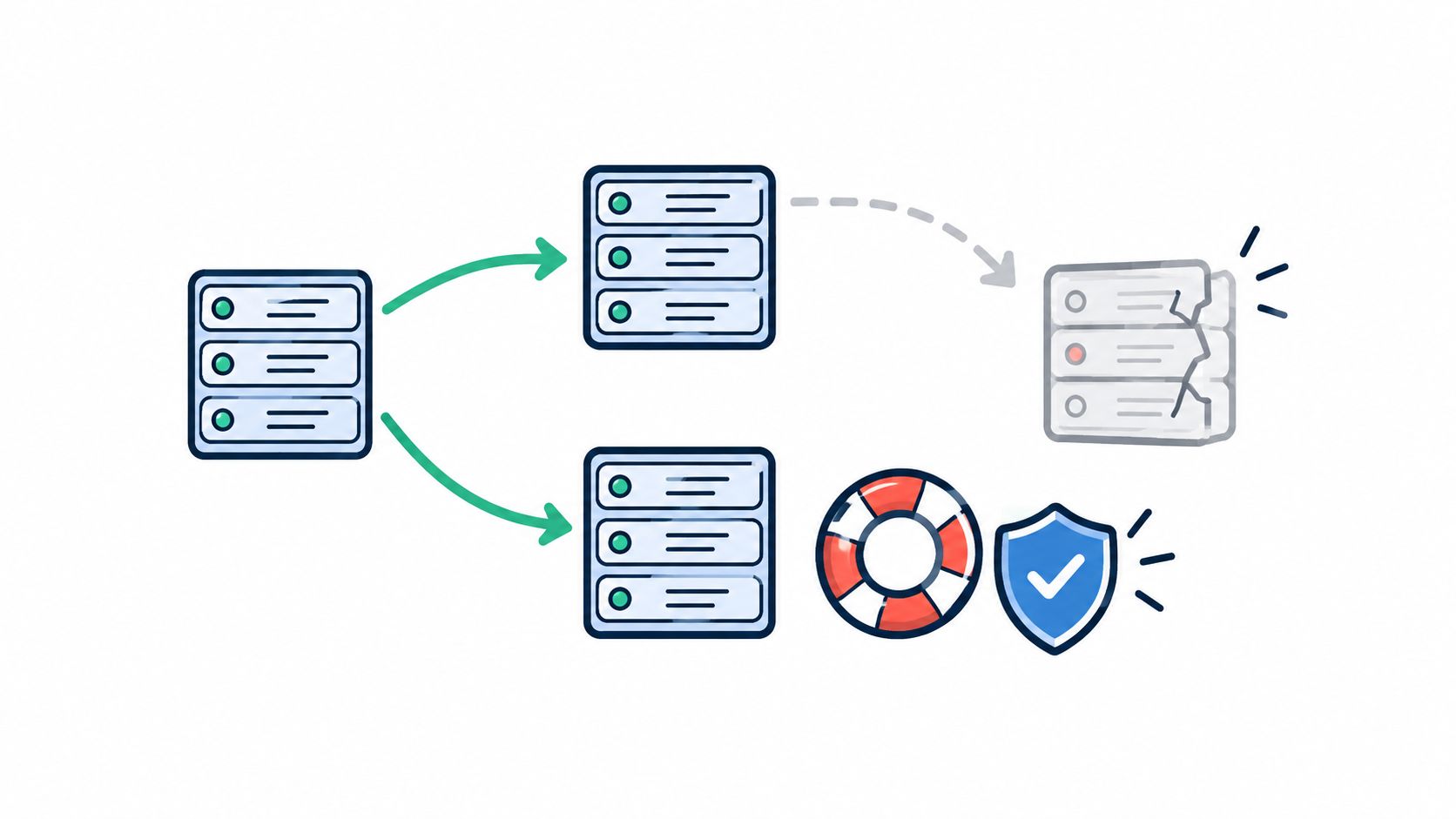
A startup interviewer isn't only asking whether the happy path works. They're asking what happens when a dependency is slow, a replica is unavailable, a queue consumer crashes, or a third-party API returns errors.
Treat every dependency as a failure boundary. Add timeouts so requests don't hang indefinitely. Use retries carefully, with backoff and idempotency. Add circuit breakers around external services so repeated failures don't consume every application thread. Health checks should remove unhealthy instances from traffic, but they shouldn't pretend that a passing process check proves the entire request path is healthy.
Suppose a payment provider is unavailable. You might accept a payment intent into a durable queue, show the user that processing is pending, and prevent duplicate submission with an idempotency key. That choice preserves correctness without pretending the payment completed.
A recommendation service can fail without taking down product browsing. Return popular or recently viewed items instead. A notification provider can fail while the core transaction succeeds. Store the event and retry delivery later.
Timeboxed drill: Draw a checkout flow and mark every dependency. For each one, write a timeout, fallback, retry rule, and recovery action. Then identify one failure where retrying would make the problem worse.
A startup interviewer is weighing faster reads against stale data, memory cost, and operational work. State the bottleneck first. Then place a cache where repeated reads justify the added failure mode. Explain what happens on a miss, during invalidation, and when the cached value is old.
Start at the edge when the content is stable. Browser caching reduces repeated downloads of JavaScript and CSS. A CDN serves static assets and public responses closer to users. An application cache such as Redis or Memcached can store sessions, popular feed entries, or computed results. Database query caching may help with carefully selected, repeated queries, but it should not hide an inefficient query indefinitely.
Each layer has a different owner and risk. A browser can retain data after the server changes it. A CDN needs cache headers and a purge process. Redis needs memory limits, expiration rules, and a plan for losing entries. Database caching can increase pressure when many requests miss simultaneously.
Use time-based expiration when the acceptable stale period is known. Use event-based invalidation when a change must appear promptly. For critical data, reading the source directly may be safer than returning an old value.
Warm the cache before a launch or large event when predictable traffic justifies it. Prevent stampedes by coalescing simultaneous misses, adding jitter to expiration, or serving a controlled stale value where the product allows it. Track hit rate, miss rate, evictions, and backend load. A busy cache that does not reduce database pressure adds cost without solving the bottleneck.
Cache only what you can explain. State its freshness rule, invalidation path, and failure behavior.
Timeboxed drill: Choose a feed or product catalog. In six minutes, identify one browser or CDN cache, one application cache, and one data path that must not depend on stale values. State the freshness rule, invalidation method, miss behavior, and stampede control for each.
The central startup trade-off here is operational simplicity versus independent scaling. Keep application servers stateless where possible, then distribute requests across instances with a load balancer. Stateless services make replacement and horizontal scaling easier because any healthy instance can handle the request.
Round-robin routing is a useful baseline when instances are similar. Health checks prevent traffic from reaching failed nodes. Geographic routing can direct users toward a nearby region when latency and regional availability matter. Rate limiting at the edge or load balancer can protect application capacity, but stateful limits require a shared or partitioned store.
Partitioning improves capacity only when the key distributes work evenly and supports the queries the product needs. User ID sharding may work for user-owned records, but it can create hot partitions if one account receives disproportionate traffic. Time-based partitioning can simplify retention and recent-data queries, but recent partitions may receive most writes.
Consistent hashing can distribute cache keys while reducing movement when nodes change. Any approach needs a rebalancing plan. Explain how the system migrates data, keeps reads available during movement, and handles a partition key that turns out to be a poor choice.
Don't claim that sharding is the inevitable next step. First ask whether indexes, query changes, replicas, batching, or caching solve the actual bottleneck. A small team may prefer a larger single database and a clear operational model until the workload proves otherwise.
Timeboxed drill: Design storage for a multi-tenant application in seven minutes. Choose a partition key, identify a hot-key risk, explain read routing, and describe how you would rebalance when adding capacity.
A queue is useful when the user doesn't need the work completed before receiving a response. It separates producers from consumers, lets each side scale independently, and gives the system a durable place to hold work during a temporary consumer failure.
User registration is a straightforward example. The account service can create the user and publish a welcome-email event. An email worker consumes it without making signup wait for the email provider. The same pattern fits analytics, notifications, media processing, fulfillment, and other background work.
RabbitMQ, Kafka, and AWS SQS offer different delivery, ordering, retention, and operational models. Don't name one without explaining the requirement. Does the consumer need replay? Does order matter per user or per account? Can messages be duplicated? How long should failed work remain available?
At-least-once delivery means a consumer may process the same event more than once. Use idempotent handlers, event identifiers, deduplication records, or transactional boundaries that prevent duplicate side effects. Monitor queue depth, oldest-message age, consumer errors, and processing latency. A growing queue is not merely an infrastructure metric. It may mean users are waiting for a business action.
Use dead-letter queues for messages that repeatedly fail, but include an operator workflow for inspecting, repairing, and replaying them. Priority queues can protect critical work, though they may starve lower-priority events if you don't control scheduling.
Timeboxed drill: Design a purchase-order workflow in eight minutes. Mark the synchronous response, every event, consumer responsibility, retry policy, idempotency key, and dead-letter path. Then explain what the customer sees during fulfillment delay.
The last decision is whether to stop after drawing the architecture or test it against actual user behavior. Walk through one important request from client to storage and back. Then walk through a failure and a traffic increase. This catches gaps that a polished diagram hides.
Start with the happy path. In e-commerce, trace order creation through payment authorization, inventory reservation, order persistence, and fulfillment. Ask which steps must be atomic and which can be asynchronous. If the payment service becomes the bottleneck, discuss connection limits, timeouts, idempotency, queueing, and reconciliation rather than just adding another service.
For a social platform, trace feed generation. Decide whether the system reads and merges followed accounts at request time or maintains a precomputed feed. A cache may reduce repeated reads, while a push-on-write approach may reduce request work at the cost of fan-out complexity. For ride sharing, trace a ride request through location matching and driver notification. Geographic partitioning may help, but it also complicates cross-boundary searches.
The software engineer interview preparation guide is useful for rehearsing these discussions, but your walkthrough should remain grounded in the specific product and assumptions in front of you.
Timeboxed drill: Set a twelve-minute timer for a ride-sharing or e-commerce prompt. Spend half the time on the happy path and half on two failures. Finish by naming the first bottleneck, its signal, and the next design change.
| Technique | Implementation complexity | Resource requirements | Expected outcomes | Ideal use cases | Key advantages |
|---|---|---|---|---|---|
| Start with Clear Problem Scoping and Clarifying Questions | Low, discussion-focused | Minimal time, domain knowledge | Aligned requirements, fewer reworks | Early interview scoping, ambiguous briefs | Prevents wrong solutions, shows communication |
| Use the Bottom-Up Approach: Start with Core Components | Low–Medium, incremental build | Knowledge of core components, time to iterate | Layered, explainable architecture | Systems with evolving requirements, teaching design | Easier to explain, prevents over‑engineering |
| Prioritize Trade-offs Discussion Over Perfect Solutions | Medium, requires judgement | Deep systems knowledge, examples | Balanced decisions, clearer rationale | Complex constraints, resource-limited contexts | Demonstrates systems thinking, business alignment |
| Apply the Estimation Framework: Back-of-Envelope Calculations | Medium, quick math under pressure | Numerical intuition, common metrics | Concrete sizing, justified choices | Capacity planning, scaling decisions | Quantifies needs, prevents mis‑sizing |
| Design for Failure and Resilience Explicitly | High, redundancy & patterns | Additional infra, monitoring, expertise | Improved reliability, graceful degradation | User-facing services, third‑party dependencies | Prevents cascades, production‑ready thinking |
| Leverage Caching Strategically at Multiple Layers | Medium–High, invalidation complexity | Cache systems (CDN/Redis), memory, monitoring | Faster responses, reduced DB load | Read‑heavy workloads, limited infra budgets | Dramatic performance gains, cost effective |
| Design for Scalability Through Load Balancing and Partitioning | High, sharding and LB logic | Multiple instances, orchestration, ops | Horizontal scale, higher availability | High‑traffic or global services | Handles massive scale, reduces single points |
| Use Message Queues to Decouple Components and Handle Asynchronous Work | Medium, async coordination | Queue service, consumer infra, monitoring | Decoupled flows, better responsiveness | Background jobs, event-driven pipelines | Independent scaling, durability, reliability |
| Validate Your Design Through Walkthrough and Bottleneck Analysis | Low–Medium, structured review | Time, scenarios, simple load assumptions | Identified bottlenecks, refined design | Final interview step, pre‑deployment reviews | Catches flaws early, shows thoroughness |
System design interview performance improves when you practice the sequence, not just the vocabulary. Use the first week to build consistency. Pick one sample question per day and run the same opening routine: clarify requirements, separate functional from nonfunctional needs, estimate workload, and draw a simple baseline. Keep the design deliberately modest until an assumption or bottleneck requires more machinery.
Timebox clarifying questions to three minutes. Write down the assumptions instead of holding them in your head. Then sketch the request path, storage model, and main read and write flows. Spend the next part of the session adding only the components that respond to a stated constraint.
A practical first week can rotate through a feed, payment flow, notification service, URL shortener, file upload pipeline, ride-sharing dispatch flow, and e-commerce checkout. The point isn't to memorize seven finished architectures. It's to notice recurring decisions around consistency, caching, queues, partitioning, failure, and observability.
In the second week, repeat selected prompts under changing conditions. Start with the same baseline, then introduce a new requirement. The product now serves multiple regions. A third-party provider is unreliable. Writes become more important. Users need deletion and retention controls. Latency becomes more sensitive. Ask how the design changes and which earlier assumption no longer holds.
Review the trade-offs you stated out loud. Did you explain what you sacrificed? Did you connect the decision to user impact? Did you name a metric or alert that would reveal the boundary of the choice? Did you describe recovery, not just failure?
Google's system-design guidance emphasizes iterative refinement, capacity planning, component isolation, graceful degradation, and operational concerns. Those habits are more valuable than a collection of impressive technology names. A strong interview answer shows how the system can start modestly, evolve under measurable pressure, and remain understandable to the team operating it.
Record one or two sessions if you can. Listen for premature technology choices, hidden assumptions, and long explanations that never reach a decision. Replace “I would use Kafka because it scales” with “I need durable asynchronous processing and replay, so I'll evaluate a log-based system. If replay isn't required, a simpler queue may reduce operational work.”
That difference matters even more in startup interviews. Small teams need engineers who can make a sound first decision, identify the riskiest assumption, validate it, and keep a rollback path. The best answer may be a monolith, a relational database, and one background worker. The best answer may later become a more distributed design. Your job is to explain when and why.
Candidates targeting startup roles can apply through Underdog.io, a curated hiring marketplace where a single 60-second application is free and reaches vetted companies. Use the practice plan to prepare for conversations where interviewers care about ownership, adaptability, and the ability to make progress without hiding uncertainty.
The final preparation session should be a full simulation. Give yourself a prompt, follow the three-minute scoping limit, estimate on paper, draw the baseline, add justified components, walk through a failure, and finish with bottleneck analysis. Afterward, write down one decision you made from experience, one from documentation, one from measurement, and one that remains a hypothesis. That provenance makes your reasoning sound human because it reflects how engineering decisions happen.
If you're preparing for a startup system design interview, Underdog.io connects software engineers with curated opportunities at startups and high-growth technology companies. Submit the free 60-second application, then use the interview practice routine above to show how you reason about trade-offs and evolving systems. Visit Underdog.io to explore the marketplace.