You can send more applications than anyone else in your market and still get fewer replies. Indeed's own analysis found that job seekers who submitted the highest number of applications were 39% less likely to receive a positive employer response (Indeed career advice). Volume isn't a strategy. It's a queue, and tech candidates are standing in the longest one.
That queue exists because online search took over the labor market in a single generation. The share of unemployed Americans using online job search climbed from 26% in 2000 to 76% in 2011, according to Indeed Hiring Lab, as employers abandoned newspaper classifieds and employment agencies for digital postings. Everyone arrived at the same aggregator, and the aggregator optimized for inventory.
The consequence is blunt. A general board's scale is an employer-side feature, not a candidate-side one. When three hundred people apply in two days, screening collapses into keyword matching, and a strong engineer with an unusual background loses to a resume that happens to repeat the right nouns. The alternative to Indeed isn't another giant database. It's a channel whose economy rewards fit.
The ten platforms below are chosen that way, each for a different kind of search. Curated startup marketplaces, niche tech boards, remote-only boards, and recruiter-led staffing firms solve different problems. One of them flips the direction of the search entirely: fact-based matching, where vetted startups approach you after a single short application, and where candidates hear back at a rate the big boards don't approach.
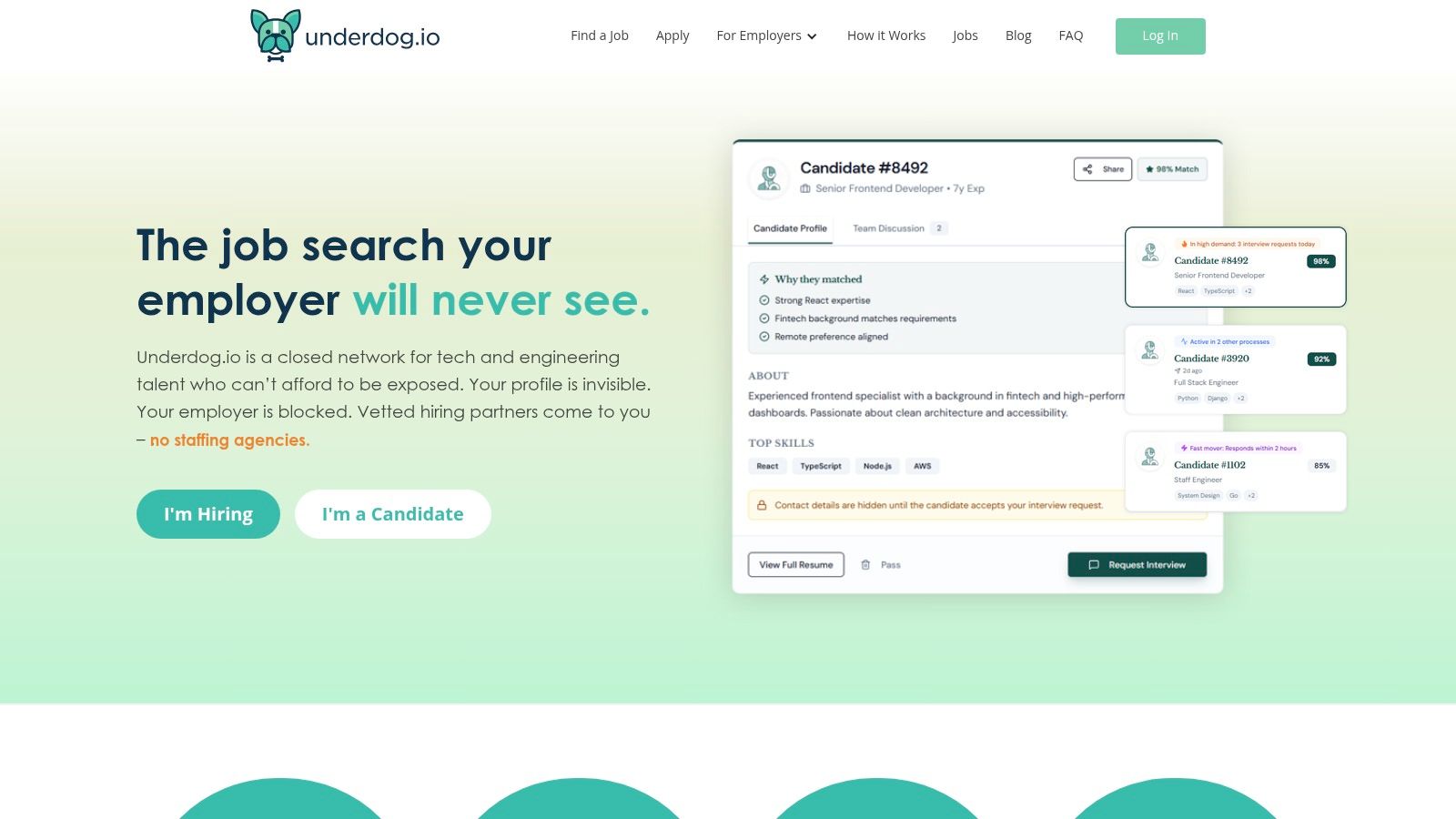
One application, roughly a minute of typing, no cover letter, no retyping your work history. Then companies come to you. That reversal is why this sits at the top of an alternative to Indeed list built for engineers, PMs, designers, and data people who want startup work without the application treadmill.
Every profile is reviewed by a person before it enters the pool, and only about 5% of applicants get accepted. Companies are screened on the other side for funding status, team quality, and product viability, so the marketplace stays small on purpose. You apply once to reach hundreds of vetted tech companies, and those companies apply to you: founders, hiring managers, and other decision makers reach out directly, with no staffing agencies in the middle.
Discretion is built into the model. Your profile stays hidden from current and past employers, and from any other companies you choose to block. That matters because most of the pool is passive: around 85% of candidates are employed and exploring rather than actively hunting. Roles span engineering, product, design, data, and marketing at early-stage to Series B startups in New York City, San Francisco, and throughout the US.
The response math shows why the model works. Indeed reports a 30% average candidate response rate worldwide for employer outreach through Indeed Resume in first-quarter 2024 data (Indeed for employers). Cold messages into a keyword-matched resume database get ignored most of the time. A message inside a small pool where every candidate opted in and passed a human review lands differently, and employers have a second reason to write carefully: companies on pay-per-hire terms owe a placement fee for each successful hire, so nobody burns a contact on a maybe.
What the employer data says: in iHire's 2025 employer survey, 68.6% of respondents said they conduct all or most hiring through job boards, while 59.7% said those boards deliver too many unqualified applicants (iHire State of Online Recruiting 2025). Curation attacks the second number without giving up the first.
Candidates pay nothing at any stage; employers pay per hire or through a subscription that includes unlimited seats and a year of unlimited hires. If startup work is the target, start with the short application at Underdog.io and see what lands in your inbox.
LinkedIn is two products wearing one coat: a job board and a professional graph. Most candidates use only the first half, which is why their applications disappear. The board gives you search, saved listings, alerts, and Easy Apply on some postings. The graph gives you the hiring manager, the recruiter, and the person who already works on the team.
Indeed's analysis of aggregated, anonymous U.S. Indeed Apply data found that candidates who applied using an Indeed Resume were 24% more likely to receive a positive employer response than candidates who uploaded a resume file (Indeed career advice). The lesson transfers directly. A structured, complete profile with skills, dates, and a one-line summary outperforms an attachment nobody opens, so build the LinkedIn profile to be read by a search query, not admired by a designer.
It suits professionals who want relationships alongside listings and don't mind maintaining a profile. Free search and alerts cover most of it, and Premium is optional.
ZipRecruiter is the general-purpose volume play. One profile, search across categories and locations, alerts, recommendations, one-tap applications on some roles, and a mobile app that surfaces new postings quickly. It's free for job seekers and covers far more than technology, which helps if you're hedging between a startup and another industry.
The catch is arithmetic. Many listings are duplicates or reposts of the same job, so one posting may not represent one open role. A single position can appear several times across the board with slightly different titles, and one posting can also cover multiple openings.
Read that as a warning about counting. If you're measuring your search by how many listings you applied to, you're measuring the wrong thing. Count responses and recruiter conversations instead.
Set alerts narrowly, apply within the first two days of a posting going live, and confirm the role still exists on the employer's own careers page before you invest an hour in a custom application.
The weakness is predictability. Recommendations drift broader than your target, some listings hand you off to an external site, and duplicate postings are common. There's no curation layer here, just inventory, so the filtering work falls on you.
It suits candidates who want maximum inventory and don't mind doing their own screening. Keep it as a second board, not an only board.
Glassdoor earns its place for research, not inventory. It pairs listings with anonymous employee reviews, company ratings, salary information, and interview reports. Use it before an interview or a compensation conversation, not as your primary source of openings.
The ownership matters here. Glassdoor is part of Indeed and draws on Indeed's job listings, so switching to Glassdoor to escape the biggest board's inventory doesn't get you there. What you get is a different lens on the same companies.
Free access is enough for candidate-side work. If you're choosing between two offers, an afternoon on Glassdoor is worth more than another round of applications.
Wellfound, formerly AngelList Talent, is the startup board most engineers already know. You build a profile, search local and remote roles, apply, set preferences, and respond to company outreach. Many postings show salary and equity, and candidate access is free.
Equity disclosure is the reason to be here, and it's also where candidates get lazy. A percentage means nothing without the strike price, the preferred valuation, the exercise window, and the current 409A. Ask all four before you compare two offers. Founders who won't answer those questions in writing are telling you something useful.
The rest of the trade-offs are structural. Company stage, role scope, and compensation disclosure vary from posting to posting. Coverage thins outside startups, so enterprise and non-tech searches stall. Early-stage listings also change fast, so a role posted three weeks ago may already be filled or re-scoped.
Treat Wellfound as a shortlist generator. Verify the company, the funding, and the role's current status yourself before you get attached.
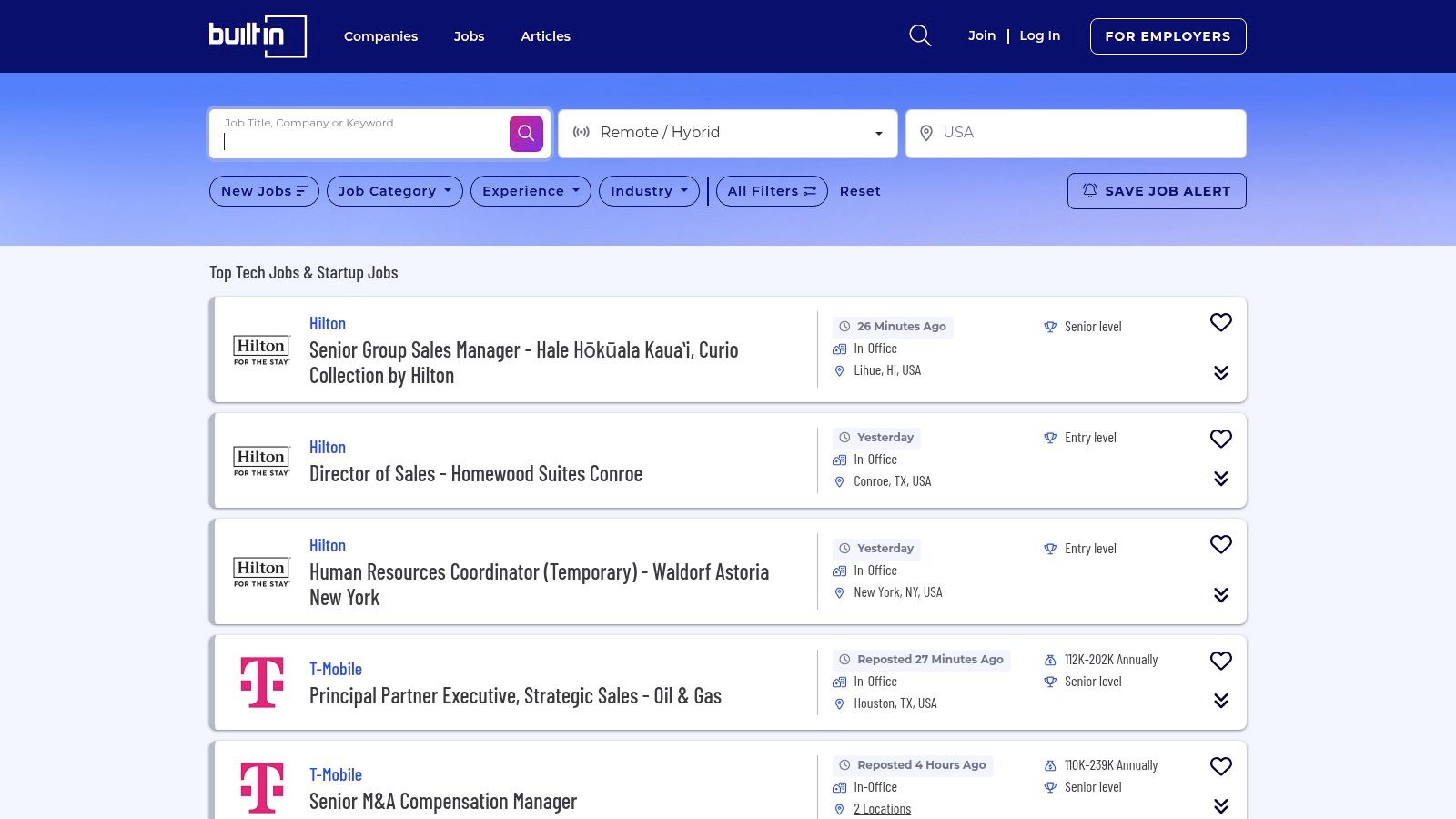
Built In does one thing well: it puts a company profile next to the listing. Engineering, data, product, and design roles across major U.S. markets and remote, plus editorial context on local tech scenes. Search is free, and you can browse by city or nationally.
Shortlisting employers before you apply. If you're moving to a new city or want to compare five companies in the same market, Built In's profile pages give you funding, size, perks, and culture in one pass, which saves twenty browser tabs.
For a deeper comparison of how this board stacks up against a curated startup marketplace, read how Built In compares with Underdog.io. My rule: use Built In for market mapping, then verify each company's funding stage yourself, because "startup" on a listing page covers everything from twelve people to twelve hundred.
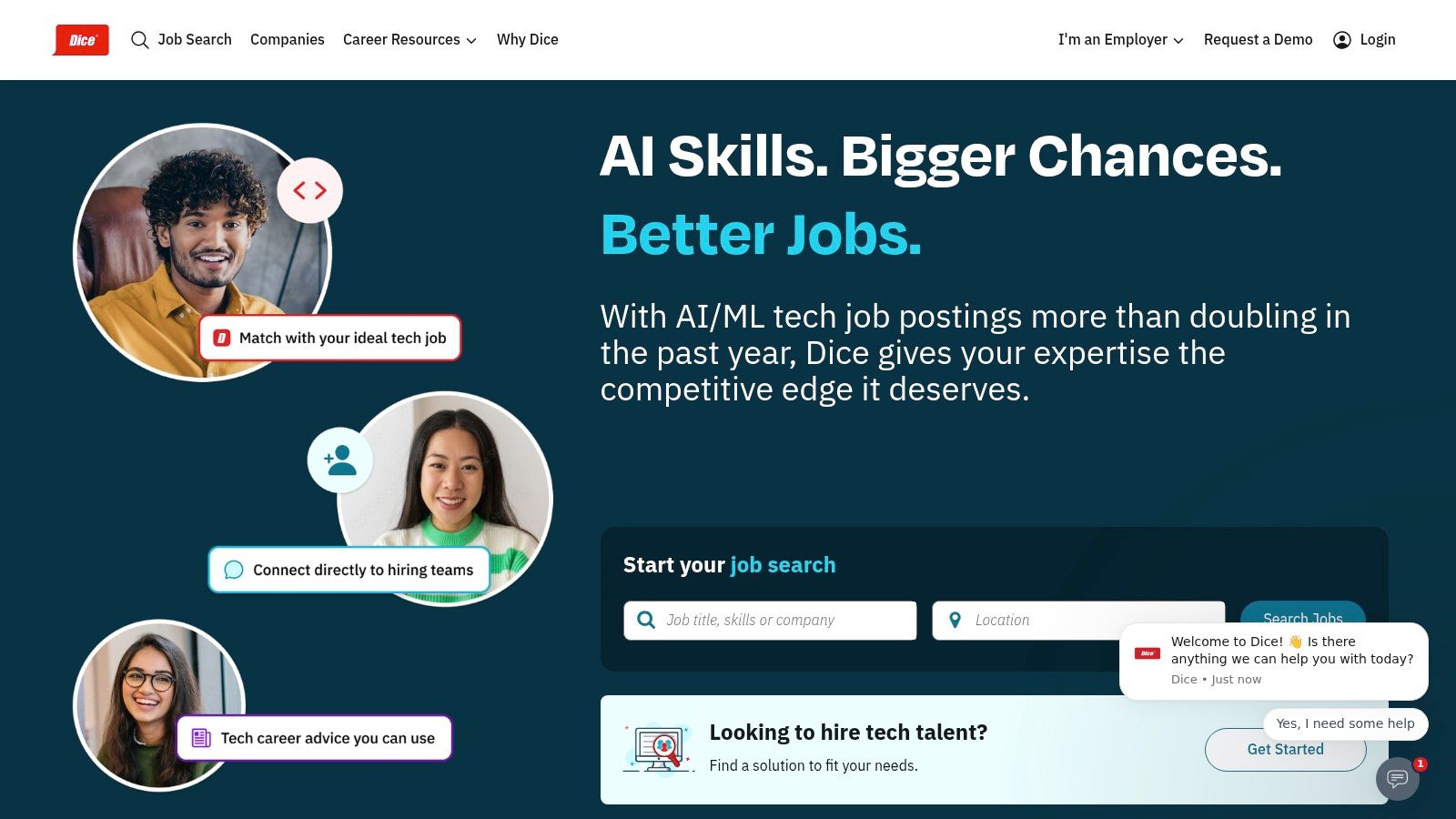
Dice is the specialist for IT and engineering searches. Skill-based filters, job title search, location and work-setting filters for remote, hybrid, and on-site, plus alerts and career resources. Profile creation and searching are free. It covers technical roles across banks, consultancies, defense contractors, and established tech companies, which makes it a useful complement to startup-only boards.
A large share of listings come through staffing agencies rather than the employer directly, and that changes what you're applying to. You may be one of several candidates submitted for the same req, and the recruiter may not tell you which company it is until you're screenshortlisted.
That opacity has a cost. A 2025 Norton survey found 33% of U.S. respondents had encountered employment-related scams or suspicious job postings on job sites, and the FTC recorded more than 132,000 reported job scams in 2025 with $636 million in losses (Norton job scam statistics). Scammers impersonate recognizable employers because the impersonation works.
Never share a Social Security number, bank detail, or a copy of your ID before a signed offer and a verified company domain. Legitimate recruiters expect that boundary.
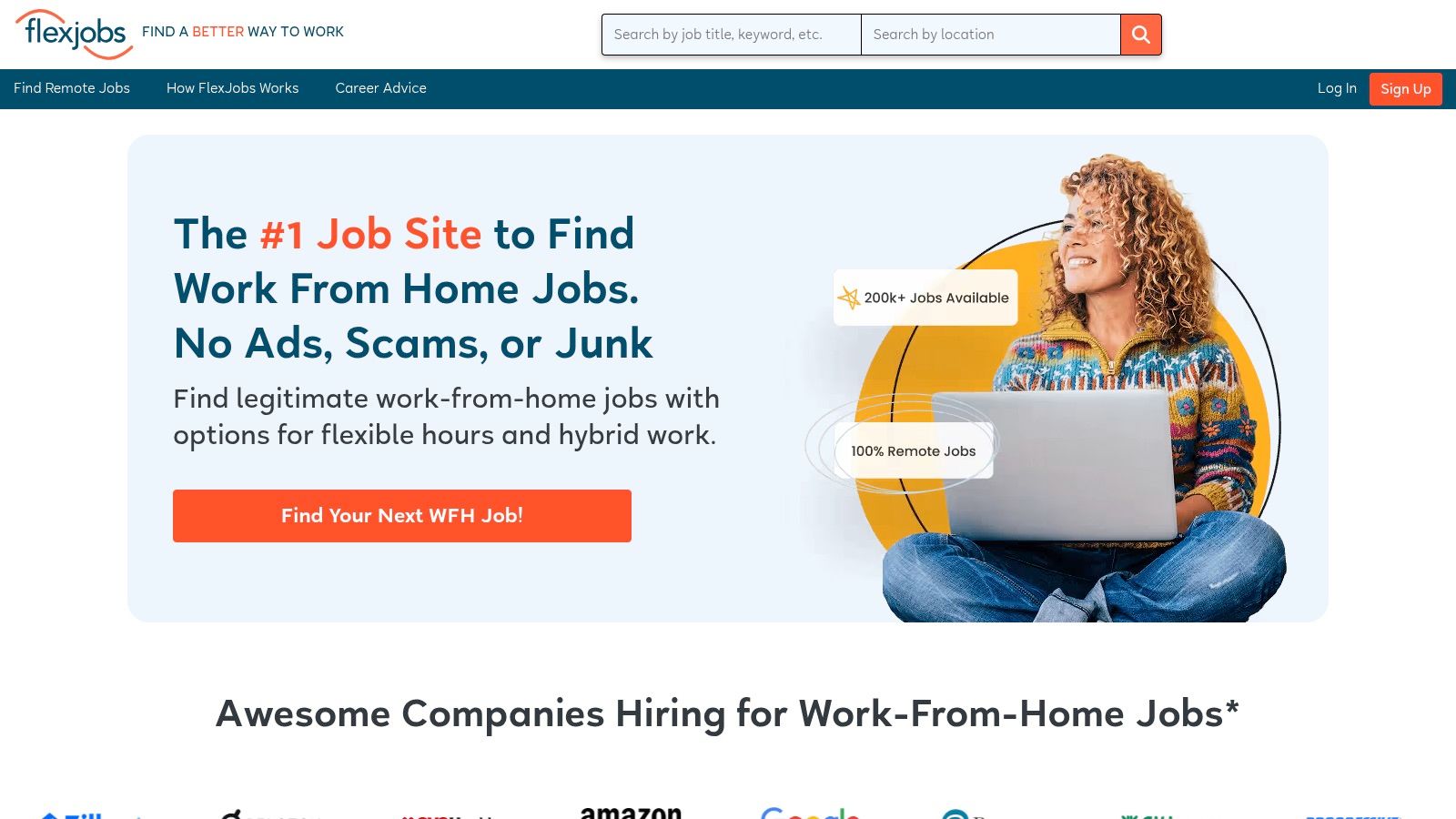
FlexJobs specializes in remote, part-time, freelance, and alternative-schedule work across many professions. Every listing and employer is reviewed before posting, and the subscription bundles job-search resources and support. It's paid for candidates, with a short trial before the recurring subscription, so read the current terms before you enter a card.
The screening is the product. That's also the problem, because a curated walled garden only pays off if you'd otherwise be sifting junk for hours every week.
The candidate-side frustration this addresses is real. A 2025 Checkr survey of 3,000 U.S. adults who had actively searched for work in the previous six months found 58% considered getting an interview or even a response through traditional job-search websites nearly impossible, and 66% had experienced ghost hiring (Checkr Hiring Disconnect 2025). Paying for fewer, cleaner listings is a rational response to that.
Robert Half is a staffing and recruiting firm, not just a listing site. You search roles and submit a résumé for technology, finance and accounting, marketing and creative, legal, and administrative work, and a recruiter may shepherd you through the process. It covers full-time, contract, and contract-to-hire engagements, and applying is free.
There's a measurable difference between a warm submission and a cold application, especially at small companies. A 2026 analysis of more than 1,200 venture-backed startups, covering 32,000 hires and 11 million applications, found startups with fewer than 25 employees cut time to hire by nearly 30% when a recruiter was involved. The same report estimated about 21 interviewer hours per technical hire at companies under 25 employees, against roughly 29 hours at companies with 100 to 300 employees (Ashby startup hiring report).
That's the core value of a firm like this: you borrow someone's pipeline instead of building your own.
The trade-offs are honest ones. Your experience depends heavily on the individual recruiter and the assignment they're filling, contract and contract-to-hire roles outnumber permanent ones in many desks, and early-stage startups are largely absent. If you want a boutique technology relationship rather than a large multi-specialty firm, nexusITgroup.com is the specialist to look at.
For a breakdown of how agency incentives work and who pays whom, read how tech recruitment agencies actually get paid.
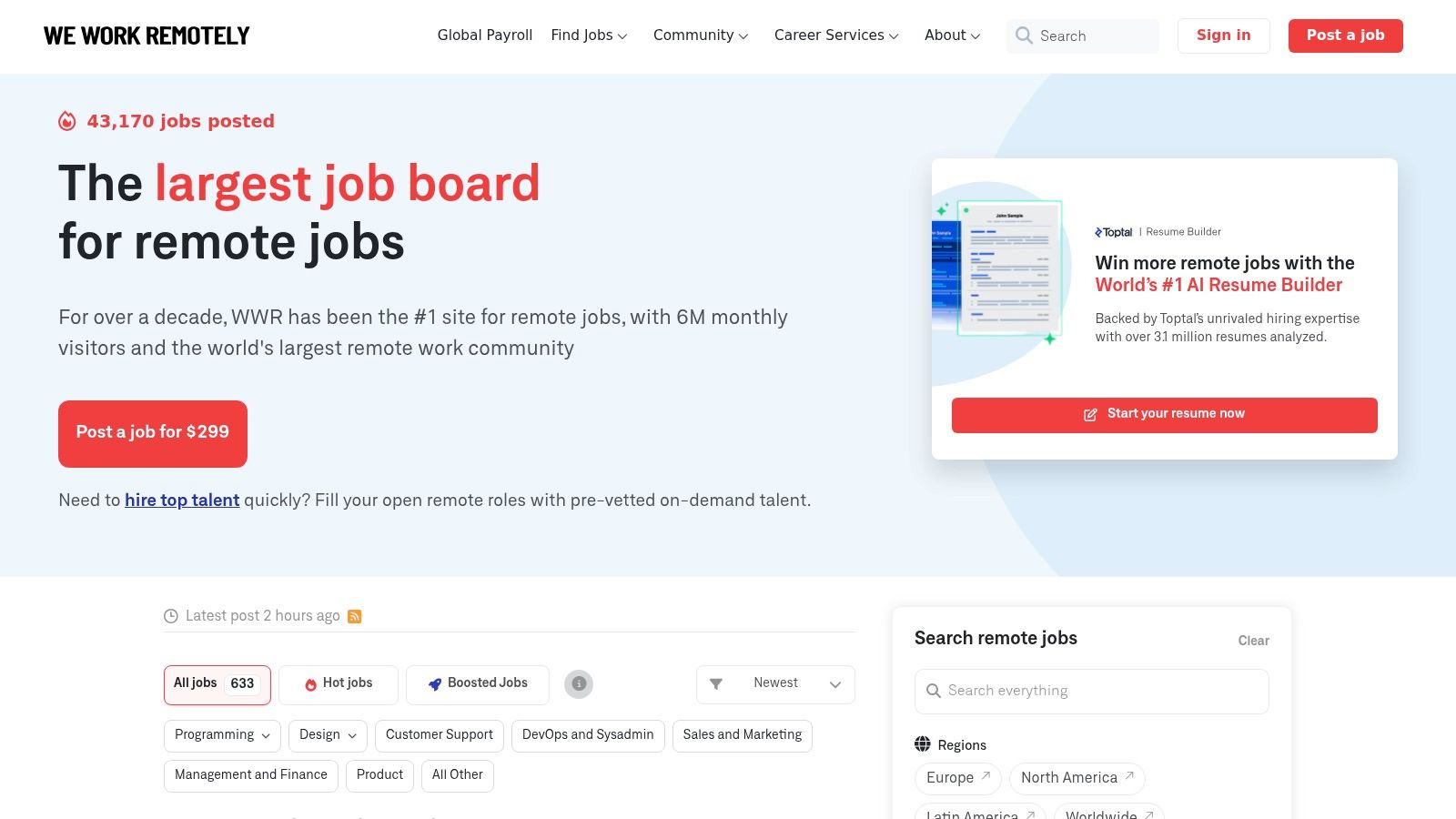
We Work Remotely is a remote-only board with programming, design, product, marketing, and support categories, plus U.S.-specific listing pages. Browsing is free, the postings are organized by function, and it's one of the few remote boards that still attracts employers hiring directly rather than through aggregators.
The location picture is shifting under candidates' feet. In a developer-heavy Hacker News hiring sample, fully remote roles remained the largest category at 46.3%, down from 48.1% a year earlier, while hybrid roles rose from 22.5% to 26.1%. Salary disclosure climbed from 20.5% to 27.4% over the same period (analysis of remote hiring trends). Read the direction, not just the snapshot. Remote-first is still the largest bucket, and it is no longer growing the way it was.
For roles open across borders, including remote positions hiring in Latin America, see this guide to find remote roles hiring in LatAm. For the US-side list of distributed-first employers, start with remote tech jobs that hire outside the headquarters city.
| Platform | Cost for Job Seekers | Best For | Focus |
|---|---|---|---|
| Underdog.io | Free | Discreetly exploring curated startup roles | Vetted tech startups and high-growth companies |
| LinkedIn Jobs | Free; Premium optional | Job seekers combining applications with networking | Broad roles, professional profiles, and employer research |
| ZipRecruiter | Free | General-purpose job searches with alerts | Broad U.S. job categories |
| Glassdoor | Free | Researching employers, salaries, and reviews | Job listings and company insights |
| Wellfound | Free | Candidates seeking startup opportunities | Startup tech and business roles |
| Built In | Free | Tech professionals comparing employers | Technology and startup-oriented roles |
| Dice | Free | IT and technical job seekers | Technology careers and skills-based search |
| FlexJobs | Paid subscription; trial available | Candidates seeking screened remote or flexible work | Remote, part-time, freelance, and flexible jobs |
| Robert Half | Free | Candidates open to recruiter support or contract work | Recruiting across multiple professional fields |
| We Work Remotely | Free to browse | Candidates seeking remote roles | Remote jobs across technical and other fields |
Fast searches run on parallel channels. The candidates who move quickest keep two or three boards active at once, each assigned a different job: one curated marketplace for fit, one broad board for market awareness, one niche source for the specific corner of the market they want.
Pick channels by the job they do, then judge them on that job alone.
If you want high-volume browsing and wide coverage across industries, use ZipRecruiter or LinkedIn. Both are free for candidates and both surface roles quickly. Both will also bury you if you treat application count as progress. Use them to watch the market and spot demand patterns, because that is what they are good at.
If you want employer research before you commit an evening to an application, Glassdoor earns its place. Salary bands, interview reports, and reviews are worth an hour before a final-round conversation, and worth nothing at midnight with no interview scheduled.
If you want fact-based matching where vetted startups come to you after a single 60-second application, start with Underdog.io. One profile, reviewed by a person, hidden from your current employer, with introductions coming from founders and hiring managers instead of a stack of automated rejections. For startup-focused tech candidates who would rather field a few qualified conversations than fire off hundreds of manual applications, that trade favors the curated route.
Then add the specialty layer. Dice for enterprise and IT infrastructure work. Wellfound or Built In for startup research and market mapping. We Work Remotely for distributed roles. FlexJobs if you will pay for pre-screened listings. Robert Half or a boutique tech staffing firm if you want a recruiter working your search on their time.
Sequencing matters more than platform names.
Update your profile and your evidence once, run each channel for a fair window, and judge it on responses. If nothing moves, swap the channel before you raise the volume.
Employers weighing pricing models can apply the same logic from the other side of the table. Pay-per-post rewards volume, which is why so many teams over-post and under-hire. Success-based pricing and subscriptions reward matching. Underdog.io prices on a pay-per-hire or subscription basis, screens the companies it accepts, and sends employers a new vetted cohort of candidates every week. That is a different cost structure from paying for clicks you cannot qualify. Ask any vendor what a qualified introduction costs rather than what a posting costs, and the comparison gets honest quickly.
The last filter is simple. Track which targeted applications turn into real conversations. If one channel produces replies while another produces silence after a fair trial, you have found your board. If both stay silent, your materials are the bottleneck and no platform switch will fix that.
Underdog.io is a curated hiring marketplace for tech professionals who want startup and high-growth roles without the application grind. One profile takes about 60 seconds, and vetted companies and hiring managers reach out to you directly instead of the other way around, with your search kept private from your current employer. Visit Underdog.io to see which startups are hiring for your role right now.