You publish a carefully written engineering role, share it across several channels, and wake up to an inbox full of applications. The problem appears solved until someone starts reviewing them. Many profiles repeat the same keywords, few show the depth your startup needs, and candidates who could succeed never make it through the first screen.
That pattern frustrates both sides. Founders spend time sorting noise, while qualified professionals submit applications that disappear into a queue. A curated tech marketplace approaches the problem differently. It treats hiring as a quality and trust problem, using selective entry, human review, privacy controls, and targeted introductions instead of relying on applicant volume alone.
A founder hiring a first product engineer may receive hundreds of applications, yet still struggle to find someone who can make sound decisions with incomplete information, communicate with customers, and work at startup speed. An open funnel rarely reveals those abilities early. Volume creates activity, not necessarily useful choices.
Startup hiring data covering more than 1,200 venture-backed startups globally, including 32,000 hires and 11 million applications, shows how selective the process can become. For every hire, 15 applicants received an interview. Technical hiring required 18 applicants per interview, compared with 13 for business hires (Ashby's talent trends report).
These figures do not make open postings useless. They show the screening burden created when every applicant receives similar attention. A recruiter can add structure, but founders may not have enough time or recruiting capacity to assess portfolios, references, technical specialties, and domain experience before interviews begin.
The cost is measured in review hours, not only applicant count. A hiring team may spend time checking duplicate profiles, clarifying missing context, and rejecting candidates who meet keywords but lack the required depth. Those hours reduce the time available for interviews, references, and thoughtful decisions about the role.
Candidates absorb a related cost. A strong engineer can tailor applications and answer screening questions without learning whether the role was a genuine match. Employers may read limited response as weak interest, while candidates read silence as a broken process. Both sides lose information that could have improved the match.
The underlying shortage is often not applicants, but qualified, startup-ready matches. The Pragmatic Engineer's 2025 tech jobs market analysis found that applications per job peaked in January and later fell about 10%, while employers still described inbound applications as noisy and increasingly used direct sourcing, extra screening questions, and assessments because many applicants lacked the required qualifications (The Pragmatic Engineer's tech jobs market coverage).
Practical rule: A hiring channel should reduce irrelevant decisions, not merely increase the number of profiles in the system.
Curation does not replace a disciplined hiring process. Your team still needs clear requirements, documented evaluation criteria, and a reliable way to manage candidate information. For broader recordkeeping and process controls, this guide to ATS for UK hiring compliance offers a useful reference.
A curated model places quality review before employer access. Human vetting can assess context that keyword filters miss, while anonymity can protect candidates until there is a credible reason to disclose identity. Selective matching then narrows the field around actual fit, rather than treating visibility as the goal. The next section examines how that model works in practice.
Think of two places where a founder might discover talent. The first is a public bulletin board where anyone can post a résumé. The second is a private gallery where someone selects which work is displayed, checks the creator's background, and introduces visitors only when there's a plausible reason to connect.
A curated tech marketplace works more like the second model. It controls who enters the supply pool, which details employers can see, when identities are disclosed, and how introductions happen. The platform isn't just hosting job listings. It's governing the conditions under which candidates and companies meet.
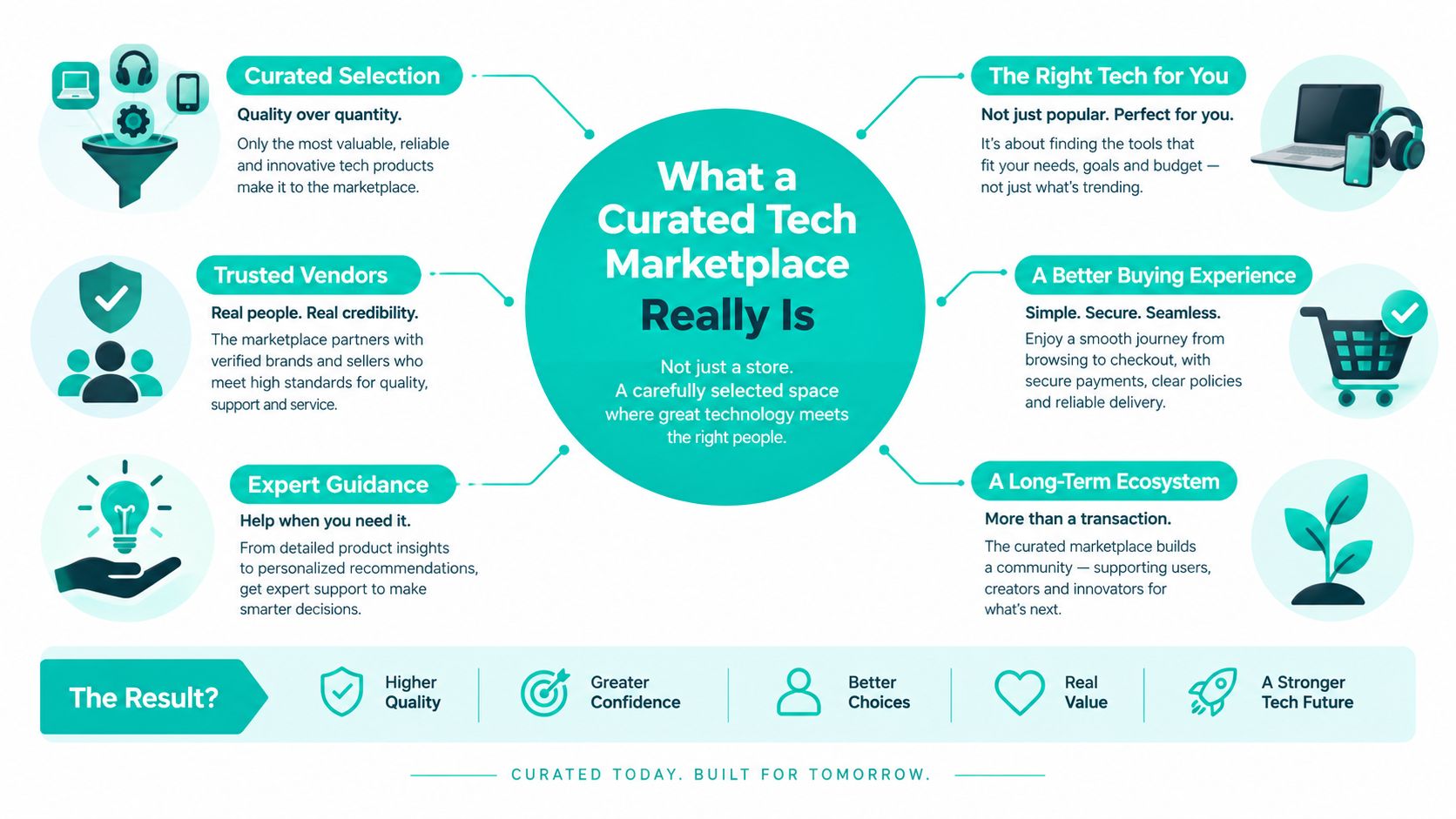
An open board usually lets a person create a profile and apply without a quality decision from the platform. A curated marketplace reviews candidates before employers receive access to them. The review may consider portfolio depth, references, technical specialization, relevant outcomes, and fit with the kinds of companies served.
That distinction matters because keyword matching can identify shared vocabulary without identifying capability. Two candidates may both list “React” and “product strategy,” but one may have built systems in a resource-constrained startup while the other has only used the terms in a course project. Human review helps separate context from labels.
Curation also governs what each side knows and when it knows it. Candidate profiles may remain anonymous while the platform assesses fit, allowing employed professionals to explore opportunities without immediately alerting their employer. Employers may receive enough information to judge relevance before receiving personal contact details.
This process reduces what hiring teams can think of as search-space entropy, the number of possible profiles and interpretations competing for attention. Filtering by portfolio evidence, references, specialization, and domain fit turns a broad search into a smaller set of meaningful comparisons.
A match isn't one-sided. The company needs the candidate's capabilities, but the candidate also needs the right product stage, management style, working arrangement, compensation context, and mission. Research on two-sided talent matching explains why résumé overlap alone is incomplete. Job and candidate selection depend on fit that may not be visible in structured data.
The practical definition is simple:
For a startup, that difference can be substantial. The goal isn't to hide options. It's to surface a smaller number of credible people with enough context to support a real hiring decision.
Each hiring channel solves a different operational problem. An open job board gives a company reach and lets candidates discover roles directly. A staffing firm, such as nexusITgroup.com, adds recruiter-led sourcing and process support. A curated marketplace places a gatekeeping and matching layer between the candidate and the employer.
The right choice depends on whether your immediate need is visibility, delegated recruiting effort, or higher-signal introductions. For a wider overview of available options, teams can also review 2026's leading hiring platforms, then compare each model against the role they're trying to fill.
| Evaluation Criteria | Curated Marketplace | Open Job Board | Staffing Firm |
|---|---|---|---|
| Quality control | Platform screens candidates and may screen companies | Employer reviews inbound applicants | Recruiter screens and presents candidates |
| Candidate sourcing | Selective profiles, often including passive talent | Candidates apply directly | Recruiter conducts outreach and maintains a network |
| Employer control | Employer receives a narrower, preselected group | Employer controls every screening decision | Employer defines the brief, recruiter manages much of the search |
| Speed to interview | Can be quick when the match is strong and the team responds promptly | Depends on application volume and internal review | Depends on recruiter capacity, role complexity, and client responsiveness |
| Cost structure | May use a hiring-related marketplace fee | Usually tied to platform access or posting terms | Typically involves an external recruiting fee |
| Startup fit | Useful when founders need targeted, startup-relevant talent | Useful when brand reach and broad discovery matter | Useful when the company needs delegated search and recruiting support |
An open board can be sensible when the role has a broad candidate profile or when you already have recruiting capacity. It becomes less attractive when every new application creates another manual review.
A staffing firm can be valuable for confidential searches, difficult specialties, or teams without internal recruiting resources. The tradeoff is that you're handing more of the sourcing and screening process to an outside partner.
A curated marketplace is most relevant when signal matters more than volume and the company wants access to people who may not be actively searching. It also changes the candidate experience, because the platform can present a role selectively rather than asking every person to enter the same funnel.
For founders comparing software categories, this explanation of job board software helps clarify why a curated marketplace isn't just a standard posting database with an extra filter.
The strongest curated marketplaces make their process understandable. A candidate submits a profile, a reviewer checks whether the experience fits the marketplace's standards, and the platform decides which companies should see that profile. The employer then receives context, not just a résumé and a keyword score.
One sourced example describes a process in which a candidate submits an anonymous profile in about 60 seconds, receives manual review, and only about 5% of applicants are accepted (Underdog's recruiting software explanation). The point of that selectivity isn't exclusivity for its own sake. It creates a supply pool in which each profile has passed an initial quality gate.
A human reviewer can ask questions that automated matching often misses:
That approach complements a structured skills-based hiring assessment for tech roles, especially when the employer needs evidence of applied ability rather than a list of tools.
Suppose a company needs a product manager who can define an initial roadmap and interview users. A profile with strong product keywords may still be wrong if the person expects a mature product organization, has no interest in customer discovery, or wants a different working arrangement.
Two-sided matching research captures this tension. In internal talent-market research, firm-dictated matches were about 33% more valuable than random assignment within job categories, while preference-based matches were only about 5% better than random but were ranked roughly 38 percentiles higher by workers (the Census working paper on internal talent markets). The lesson is not that preferences are unimportant. It's that objective role value and perceived personal fit are separate signals, and a good process needs both.
Accepted candidates may be sent to a vetted startup network in weekly batches. In an Underdog-style workflow, candidates typically receive 1 to 3 personalized introductions per month (the overview of curated tech job boards). That cadence is deliberately different from sending every possible opening to every possible person.
You can learn more about the matching flow through Underdog's job matching process, but the central principle applies to any provider: human judgment should narrow the field, explain the match, and preserve room for both sides to decline.
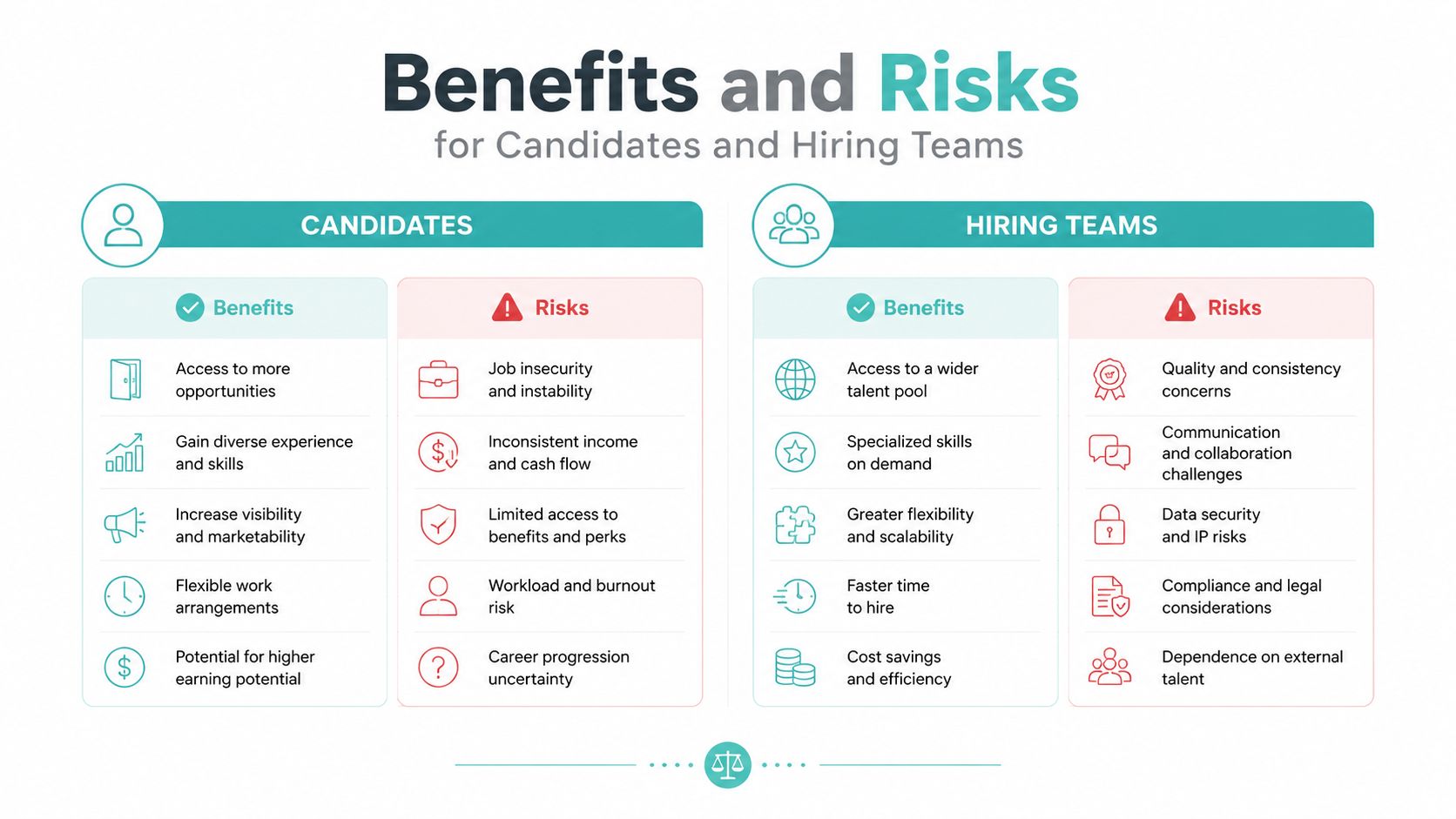
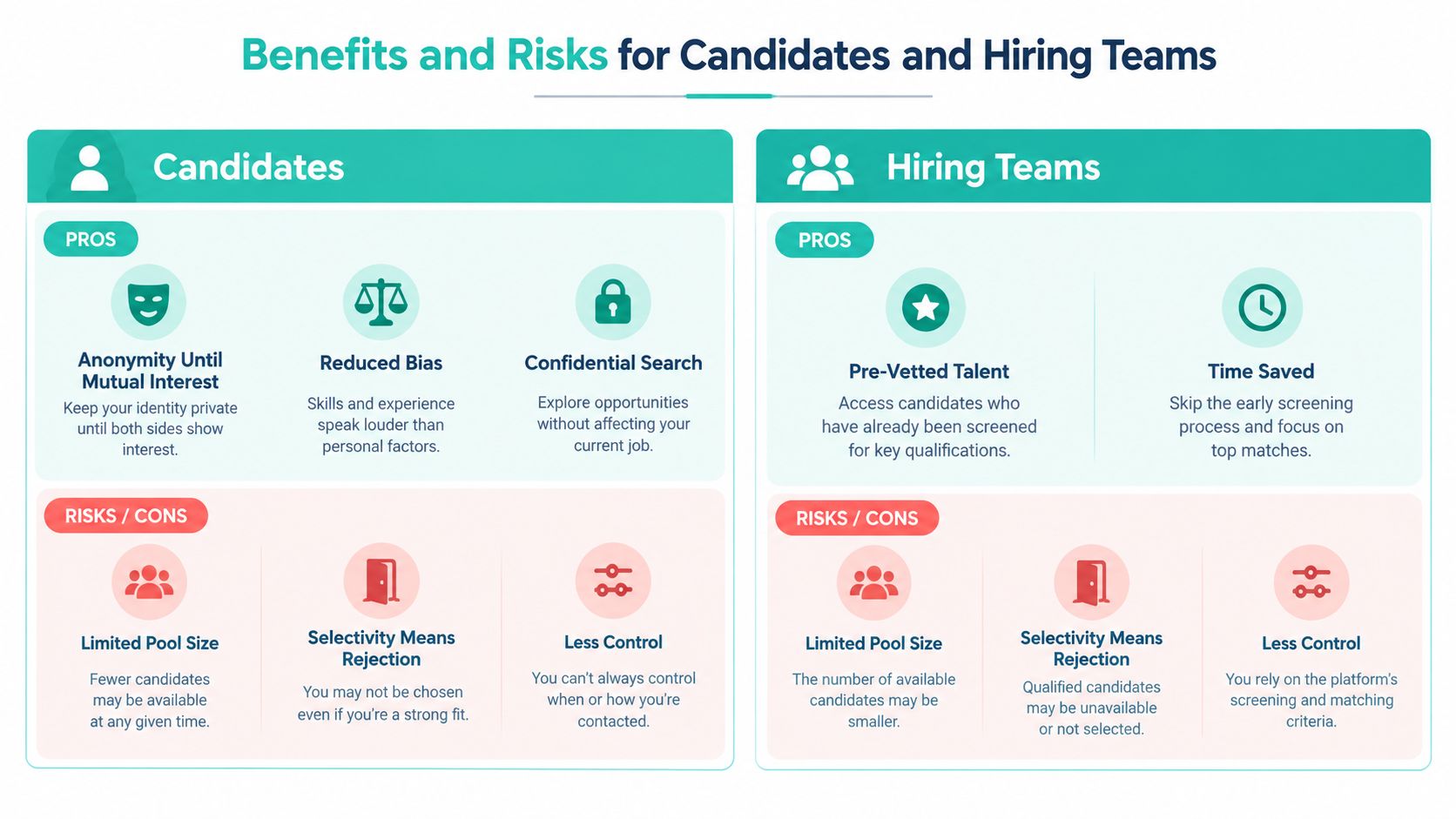
A curated marketplace trades reach for judgment. Candidates may see fewer openings than on an unrestricted application site, while hiring teams review a smaller pool. The intended exchange is better signal: human vetting, selective matching, and enough context to make an introduction worth considering.
For candidates, anonymity can make market exploration safer. In a model described by Invited Jobs on LinkedIn, a candidate stays unidentified until choosing to reveal their identity. That arrangement suits someone with a current job who wants to test interest without announcing a search.
A private profile can also limit irrelevant signals during the first review. Removing an employer name or other identifying detail may help reviewers focus on capability and role fit. It does not remove bias from interviews or final decisions, so candidates should still ask how the platform and employer evaluate people.
Candidates can gain:
Candidates also accept:
Hiring teams can reduce early screening work and improve the quality of the first conversation. That benefit is most relevant for startup roles where adaptability, ownership, and comfort with uncertainty matter alongside formal titles. A curator can act like a quality-control filter, removing obvious mismatches before founders spend time on interviews.
The filter has limits. It can miss unconventional candidates, people changing careers, or specialists whose value is difficult to summarize in a short profile. Employers should pair curation with work samples, structured interviews, references, and consistent evaluation criteria.
Small teams also face a capacity tradeoff. Without dedicated recruiting support, founders must write a precise brief, respond quickly, and distinguish genuine requirements from preferences. Curation can improve the starting signal, but the hiring team still owns the candidate experience and the final decision.
A curated marketplace works best when both sides provide usable information. A candidate's profile should help a reviewer understand capability and direction quickly. A hiring team's brief should explain the work, constraints, decision process, and reasons a qualified person would care.
For candidates, a short anonymous application isn't a compressed résumé. It's a signal document. Lead with the kind of problems you solve, then support that statement with evidence from products shipped, systems improved, customers served, or teams influenced.
A passive engineer who wants to explore discreetly might emphasize system ownership and preferred product stage without naming an employer publicly. A product designer moving toward an early-stage company might highlight research, prototyping, and collaboration with founders rather than listing every design tool used.
Founders should give the matching team a useful brief, not a copied job description. Explain the first problems the hire will own, the decisions they'll influence, the skills that are required, and what the company can disclose about compensation, equity, and funding.
Use the marketplace's company hiring workflow to understand what information the platform needs before introductions begin. Then assign one person to respond quickly, record structured feedback, and avoid adding new requirements after seeing the first candidates.
The marketplace can narrow the search, but the employer still has to create a credible role and run a respectful process. Curation improves the starting point. It can't fix unclear ownership, hidden compensation expectations, or slow decision-making.
Start by asking what the platform curates. If the answer is only “profiles matched by AI,” you're looking at a search interface, not necessarily a quality-controlled marketplace. A credible provider should explain who reviews candidates, what standards apply, whether companies are screened, and how either side can challenge a poor match.
Review the entry criteria. Look for specific signals such as technical depth, portfolio evidence, references, role specialization, and company-stage fit. Vague promises about “top talent” don't tell you how quality is assessed.
Check the company gate. Candidate vetting is only half the marketplace. Hiring teams should want evidence that participating companies offer real roles, credible leadership, and enough information for candidates to make an informed choice.
Inspect privacy controls. Candidates should understand when their identity becomes visible, who can access their profile, and whether they can decline an introduction without penalty.
Ask about human involvement. Human review remains a meaningful differentiator in a market where many professionals are skeptical of fully automated hiring. In 2025, 68% of tech professionals said they distrusted fully AI-driven hiring, while 80% trusted human-driven approaches, and 92% believed AI tools miss qualified candidates who don't optimize for keywords (Dice's report on trust in tech hiring).
Safety and reputation aren't decorative features. OECD research on peer-platform markets found that users trusted platforms more than conventional businesses in the same market in 32% of cases, while 10% trusted them less. A separate consumer survey found that 86% of respondents considered a platform's safety and security reputation important when deciding whether to use it (Chubb's research on the e-commerce trust divide).
Look for transparent introduction practices, clear salary and evaluation expectations, and a selective cadence that gives both sides time to assess relevance. Be cautious when a marketplace emphasizes an enormous candidate count but can't explain how it protects employers from noise or candidates from indiscriminate outreach.
The most useful provider won't necessarily show the biggest pool. It will show that its process can surface a small number of credible, role-ready people with enough context to make the next conversation worthwhile.
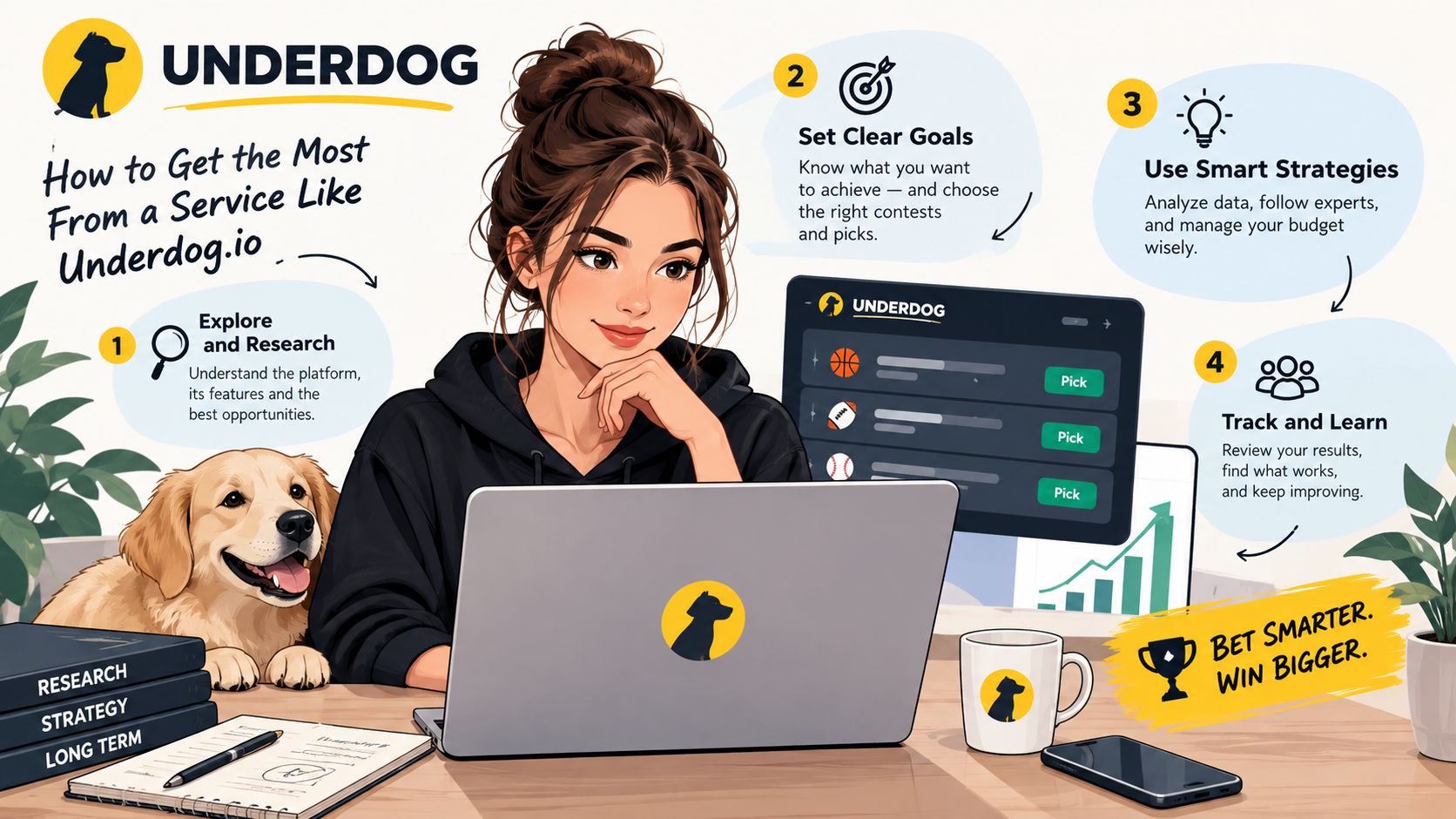
Underdog.io offers a curated hiring marketplace for tech candidates and startups, using selective profile review, anonymous matching until mutual interest, and personalized introductions rather than broad application volume. If your team needs a more focused way to reach startup-relevant talent, visit Underdog.io and evaluate whether its matching process fits your hiring goals.