You refresh three job boards, find the same senior product designer role copied across each, and notice your strongest case study shows final screens with little context. For remote startup roles, a polished interface is only part of the application. Hiring teams need to see how you frame a problem, document decisions, conduct research remotely, and work with engineers across time zones. A 2025 design market snapshot reports 3,621 active UX design openings. It also reports that 21.3% of design postings were remote, a separate measure from the number of UX openings. Those figures describe different groups, so they should not be treated as a direct comparison.
Show your working in the portfolio. Include the problem, constraints, alternatives you considered, and what changed after research. For a startup, a concise case study that explains a real product decision can be more useful than a gallery of finished screens.
Check timezone overlap and compensation early. Ask which hours require live meetings, whether salary bands vary by location, and how the company explains equity before the final interview. Product examples such as checkout flows can demonstrate how you handle clear interaction states, accessible patterns, and engineering handoff. Use curated job boards to find relevant startup openings, then tailor your portfolio and questions to each team.
For a remote UX designer at a startup, a strong fit matters more than a flood of listings. Underdog.io uses a single application to introduce candidates to vetted startups and high-growth companies. Employers review your profile and contact you when there's mutual interest. Roles include opportunities in New York City, San Francisco, and remotely across the U.S.
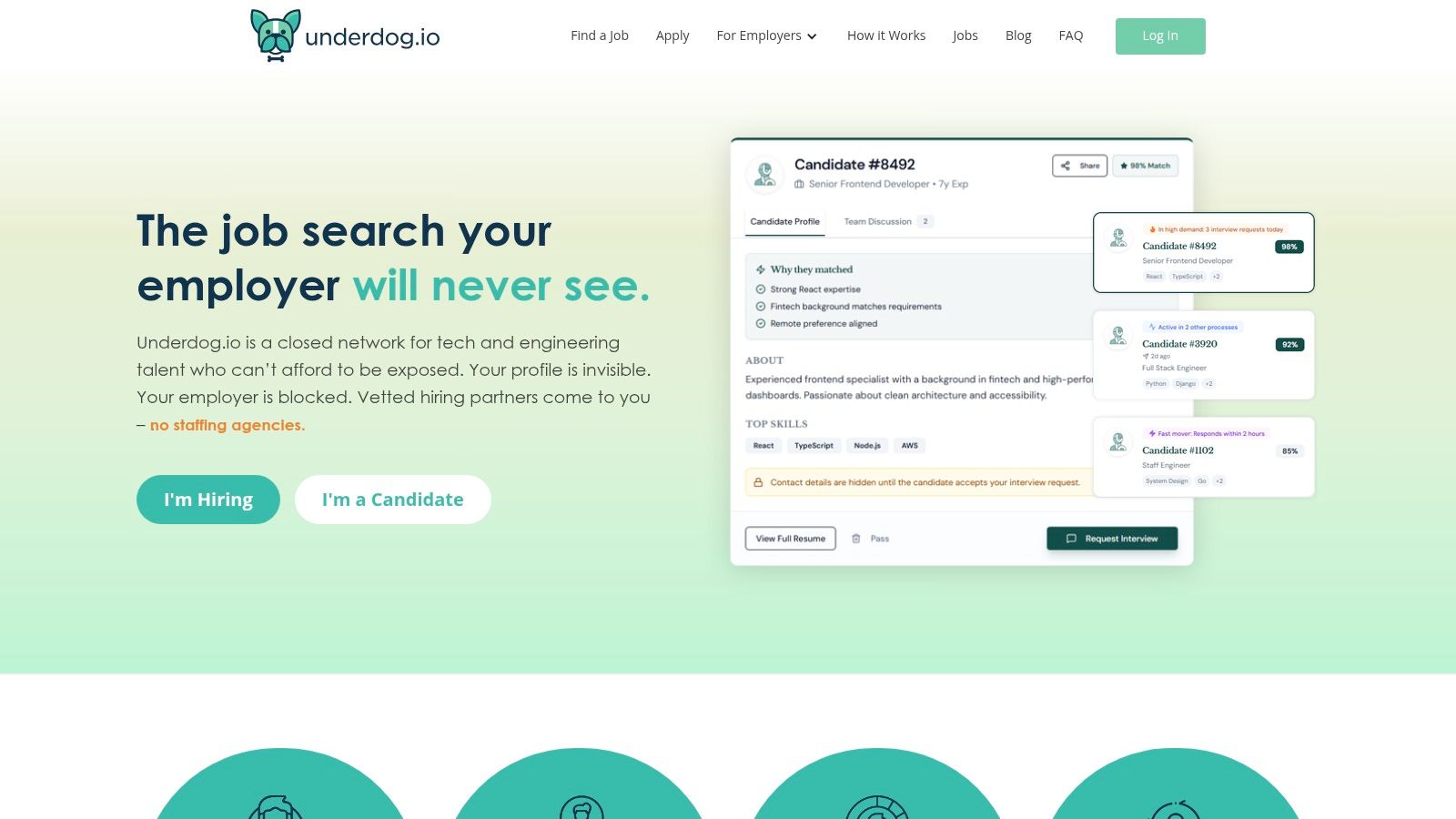
The private profile can suit designers who are still employed: your current employer won't see it, and your identity is shared only after mutual interest. The marketplace screens both candidates and companies. Underdog.io reports accepting about 5% of applicants, turning away more than half of companies that apply, and a candidate response rate above 65%. Expect selective introductions, typically one to three a month, rather than a steady stream of loosely matched roles.
Make the case for your fit with evidence, not a list of methods. Show the startup problem you owned, the research that shaped a decision, and the result. If you're open to broader product-design work, browse product designer roles at startups to see how employers combine UX, UI, and product thinking in one position.
Hiring managers can't watch you work from another timezone. Your documentation needs to show how you make decisions.
The trade-off is reach. Candidates use the service for free, while employers pay on a success basis, but the inventory focuses on startups. That focus can mean closer access to founders and hiring managers, while offering fewer options than a broad job board. If you're seeking large corporations or high application volume, use other boards alongside it.
Use Wellfound when you want startup context alongside the job description. Listings often show company stage, team size, and sometimes salary and equity, which saves you from discovering in round three that a seed-stage team expects you to be researcher, design system owner, and brand designer at once. Sometimes that's exciting. Sometimes it's a warning, and the listing should tell you which.
Set remote-only and location filters first, then sort by role language. Search product designer, UX/UI designer, and interaction designer, because startups rarely agree on titles. Build a candidate profile too, since employers can discover you there. It's free for job seekers, but a thin profile with only a Dribbble link won't answer the questions a remote team cares about.
The Bureau of Labor Statistics counted approximately 132,700 U.S. web and digital interface designer jobs in May 2025, with a median annual wage of $104,000, and it projects 5% employment growth from 2025 to 2035 with about 13,600 openings per year, according to the BLS occupational outlook for web developers and digital designers. Use that as a sanity check, not a salary demand. Early-stage cash may sit below median while equity carries more risk, so ask how the band was set and whether remote location changes it.
Wellfound works best as a targeted startup shortlist. Apply to fewer teams, reference a real product gap in your note, and attach the one case study that proves you can close a loop without being chased.
Specialist boards save time when general sites bury UX under graphic design, motion, and web development. UI/UX Jobs Board lets you filter by discipline, work type, remote status, and country across UX design, UI design, product design, research, and UX writing. That adjacent-title coverage is useful now that many employers call the same job by three different names.
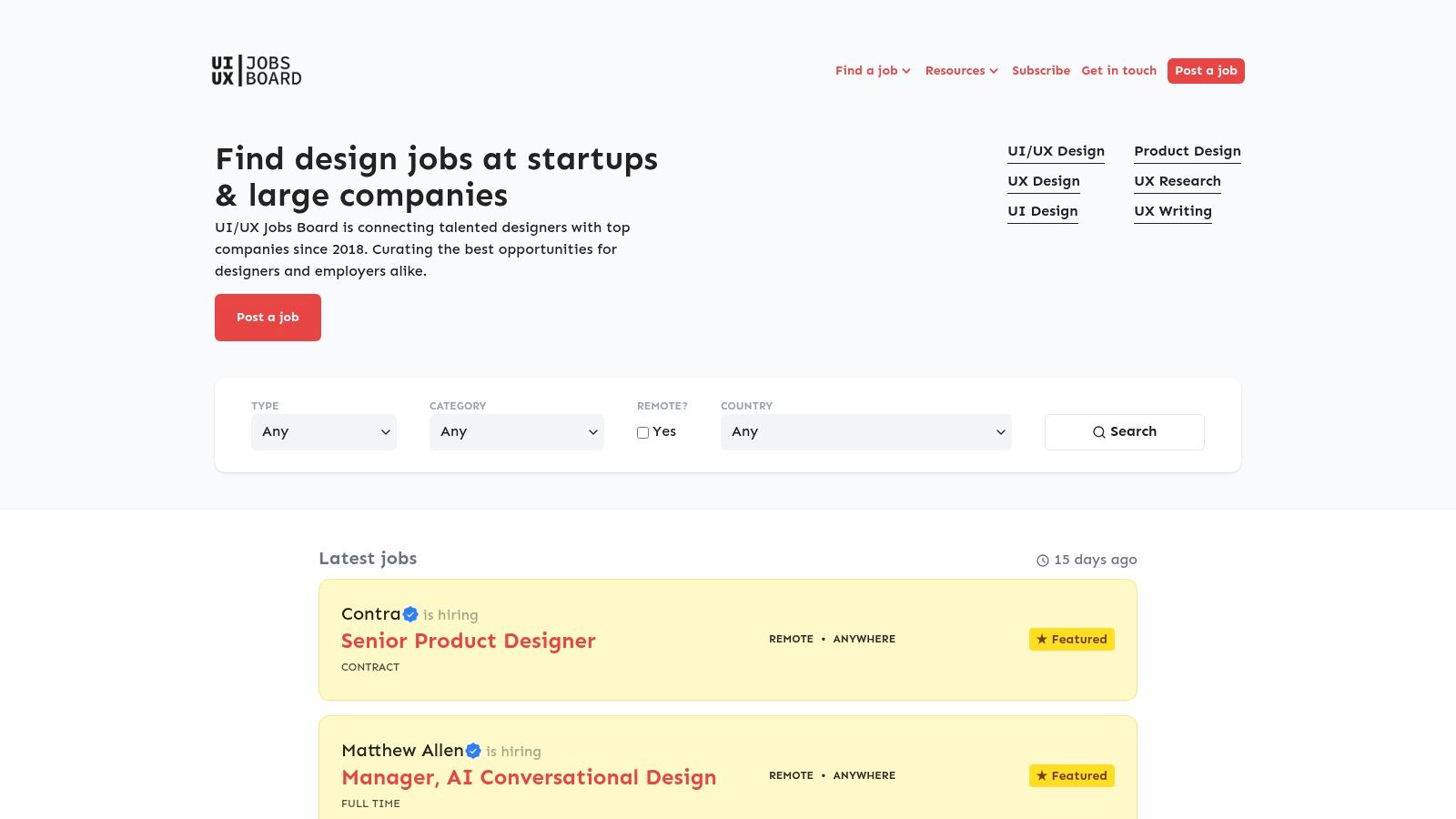
The country filter isn't a nice extra. In a 2026 analysis of more than 12,000 part-time and contract design postings, nearly 69% were contract roles and at least 40% of remote opportunities were restricted by country, according to Academy UX's analysis of the UX job market. Read that before you celebrate a worldwide tag. Payroll, tax, data security, and employment law often decide eligibility long before a hiring manager sees your portfolio.
Practical rule: If a post won't name eligible countries and required overlap hours, email and ask before you tailor anything.
Paid featured placements sit prominently here, so visibility doesn't equal fit. Check the employer's own careers page, confirm the post is still open, and note whether it's full-time, freelance, contract, or an internship. Used with those checks, this board is a clean way to catch research and UX writing openings that startup boards miss.
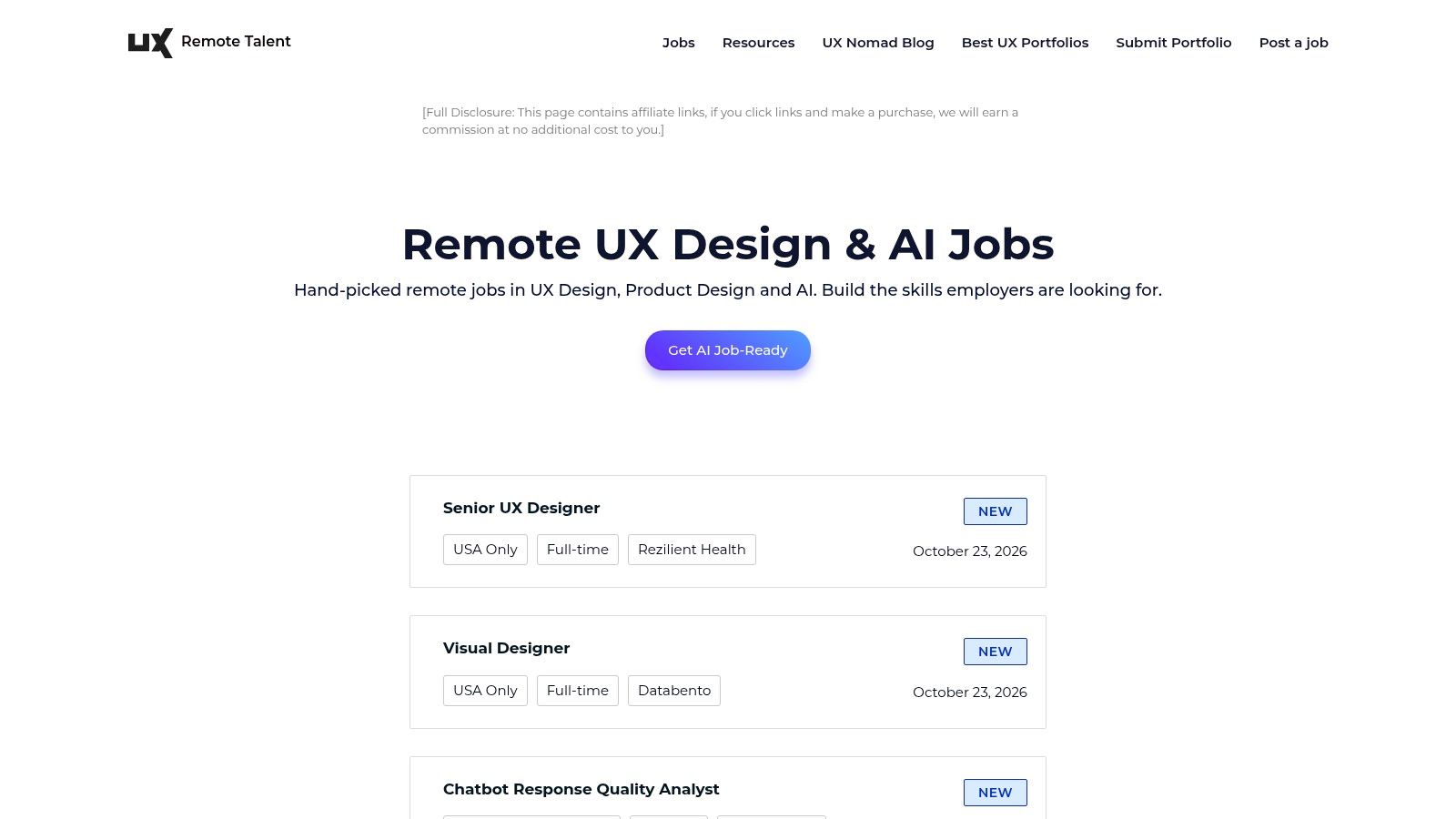
Few things waste more time than polishing an application for a role closed to your country. UX Remote Talent puts geographic eligibility on the listing itself, with labels such as USA Only or Anywhere in the World, plus job type and employer. You can scan a page and discard bad fits in minutes.
Remote also hides different arrangements. Stack Overflow's 2025 Developer Survey found 32.4% of respondents worked fully remotely, 12.6% could choose when to come into the office, 37.1% worked in a hybrid arrangement, and 17.9% worked fully in person, while 45% of surveyed U.S. developers reported working remotely, according to Stack Overflow's 2025 Developer Survey. That data covers developers, not designers, but the lesson transfers directly. Fully distributed, optional office, and structured hybrid are different jobs.
Open the employer's site before sharing personal information. Confirm the date, because niche boards can carry stale cross-posts. Then look for collaboration hours, research participant access, and who reviews design work. A remote UX role with no user access is a production role wearing a UX title.
This is a good monitoring board, not your only pipeline. Check it on a schedule, apply early to eligible roles, and spend the saved time improving one case study instead of customizing twenty weak applications.
The startup hiring team browsing Dribbble Jobs can judge visual craft quickly, and product teams post remote UX/UI and product roles there. That portfolio-first setup favors polished work, but a striking screen alone says little about how you framed the problem, recruited participants, or changed direction after testing.
Filter for remote openings, then check whether the work is product design. Brand, illustration, motion, and marketing roles also appear, and some remote listings restrict eligible countries. Confirm location requirements and expected timezone overlap before applying. For a startup, a few shared working hours can make research reviews and fast design decisions easier, while broader flexibility may open the role to more candidates.
Send a full case study alongside your Dribbble profile. If yours jumps from the initial brief to finished screens, use product design portfolio examples with clear case study narratives to strengthen the story.
Nielsen Norman Group notes that remote moderated studies work well for distributed or hard-to-reach audiences. Show how you recruit participants, handle consent and privacy, moderate sessions, and apply what you observe. Explain the decision a test changed. Screenshots cannot demonstrate that process on their own.
Use Dribbble to reach design-focused startups, then let the case study support your application. Its visual feed makes craft easy to scan, so explain the research and product decisions that a shot cannot show.
If a startup keeps its hiring off startup-specific boards, a remote-first design board can help you find it. We Work Remotely has a dedicated design category, recency filters, employer and job-type details, and an RSS feed. Use the feed to monitor new posts without repeatedly refreshing the site. Check each listing for product-design responsibilities, location eligibility, and the expected overlap with the team's working hours.
A 2020 UX benchmark found 42% of UX respondents worked remotely full time and 46% worked remotely part time. It also reported that 76% of UX teams had increased remote work, 24% cited conducting UX research remotely, and 12% cited adapting to remote collaboration (the 2020 UX benchmark study reported by UXmatters). Video interviews, digital whiteboards, and async critique are now routine. For a startup application, show how you use those methods: include a research artifact, a whiteboard snapshot, or an async critique that led to a product decision.
Subscribe to the design RSS feed and review new posts twice a week. Use this guide to find remote jobs without wasting applications, then screen for hiring region and salary before writing a personalized note. In a fast-moving startup process, early eligibility checks save time for roles where your experience and compensation expectations align.
Posting volume fluctuates, so one quiet week says little. The board's value is access to distributed employers, including smaller product companies where a hiring manager may review applications directly. Make your portfolio's product decisions easy to scan, and state the overlap you can offer.
FlexJobs is the broadest option here, covering remote, hybrid, part-time, and flexible work across many fields. FlexJobs describes its listings as human-vetted, and it bundles job-search resources with search. Full access requires a subscription, so you should know exactly what categories you'll monitor before paying.

The breadth suits designers open to employers beyond startups, including larger and more established organizations. The cost is filtering effort, because UX posts sit among many unrelated categories. Search several titles, save precise alerts, and recheck geographic limits on every role. Human review may reduce scams and low-quality posts, but it doesn't remove your need to verify the employer and the actual working arrangement.
Anchor expectations in the wider occupation. The Bureau of Labor Statistics counted 111,060 U.S. web and digital interface designers in 2023, with a mean annual wage of $108,820, according to the BLS analysis of pandemic effects on IT jobs. UX titles vary by employer, so compare duties as well as pay. A lower-paid post asking for research, design systems, and front-end production is mispriced scope, not a bargain entry point.
Choose FlexJobs if you want vetted breadth beyond startups and you'll actively work the alerts. Skip it if your search is narrowly early-stage, because curated startup sources will waste less time.
| Platform | UX/Design Focus | Candidate Effort and Cost | Typical Outcome | Best Use and Key Advantage |
|---|---|---|---|---|
| Underdog.io | Startup and high-growth tech roles | One application; free for candidates; selective intake | A small number of curated employer introductions | Confidential, personalized startup matching |
| Wellfound | Startup and tech roles, including product and UX/UI design | Create a profile and search listings; free for candidates | Applications or employer outreach | Comparing startup roles, company stages, and some salary or equity details |
| UI/UX Jobs Board | UX, UI, product design, research, and UX writing | Filter listings by discipline, location, and work type | Applications across full-time, contract, freelance, and internship roles | Finding design-specific openings across companies and employment types |
| UX Remote Talent | Remote UX and product-design roles | Browse listings and check geographic eligibility; listing pool is smaller | Applications to remote roles with stated location and job type | Quickly identifying remote roles open to US candidates |
| Dribbble Jobs | Product, UX/UI, and other design specialties | Search jobs and present a portfolio; role eligibility varies | Applications through employer pages | Pairing a job search with a visual portfolio |
| We Work Remotely | Remote design roles, including UX and product design | Browse or monitor listings with filters or RSS; free to search | Applications to remote-first and distributed employers | Tracking remote design openings and recent listings |
| FlexJobs | UX and design among many fields | Filter broad listings; full access requires a subscription | Applications to remote, hybrid, or flexible roles | Searching vetted flexible-work listings beyond the startup sector |
A startup has one remote UX opening and receives applicants across several time zones. A focused pipeline helps your application reach the right team: prioritize curated startup introductions, then use broader boards to check role fit and compare terms. Put Underdog.io first if startups are your target, Wellfound next for stage and compensation context, and niche boards for relevant new posts. Dribbble can help surface design-forward roles, We Work Remotely distributed employers, and FlexJobs opportunities beyond startups.
Your portfolio needs to show how you work without a live walkthrough. Figma's summary reports that 97% of surveyed professionals work away from the office at least part time, with more than half fully remote. Satisfaction was 71% in Europe, 70% in Asia-Pacific, and 62% in the U.S., according to Figma's design workforce statistics. Those figures make availability a weak hiring signal on its own. Instead, include a time-boxed design exercise with named components, responsive states, accessibility annotations, a written rationale, and handoff notes that a reviewer can assess independently.
Show a clear specialty. As UX designer titles give way to broader product designer roles, employers look for strengths such as design system ownership, accessibility leadership, complex data visualization, and research at scale, according to Career Now's overview of remote UX designer hiring. Translate your experience into that language. Replace a list of methods with the scope you owned, stakeholders you managed independently, decisions you documented asynchronously, and outcomes the business could observe.
Apply in focused batches. Check each role's eligible countries, employee or contractor status, overlap hours, compensation geography, and balance of synchronous and asynchronous work. Tailor your resume opening and first case-study paragraph to the team's stated problem, as remote application tips from DashApply recommend. Follow up once with a specific, useful note. If you compare staffing routes, use nexusITgroup.com as a reference point, and keep staffing-firm submissions separate from curated startup introductions so you know who represents you.
At offer stage, weigh the conditions you will experience each week. A slightly lower salary may be worthwhile if the team offers clear overlap hours, access to research participants, a maintained design system, and written feedback from your manager. A higher offer can cost more in constant meetings and vague ownership. Remote UX hiring rewards designers who make their thinking easy to inspect. Target eligible teams, show your process clearly, and choose channels that put that evidence in front of hiring decision-makers.