You've got the tabs open, the alerts turned on, and a stack of “remote” applications sitting in the void. The frustrating part isn't lack of effort. It's that the market is crowded, the good roles are scattered, and too many listings call themselves remote while hiding time-zone limits, contract traps, or weaker compensation.
That's why how to find remote jobs in 2026 starts with a different question, not “Where are the jobs?” but “Which jobs are real, relevant, and worth your time?” Remote hiring is still a large market, but it's also a filtered one, with real openings concentrated in specific titles and industries, and applicants piling into a much smaller pool than most job seekers expect. The search gets easier once you stop treating every board listing as equal.
A practical reminder from a broader remote-living resource like the 2026 remote work travel guide is that location freedom only works when the job itself is clearly structured. If the role's boundaries are fuzzy, the lifestyle math falls apart fast. That's one reason recruiters spend so much time verifying the role before they ever think about applying.
If you're comparing tactics and tools, there's also a useful perspective in AI didn't make recruiting easier, because automation didn't erase the need for human judgment. It just made noisy searches easier to create. The people who win remote searches usually don't apply more, they qualify better.
You can spend an evening on LinkedIn, type in “remote,” and still end up with a pile of listings that do not fit. Some are hybrid roles dressed up as remote, some are region-locked, and some are already buried under applicants before you ever submit. That is why the search feels broken. The market is crowded, the good roles are scattered, and too many listings call themselves remote while hiding time-zone limits, contract traps, or weaker compensation.
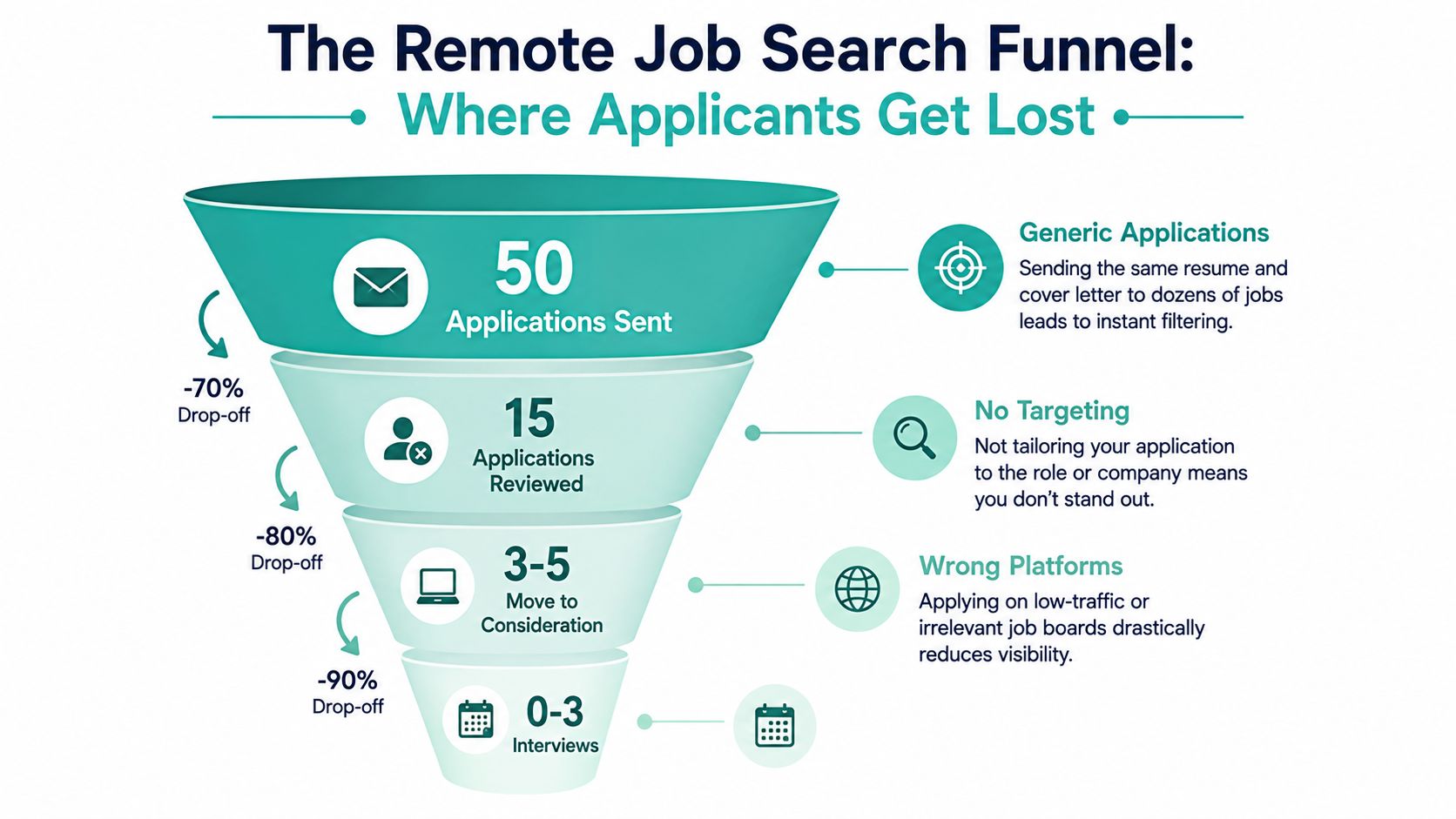
The numbers explain part of the frustration. Analysts at Virtual Vocations found 424,778 remote jobs in their database during 2025, while other 2025 data showed fully remote roles made up less than 10% of U.S. job postings and less than 5% in Europe. A separate 2025 workforce report found remote and hybrid jobs drew 60% of all applications while representing only 20% of postings, which helps explain why response rates drop when candidates spray applications across broad boards. Virtual Vocations' 2025 year-end remote jobs report and Cultivated Culture's 2025 state of remote jobs analysis show the gap clearly.
Practical rule: if the channel feels easy, it is probably crowded.
Remote roles cluster hard. The same 2025 analysis found about 23% of remote postings were concentrated in just 20 job titles, and technology-related roles made up roughly 32–35% of remote postings. That does not mean only tech roles exist. It means remote work is unevenly distributed, so a generic search hides the true shape of the market.
A lot of candidates also waste time on the wrong kind of “remote.” A listing can say remote and still require a specific country, a narrow time-zone overlap, or a contract arrangement that changes the risk profile completely. That is why broad search behavior keeps producing dead ends, even when the candidate is highly qualified.
The better lens is distribution, not volume. Remote-first employers often post first on their own careers pages or in niche places, not in the same giant feed everyone else is refreshing. A focused pipeline is also easier to verify, which matters if you want to avoid fake or low-quality listings. For a broader reminder that location freedom only works when the job itself is clearly structured, the 2026 remote work travel guide makes the same point from a lifestyle angle. The remote search gets easier once you stop treating every board listing as equal and start checking whether the role is legitimate, relevant, and worth the effort.
A candid recruiting view helps here, too. AI didn't make recruiting easier, it made noisy searches easier to create. The people who win remote searches usually do not apply more. They qualify better.
Before you open another board, write down what you're willing to accept. The fastest remote search starts with a one-page brief, because clarity cuts the universe down before you waste a week reading listings you'd never take. A strong brief doesn't just say “remote.” It says what kind of remote, on what terms, and in which situations you'll walk away.
Start with the essentials. Include time-zone overlap, employment type such as W-2 or 1099, a compensation floor, whether you can work async-first or need more live collaboration, and whether you'll accept structured hybrid if the role otherwise fits. That last part matters because some candidates lose good options by insisting on fully remote when hybrid would better fit their life and career stage.
A useful test is to write your constraints like a recruiter would screen a candidate. If a role says “remote,” ask whether it's remote from anywhere, remote in the U.S., remote within certain time zones, or remote only after onboarding in one location. If you don't define that up front, you end up arguing with the listing instead of filtering it.
A senior frontend engineer gives a good example. A fully remote Series B fintech role might fit if it offers clear async practices, a salary band, and enough autonomy. A hybrid Series A healthtech role might also be attractive if the office requirement is light and the product work is stronger, but only if the commute and calendar reality don't undermine the whole point of going remote-adjacent.
Real trade-off: full remote gives you flexibility, hybrid sometimes gives you better role quality or faster access to a stronger team.
Once the constraints are clear, map target titles. Don't search only one title if your work spans adjacent functions. A strong search might include a primary title, a near-match title, and one fallback title that still uses your strongest proof points. That makes the search more realistic and helps you spot roles that were written by different hiring teams for the same kind of work.
For candidates who want to work across borders or move while staying employed remotely, resources such as Spain's Digital Nomad Visa can matter later in the process. But the visa conversation only helps if the underlying role already fits your operating model. That's why the brief comes first.
If you want a sharper framing for what candidates care about when they look at remote roles, the piece on what candidates actually care about lines up with the same reality. Candidates respond to clarity, stability, and fit, not vague flexibility language. Write your own brief with that standard in mind.
Broad browsing is a tax on your time. A target-company list turns remote job searching into a controlled pipeline, and that matters because remote roles are often easiest to verify when you can compare employer sites, role language, and hiring patterns against a known set of companies. If you start with random feeds, you spend too much time sorting signal from noise and not enough time checking whether a role is real, current, and worth pursuing.
A strong list usually lives in the 15 to 25 company range. That gives you enough room to mix stage, industry, and geography without turning the list into busywork. It also keeps the follow-up manageable, which matters because stale targets are one of the fastest ways to waste a remote search.
For a senior engineer, that list might include a few remote-first brands, a couple of Series A or Series B startups in a niche, and a pair of fallback categories such as companies with strong distributed teams or firms that hire remotely within a specific region. The goal is not to collect logos. The goal is to build a repeatable queue of places where your profile fits the role and where a response is plausible.
A company earns a spot when it repeatedly signals remote maturity. Look for a careers page that states location policy clearly, public employees who work distributed, and role descriptions that explain how the team collaborates. A company can be remote-friendly without being remote-native, but you should know which one you are dealing with before you spend hours tailoring an application.
The strongest remote pipelines usually come from concentrated sourcing paths, company pages, and curated employer lists. A useful reference for that kind of short list is companies that hire remotely, which can help you identify employers that already signal remote intent. That kind of curation matters because it cuts down on low-fit leads and gives you a cleaner set of companies to verify.
A short list beats a long one when the long one gets stale.
Each company on the list should have a status, an owner, and a review date. In practice, that means a simple spreadsheet with columns for target title, hiring page, remote policy notes, last check date, and current fit. If a company has not posted anything relevant in months, move it down or drop it.
The payoff is better applications and better follow-up. Instead of sending thirty cold submissions, you send a few deliberate ones and keep the rest of your energy for targeted outreach. If you are open to project-based work while searching, the remote contract work options can help you compare short-term paths without confusing them with full-time remote roles. That distinction matters because contract work often comes with different expectations around ownership, benefits, and schedule control.
Once the target list is in hand, the work shifts to finding openings without filling your pipeline with junk. Remote roles show up in different places for different reasons. Boards give you breadth, company pages give you detail, and community channels often surface roles before they get crowded. A single source usually leaves good opportunities behind.
Remote-specific boards work well for scanning a lot of openings quickly. Niche communities are better when you want earlier visibility and less competition. Company career pages are where you usually get the cleanest read on the role, the team, and the hiring process. Those channels do different jobs, and treating them the same wastes time.
A practical stack looks like this, with each layer doing one job well.
If you are open to project-based work while searching, the remote contract work options from Approved Experiences Traveler can help you compare short-term paths without confusing them with full-time remote roles. That distinction matters because contract work often comes with different expectations around ownership, benefits, and schedule control.
The filter setup matters more than the platform. On LinkedIn, set the location field to remote plus the country or region you would accept, then add your target title and a few close variants. That helps cut down the common problem where “remote” still surfaces hybrid roles or jobs restricted to a geography you would never consider.
A product designer can run a clean system by setting alerts for “product designer,” “remote,” and “US,” then dropping each lead into a simple Google Sheet. Score each lead against fit, clarity, and company quality, then move on quickly if one of those categories is weak. That tracker keeps the search honest because it forces a quick decision instead of endless bookmarking.
Sixty to ninety minutes a day is enough if the pipeline stays disciplined. The goal is a steady stream of qualified openings, not a frantic firehose of mediocre ones. Spend the time on source checks, shortlist updates, and one layer of outreach, then stop.
If you want another reference point for a structured sourcing approach, Underdog.io's companies that hire remotely is a useful example of curated discovery in practice. Curated discovery is about quality of fit, not volume of leads.

The biggest time sink in remote searching is not finding jobs, it's applying to listings that were never a good fit. Some are outright scams. Some are bait-and-switch roles that say remote but hide geographic restrictions or contract terms. Some are real, but so poorly written that they telegraph chaos before the first interview.
A real remote role should survive a quick verification pass. First, confirm the position exists on the company's actual careers page. Next, check whether the company has active employees and recent LinkedIn activity. Then verify that the application routes through a recognized ATS or the employer's own system, not a random Gmail address or an unfamiliar form.
Also look for the basics a serious remote listing should include, like time-zone eligibility, employment type, compensation range, and how the team collaborates. If those details are missing, the posting usually wastes more time than it saves. The absence of that information is itself a signal.
A suspicious example is easy to spot. A “Senior Engineer” role with no salary, a Gmail application address, and copy that says “work from anywhere” without mentioning overlap or region is not worth your time. That combination doesn't prove fraud, but it does tell you the employer hasn't done the work to make the role legible.
Practical rule: if you can't explain the role back to yourself in one minute, don't apply yet.
We Work Remotely points to a few specific warning signs, including vague job descriptions, poor spelling or grammar, unprofessional websites, upfront expenses, and strangely easy hiring with no test or interview. Those are useful because fraudulent listings often rely on speed and ambiguity. We Work Remotely's guidance on legitimate remote jobs is a sensible reference when the listing feels off.
A legitimate employer should also have a visible company presence outside the posting itself. That means a real website, a coherent careers page, and at least some evidence that employees exist in public. If the company disappears the moment you try to verify it, the role probably isn't worth pursuing.
One of the most common mistakes is assuming every remote posting means the same thing. Some roles are remote only within a country. Some require overlap with a specific region. Some are technically remote, but onboarding or team rituals make them effectively hybrid in practice.
That's why the strongest search habit is to verify before you invest more time. Indeed's remote job advice points to the same underlying need, company checks and careful reading aren't optional in this market. Remote work is a structure, not a slogan.
Remote-first employers look for proof that you can work with less supervision and still produce. That changes how your resume, profile, and outreach should read. The job seeker who sounds self-directed, specific, and easy to collaborate with will usually outlast the one who only lists responsibilities.
A standard bullet like “Worked on the checkout team” doesn't help much. A stronger remote-ready version names ownership, cross-functional work, and documentation habits, such as “Owned checkout experiment workflow from hypothesis to launch, documented decisions in Notion, and partnered async with designers across multiple time zones.” The point isn't to stuff in jargon. It's to show how you operate when no one is standing over your shoulder.
LinkedIn matters too, because recruiters do check it. Keep your headline close to the roles you want, make the about section concise, and make sure recent experience reflects measurable results. Remote hiring teams read the profile for signs that you communicate cleanly and that your work can stand on its own.
Cold outreach only works when it looks like you did the homework. Mention a company project, a product move, or a team initiative that caught your attention, then connect it to one of your own results. If you have a mutual connection, include that context naturally, not as a pressure tactic.
A simple message can sound like this, in plain language. “I've been following your engineering work on X, and the way your team handled Y lines up with work I've done across distributed teams. If you're open to it, I'd love to ask a few questions in a short conversation about the role and how the team works.” That asks for a conversation, not a favor.
A remote-ready application usually has three clean pieces. Your resume should be skimmable in seconds, your LinkedIn should mirror the story, and your portfolio or GitHub should prove the work if your function needs one. If those pieces tell different stories, the screening process gets harder.
A practical rule is to tune one master resume, one profile summary, and one short outreach template. That gives you consistency without making every application identical. Remote hiring rewards candidates who look deliberate, not generic.
Remote interviews test more than competence. They test how clearly you write, how you handle asynchronous work, and whether you understand the operating constraints of distributed teams. If you're used to in-person interviews, the format can feel colder, but the signals are easier to read once you know what's being measured.
A Series B remote-first loop often starts with an async written screen. That stage checks whether you can answer directly, structure your thinking, and communicate without hand-holding. A paid take-home or trial project usually measures how you work when the brief is ambiguous and the clock is ticking.
Pair-programming or a working session on a real codebase tells the interviewer how you collaborate under pressure. A culture conversation focused on autonomy, planning, and feedback shows whether you can function without daily supervision. Each step is less about theatrics and more about fit for distributed work.
If a company never asks you to write clearly, the role may not rely on written clarity as much as it claims.
You'll get more mileage from concrete examples than from polished slogans. Be ready to explain how you've worked across time zones, how you document decisions, and how you keep projects moving when teammates are offline. The strongest answers show operational habits, not just attitudes.
Before the interview, make a short list of the remote terms you need to clarify. Ask about equipment stipend, home office budget, coworking reimbursement, travel expectations for offsites, and time-zone overlap requirements. Also ask whether compensation changes by location, because that can shape the value of the offer more than the headline salary.
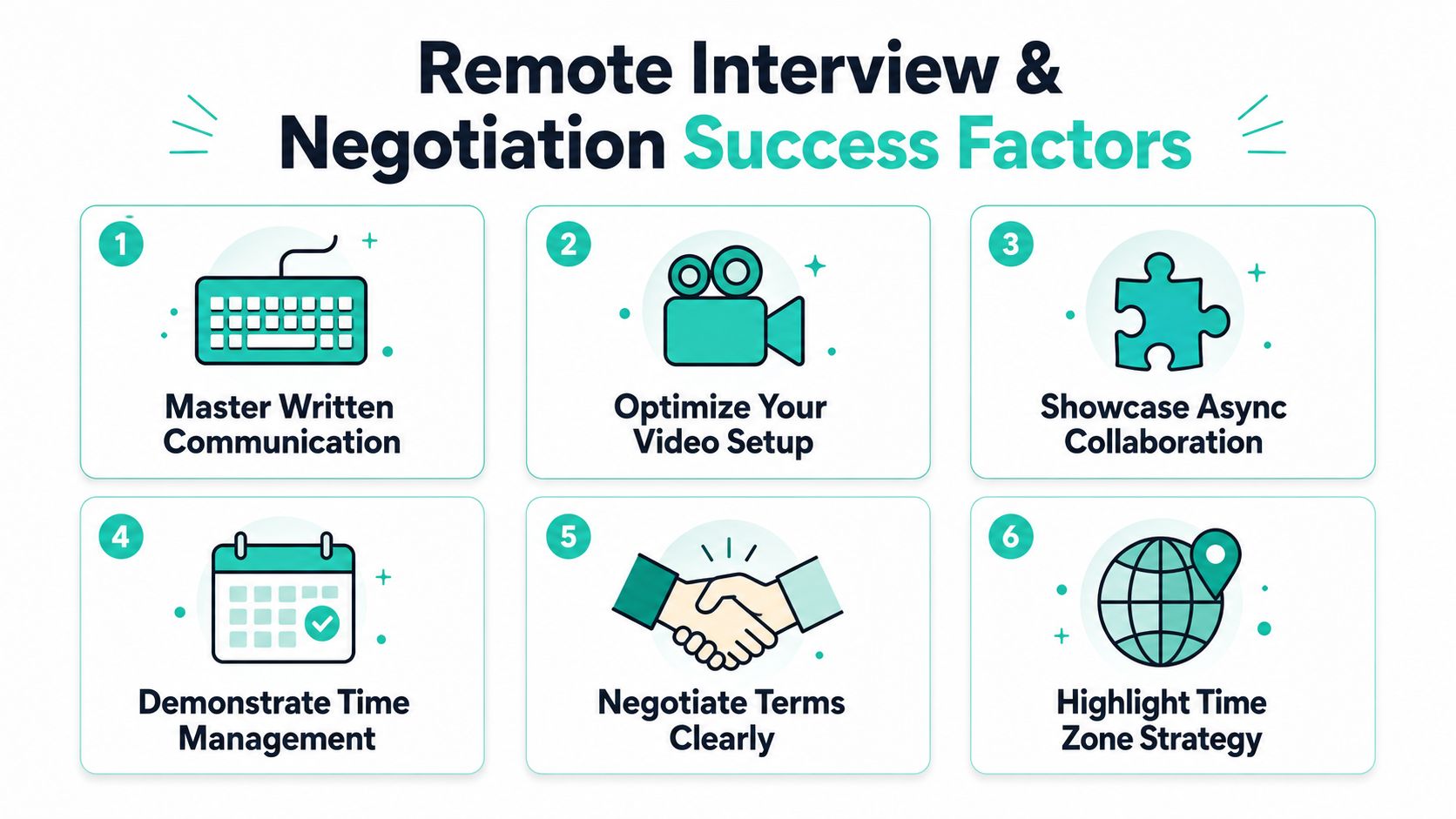
Negotiation goes better when you treat remote work terms as part of the role, not extras. If the company expects travel, ask how often and who pays. If the team needs overlap, ask what that means in practice and whether it changes by function. If the company uses different comp bands by geography, ask where you sit and why.
A good script stays calm and direct. “I'm excited about the role, and I want to make sure the remote setup fits both sides. Can we clarify time-zone expectations, the equipment budget, and how travel works for offsites?” That language is professional, specific, and easy for the hiring manager to answer.
Practical rule: don't accept vague remote terms just because the title sounds good.
A remote search works better when you measure it. Track applications sent, response rate, screens booked, and outreach conversions each week. The exact numbers will vary, but the health of the search is visible in the trend, not in how busy you feel.
The final calibration matters too. A healthy remote search usually does not turn every application into a screen, and it definitely doesn't reward impatience. The goal is a repeatable monthly system, with week one for priorities and target companies, week two for sourcing and verification, week three for targeted applications and outreach, and week four for interview prep and funnel cleanup. That rhythm keeps you moving without burning out.
If you want a more curated route into startup and tech openings, Underdog.io offers a single application that matches candidates with vetted companies, including remote-friendly roles, so employers can reach out when there's mutual fit. If your search feels too noisy, use that kind of quality-first workflow to reduce the clutter and keep your momentum.