The tech frontier is moving to the farm. The global smart agriculture market was valued at $25.36 billion in 2024 and is projected to reach $83.72 billion by 2033, a 14.6% CAGR. That kind of growth gets attention, but the more useful signal for job seekers is where the core work sits: implementation, interoperability, machine data, robotics, and products that farmers will keep using after one season.
For tech professionals, agricultural technology companies offer something many software markets don't. Your work connects directly to yield, labor, financing, equipment uptime, and food supply resilience. The catch is that agtech is less forgiving than consumer SaaS. Farmers don't care about novelty. They care whether a tool works in weak connectivity, messy workflows, and tight operating margins.
That makes this sector attractive for a certain kind of builder. Engineers who like hardware constraints, product managers who can translate field operations into software requirements, and data people who understand noisy real-world signals tend to do well here. If you're also thinking about launching your agritech venture, studying the hiring patterns at leading firms is a fast way to see where the market is investing.
FBN sits in a useful corner of agtech because it isn't just selling a point solution. It combines crop input purchasing, financing, grain marketing, insurance, and farm intelligence into one operating layer. That matters for hiring. Teams like this usually need engineers who can build marketplace infrastructure, underwriting workflows, logistics tooling, and farmer-facing product experiences without overcomplicating the interface.
The business appeal is straightforward. Farmers can shop online, see transparent list pricing, arrange delivery, and connect those purchases to financing aligned with farm cash-flow cycles. The product challenge is less glamorous than AI branding. It's transaction reliability, data integrity, and trust.
If you're targeting FBN, think in systems rather than features.
The strongest candidates usually show they can work across regulated or high-trust workflows. An engineer who's built ad ranking alone may look less relevant than one who's worked on fintech ops, underwriting systems, procurement platforms, or supply chain products at high-growth tech companies.
Practical rule: In ag marketplaces, "user experience" often means fewer phone calls, fewer pricing surprises, and fewer broken workflows during peak season.
The trade-off is that broad platforms can feel less clean than single-purpose tools. Grain marketing and brokerage carry real producer risk, and financing terms vary by approval and state. From a talent standpoint, that's not a bug. It's where the defensibility sits. If you're interviewing, ask how product, risk, and field teams resolve conflicts when a smooth customer flow runs into real underwriting or market constraints.
Visit Farmers Business Network.
Climate FieldView is one of the clearest examples of why agricultural technology companies increasingly win on integration, not novelty. The platform centralizes field data from planting, application, and harvest, then layers in analytics, maps, scouting, scripting, and prescription workflows. For product and engineering talent, that means machine connectivity, cloud sync, data normalization, and UX for mixed-fleet farms are core problems.
In the U.S., precision agriculture systems and services generated $6.3 billion in revenue in 2025, and IBISWorld also describes a sizable ecosystem serving software, guidance systems, yield monitoring, and data analysis. FieldView fits squarely into that reality. It's not selling a speculative future. It's organizing data that growers and agronomists already generate.
Here's the product in context:
FieldView is a strong target if you like applied data platforms more than pure robotics.
A practical hiring read: Bayer-backed platforms often value candidates who can operate in a larger-company environment without losing product sharpness. That means clear written communication, comfort with cross-functional dependencies, and evidence you've shipped through compliance, hardware, or partner constraints.
FieldView's broad compatibility is a real plus. The downside is also familiar. Advanced analytics and imagery sit behind paid tiers, and hardware like FieldView Drive 2.0 is a separate purchase. If you're interviewing for PM or growth roles, pay attention to how the team balances adoption against monetization. That's the core tension in farm software.
Visit Climate FieldView.
Indigo Ag is a good fit for candidates who want mission-driven work but don't want their entire career tied to farm equipment or pure SaaS. The company spans biological crop treatments, carbon programs, and on-farm systems such as CLIPS for seed treatment. That mix creates roles across life sciences, software, measurement workflows, marketplace operations, and grower success.

This is also where job seekers need to think clearly about commercialization. Carbon and sustainability products sound compelling, but farm adoption still comes down to business case clarity. McKinsey says connected agriculture could generate between $130 billion and $175 billion in value by 2030, while also noting the need for stronger business cases. That's the key lens for evaluating Indigo and similar firms.
Indigo tends to reward candidates who can bridge science and operations.
Practical candidates don't pitch "climate passion" alone. They show they understand delayed payouts, field variability, and the burden of verification on the customer.
The upside here is range. Indigo touches resilience, input performance, and sustainability-linked revenue. The downside is complexity. Carbon payouts depend on verification and credit sales, and biological efficacy isn't uniform across environments. In interviews, the best move is to ask how the team handles grower trust when outcomes take time to validate.
Visit Indigo Ag.
Pivot Bio is one of the more compelling agtech stories for technical candidates who like hard science translated into commercial product. PROVEN 40 is a microbial nitrogen solution designed to replace part of synthetic nitrogen with plant-available nitrogen at the root zone. For an engineer or PM, this is a reminder that some of the best agricultural technology companies don't look like software firms first. They look like biology platforms with serious data, field operations, and channel requirements.
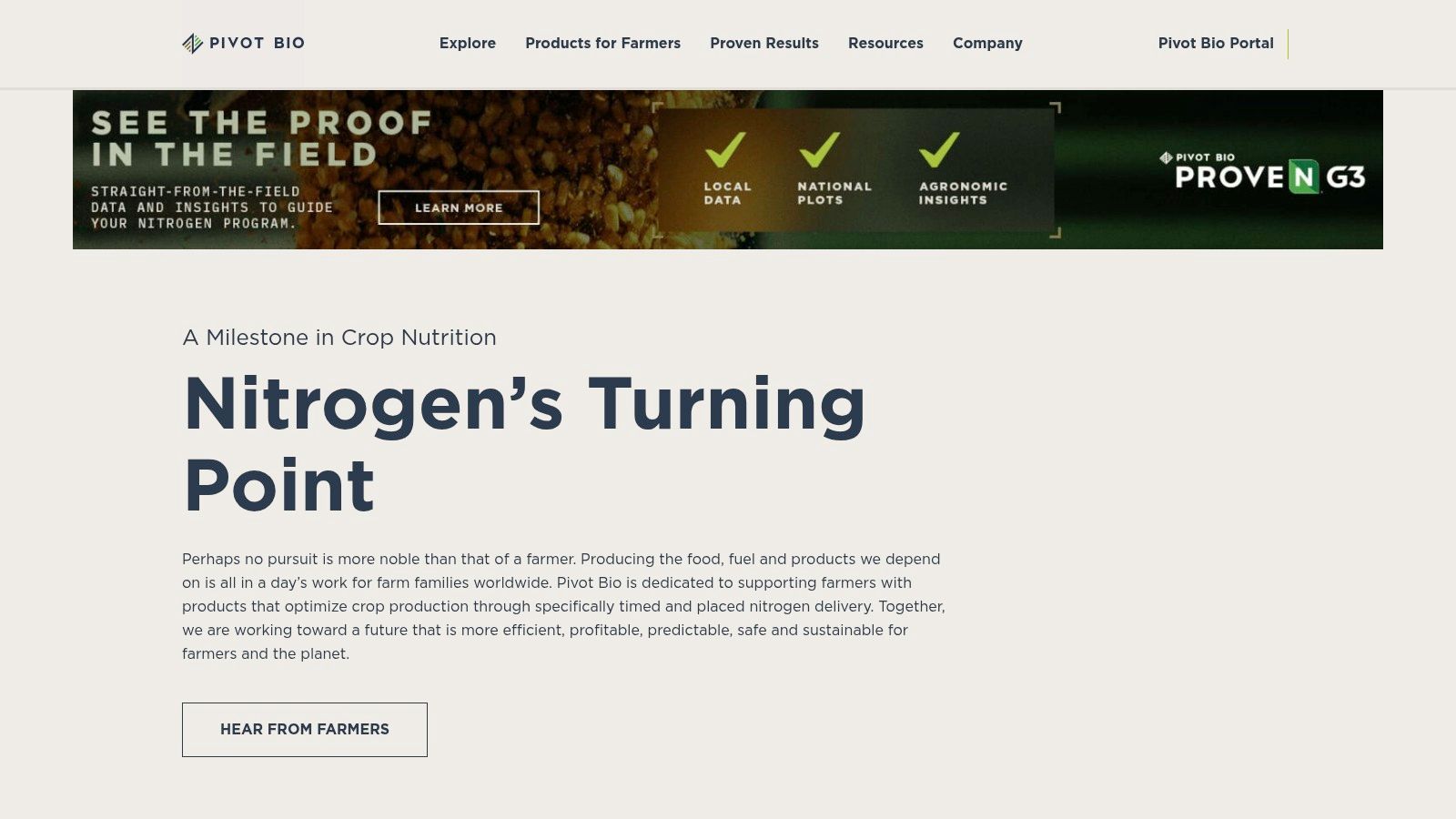
What makes Pivot interesting from a hiring angle is the go-to-market complexity. Dealer relationships, territory support, stewardship guidance, and environmental variability all matter. That creates room for product ops, field data, and customer education roles that many SaaS candidates overlook.
The strongest candidates usually come in through one of three narratives:
The product has a practical value proposition. It may reduce nitrogen volatility and logistics complexity versus split applications. The trade-off is that pricing is quote-based, ROI varies by environment and management, and distribution depends on regional channels.
"Can you help a field team explain the product honestly?" is a better interview question in agtech than "Can you move fast?"
If you're interviewing at Pivot Bio, ask how product claims are validated internally, how field feedback gets incorporated, and where engineering support ends and agronomy support begins. That line matters.
Visit Pivot Bio.
Carbon Robotics is where software talent often gets excited first, and for good reason. The company combines computer vision, AI, industrial lasers, and telemetry in systems designed to identify and eliminate weeds without herbicides or soil disturbance. If you're an ML engineer, robotics software engineer, perception specialist, or systems PM, this is one of the more obvious targets in agtech.

The hiring story gets stronger when you pair the robotics angle with infrastructure reality. Deloitte estimates the installed base of IoT endpoints for precision crop farming, livestock management, and equipment tracking will reach nearly 300 million by the end of 2024, up from 200 million in 2022. In other words, advanced field systems are no longer fringe. Integration and usable deployment matter more than glossy demos.
Carbon Robotics is best for people who enjoy the interface between hardware and software.
This category has sharp trade-offs. Chemical-free weed control is attractive, especially for high-value specialty crops and organic operations. But capital cost is substantial, pricing is quote-based, and ROI depends heavily on acreage, crop mix, and local labor dynamics.
The practical lesson for job seekers is simple. Don't pitch yourself as an "AI person" in the abstract. Show you've thought about downtime, serviceability, safety cases, and what happens when a model performs well in testing but encounters field variation at commercial scale.
Visit Carbon Robotics.
Monarch Tractor sits at the intersection of electrification, autonomy, and fleet software. The MK-V is a driver-optional electric compact utility tractor aimed at vineyards, orchards, dairies, and vegetation management. For candidates, that's a strong signal that the company likely values multidisciplinary talent more than narrow software specialists.
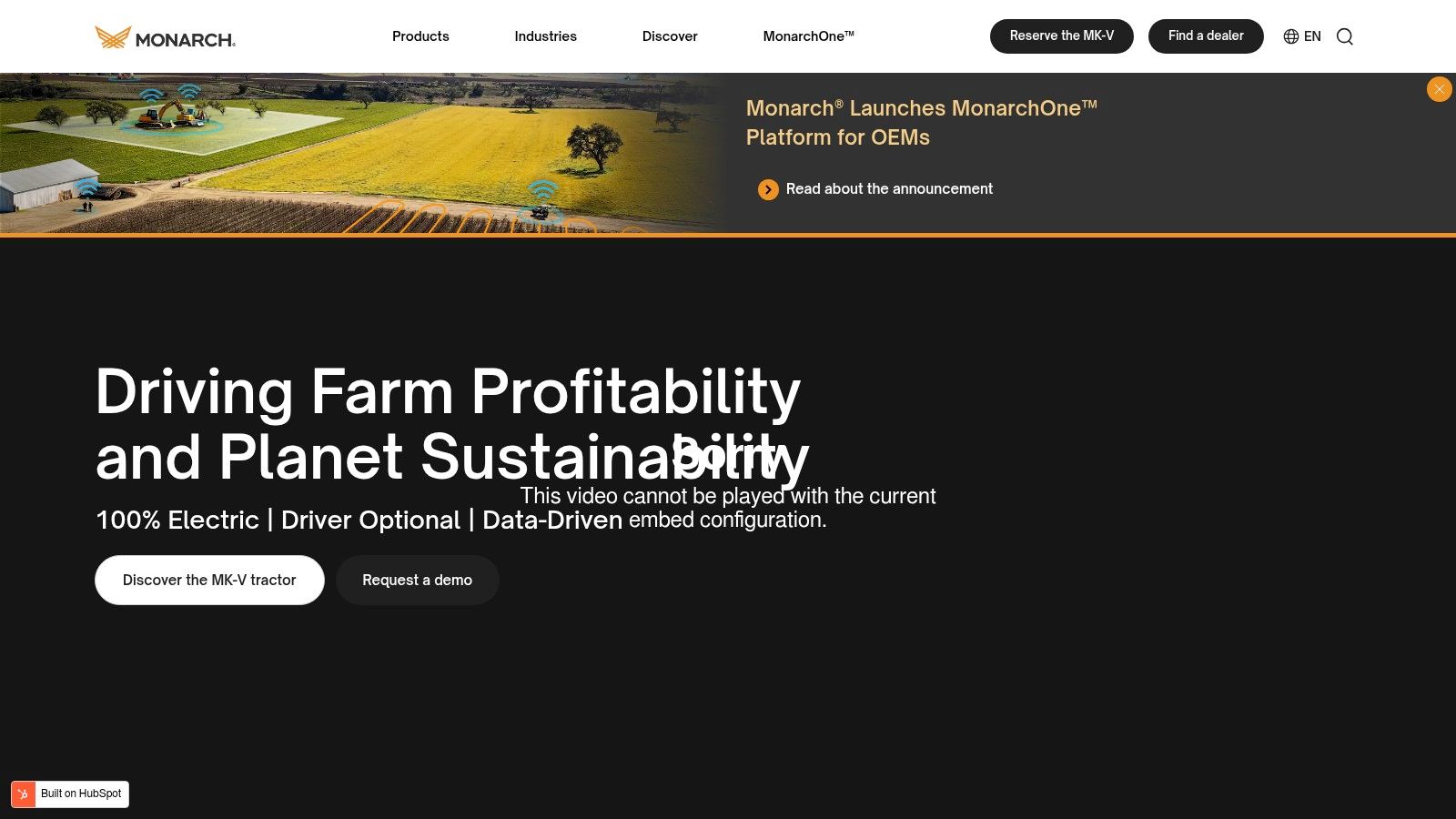
This is also where adoption economics matter. USDA reporting shows precision-ag adoption is scale-dependent, with guidance autosteering used by 52% of midsize crop farms and 70% of large-scale crop-producing farms in 2023. That doesn't map perfectly onto every tractor use case, but it does reinforce the pattern recruiters should understand: larger and more operationally advanced farms adopt labor- and timing-saving tech faster.
Monarch is attractive if your experience sits in mobility, autonomy, or energy systems.
The product upside is clear. Electric equipment eliminates diesel use at the point of operation, and autonomy features target repetitive labor-intensive work. The limitations are equally real. Pricing isn't publicly listed, incentives vary by location, and autonomy and runtime depend on the actual task.
If you're recruiting for agricultural technology companies in autonomy, screen for workflow understanding, not just robotics pedigree. A candidate who understands repetitive farm tasks often outperforms one who only knows warehouse automation.
Visit Monarch Tractor.
Bowery Farming is the outlier on this list because it's an operator, not a vendor. That distinction matters. You aren't joining a company that sells software to farms. You're joining a company that uses its own stack, BoweryOS, to run controlled-environment production with sensors, computer vision, machine learning, robotics, and traceability systems.
For some candidates, that's a negative because there isn't an external software product to shape. For others, it's ideal because the feedback loop is tighter. Operators, engineers, and product teams can observe plant, facility, and workflow outcomes directly. That can be far more satisfying than building a dashboard for a distant customer base.
Bowery is a good target for people who like vertically integrated systems.
The upside is coherence. BoweryOS can coordinate sensing, automation, and production decisions inside one environment. The downside is portability. Farmers can't directly buy and deploy the technology stack the way they can with a software platform or implement vendor.
That also changes how hiring works. Operators with strong technical instincts can be unusually valuable here. If you're applying, show that you can improve real production systems, not just write elegant code. Controlled-environment agriculture rewards candidates who think in terms of throughput, consistency, reliability, and biological constraints.
Visit Bowery Farming.
| Provider | Implementation complexity | Resource requirements | Expected outcomes | Ideal use cases | Key advantages |
|---|---|---|---|---|---|
| Farmers Business Network (FBN) | Low–Medium: online onboarding and account setup | Minimal capital; internet access; financing options vary by state | Streamlined procurement, consolidated financing and grain marketing | Row‑crop and mixed operations seeking one platform for buying and risk management | Transparent pricing; integrated inputs, financing, and marketing |
| Climate FieldView (Bayer) | Medium: hardware installation optional; data integration | FieldView Drive 2.0 for full functionality; connectivity; subscription tiers | Centralized field data, prescriptions, yield and scouting insights | Operations standardizing data/prescriptions across mixed fleets | Strong OEM connectivity; free Basic plan; robust mapping/analytics |
| Indigo Ag | Low–Medium: enroll in programs and adopt biologicals | Purchase biologicals or CLIPS system; verification for carbon program; time to vest payments | Yield resilience support and supplemental carbon revenue (vests over time) | Growers pursuing regenerative practices and carbon revenue streams | Biological products + farmer‑first carbon program with revenue sharing |
| Pivot Bio (PROVEN 40) | Medium: change N management and application methods | Dealer procurement; per‑acre product rates; training and stewardship | Partial replacement of synthetic N, reduced leaching risk, maintained yields | Farms reducing synthetic N and participating in low‑carbon programs | Microbial N replacement backed by multi‑state datasets and programs |
| Carbon Robotics (LaserWeeder G2) | High: implement install, AI/vision calibration, autonomy setup | High capital; compatible implements/tractor; telemetry and power; financing options | Chemical‑free weed control, reduced labor, data for continuous improvement | High‑value specialty and organic crops with high weeding costs | Field‑scale laser + AI weed control with performance telemetry |
| Monarch Tractor (MK‑V) | Medium–High: vehicle acquisition and software/autonomy integration | High capex (offset by incentives sometimes); charging infrastructure; implements | Zero tailpipe emissions, autonomy for repetitive tasks, potential fuel/maintenance savings | Vineyards, orchards, dairies, vegetation management seeking electrification | Electric driver‑optional tractor with autonomy and exportable power |
| Bowery Farming (BoweryOS) | High (operator model): advanced CEA stack not directly deployable | Significant capital and integrated sensors/robotics if replicated; otherwise retail partnerships | Consistent, pesticide‑free produce with traceability and automation | Retailers/foodservice needing reliable near‑consumer produce supply | Proprietary OS combining sensors, vision, ML and robotics at scale |
The easiest mistake in agtech hiring is treating the sector like one market. It isn't. Agricultural technology companies span fintech-like marketplaces, machine data platforms, biological products, robotics, electric vehicles, and tightly integrated farming operations. The job search gets easier when you decide which problem type fits you.
If you like transactional systems and complex workflows, FBN is a stronger target than a robotics company. If you're strongest in data infrastructure, connectivity, and machine integrations, Climate FieldView is the more natural fit. If your background blends science and product, Indigo Ag and Pivot Bio stand out. If you're an autonomy, perception, or controls candidate, Carbon Robotics and Monarch Tractor deserve attention. If you want to build systems that directly run production, Bowery is the clearest fit.
For recruiters, the main lesson is just as practical. Generic startup screening misses good agtech talent. Many strong candidates won't have explicit agriculture experience, but they'll have adjacent experience in logistics, fintech infrastructure, embedded systems, industrial software, mobility, energy systems, or regulated workflows. Those backgrounds often transfer better than pure consumer app pedigrees.
A few tactics consistently help job seekers:
This sector is growing, but growth alone isn't the career story. A key opportunity is that agtech still rewards builders who can solve practical problems under hard constraints. That's a good market for serious engineers, product managers, and technical operators.
Underdog.io is a strong option if you want startup opportunities without turning your search into a full-time job. The platform is curated for tech talent, focused on high-growth companies, and designed so employers reach out to you after one application. If you're exploring agtech, climate, robotics, data infrastructure, or adjacent startup roles, create a profile on Underdog.io and let vetted companies come to you.