If you're job hunting in tech right now, you've probably seen the same pattern over and over. A startup says it's "scaling fast," posts a flashy funding announcement, and talks like it's the next category winner. Then you get into the interview loop and realize the team doesn't know its hiring plan, the product still feels half-formed, and nobody can explain why customers stick around.
That's the gap frequently missed.
Real high growth tech companies don't just look busy. They show operational traction. They solve a painful problem, in a market big enough to matter, with a product that gets stronger as the company adds customers, data, and distribution. If you're a candidate, that difference affects your career risk, compensation upside, and day-to-day work. If you're a hiring manager, it affects whether you can attract people who know how to operate under real scale pressure.
The useful question isn't "Which startups are hot?" It's simpler and harder. Which companies are compounding, and which ones are just narrating growth?
Most startups are saplings. They need steady care, they grow gradually, and a lot of them stay small for longer than founders expected.
A true high-growth company behaves more like bamboo. You don't see much at first, then suddenly the growth curve changes. New customers arrive faster, product cycles tighten, hiring accelerates, and adjacent use cases open up because the underlying system was built to scale.
That kind of trajectory usually comes from two things working together. First, the company solves an expensive operational problem. Second, it sits inside a market that's already expanding, so demand doesn't need to be manufactured from scratch.

One of the clearest markers of this environment is AI and enterprise software spending. Deloitte projects that worldwide spending on AI will grow at a 29% compound annual growth rate from 2024 to 2028, while global IT spending overall is projected to rise 9.3% in 2025, with data center and software segments growing at double-digit rates, according to Deloitte's technology industry outlook.
That matters because high growth tech companies usually don't win by "disrupting" in the abstract. They win because buyers already have budget pressure, labor pressure, or compliance pressure. The product lands in a budget line that teams need to protect.
A lot of founders get this wrong. They think a polished demo equals momentum. It doesn't. Momentum shows up when the market is already leaning toward adoption.
Practical rule: If a company has to educate every prospect from zero, growth will usually be slower than the story suggests.
There's also a structural difference between a startup and a high-growth company. Plenty of startups have ambition. Fewer possess a key advantage. The ones that scale tend to build on a repeatable layer such as workflow infrastructure, data systems, AI tooling, or embedded distribution.
That's why product execution matters so much. Teams that understand prioritization, shipping discipline, and user feedback loops usually create more durable momentum than teams that chase features. If you work in product, it's worth reviewing strong PM best practices because the basics matter more, not less, once growth starts to accelerate.
For candidates trying to sort signal from noise, broad startup advice won't get you far. A more practical filter is understanding how startup trajectories differ by stage, market, and hiring need. This overview of careers in tech startups is a useful companion if you're comparing early-stage environments rather than just scanning job titles.
Use this checklist before you call something high growth:
If those pieces aren't present, you're probably looking at a startup with potential, not a high-growth business with significant inherent profit scalability.
Many evaluators assess a startup with the wrong inputs. They focus on the funding headline, the brand-name investors, or whether the founder has a strong social presence. Those things can matter, but they don't tell you whether the company can scale efficiently.
The cleaner way to judge high growth tech companies is to look at the operating signals underneath the story.
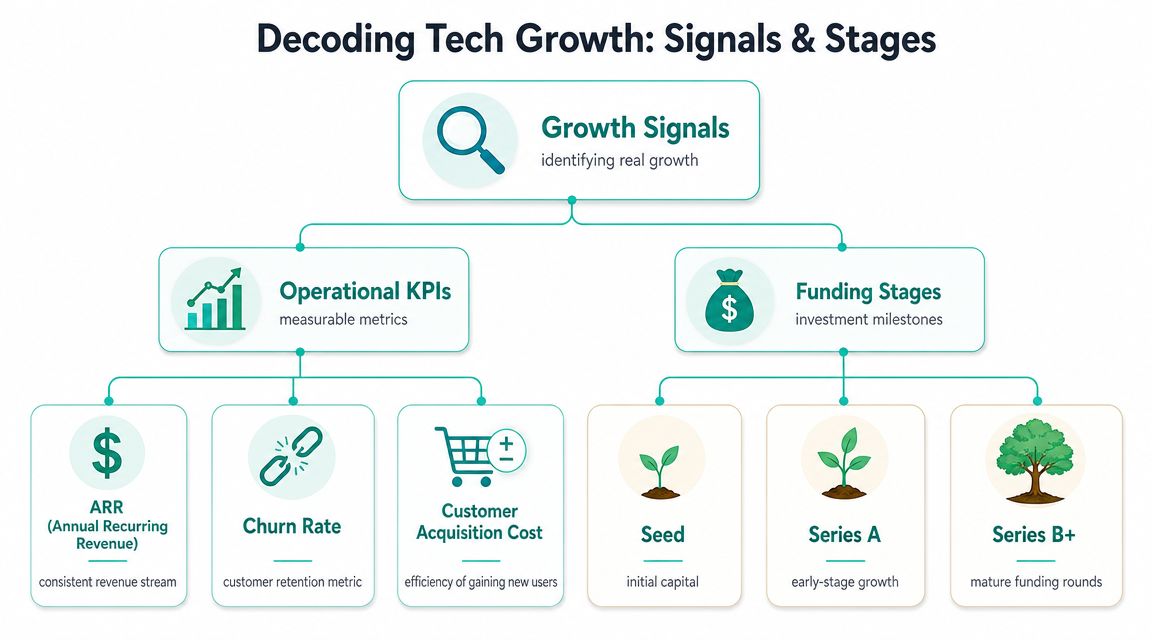
A practical framework comes from Landbase's review of fast-growing productivity tech companies, which points to revenue growth rate, user adoption metrics, customer retention, time-to-value, and expansion revenue from existing customers as the more useful indicators of product-market fit and efficient scaling.
Those metrics matter because each one answers a different question:
| Signal | What it tells you |
|---|---|
| Revenue growth rate | Whether demand is increasing, not just existing |
| User adoption | Whether customers actually activate and use the product |
| Customer retention | Whether the product remains important after the sale |
| Time-to-value | How fast a user gets to the "this works" moment |
| Expansion revenue | Whether the product grows deeper inside accounts |
You can still ask about ARR, churn, or CAC payback in interviews. Just don't act like every company will disclose them precisely. Good candidates ask for direction, trend, and decision-making logic. Weak candidates ask for vanity numbers.
Ask, "What changed in the business over the last two quarters that gave you confidence to hire this role?" The answer usually reveals more than the funding announcement.
If the company sells into data-heavy enterprises, understanding the architecture behind the product also helps. This guide to enterprise data platforms is useful context because a lot of growth-stage software businesses rise or fall on messy data integration, not surface-level product polish.
Funding rounds matter, but mostly because they change expectations.
That doesn't mean later stage is always safer. Sometimes a late-stage startup has more pressure because it has less room to hide weak retention or a confused product strategy.
Candidates often misread stage because they treat it as a prestige ladder. It isn't. It's a risk-and-constraints profile. A seed company may offer more role scope. A Series B company may offer better management layers. A later-stage company may offer more process but less influence.
If you want a grounded view of what each round usually means for hiring and company maturity, this explanation of what Series A funding means is worth reading before you interview.
Three bad evaluation habits come up constantly:
The companies worth betting on usually have a boring core. Customers adopt, get value quickly, renew, and expand.
The fastest way to waste a job search is to rely on generic job boards and whatever company names happen to be loud that week. Good opportunities in high growth tech companies usually surface earlier than that, and often in categories that look less glamorous from the outside.
One of the strongest clues right now is where capital is concentrating. A Venture Atlanta outlook on startup industries says investors are focusing on Vertical Artificial Intelligence, Cybersecurity, Robotics, Defense Technology, and Government Technology. Those categories tend to be harder to copy and often require domain-specific execution.
The best companies usually sit where the problem is expensive, regulated, operationally ugly, or all three at once.
That's why these sectors deserve a closer look:
A lot of candidates skip these categories because they seem less intuitive than a consumer app or collaboration tool. That's often a mistake. The more specialized the problem, the less likely the company is competing on shallow product differentiation.
When I assess a startup, I don't start with the pitch deck language. I start with four questions.
Does the leadership team understand the buying motion?
Founders don't need perfect polish. They do need clear thinking about customer pain, implementation, and why users stay.
Is the product sticky in a real workflow?
Nice-to-have tools get cut. Workflow products that sit near revenue, compliance, infrastructure, or core execution survive longer.
Can the company grow without brute force?
If every new customer requires heroic support, the business may still be in custom-services mode.
Does the role match the company's actual problem?
A lot of hiring plans are aspirational. The sharp question is whether the company knows why this role matters now.
The strongest opportunities often look slightly unsexy at first glance. That's because operationally painful markets create better businesses than fashionable ones.
Before you apply or take a recruiter call, check for these signals:
If you can't answer most of those after basic research and one call, slow down. The problem isn't that you're missing information. The problem is usually that the company hasn't created enough clarity yet.
High-growth hiring doesn't feel like corporate hiring. The cadence is faster, the ambiguity is higher, and the company usually cares less about polished interview theater than about whether you can solve urgent problems without needing a lot of scaffolding.
That changes what gets rewarded.
In early and growth-stage teams, the strongest candidates usually show some combination of range, judgment, and speed. That doesn't mean everyone has to be a generalist forever. It means companies want proof that you can operate when the org chart is incomplete and priorities move.
Hiring managers usually look for signs like:
Candidates often undersell this. They present themselves as owners of a narrow lane when the team really needs someone who can handle a messy handoff, define the problem, and still deliver.
A lot of people negotiate startup offers like it's a normal salary discussion with a little lottery ticket attached. That's the wrong frame.
If you're joining a company because you believe it's one of the few high growth tech companies with real upside, you need to understand the equity package with the same seriousness you'd bring to base salary. That means asking what form of equity you're receiving, how vesting works, what happens if you leave, and how future dilution may affect your ownership.
Common issues candidates miss:
Don't ask these questions in a combative way. Ask them like someone who understands how startup compensation works. It changes the tone of the conversation immediately.
For a grounded overview of how to compare cash, equity, and perks, this guide to startup compensation and benefits is a solid reference.
If a company says equity is meaningful but can't explain it clearly, treat that as a hiring signal.
Two mistakes show up constantly. First, candidates optimize only for cash and ignore ownership structure. Second, founders oversell upside and under-explain risk.
A better approach is simple. Push for clarity, not just headline numbers. You want a package you understand, at a company you can stay long enough to benefit from.
Location still matters more than a lot of people want to admit. Remote work widened access, but hiring density, local networks, and in-person ecosystem effects still shape where many high-growth opportunities cluster.
That matters for both candidates and companies. Talent doesn't distribute evenly, and neither do fast-moving startup communities.
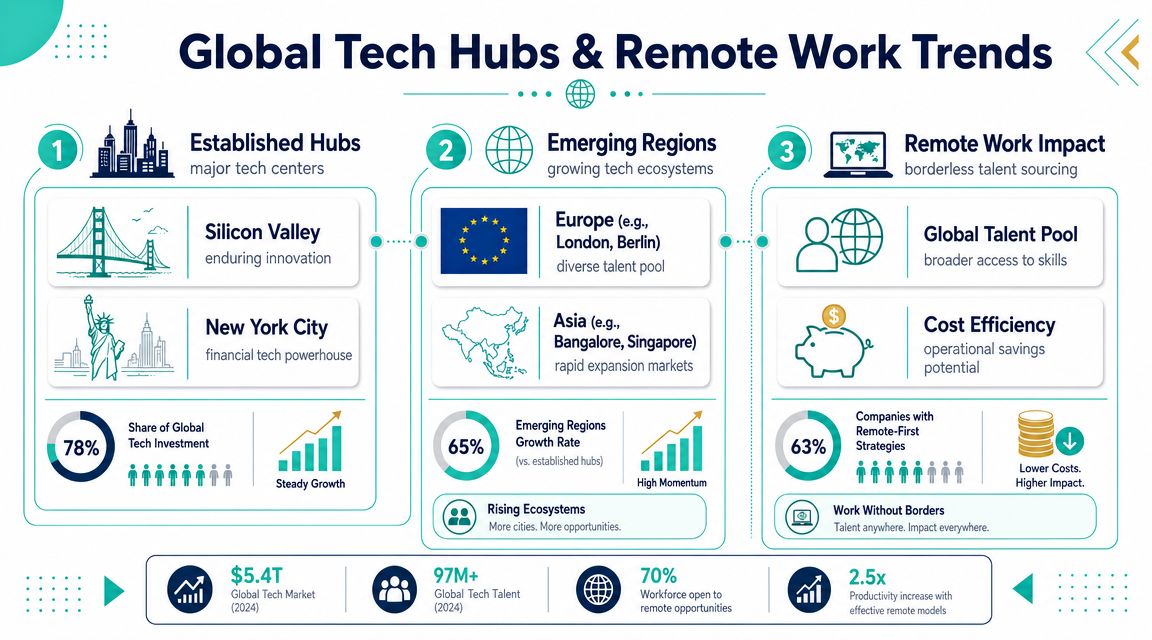
Seattle is a good example of why metro-level dynamics matter. The Greater Seattle region's tech industry is described as generating $148.9 billion in annual economic impact, supporting 193,400+ jobs, with projected growth of 11% by 2029, according to Greater Seattle's tech market snapshot.
That doesn't just tell you Seattle is large. It tells you concentration creates second-order effects. More operators. More founders with scaling experience. More hiring overlap between infrastructure, cloud, enterprise software, and adjacent startups.
A simple comparison helps:
| Market | Common strength | Candidate trade-off |
|---|---|---|
| San Francisco Bay Area | Dense founder and investor network | Heavy competition, fast-moving expectations |
| New York City | Strong mix of fintech, enterprise, and product talent | Hiring can be intense and highly networked |
| Seattle | Deep infrastructure, cloud, and enterprise ecosystem | Roles can skew toward technically demanding environments |
Remote hiring is useful, especially for specialized engineering, product, and data roles. It gives companies access to broader talent and gives candidates access to companies they wouldn't relocate for.
But remote also creates friction that candidates should price in realistically.
For some people, a hybrid role in a major hub is still the best career move because it compounds network access, mentorship, and internal trust faster than a fully remote setup. For others, remote is a smart way to access category-leading work without local market constraints.
The key is not to romanticize either path. A remote role at a disciplined company can be excellent. A hub-based role at a chaotic company can still be a mess.
If you're early in your startup career, a dense market can accelerate learning because you get more exposure to operators, interview loops, and adjacent opportunities. If you're already specialized, remote can work well when the company is explicit about ownership, communication, and decision cadence.
Geography isn't just where the office is. It's how the company builds trust, transfers knowledge, and hires around its center of gravity.
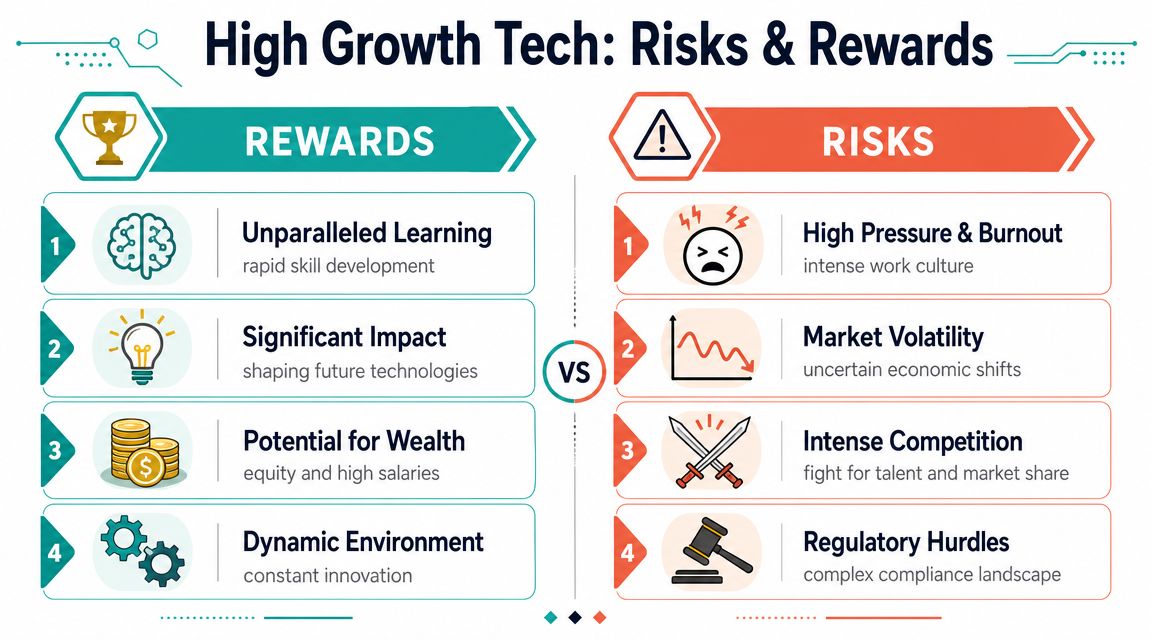
High-growth environments can be career accelerators. They can also be expensive mistakes.
Both things are true at once. That's why the useful question isn't whether high-growth companies are good or bad. It's whether the trade-off matches your temperament, finances, and stage of life.
There is genuine demand behind this part of the market. About 90% of organizations are undergoing some form of digital transformation, which creates sustained demand for software and tools, according to Mooncamp's digital transformation statistics roundup.
That doesn't guarantee any single company will win. It does mean these businesses aren't operating in a vacuum. Many are building into urgent enterprise needs, which is why the upside can be meaningful for people who join the right team at the right time.
The rewards are straightforward:
The same conditions that make these roles exciting also make them unstable. Priorities change quickly. Management layers may be immature. Burnout risk is higher when the company confuses urgency with discipline.
Here is the honest version:
You don't need to be fearless to join a high-growth company. You do need to be honest about your risk tolerance.
The candidates who do best usually want responsibility, can handle imperfect systems, and don't need constant certainty to do good work.
A candidate gets excited by a big funding headline, takes the first interview, and only later learns the team is missing quota, churn is creeping up, and the role exists because the last two hires quit. That happens all the time.
A better search starts with a tighter filter. Look for companies with clear demand, repeatable hiring patterns, and a role tied to a real business need, not a vague mandate to "help us scale."
Start with a short target list. Ten strong companies beat fifty random applications because you can examine the signals that matter.
Build a target list
Choose companies in markets you understand or want to learn well. Then check for signs that the business is adding structure, not just attention. New manager hires, posted openings across sales, product, and customer success, and consistent role scope usually indicate planned growth instead of reactive hiring.
Rewrite your resume for startup relevance
Early and growth-stage teams hire for evidence. Show where you owned outcomes, worked across functions, handled incomplete information, and shipped work that affected revenue, retention, or product adoption. Cut generic bullet points. Keep the parts that prove range and judgment.
Prepare interview questions that test operating reality
Ask what changed in the business over the last two quarters. Ask why this role was opened now. Ask how the team measures success in the first six months. Ask what tends to slow execution today. Good companies answer directly. Weak ones drift into slogans.
Choose your risk band before you interview
Seed, Series A, and later-stage growth companies hire differently and manage differently. Seed may offer raw scope with little support. Series A often gives the steepest learning curve and the messiest systems. Later-stage companies usually bring more structure, but they may narrow your role faster. Pick the trade-off on purpose.
Use focused channels, not only broad job boards
Strong opportunities often show up through investor portfolios, founder referrals, operator communities, and specialized recruiting channels before they get blasted across high-volume boards. The goal is better signal, not more listings.
Run your search like a pipeline. Track target companies, outreach, recruiter screens, interview notes, compensation ranges, and the concerns you hear repeatedly. After five to ten conversations, patterns show up fast. You will hear which companies have a crisp story on retention and hiring plan, and which ones are still selling hope.
Candidates who do this well are not trying to sound "startup-ready." They can explain the kind of environment they want, the kind they want to avoid, and the evidence they need before saying yes.
If you're a hiring manager, apply the same standard to your own process. Explain why the company is growing, why this role matters now, what the first year should produce, and how compensation works. Serious candidates are screening you for operating discipline, not just brand and upside.
If you want a cleaner way to get on the radar of startups without blasting resumes across the internet, create a profile on Underdog.io. It lets vetted tech candidates be discovered by hiring teams at growth-stage companies, which is often a more efficient path than starting every conversation from scratch.