You're a product manager refreshing a careers page on your phone during standup. You don't want the page in a work browser that IT manages, and you certainly don't want a recruiter calling your office number. You're curious about another role, not ready to announce a departure.
An anonymous job search creates space between those decisions. The challenge is keeping enough evidence visible for a hiring manager to recognize your fit without giving a coworker enough clues to recognize you.
An anonymous job search is controlled disclosure, not a false identity. You describe your real skills and experience while delaying the release of your name, contact details, and identifying employment information.
For someone already working at a startup, the risk isn't limited to the boss finding a résumé. An application might reach a former colleague, a client, or a hiring manager who knows your current team. You need room to explore without making that exploration public.
Hide the person, keep the proof.
Start with quiet research. You inspect companies, compare responsibilities, and decide whether a different environment would solve the problem that's making you look.
Next comes a restricted profile or an introduction through someone who holds your identity. A hiring manager can assess your craft, seniority, and preferences without immediately receiving your full employment record.
The final stage is a normal, named hiring process. Both sides want to talk, you know which company is involved, and you deliberately authorize the next disclosure.
| Search stage | What you're deciding |
|---|---|
| Quiet research | Is another role worth exploring? |
| Restricted introduction | Is there enough professional fit to talk? |
| Named process | Do I trust this employer with my identity? |
The protection has limits. A profile can be recognizable without a name, and a heavily stripped résumé can become too vague to match with a real role. Privacy also doesn't guarantee fair evaluation.
Your first decision therefore isn't where to apply. It's how visible you're willing to become before the first reply, and what evidence a hiring manager needs to earn that reply.
Suppress direct identifiers, but preserve job-relevant evidence. A startup engineering manager needs to understand whether you can own production systems, not merely see a list of programming languages.
For example, “backend engineer at a Series B fintech, responsible for payment reliability and incident response” provides useful context without naming the company. If that combination describes only one person in your city, broaden the company description further.
| Signal | Early stage | Why | Reveal when |
|---|---|---|---|
| Legal name | Hide | Direct identifier | Mutual interest |
| Photo and social profile links | Hide | Face and network point to the employer | Optional, after a real conversation |
| Personal email and phone | Separate search inbox only | Work accounts and shared devices can expose alerts | Scheduling a conversation |
| Home address | Never on a profile | Unnecessary for matching | Not needed for an interview |
| Current employer | Industry and stage only | Small teams can make a person identifiable | First serious conversation |
| Job title | Standard title, no internal codename | Matching needs function | On the profile |
| Outcomes and scope | Keep, without client or product names | Evidence makes responsibilities credible | On the profile |
| Location | City or remote preference | Street address adds risk, not signal | Exact logistics near an offer |
| Work authorization | Status in words, no documents | Employers need to understand hiring eligibility | Documents during a legitimate verification process |
| Education and dates | Relevant school and years, trim unique month ranges | Exact dates plus a niche employer can identify someone | On the profile if it supports the role |
Your legal name adds little to an initial assessment of technical fit. A photo adds even less, and LinkedIn, GitHub, or personal-site links can immediately reconnect an otherwise anonymous profile to your employer.
If you later choose to add a portrait to a named professional profile, Secta Labs professional portrait styles offers a reference for presentation choices. That belongs after the anonymity decision, not in an early confidential introduction.
Use a separate inbox for communication rather than publishing your usual email or phone number. Leave your home address out entirely.
Replace your employer's brand with useful context, such as industry, business model, or company stage. Keep a recognizable title and seniority, rather than an internal label that only your colleagues understand.
Scope and outcomes should survive redaction. Explain what you owned, which technologies or design methods you used, and what improved. Remove client names, internal product codenames, and distinctive conference talks that would make the achievement searchable.
City or remote preference helps with matching; a street address doesn't. State work authorization plainly, but don't attach identity or immigration documents to an introductory profile.
Relevant education can remain when it supports your qualifications. Shorten exact month ranges if the combination of school, start date, and niche employer would make identification easy.
At Underdog.io, our candidate profiles are invisible on the platform, and the candidate's employer is blocked. Discovery doesn't have to begin with a publicly searchable résumé.
Suppose a profile describes a staff machine-learning engineer who worked from 2019 to 2024 at a health-tech company in a midsize city and maintained a named open-source project. This is a hypothetical example, but the identification problem is concrete: someone can search the project, find its maintainer, and connect the remaining details.
Each field looks harmless alone. Together, they can identify the person.
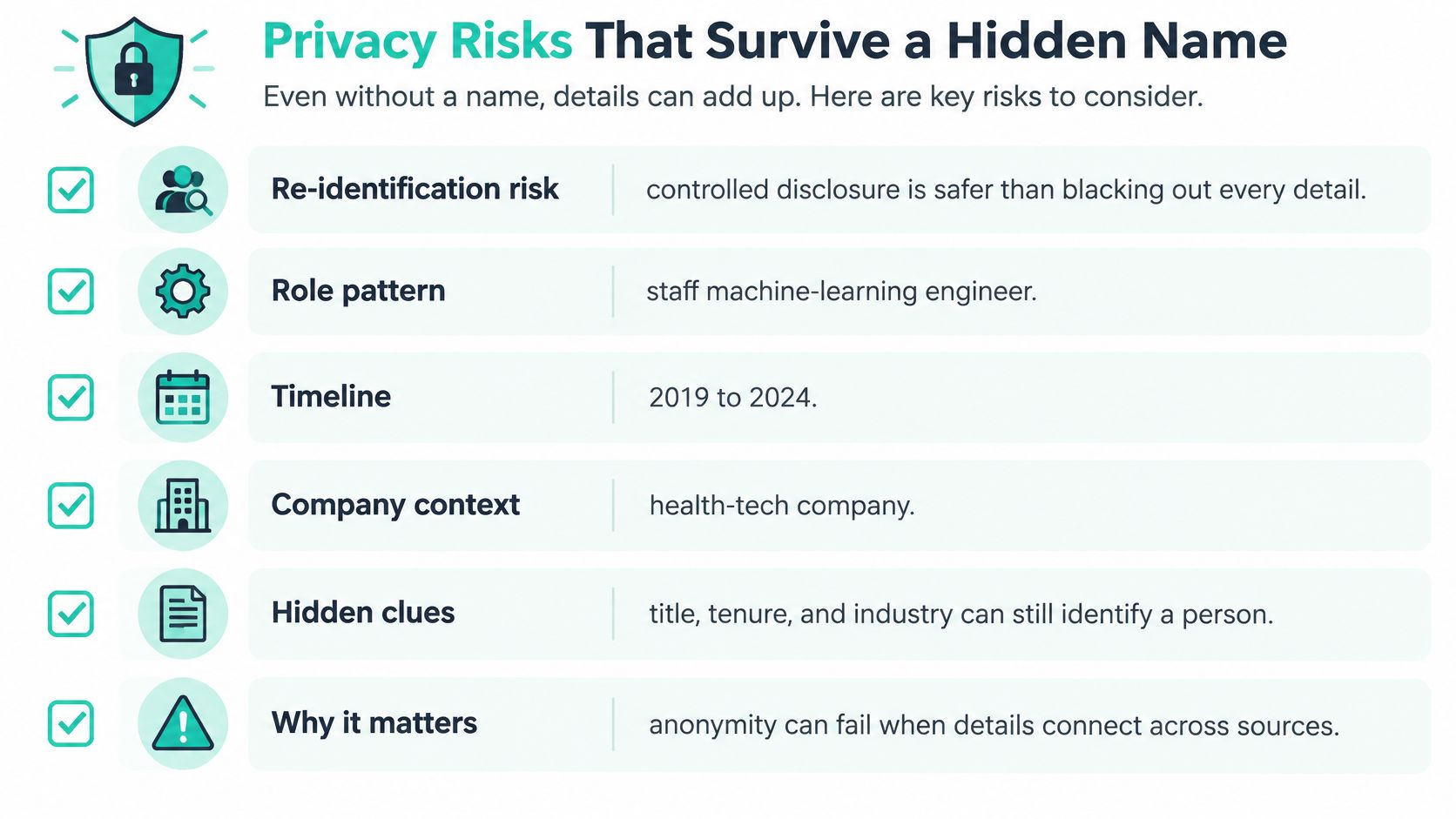
Watch for rare titles paired with employer descriptions, cities paired with exact dates, and distinctive projects paired with technical specialties. Remove the least useful identifying detail rather than deleting everything that demonstrates competence.
For the hypothetical engineer, “senior machine-learning practitioner in healthcare” might preserve the relevant experience while dropping the searchable project and unusual title. The hiring manager can still ask about model deployment, evaluation, and production ownership.
The Privacy While Seeking Employment Online guide recommends withholding contact information, using generic employer descriptions, and checking how a service stores and shares applicant information before uploading a résumé. It also warns about résumé access by purported employers without reliable identity verification.
That means a hidden name in the visible header isn't enough. You need to understand who can retrieve the underlying file.
Before uploading, ask where the résumé lives, who can download it, and how employer accounts are verified. Read the relevant policy, including Underdog.io's privacy policy, rather than treating a privacy label as a complete explanation.
Use this minimum kit:
Rename the exported document with a generic label rather than your full name. Open that final file and check it, not just the editable original.
Treat every upload as a disclosure to a recipient, not simply a file saved behind a login.
For an employed candidate, exposure can become a workplace and reputation problem, not just unwanted email. Before your next upload, delete one uniquely identifying detail that doesn't help the employer judge your qualifications.
In a French public-employment experiment, the interview-rate gap between minority and non-minority applicants increased from 2.4 percentage points with standard résumés to 13 percentage points with anonymous résumés, according to the evaluation by Luc Behaghel, Bruno Crépon, and Thomas Le Barbanchon. The evaluation reported a deterioration of 10.7 percentage points and a widening of the hiring gap by 3.7 percentage points.
Participating employers were randomly assigned conventional or anonymized résumés. The program aimed to reduce racial and ethnic stereotyping during screening, but anonymization didn't materially change overall interview or offer numbers, hiring duration, or employers' use of other recruiting channels.
| Measure | Standard resumes | Anonymous resumes | Change |
|---|---|---|---|
| Interview-rate gap | 2.4 percentage points | 13 percentage points | +10.7 percentage points, as reported |
| Hiring gap | Baseline not specified in the evaluation summary | Endpoint not specified in the evaluation summary | +3.7 percentage points |
The displayed interview figures are rounded; the change shown is the evaluation's reported estimate, not a subtraction recalculated from those rounded endpoints.
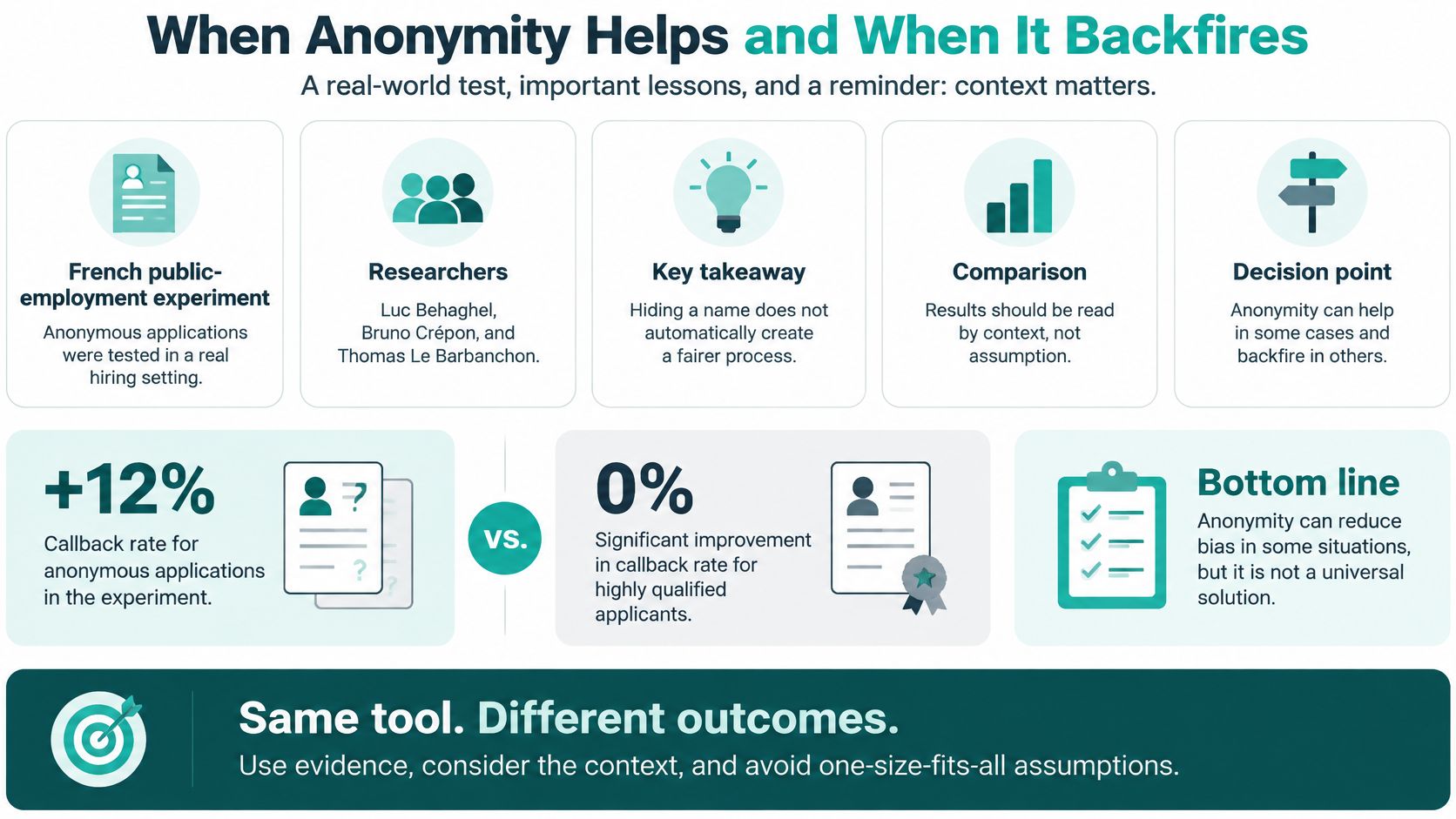
The researchers attributed the unexpected outcome partly to lost context. Employers could no longer interpret or discount some negative signals in the same way.
A recruiter who can't see identity may still respond to school names, employment gaps, language, or location. Removing explicit demographic information doesn't remove those proxies, and deleting explanatory context can make a candidate's record harder to interpret fairly.
Less identity is not the same as less bias.
There are counterweights: the 2025 IZA review of anonymous applications describes field experiments across Europe, Canada, and Australia with effects that vary by country and process, and discusses Harvard Business School findings of higher average productivity, larger shares of women and older hires, and an approximately 25% narrowing of gender and age gaps among applicants under blind hiring.
The practical conclusion isn't to abandon anonymity. It's to preserve scope, outcomes, seniority, and work authorization while asking employers to evaluate those signals consistently.
An employer also needs structured interviews after identity returns. Where demographic monitoring is lawful and appropriate, keep it separate from selection decisions so hiding information from reviewers doesn't prevent the organization from detecting disparities.
Browsing privately, signaling availability to recruiters, and publishing a résumé are different actions. A setting that protects your browsing identity doesn't automatically hide your profile or make an application confidential.
LinkedIn's profile-viewing guidance distinguishes named, semi-private, and fully private viewing: fully private mode shows only that a LinkedIn member viewed the profile, while semi-private viewing can expose professional characteristics.
| Channel | Who can see you | What stays hidden | Name released |
|---|---|---|---|
| LinkedIn fully private browsing | The viewed member sees only a LinkedIn member | Name, headline, and employer in the viewing notification | If you choose to identify yourself through messaging |
| LinkedIn semi-private browsing | Viewed member may see title, industry, school, or employer | Full name in the viewing notification | When you engage through your named account |
| Open to Work for recruiters | LinkedIn Recruiter users matching your interests | The job-seeking signal from the wider network, if set to recruiters only | Your named profile can already be visible to recruiters |
| Public job-board resume | Employer accounts, sometimes weakly verified | Often nothing if the file contains contact details | On upload or application |
| Curated marketplace such as Underdog.io | Screened employers after profile review; current and past employers blocked | Identity during initial confidential introductions | After you approve the connection |
Private browsing is not private availability. Turning on a recruiter-facing job-seeking signal is an intentional step toward discovery, not a way to conceal yourself from every recruiter.
Likewise, a semi-private profile view can be enough to identify someone on a small team. If you're researching a manager at a target startup, use fully private viewing rather than relying on your name alone being absent.
At Underdog.io, we hide candidates from current and past employers, and every candidate profile is screened before employers see it. Hiring managers reach out directly to the candidate's inbox with interview requests.
That changes the candidate's task. Designers, for example, create one profile rather than applying posting by posting; companies contact them directly. Our guide to an alternative to LinkedIn job searching explains that different search approach.
A staffing-firm route is another option. With a firm such as nexusITgroup.com, establish in writing which employers may receive your résumé, when your name can be released, and whether previous employers are excluded. Don't assume a private conversation with a recruiter means unlimited permission to circulate your information.
For quiet company research, choose fully private browsing. For a passive startup search, consider a screened marketplace with employer blocking. For a named application, wait until you've verified the company and decided that the specific opportunity justifies disclosure.
None of those choices removes the need to review what you share. The channel determines who gets access; your profile determines what they can infer.
Use a month to test a controlled search rather than distributing your résumé everywhere at once. Set up your boundaries at the beginning, evaluate conversations as they arrive, and change visibility deliberately instead of reacting to every recruiter message.
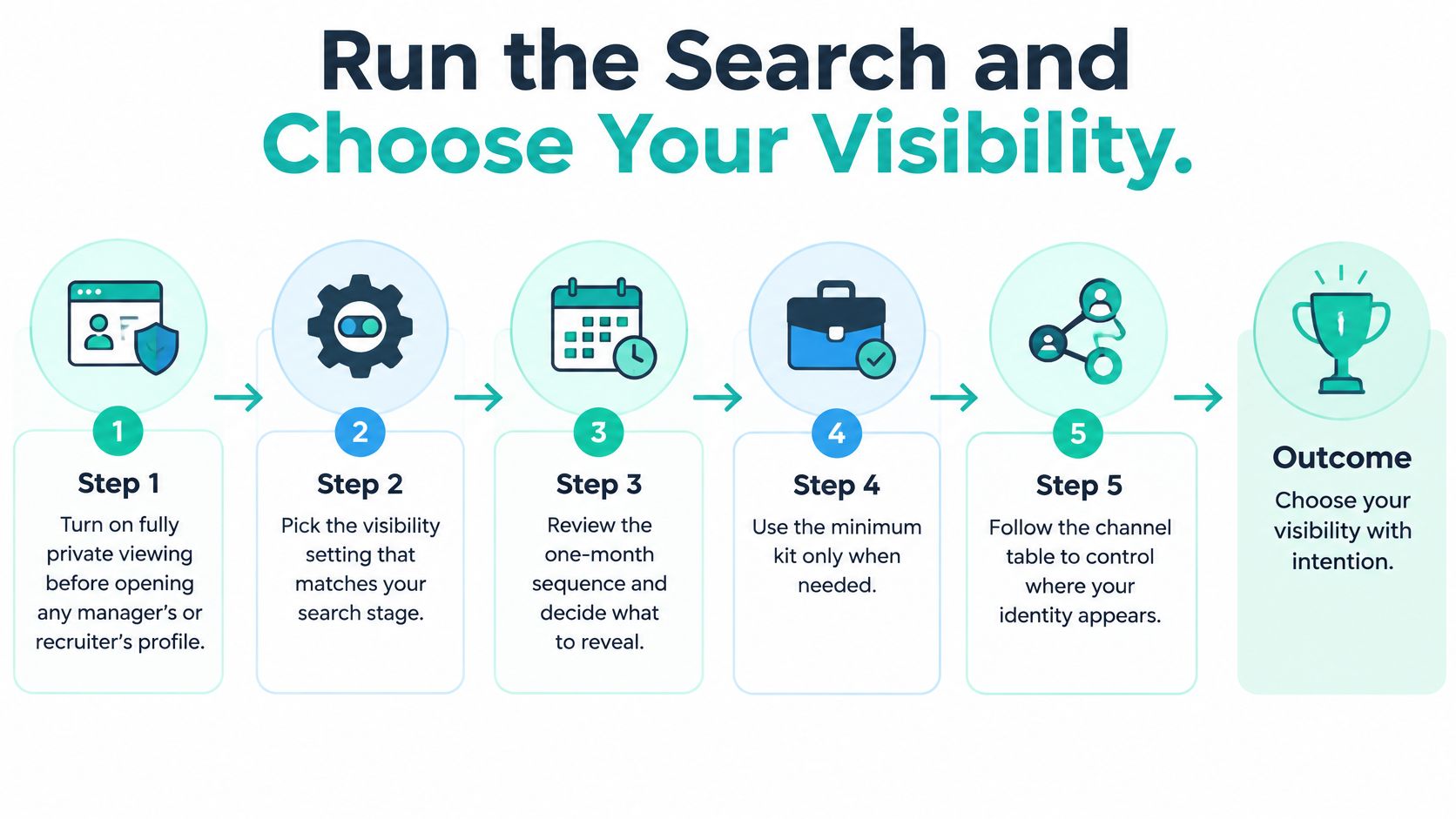
Set browsing privacy before researching people. Turn on fully private viewing before opening a manager's or recruiter's profile. Use a personal device and account for the search, and schedule conversations outside work commitments.
Choose a channel for the month. Use private research plus a recruiter, or a screened marketplace, rather than placing the same résumé across public boards. At Underdog.io, applying takes 60 seconds, with no cover letter and no retyping of your full work history. A match or introduction isn't a promise of an offer.
We list startup openings in New York City, San Francisco, and remote roles. If you're comparing options for technical roles, use our job-search sites guide for software engineers to narrow the choice before creating more accounts.
Investigate screening before sharing more. Ask whether AI screens or ranks the profile, what information is retained, who receives it, and whether a person reviews rejection decisions. Also verify the company through its official careers presence and confirm the recruiter's relationship to the role.
In Gartner's first-quarter 2025 survey of 2,918 candidates, 52% believed AI screened their application information, 26% trusted AI to evaluate them fairly, and 32% worried AI could cause their application to fail; only half trusted that the jobs they applied for were legitimate. Those are candidate perceptions, not measurements of screening accuracy, but they identify useful questions to resolve.
Release your name for a specific process. Once a real employer has established a role and both sides want to proceed, authorize the named introduction and fuller employment history. Write down the recipient and purpose. Permission to introduce you to one startup shouldn't become permission to forward your résumé throughout an investor's portfolio.
Handle background checks through the legitimate hiring process. Don't provide verification documents merely because someone requests them in an unsolicited message. For a U.S. employer obtaining a report from a background-reporting company, EEOC guidance requires written permission and, before an adverse decision based on that report, a copy of the report and a summary of rights, giving you an opportunity to identify inaccuracies.
Agree on reference timing. Ask each referee whether they're comfortable being contacted, and tell the prospective employer that reference contact requires your approval after an offer. Don't name a current manager as a reference until that manager knows about your search. If an employer wants references sooner, negotiate that explicitly rather than assuming your preference will be respected.
Review recognizability weekly. Read the profile as a coworker would. If the combination of title, city, and project identifies you, remove or broaden the least useful clue. Check whether conversations are producing relevant opportunities before increasing exposure.
Stay fully private if a leak would be costly at a small company and you're still deciding whether to leave. Move to a screened, employer-blocked profile when you want inbound conversations without publicly naming your employer. Reveal your identity when a particular employer has a credible process and a role you want to investigate.
Before submitting, confirm that your current employer is blocked, your profile still demonstrates craft and outcomes, and no public board holds a named résumé you've forgotten about. The useful boundary isn't anonymous forever. It's identifiable only when there's a reason.
At Underdog.io, we screen candidate profiles, hide candidates from current and past employers, and let hiring managers send interview requests directly to your inbox. Visit Underdog.io to explore startup opportunities while keeping control of when your search becomes a named conversation.