You’re probably looking at a job description that says “competitive salary,” a recruiter who wants your number first, and a spreadsheet you started because the offer details don’t fit on one screen. That’s normal.
Back end developer salary is one of those topics that looks simple until you get a real offer in hand. Base salary matters. But if you’re targeting startup roles, base salary alone is the wrong lens. You need to read the whole package the way an experienced hiring manager does: cash now, upside later, and risk attached to each part.
I’ve seen mid-level engineers focus too hard on one line item and miss the actual economics of the offer. A lower base can still be the better deal. A flashy equity grant can also be close to meaningless. The difference is whether you know how to price the trade-offs before you say yes.
Most developers say “salary” when they mean compensation. Those aren’t the same thing.
The easiest way to think about it is the difference between a car’s sticker price and its total cost of ownership. The sticker price is what catches your eye. The ultimate decision depends on fuel, maintenance, resale value, and financing. Tech offers work the same way. Base salary is the sticker price. Total compensation is what determines whether the offer is strong.
Across the U.S., back end developers earn a premium over front end developers. One cited comparison puts backend at $115,000 on average versus $103,000 for frontend, with a 12 to 20 percent edge tied to the complexity of server-side systems, databases, and APIs, as summarized by Clarusway’s backend salary analysis.
That premium is real, but base salary still doesn’t tell you enough. Two offers with similar base pay can have very different outcomes depending on bonus structure, equity terms, and benefits.
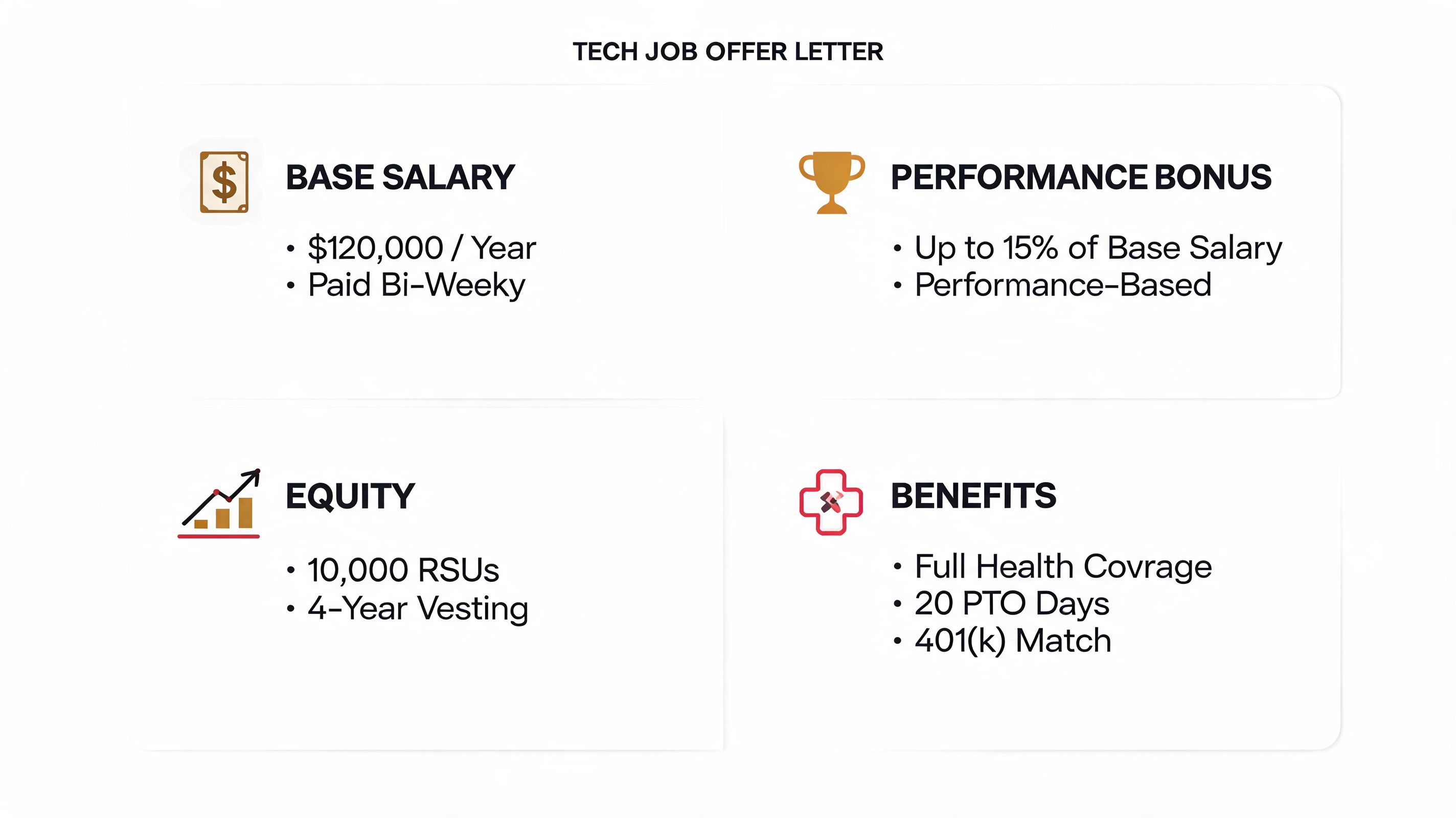
When I review offers with candidates, I break them into four buckets:
Base salary
This is your fixed cash compensation. It pays the bills, anchors future raises, and usually determines your signing advantage.
Bonus or additional cash comp
This can include performance bonus, signing bonus, or annual cash incentives. Some companies make this predictable. Others make it feel “target-based” and discretionary, which often means you should discount it mentally.
Equity Startup offers become hard to compare in this area. Equity can create meaningful upside, but only if you understand what you’re being granted and under what conditions.
Benefits
Health coverage, retirement support, parental leave, remote setup, learning budget, and time off all change the quality of the package. Benefits aren’t as exciting as stock options, but they can materially affect your take-home value and your day-to-day life.
Don’t score every part equally. Weight them by certainty.
A practical ranking looks like this:
Practical rule: Treat startup equity as upside, not rent money.
That framing helps you avoid the most common mistake mid-level engineers make. They compare a startup offer to a larger-company offer as if every dollar is equally likely to materialize. It isn’t.
If you want a better framework for comparing the non-obvious parts of an offer, Underdog’s guide to compensation and benefits is worth reading alongside your spreadsheet.
What works is asking for the written breakdown. Ask for base, target bonus, equity type, vesting schedule, refresh policy, and benefits summary in one place.
What doesn’t work is evaluating the offer from the recruiter’s verbal summary. “Strong equity” and “competitive comp” are not compensation details. They’re sales language.
You get a backend offer from a Series B startup in New York. The base looks solid. Then a remote company based in Denver sends a lower base with a better title and broader ownership. A third company says it pays "top of market" but anchors compensation to your home city. Those are three different markets, even if the job description looks almost identical.
That is why benchmarking backend salary starts with scope, then level, then location.
For startup hiring, I would treat experience bands as a first pass, not the answer. Titles drift. A mid-level engineer at one company may own tickets inside an existing service. At another, the same title may mean owning an API, a database migration plan, on-call rotation, and a messy part of the roadmap nobody else wants.
Use level bands like this:
| Level | NYC / SF Metro Area | Other US Tech Hubs (e.g., Austin, Denver) | US Remote |
|---|---|---|---|
| Junior | Usually below the top startup bands unless the company is hiring aggressively | Often priced closer to early-career ranges | Often tied to company-wide remote bands, not your city |
| Mid-level | Frequently lands in strong six figures when you can show service ownership | Competitive for engineers with production depth in APIs, data stores, and cloud infra | Wide spread. National-pay companies and geo-adjusted companies produce very different offers |
| Senior | Often pushed higher when the role includes architecture, incident leadership, and mentoring | Still strong, especially for engineers who can own systems end to end | Strong at startups that hire nationally and care more about capability than zip code |
| Staff | Highly variable, often customized around scope and equity | Less standardized and heavily title-sensitive | Depends on stage, business criticality, and whether the company needs immediate technical leadership |
The practical read for a mid-level backend engineer is simple. Four to six years of experience usually puts you in the range where companies expect ownership, not just execution.
Analysts at Built In report that backend developers in the U.S. earn an average base salary of $141,809 and average total compensation of $159,242. In San Francisco and New York, the numbers move up materially. Built In lists average total compensation at $216,877 in those markets, with $165,567 in base salary and $51,310 in additional cash compensation.
Those numbers matter most if the company competes for talent in the New York or Bay Area startup market, even when the role is remote. I have seen founders benchmark against local talent pressure, then hire nationally. That can work in your favor if you are interviewing with a startup that needs someone who has already handled incidents, schema changes, observability gaps, and scaling pain.
Location policy is one of the least transparent parts of startup compensation.
Some startups now use national pay bands for engineering. Others still localize heavily, especially if they have concentrated teams in New York, San Francisco, or Seattle. Two remote offers can differ by $20,000 to $40,000 in base salary because one company pays for role scarcity and the other pays for labor market averages in your city.
The unwritten rule is this. Companies pay more when the role is harder to backfill, when the system is revenue-critical, and when the team cannot afford a miss.
That is why backend engineers with the same years of experience often get very different offers. The engineer who has owned production systems, handled ugly outages, and made solid trade-offs around data models and performance usually prices above the engineer whose work has been narrower.
The offer reflects your market. It also reflects how much risk the company thinks it removes by hiring you.
Use three filters before you decide whether an offer is strong:
Compare scope to compensation
A higher title with narrow ownership can be a weaker deal than a lower title with clear system ownership and better growth path.
Ask for the location policy in writing
"Remote-friendly" does not tell you whether pay is national, geo-adjusted, or negotiable for exceptional candidates.
Separate startup market data from broad tech averages
General salary sites are useful for rough framing. They are less useful when you are pricing a role at a high-growth startup with unusual scope, equity, and urgency.
If you want a startup-specific reference point, Underdog’s 2025 tech salary guide for startup engineering roles is a better calibration tool than generic national averages, especially if you are comparing offers from fast-growing companies rather than enterprise employers.
A startup offer and an enterprise offer can both look good on paper and still represent completely different bets.
One is built around predictability. The other is built around advantage.
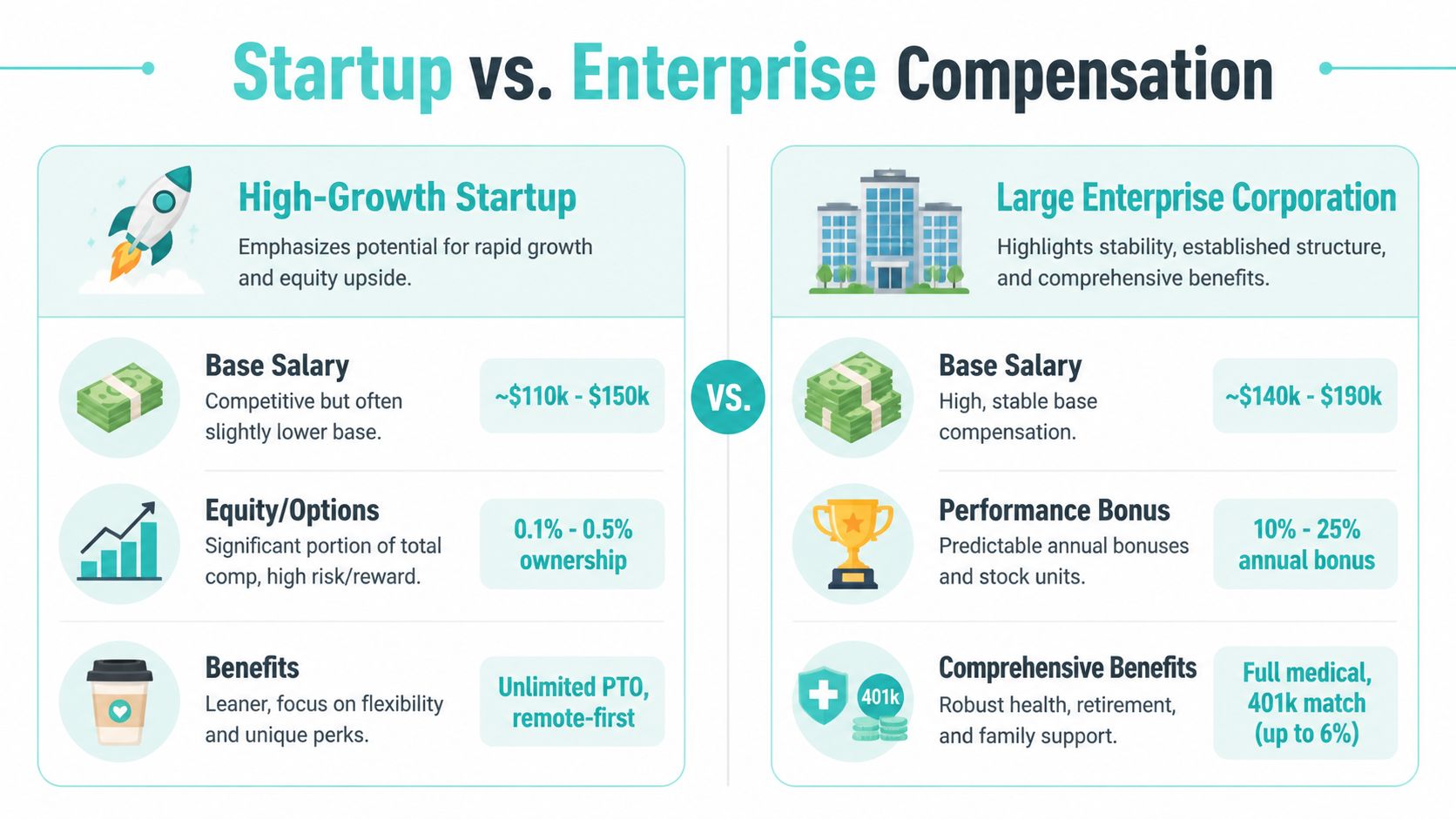
Large companies usually pay for consistency. They want stable execution inside an established system, and their comp philosophy reflects that.
You’ll usually see:
That structure appeals to engineers who value planning. If you care about mortgage underwriting, family benefits, or predictable annual compensation, enterprise comp is easier to model.
Startup offers are different because the company is asking you to absorb more uncertainty. In exchange, it gives you more upside.
Verified data tied to Coursera’s backend salary overview states that startups often offer 20 to 40 percent lower base salaries than Big Tech, while making up for that with 0.1 to 0.5 percent equity grants that could be worth over $200k at a successful exit.
That’s the headline. The unwritten rule is more important: most candidates overvalue the upside when they’re emotionally bought into the company’s story.
A startup package can beat an enterprise package. But only under certain conditions.
The startup offer gets stronger when:
The startup offer gets weaker when:
A startup is not paying you less because it’s “scrappy.” It’s asking you to share risk.
That can be a smart trade. It can also be a bad one if your downside is immediate and the upside is mostly narrative.
For a mid-level engineer, the choice usually comes down to what kind of growth you want.
Enterprise is often better if you need structured mentorship, formal leveling, and low-variance compensation.
Startup is often better if you want faster scope expansion. In a good startup, a mid-level engineer can move from feature delivery into architecture, hiring loops, incident ownership, and product influence much faster than in a larger company.
That growth has compensation value, even if it doesn’t all show up in year one.
When you’re comparing startup and enterprise offers, ask these questions in order:
If the answer to that last question is no, your offer probably depends too heavily on a future outcome you don’t control.
Equity gets sold as ownership. That’s true, but incomplete.
In practice, startup equity is a contract with timing rules, tax implications, and uncertainty layered on top. If you can’t explain your grant in plain English, you shouldn’t treat it as a major part of your compensation.

Most startup candidates will see one of two things:
The important point isn’t the acronym. It’s whether you understand when value becomes real, what you have to pay to access it, and what happens if you leave.
Ignore the emotional language around “ownership” for a minute and focus on mechanics.
Here’s what I tell engineers to pin down before they compare offers:
Vesting schedule
Most startup offers use time-based vesting. If you leave early, you usually leave part of the grant behind.
Cliff
This determines whether you earn anything before a certain date.
Strike price
If you have options, this is what you’ll pay per share to exercise.
Post-termination exercise window
This tells you how long you have to decide after leaving.
Dilution
Your percentage ownership can shrink as the company raises more money.
Don’t try to predict an exact future value. You can’t. Instead, put the grant into buckets:
Guaranteed current value
Usually none, unless you’re at a public company or there’s a structured liquidity path.
Potential future value
This depends on the company’s trajectory, financing, and exit.
Cost to realize that value
Exercise cost, taxes, and the time you need to stay for vesting all matter.
That means the right question isn’t “What is this equity worth?” It’s “Under what conditions does this equity become worth something to me?”
Reality check: Equity is easiest to overrate when the company gives you a percentage but not enough context to translate it into actual economics.
Ask these in writing or in a live call with someone who can answer them clearly:
If the answers are vague, discount the equity more aggressively.
The best comparison method is boring, which is why it works. Make a spreadsheet with one row per offer and one column each for base salary, bonus, equity type, vesting, exercise requirements, benefits, and your confidence in the company’s execution.
Then add one more column: Would I still take this role if the equity ended up worth little or nothing?
That question catches a surprising amount of bad decision-making.
For a plain-English breakdown of common startup equity terms, Underdog’s startup equity basics for job seekers is a useful companion.
Most negotiation mistakes happen too early. A candidate gives a number before they understand scope, level, or how the company structures compensation. Then they spend the rest of the process trying to recover from their own anchor.
A better approach is to negotiate in sequence. Recruiter screen. Hiring loop. Offer stage. Final trade-offs.
Your job isn’t to name the lowest acceptable number fast. Your job is to keep enough room to learn.
Use language like this:
“I’m focused on roles with the right scope and team fit. Once I understand level, cash comp, and equity, I can give you a more informed range.”
That response is calm, professional, and hard to argue with.
If the recruiter pushes, give a range only after you’ve benchmarked the market and leave yourself room at the top. Don’t anchor to your current salary unless doing so helps you.
It is here that negotiating power is established. Not at the end.
Your value increases when the team sees evidence that you can reduce risk in production. Verified data from 6figr’s backend developer compensation page notes a 28 percent premium for senior back-end developers, and ties higher-end compensation to engineers who can mitigate bottlenecks and reduce infrastructure costs by as much as 40 percent.
You may not be senior yet, but the lesson still applies. Companies pay more for engineers who can prevent expensive mistakes.
Mid-level developers undersell themselves by describing tasks instead of outcomes.
Don’t say:
Say:
Don’t say:
Say:
That framing works because hiring managers aren’t buying code volume. They’re buying judgment, reliability, and lower execution risk.
Don’t negotiate from excitement. Read the offer like a contract.
Use this checklist:
Base salary
Is it aligned with your level and market?
Bonus terms
Is the bonus guaranteed, target-based, or discretionary?
Equity details
Is the grant explained clearly enough to compare?
Title and leveling
Does the title match the work you discussed?
Benefits and flexibility
Are there material trade-offs hidden outside cash comp?
Then respond with specifics. A useful pattern is:
“I’m excited about the role and the team. I’d like to see if we can improve the package in a few areas. Based on the scope and the market for backend roles, I’m looking for stronger base compensation and clearer equity context.”
That works better than “Can you do better?” because it shows you’re negotiating from substance.
If the base won’t move much, ask for another lever.
One caution. Don’t negotiate every line item just because you can. Pick the two or three that matter most. Broad, unfocused counteroffers make candidates look harder to close than they are.
Most engineers don’t struggle because they’re bad at evaluating offers. They struggle because they don’t get enough good offers to compare.
That’s the practical problem with broad job boards. You end up sorting through inconsistent roles, vague compensation language, and companies that aren’t serious about hiring. It’s hard to negotiate well when your alternative pipeline is weak.
A curated marketplace changes that dynamic. Underdog.io focuses on startup and high-growth tech hiring, especially the kind of roles where understanding total compensation really matters. That matters because startup offers are rarely simple. The details around equity, level, and role scope can vary a lot from one company to the next.
You’ll get better traction if your profile reads like an owner, not just an implementer.
Focus on:
System responsibility
Name the services, APIs, data stores, or infrastructure you owned.
Production judgment
Mention incidents, migrations, observability work, performance tuning, or reliability improvements.
Business context
Show where your engineering work touched product delivery, internal efficiency, or customer experience.
When startups reach out, don’t just ask whether the role sounds exciting. Ask whether the package and scope justify the risk.
A strong opportunity usually has:
That last point matters more than candidates think. If a company can’t explain why it’s hiring a back end engineer beyond “we need to move faster,” there’s a good chance the scope is fuzzy too.
The goal isn’t to collect interest. It’s to create a real comparison set, so when you do negotiate, you’re doing it from options instead of urgency.
If you’re exploring startup roles and want a cleaner path to vetted companies, Underdog.io is built for that. You apply once, stay discreet, and get introduced to high-growth tech companies that are already looking for engineers with startup-relevant experience. That makes it easier to compare real offers, ask sharper compensation questions, and negotiate from a stronger position.