Tech hiring isn't dead. It's being redistributed.
The cleanest way to see it is this: CompTIA projects U.S. tech occupations will grow by 2.2% in 2026, adding roughly 128,000 jobs, while another 323,000 openings will come from replacement demand as workers retire or leave the field, according to its State of the Tech Workforce 2026 analysis. That's not a market with no demand. It's a market where demand is concentrated, selective, and much harder to satisfy.
If you're a startup hiring manager, that changes the playbook. If you're an engineer, it changes where your bargaining power lies. The headline story in 2026 isn't “tech is down” or “AI is up.” It's that hiring has split into two different markets with two different sets of rules.
A lot of companies still talk about the market as if every tech role rises and falls together. That's no longer useful. The more accurate view is that overall demand remains durable, but teams are far more disciplined about which roles they open and which skills they'll pay for.
CompTIA's projection matters because it combines two forces at once: net-new job growth and backfill pressure. Even if a company isn't expanding aggressively, it still has to replace people who leave. That means hiring pressure doesn't disappear in a cautious economy. It just becomes more targeted.
Hiring managers are opening fewer speculative roles. Engineers are seeing fewer broad “software engineer” openings that leave room for a wide range of profiles. Recruiters are being asked to justify every hire in terms of delivery risk, infrastructure reliability, security posture, or product acceleration.
That's why the market can feel frozen and competitive while still producing real hiring volume.
Practical rule: Don't ask whether tech is hiring. Ask which functions are still tied directly to revenue, resilience, automation, or platform advantage.
For startups, that usually means fewer hires overall and higher expectations per hire. Founders want candidates who can do more than write code in isolation. They want people who can operate across systems, understand tradeoffs, and contribute fast in messy environments.
For candidates, general competence still matters, but it's no longer enough on its own. Employers want evidence of applied skill in areas they see as strategically durable.
For hiring teams, the main mistake is using an old-market process in a split market. A generic job description, a slow interview loop, and a compensation package built around base salary alone won't land scarce talent in specialized categories.
Indeed's recent labor-market data captures the split better than most commentary. It found that tech job postings have been weak since mid-2023, but machine learning engineer postings remain 59% above early-2020 levels, according to Indeed Hiring Lab's analysis of the U.S. tech hiring freeze. That single contrast explains why so many people can look at the same market and reach opposite conclusions.
One group is operating in a category where demand remains sticky. Another is competing in a category where employers have become cautious, delayed, or price-sensitive.
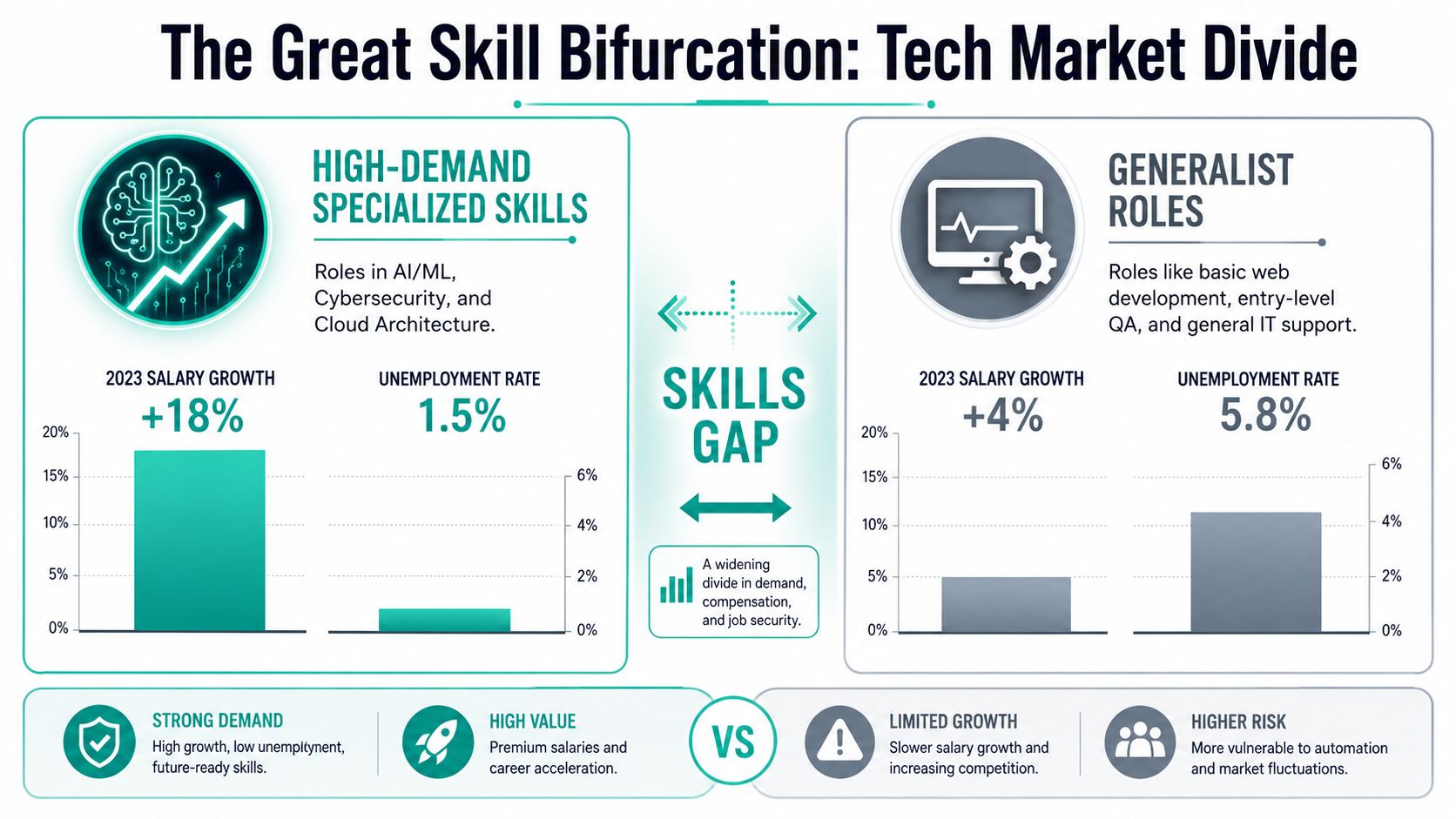
The resilient side includes roles connected to model development, data infrastructure, cloud architecture, production reliability, and security. These jobs don't survive because they're trendy. They survive because companies can tie them to immediate operating needs.
If a team is deploying AI features, it needs engineers who can manage data pipelines, inference costs, observability, and governance. If a company is consolidating vendors or reducing operational risk, it needs DevOps and security depth. If leadership wants more output from a leaner team, it needs people who can automate workflows and maintain critical systems.
The weaker side of the market includes more traditional and more interchangeable roles. That doesn't mean those jobs vanish. It means employers treat them differently. They may combine responsibilities, hire fewer juniors, or wait longer before replacing someone.
Generalist software work is still valuable, especially in startups. But it doesn't command the same urgency unless it's paired with a harder-to-find specialty. “Backend engineer” is less compelling than “backend engineer with production AI evaluation experience.” “Frontend developer” is less defensible than “frontend engineer who can ship data-heavy internal tools and own performance instrumentation.”
The question that matters in 2026 is simple: are you attached to a budget line, or to a business constraint executives urgently want removed?
Most hiring advice still assumes one tech market with one temperature. That leads to bad decisions. Engineers conclude the market is impossible when their niche is just oversupplied. Startups assume candidates have lost their bargaining power when, in specialist lanes, they haven't.
The useful framing is bifurcation. Some roles are crowded and filtered aggressively. Others are short-supplied and hard to close. Once you accept that split, the rest of the hiring situation starts to make sense.
Robert Half's hiring data points to the clearest concentration of demand in AI/ML engineering, cybersecurity engineering, data science and data engineering, DevOps, and network or cloud engineering. It also found that 65% of tech leaders say finding skilled professionals is more difficult than it was a year ago, based on its 2026 tech talent demand reporting. That combination matters. Demand is rising in the same areas where search difficulty is already high.
For engineers, these are the lanes where deliberate upskilling can change your market position. For hiring teams, these are the areas where vague role scoping creates expensive hiring misses.
A lot of job descriptions still blur titles together. That's a problem because the hiring market doesn't reward title familiarity. It rewards operational clarity.
| Role | Key Skills | Median Salary Range (NYC/SF) |
|---|---|---|
| AI/ML Engineer | Python, PyTorch or TensorFlow, model evaluation, APIs, cloud deployment | Varies by company and scope |
| Cybersecurity Engineer | Identity and access controls, cloud security, threat detection, incident response | Varies by company and scope |
| Data Engineer | SQL, Python, ETL design, data modeling, warehouse architecture | Varies by company and scope |
| DevOps Engineer | AWS or GCP, Kubernetes, Terraform, CI/CD, observability tooling | Varies by company and scope |
| Cloud or Network Engineer | Cloud architecture, networking fundamentals, reliability, infrastructure automation | Varies by company and scope |
The salary column is qualitative on purpose. Compensation changes too much by company stage, equity mix, and in-office expectations to make up ranges without hard sourcing.
Hiring teams aren't just screening for exposure. They want proof that a candidate can produce in production environments.
Don't chase every tool. Build around a problem domain.
If you're moving toward AI work, combine application-level experience with infrastructure literacy. A candidate who understands Python and model workflows but can't explain deployment, monitoring, or cost tradeoffs will lose to someone who can.
If you want a structured way to go deeper on cloud-based AI implementation, this expert guide for AWS Generative AI certification is a useful example of the kind of hands-on knowledge map that aligns better with hiring demand than surface-level course collecting.
Hiring signal: The strongest candidates don't list tools as nouns. They describe what they built, what broke, and what they changed.
Most startup job descriptions fail because they describe an idealized person, not the work. A better approach is to define the first problems the hire must solve.
Instead of “seeking a world-class DevOps engineer,” say the role will own infrastructure reliability, CI/CD speed, and Kubernetes-based deployment workflows. Instead of “looking for an AI engineer,” state whether the hire will build customer-facing AI features, evaluation pipelines, or internal productivity systems.
That shift does two things. It attracts candidates who recognize the work, and it filters out people who only recognize the buzzwords.
The labor market shift isn't only about skills. It's also changing what candidates evaluate in an offer.
The World Economic Forum reports that 60% of employers expect AI to significantly transform their business by 2030, according to its Future of Jobs Report 2025. Once companies believe a capability is central to future competitiveness, they stop treating compensation as a simple salary benchmark. They start using total package design to win people who can lead that transition.
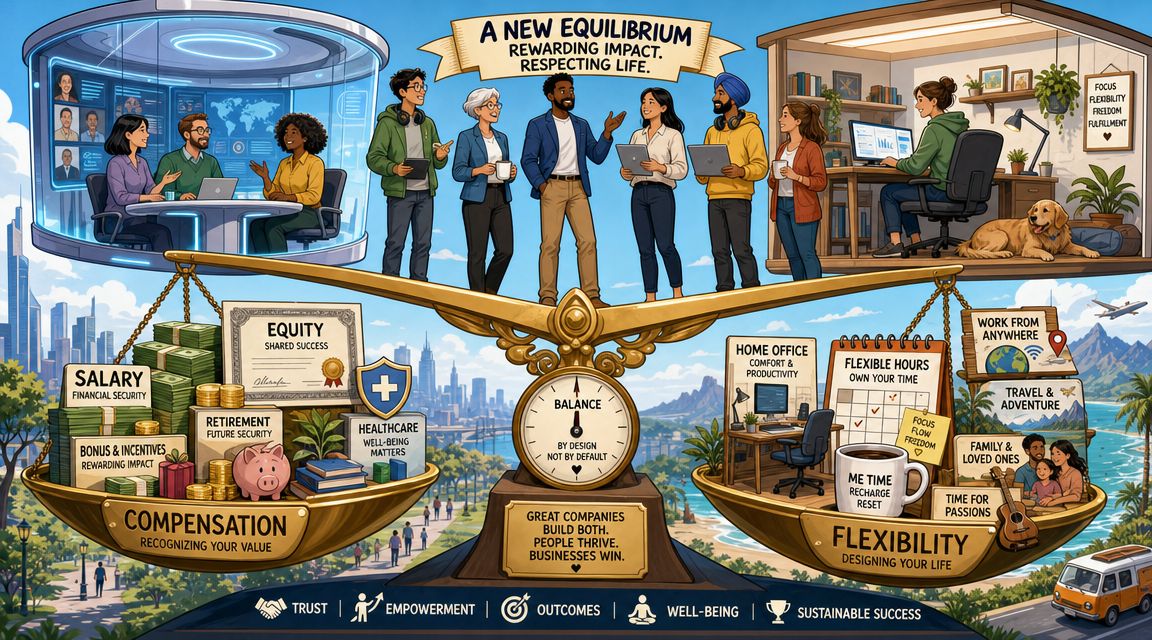
Startups often lose candidates because they frame offers too narrowly. Base salary still matters, but specialized candidates increasingly weigh equity, role scope, technical ownership, manager quality, and flexibility as one combined decision.
That's especially true when two companies offer similar cash but very different day-to-day realities. A smaller startup can stay competitive if the role offers direct product influence, visible ownership, and equity with a credible story behind it. A larger company may still win on cash and perceived stability, but it doesn't automatically win the candidate anymore.
A practical compensation framework should include:
Teams that want a stronger framework for packaging offers can use this Underdog post on compensation and benefits as a practical reference point.
Remote policy now functions as part of compensation. Candidates read it that way, and employers should too.
A strict office requirement can still work when the work is compelling and the team is concentrated in a major hub. But the company has to justify the tradeoff. If a role can be done remotely and the organization insists on office presence without a strong operating reason, candidates often discount the offer.
For hiring teams trying to benchmark flexibility expectations across distributed talent pools, this overview of remote jobs trends and salary data is a useful qualitative resource.
Candidates don't just compare salaries. They compare lifestyles, commute burden, learning opportunity, and the odds that the role expands their future options.
Engineers who focus only on base compensation leave value on the table. In a selective market, negotiation works better when it's tied to the business case for your hire.
Ask about ownership boundaries. Ask how success will be measured. Ask whether the company expects office attendance because of collaboration needs or because it hasn't updated its management habits. Those answers tell you more than a polished benefits summary.
The strongest offers in 2026 feel coherent. The role, compensation, and work model all support the same story.
The startup advantage in this market isn't money. It's speed, specificity, and credibility.
That matters more because the bottom of the market has hollowed out. Ravio reports a 73% drop in hiring for entry-level P1/P2 tech professionals over the past year in its 2025 tech hiring trends analysis. Most companies have responded by reducing investment in junior hiring. That creates an opening for startups willing to think beyond immediate req-filling.

Specialized candidates usually don't disappear because they reject startups in principle. They disappear because startups create uncertainty. A long interview loop, inconsistent feedback, and vague role ownership are expensive signals.
Tighten the process:
If you're hiring for specialized AI talent, this Underdog guide on how to hire an AI engineer is useful because it forces sharper role definition before sourcing begins.
Large companies can offer familiarity. Startups have to offer consequence.
Candidates in scarce skill categories want to know whether their work will matter, whether leadership can make decisions, and whether the company knows why it's hiring them. “Join our fast-growing team” is forgettable. “Own the reliability layer for a product moving into regulated customer environments” is concrete.
That pitch gets stronger when founders can explain:
Founder test: If you can't explain the first three decisions this hire will make, the role probably isn't scoped tightly enough.
The collapse in junior hiring creates a strategic opportunity. Startups don't need to build giant new-grad programs to benefit from it. They can create narrower entry points tied to real work.
That could mean internships connected to infrastructure projects, apprenticeships around internal tooling, or contract-to-hire models for promising early-career engineers who already show strong execution through open-source work, freelance systems, or technical writing.
The point isn't altruism. It's supply creation. If everyone fights for the same senior specialist, costs rise and time-to-fill drags. If your company can identify and shape high-upside early talent in overlooked segments, you create a future hiring advantage.
Operationally, some startups also need help building the employment infrastructure to hire across geographies or manage people operations cleanly. For teams comparing options there, this guide to compare PEOs for growing companies can help frame the tradeoffs.
The biggest mistake in reading today's tech hiring trends is assuming one market mood applies to everyone. It doesn't. Some engineers are competing in crowded pools where employers have become conservative and slow. Others are in specialized lanes where companies still need to move decisively, pay thoughtfully, and sell hard.
That split changes how both sides should act.
For engineers, the winning move is to position yourself around hard business problems, not generic technical identity. It's more valuable to be “the engineer who can productionize model-backed features and keep them reliable” than “a software engineer interested in AI.” Specialization doesn't mean becoming narrow. It means becoming legible.
For startup teams, the right response isn't posting more jobs. It's reducing ambiguity. Tighten scope. Show urgency. Explain the mission in operational terms. And don't let a slow process signal indecision to candidates who already have options.

Curated marketplaces make more sense than broad application funnels. In a bifurcated market, volume creates noise. Precision creates conversations.
For candidates who want startup opportunities without spending weeks sorting through mismatched listings, how to get recruited by startups is a practical place to understand how a curated process works. And if you want one option that sits between passive networking and cold-applying everywhere, Underdog.io offers a marketplace where engineers, product people, and designers can submit a single application and get introduced to vetted startups when there's real fit.
That model aligns with the market we have now. Hiring is more selective. Good candidates want fewer, better-matched conversations. Startups want signal, not inbox overflow. The companies and engineers that adjust to that reality will move faster than everyone still reacting to old headlines.
If you're hiring for startup talent or exploring your next role, Underdog.io offers a simpler path than broad job boards. Candidates can apply once and get matched with vetted startups. Hiring teams can meet people who already want startup environments and have been screened for fit.