You've probably looked at a Director of Product offer and had the same reaction most experienced candidates do: the base looks solid, the equity is vague, the bonus language is slippery, and the recruiter keeps saying “total comp” like that settles anything.
It doesn't.
At this level, a director of product management salary isn't one number. It's a package with trade-offs baked into it. That matters even more in startup hiring, where two offers can look similar on paper but carry very different real-world value once you factor in equity type, company stage, liquidity, and how much strategic scope you're taking on.
The hard part isn't finding a salary number online. The hard part is figuring out whether your specific offer reflects your market value, your risk tolerance, and the kind of company you want to join.
A competitive director of product management salary starts with cash, but it doesn't end there. Candidates get into trouble when they benchmark only the base salary and ignore the rest of the package.
The national market is broad. PayScale's 2026 Product Management Director salary data reports an average salary of $161,623, with base pay typically ranging from $116,000 at the 10th percentile to $205,000 at the 90th percentile. The same dataset shows total pay of roughly $122,000 to $225,000 once bonus, profit sharing, and commissions are included. That same source also lists the highest observed pay at $205,000 and the lowest at $116,000. Separately, an industry roundup citing Glassdoor places average annual pay for director of product roles at $184,047 and notes that total compensation can exceed $250,000 in top-tier tech firms or major metros, as summarized in that PayScale reference.
That spread is the point. Director pay isn't a single market rate. It's a compensation tier shaped by company stage, location, business model, and whether the equity is likely to become real money or stay hypothetical.
The first mistake is treating “competitive” as “above average.”
That's too simplistic. A below-average base can still be a strong offer if the equity is meaningful, the company is well financed, and the role has true portfolio-level scope. A high base can also be a weak offer if the equity is tiny, the bonus is discretionary, and the title is inflated.
A useful way to evaluate any offer is to separate it into three questions:
If you're comparing this role against adjacent PM levels, Underdog's own guide to product manager salary ranges is a useful reference point for how compensation stacks up as scope increases.
Practical rule: If an employer wants you to think like an executive, evaluate the offer like an investor.
A director-level comp package usually has four moving parts: salary, bonus, equity, and benefits. Candidates tend to spend almost all their time on the first one because it feels concrete. That's understandable, but it's incomplete.
Here's the cleanest way to think about it.
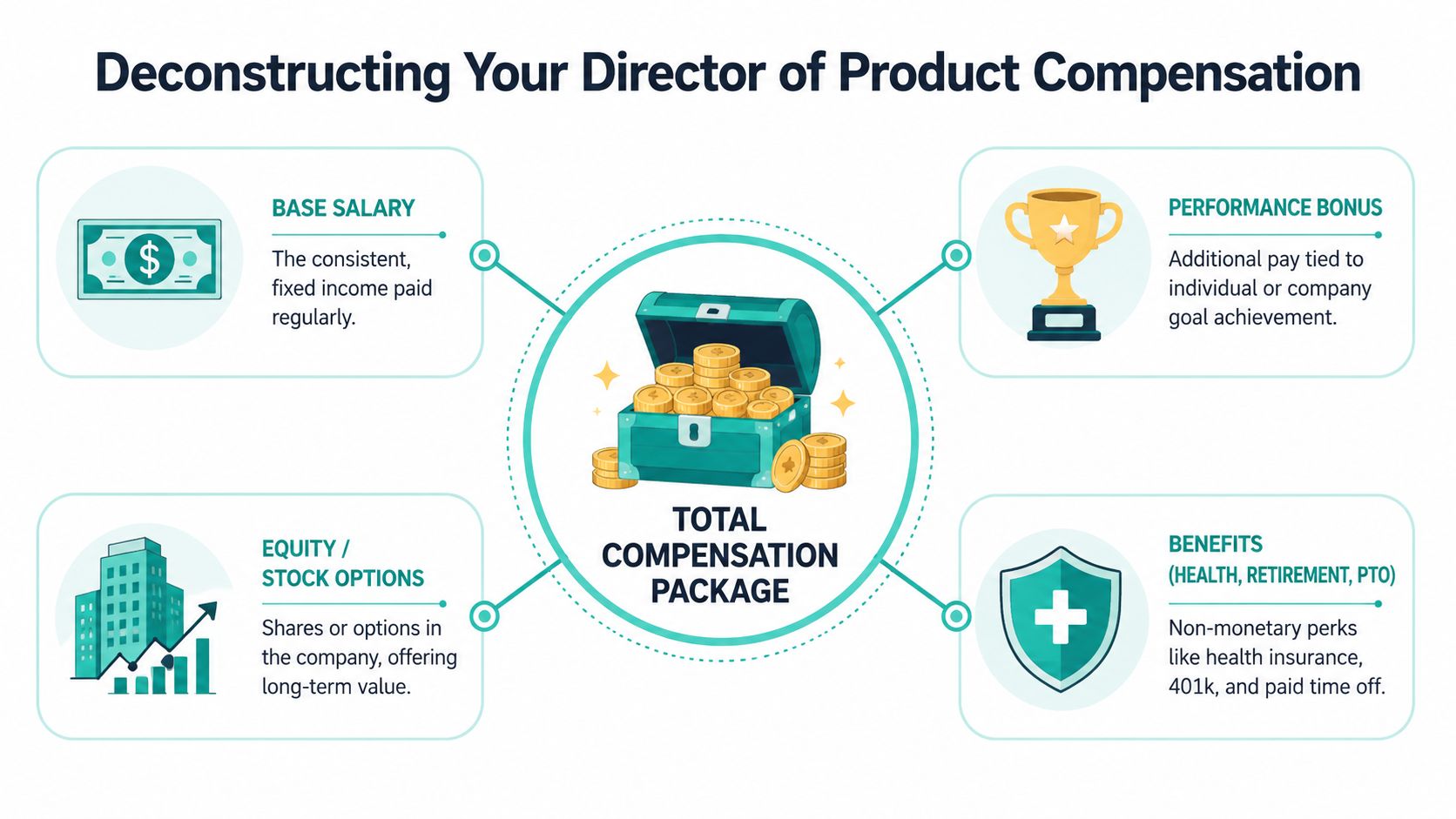
Base salary is your fixed cash compensation. It covers your monthly reality: rent or mortgage, childcare, savings, debt, and everything else that can't be paid with potential upside.
Indeed's salary data for Director of Product Management shows an average base salary of $192,992 per year, plus about $20,000 in cash bonus, with a low-to-high range of $130,016 to $286,472. The same page lists an average total salary figure of $199,058. That differs materially from PayScale's 2026 research, which places average base salary at $161,623 and total pay at $122,000 to $225,000, as cited in the same Indeed comparison.
That difference is why casual salary comparisons go sideways. Some sources skew toward cash compensation. Others capture bonus and equity more fully. Startup candidates especially need to know which number they're looking at.
A bonus line item only matters if you understand how it works.
Ask whether it's tied to company revenue, product milestones, board-approved objectives, or manager discretion. A target bonus sounds nice, but if the plan isn't documented or the company has no history of paying it consistently, treat it cautiously.
Good bonus plans are boring. They're documented, measurable, and predictable. Vague bonus language usually means the company wants credit for compensation it may never pay.
Experienced candidates often slow down at this point, and they should.
RSUs are the simpler instrument. Think of them as compensation that converts into company shares on a vesting schedule. In a public company, they're much closer to deferred cash because the stock is liquid.
Stock options are different. They're closer to a contractual right to buy shares later at a set price. In startup hiring, that means you're betting that the company will increase in value enough to make the options worth exercising.
Two offers with the same stated equity value can be wildly different depending on the strike price, the preferred versus common share structure, the company's financing history, and whether there's any realistic liquidity path.
Senior candidates sometimes wave past benefits because the salary is large enough that the details feel secondary. That's a mistake. Retirement match, health coverage, parental leave, and PTO all affect the quality of the package.
For a broader framework on weighing the non-salary parts of an offer, this guide to compensation and benefits is worth reviewing before you negotiate.
A startup can't always match big-tech cash. It can still make a compelling offer if the equity is credible and the role is genuinely high leverage.
Location still changes comp, even in a market where plenty of product leaders can work remotely. It changes the cash portion most visibly, but it also affects how companies frame equity, title scope, and expectations around cross-functional leadership.
New York City is the clearest data point in the verified market set. Built In's New York City compensation page for Director of Product Management reports an average salary of $183,993, average additional cash compensation of $34,596, and average total compensation of $218,589. The same source says the most common pay band in NYC is $190k–$200k, with an overall salary range of $80K to $375K. It also reports that directors with 7+ years of experience average $193,234. In parallel, Indeed reports that a senior director of product management in the United States averages $197,390 per year based on 530 salaries, as summarized in that Built In comparison.
NYC doesn't just pay more because it's expensive. Companies there often expect broader business fluency from product directors. Many roles sit close to revenue, platform strategy, or regulated product work. In practice, that pushes comp upward because the hiring bar is tighter and the opportunity cost for strong candidates is high.
A director running product in a New York fintech startup often isn't just shipping roadmap. They're navigating compliance constraints, executive stakeholder management, and hiring in a crowded market where the same candidates are also hearing from larger firms.
The data below uses only verified figures. Where hard location-specific numbers weren't provided, the safest move is to state that directly instead of pretending the market is more precise than it is.
| Location | Average Base Salary | Average Bonus | Average Total Compensation |
|---|---|---|---|
| New York City | $183,993 | $34,596 | $218,589 |
| San Francisco | Qualitatively high premium market | Often meaningful in equity-heavy offers | Often above base in startup and public-company packages |
| Remote U.S. | Varies by employer benchmarking approach | Varies | Varies based on whether company pays national, geo-adjusted, or hub-based rates |
For San Francisco, the issue usually isn't whether comp is high. It's whether the company expects big-tech-level talent while offering startup-level certainty. Candidates there should assume the strongest offers will need to compete not only on cash, but also on upside and role scope.
Remote adds a separate layer of ambiguity. Some companies pay by candidate location. Others anchor comp to a major hub. Others create broad national bands. If a startup says the role is remote, ask whether it uses a single national band or location-based adjustments. That answer affects both your current offer and future raises.
Use geography as context, not as your only argument.
If you're in NYC, a company already knows it's hiring into a premium market. What matters is whether your role maps to true director scope. If you're remote, the better question is whether the company is benchmarking against top startup markets or trying to price the role as a generic national manager-level hire.
Don't negotiate from your rent. Negotiate from the replacement cost of someone who can do this job well in your target market.
Company stage changes the logic of the offer more than most candidates expect. Big tech and startups aren't just paying different amounts. They're solving different hiring problems.
A large public company usually buys certainty. It offers strong cash compensation, mature leveling, clearer bonus structures, and equity that employees can model with more confidence.
A startup buys belief. It asks candidates to absorb more ambiguity in exchange for a larger upside story and, ideally, wider strategic ownership.
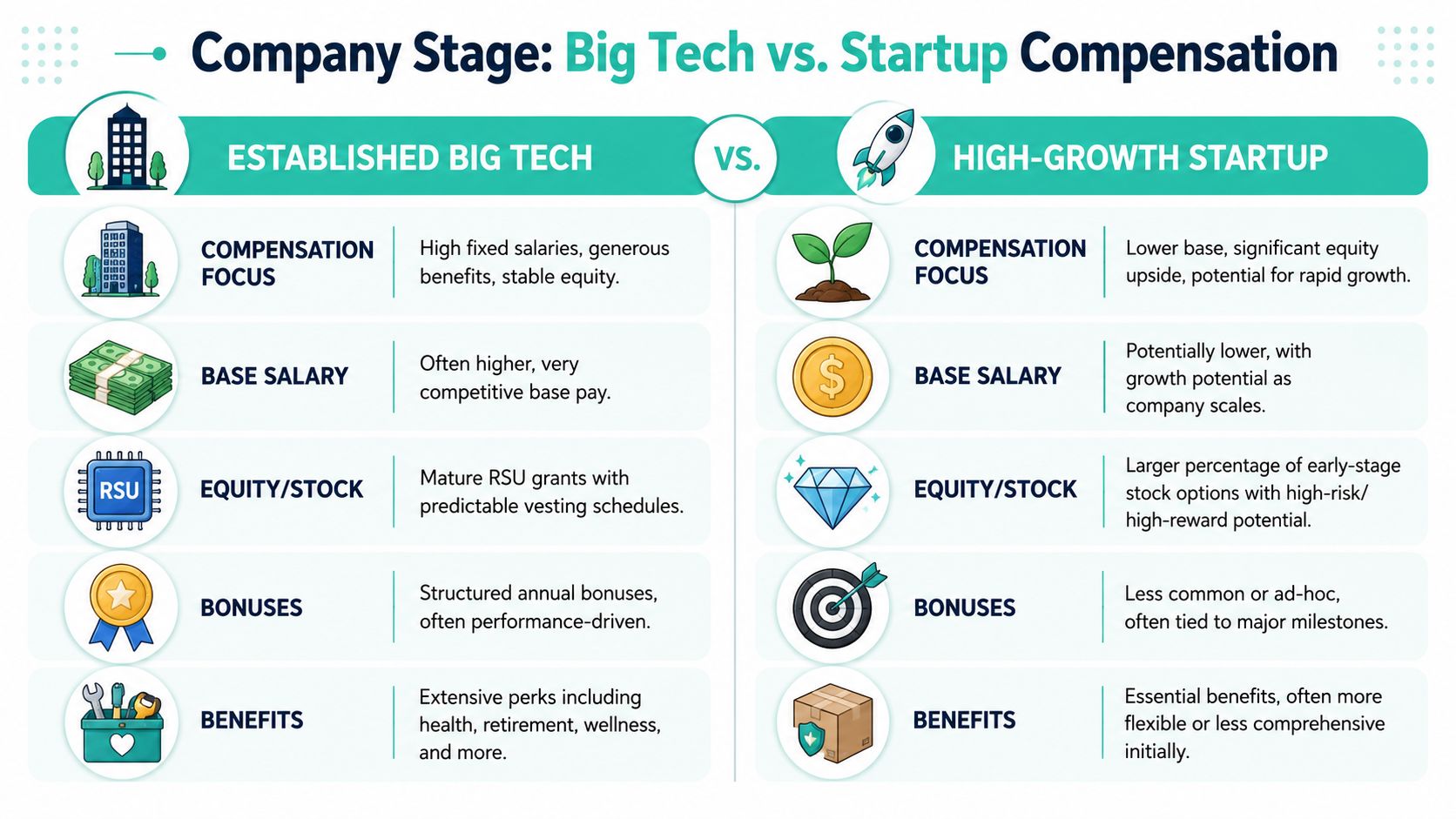
In mature companies, director offers tend to be easier to compare. Leveling is tighter. Equity often comes in RSUs. Bonus frameworks are more standardized. Benefits are usually more complete.
That doesn't mean every big-tech offer is automatically better. It means the value is easier to measure, and the downside risk is usually lower.
At a startup, the package often looks less polished and more negotiable. That can work in your favor if you know what to ask for.
You might accept a lower base if the company is willing to move meaningfully on equity, title scope, refresh expectations, or severance terms. But that only works when the equity has a credible path to value and the company is honest about dilution, fundraising plans, and exercise mechanics.
Glassdoor salary estimates for director product roles show how much compensation can diverge based on title normalization and role breadth. One listing for Director of Product Management shows an average salary of $274,619, while another for Director Product Management shows $345,858. The practical read is that comp at this level is highly sensitive to portfolio ownership, people management depth, strategic impact, and whether the number reflects base salary or a broader pay band.
That's why startup candidates should inspect the actual job, not just the title.
A director who manages one PM and a roadmap slice is not the same market as a director who owns multiple PMs, a product portfolio, cross-functional planning, and executive communication with the CEO and board.
Use this lens:
If you're trying to calibrate startup-stage trade-offs, Underdog's guide to startup compensation benchmarks is a practical reference.
A director candidate gets an offer that looks strong on paper. The base is close to target, the title is right, and the recruiter says the equity could be worth a lot. Then the details come out. The grant is smaller than expected, there is no clear refresh policy, and the role owns one product line instead of a true portfolio. That is where good candidates lose real money.
At this level, negotiation is package design. Startup boards often constrain cash but leave room on equity, sign-on, scope, or severance. Big tech usually gives you less room to reshape the package, but the equity is easier to value and the compensation system is cleaner. Candidates who understand that difference make better asks.

Your case for more compensation should be short, specific, and tied to business scope.
Strong examples include:
That last point can change the range. Product School's 2026 salary roundup notes that AI product roles in the U.S. often command higher pay than generalist PM work. If a startup wants director-level product leadership plus data or ML judgment, a generic product director benchmark can come in low.
A lot of candidates ask for more equity before they know what they already have.
Ask for the terms behind the headline number:
In startup offers, this is often the part handled worst. A company with a serious hiring process should be able to answer these questions clearly, even if a few items still need finance approval.
Do not negotiate every line item with equal force. Pick the two or three that change the outcome.
This matters more in startups than in big tech. In a late-stage startup, an extra chunk of equity or a longer post-termination exercise window can be worth more than a small base increase. In big tech, a base bump or sign-on is often the cleaner win because the stock is already liquid and the leveling system is tighter.
A simple script works:
“I'm excited about the role. I'd like to revisit the package based on scope, especially the mix of base, equity, and the expectations for team ownership.”
Director-level negotiations affect more than first-year cash. They shape your next title, your exit options, and whether the equity risk is priced fairly. If you want a framework for how to structure the conversation and advocate for yourself without sounding adversarial, this resource on coaching for executive compensation is useful.
The simplest way to think about a director of product management salary is this: treat it like a portfolio, not a paycheck.
Base salary pays for certainty. Bonus pays for performance, if the company runs the plan cleanly. Equity pays for risk, but only if you understand what you're getting and the company has a believable path to value creation.
When candidates regret an offer at this level, it usually isn't because they misread the base. It's because they overestimated vague equity, accepted a title without matching scope, or joined a startup that wanted executive output on a manager-grade package.
Sometimes. It's a good deal when the company is strong, the equity is meaningfully larger, and you can afford the cash trade-off. It's a bad deal when the company uses equity to excuse weak cash compensation without giving you enough ownership to justify the risk.
Yes, but don't compare line by line. Compare the startup's upside against what you're giving up in cash stability, liquidity, and benefits. If the startup offer doesn't provide a plausible reason to choose risk, it's not competitive.
Usually scope. Scope drives future compensation more reliably than a modest bump in current cash. A real director role expands your future market. A cosmetic director title can trap you.
Ask how the company benchmarks pay. Remote doesn't automatically mean discounted or premium compensation. It means the company has chosen a philosophy, and you need to know what it is before you sign.
If you're evaluating startup product leadership roles and want a cleaner way to compare real opportunities, Underdog.io helps experienced tech candidates get introduced to vetted startups in NYC, San Francisco, and across the U.S. through a single application.