Judging a job offer by salary alone is a classic rookie mistake. It's tempting, for sure. But focusing on that single number means you’re missing the bigger picture—and potentially leaving a lot of value on the table. A great offer is a full package, blending salary with equity, bonuses, and benefits that all contribute to your financial well-being and lifestyle.
Getting past that base number is the first real step toward making a smarter career move.

It’s completely natural to fixate on the salary when an offer hits your inbox. That number is real, it’s immediate, and it’s easy to compare against other offers. But in the tech and startup world, that base number is just one part of a much more interesting story.
The best way to look at any offer is to see it as a personal wealth toolkit. Every piece—base pay, equity, bonuses, and benefits—is a different tool designed to build your financial future. Understanding how all these tools work together is what separates a good decision from a great one.
Let's break down the four core components you'll typically see in a tech or startup offer. Think of these as the pillars that hold up the total value of your package.
ComponentWhat It IsPrimary PurposeSalaryThe fixed, predictable income you receive.Covers your immediate living expenses and lifestyle needs.EquityA share of ownership in the company (e.g., stock options, RSUs).Offers potential for significant long-term wealth if the company succeeds.BonusesVariable cash payments tied to performance (individual or company).Rewards direct contributions and aligns your goals with the business.Benefits & PerksNon-cash compensation (e.g., health insurance, 401(k), remote work stipends).Supports your health, well-being, and work-life balance, adding hidden financial value.
Looking at an offer through this four-pillar lens gives you a much clearer, more accurate picture of its true worth.
Thinking about the total package is especially important when you’re looking at early-stage companies. Most startups simply can't match the massive base salaries of big tech corporations. So, they get creative and build compelling offers using other powerful levers.
This blended approach is becoming the norm. While overall compensation budgets are stabilizing globally, the competition for talent in high-growth fields like tech remains fierce. In fact, projections show total salary increases hitting up to 3.7% by 2026 for in-demand roles in AI and engineering, forcing companies to build more comprehensive packages to stay competitive.
The goal is to stop asking, "What's the salary?" and start asking, "What is the true, total value of this offer?" This shift in perspective is a skill in itself.
By breaking down an offer into its core parts, you can accurately compare different opportunities—even if one has a lower base salary but offers incredible long-term growth potential through equity.
For instance, a startup offer with a $130,000 salary and a meaningful equity grant could be vastly more valuable in five years than a corporate job offering a $150,000 salary with a tiny annual bonus. Learning how to weigh these components is a skill that will pay dividends throughout your entire career. If you want to get a head start, our guide on how to evaluate a job offer provides a great framework for this analysis.
This guide will walk you through each piece of the total compensation puzzle. We’ll demystify everything from salary benchmarks and bonus structures to the nitty-gritty of startup equity, giving you the practical knowledge you need to assess any offer with confidence.
Cash is king, right? When an offer lands in your inbox, the first thing most of us look for is the base salary and any potential bonuses. This is the foundation of your entire compensation package, the money that covers your day-to-day life and rewards you for hitting your goals.
But that base salary number isn't just pulled out of thin air. It’s a carefully calculated figure that falls within a specific “compensation band” for the role, designed to be both fair and competitive. Understanding how companies land on these numbers is the first step toward knowing what an offer is truly worth.
Hiring managers and compensation teams don't just guess what to pay you. They rely on a few key inputs to build a salary range that attracts and keeps great people.
Knowing these three factors gives you the power to research your own market value effectively. When you understand what drives the numbers, you can build a much stronger case for yourself during negotiations.
For example, platforms like Underdog.io give candidates salary ranges to help them benchmark their expectations before they even apply.
This snapshot shows how modern platforms use data to give you a realistic starting point for what a role might pay. Transparent, data-backed information helps get everyone on the same page from the very beginning.
While your salary is predictable, bonuses are the variable part of your cash compensation. They’re designed to reward performance and align your personal goals with the company’s success. You'll most commonly run into two types: signing bonuses and performance bonuses.
A signing bonus is a one-time, guaranteed payment to entice you to accept an offer. A performance bonus, on the other hand, is variable and depends on meeting specific individual, team, or company goals.
It's absolutely crucial to understand this difference. A signing bonus is guaranteed cash in your pocket, often used to make an offer more attractive or to cover a bonus you might be leaving behind at your old job.
Performance bonuses are never a sure thing. They are tied to future results, so you should always ask for total clarity on the metrics they’re based on. For instance, if a bonus is tied to "company performance," ask them to clarify if that means revenue targets, user growth, or profitability. The more specific they are, the better you can judge its likelihood.
The cash part of an offer from an early-stage startup can look radically different from one at a big, established company. How much money a startup has raised from investors—its funding stage—directly impacts its ability to offer high salaries.
Knowing a company’s funding stage gives you critical context for their offer. It helps you understand the "why" behind their numbers and lets you decide if their particular mix of cash and equity lines up with your own financial goals and tolerance for risk.
Salary is simple. You know what a dollar is worth. Equity? That’s where things get complicated, fast. It's often the most powerful—and most misunderstood—part of a startup offer. But the idea behind it is straightforward: you're getting a small slice of ownership in the company.
If the company takes off and becomes more valuable, so does your slice. This section is your guide to translating the often-confusing world of startup equity into real, practical knowledge.
Just like with salary, your equity grant is influenced by a mix of factors. While the specifics of equity are different, the same forces of market data, your experience level, and even location play a role in shaping the overall value of your compensation package.
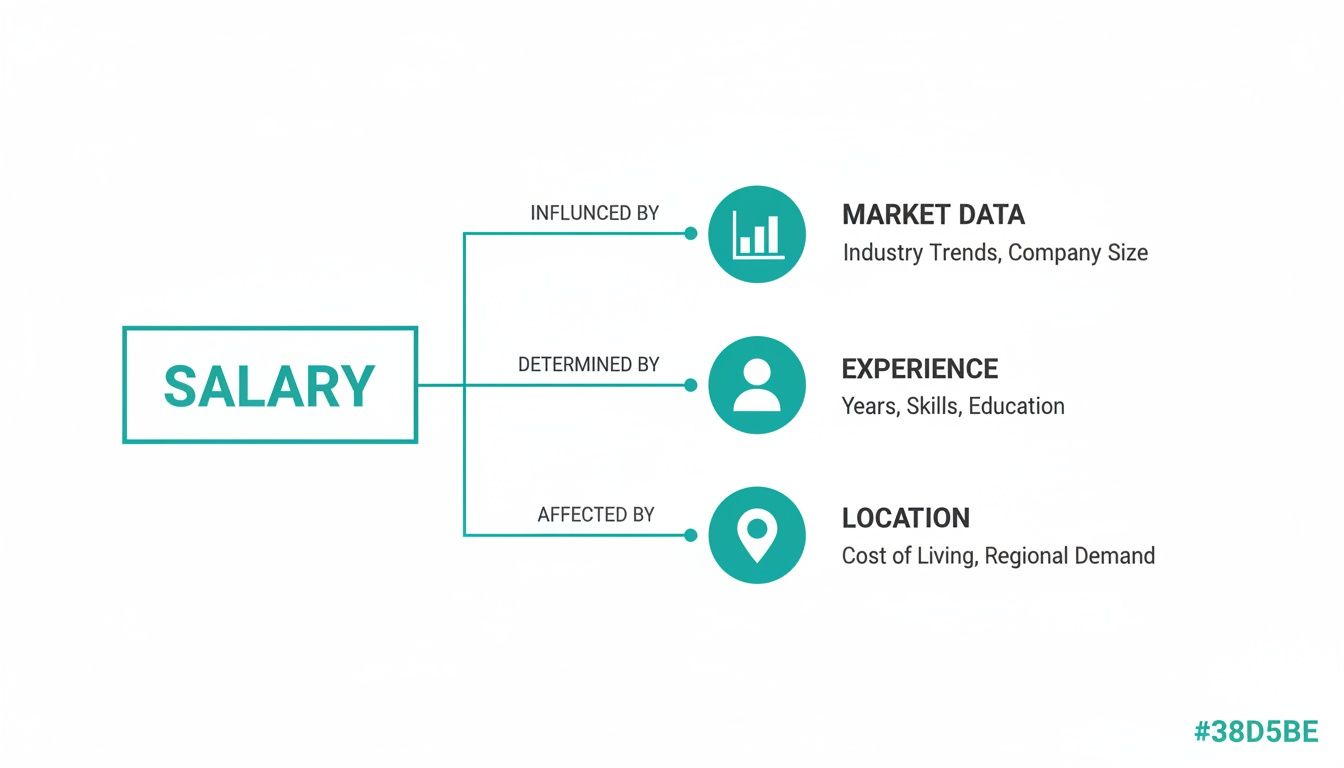
Think of this as a reminder that your entire compensation—cash and equity combined—is a blend of market forces and your unique value. Understanding both sides is critical.
When a startup offers you equity, it almost always comes in one of three flavors. Each has its own set of rules and, more importantly, different tax implications. Getting the basics down is the first step to figuring out what your offer is truly worth.
1. Incentive Stock Options (ISOs)
You’ll see ISOs most often at early-stage startups. They give you the right to buy company shares at a fixed price, known as the strike price. This price is locked in on the day you get your options. The big draw for ISOs is their potential for favorable tax treatment. If you hold onto the shares for a specific period after you buy them, your profit could be taxed at the lower long-term capital gains rate, not the higher ordinary income rate.
2. Non-qualified Stock Options (NSOs)
NSOs work a lot like ISOs—they give you the right to buy shares at a predetermined strike price. The difference is all about taxes. When you exercise NSOs, the gap between your strike price and the stock's current market value is taxed as ordinary income for that year. This happens whether you sell the shares or not. You’ll often see NSOs offered to contractors, advisors, and employees at later-stage companies.
3. Restricted Stock Units (RSUs)
RSUs are the standard at more established, public, or pre-IPO companies. Instead of getting an option to buy shares, an RSU is a simple promise from the company to give you shares in the future. Once you meet the vesting conditions (usually just sticking around for a certain amount of time), the shares are yours. No purchase necessary. The catch is that the total value of the shares is taxed as ordinary income as soon as they vest.
The core difference between options (ISOs/NSOs) and RSUs is simple: with options, you have to buy the shares. With RSUs, the company just gives them to you once they vest.
Equity has its own vocabulary, but don't let the jargon scare you off. These are the handful of terms you absolutely need to understand to talk intelligently about your offer.
Let's say you're granted 10,000 ISOs on a 4-year vesting schedule with a 1-year cliff. After your first year, 2,500 shares vest. After that, the remaining 7,500 shares will typically vest in smaller chunks every month or quarter for the next three years.
Knowing these terms gives you the power to ask the right questions and figure out what an equity offer is actually worth. An offer of "10,000 shares" is meaningless without context. For a much deeper look into the details, our guide on startup equity basics for job seekers will arm you with even more knowledge.
To get a real sense of your offer's value, you need to ask some direct questions.
Getting answers to these questions lets you do the math. You can calculate your potential ownership percentage and the current implied value of your grant. For example, if your offer is 10,000 shares and the company has 10 million shares outstanding, you own 0.1% of the company. If their last valuation was $20 million, your grant is currently worth $20,000. This is how you turn an abstract number of shares into a concrete figure, allowing you to compare offers and make a smart decision about your career.

Salary and equity might grab the headlines, but the real story of a job offer is often hidden in the benefits package. The right perks can quietly add thousands of dollars in value, supporting your health, finances, and overall lifestyle.
A great benefits package is more than just a list of features in a brochure. It’s about the practical, day-to-day value those perks deliver. You have to look past the marketing to understand their true financial impact on your life.
Every solid compensation package is built on a foundation of health insurance and a retirement plan. But not all plans are created equal—the difference in quality between two companies can be staggering. Don't just tick the box; you need to get into the weeds.
For health insurance, the only question that really matters is: What are my actual monthly costs? A plan might boast a low deductible, but if you’re paying sky-high monthly premiums, it’s no bargain. Always ask for the plan summary to see what you'll really pay for premiums, deductibles, and co-pays.
When you turn to retirement, the magic word is "match." Most tech companies offer a 401(k), but the great ones put their own money into it for you.
A common matching formula is 50% of your contributions up to 6% of your salary. This is essentially a guaranteed 3% annual return on your money—a benefit too valuable to ignore. For 2026, the IRS has set the employee contribution limit for 401(k)s, so be sure to check the latest figures to maximize your savings.
Asking "Do you offer a 401(k) match, and what is the formula?" can tell you a surprising amount about the real financial value of an offer.
The modern tech workplace has evolved far beyond basic insurance. Today, perks focused on flexibility, wellness, and family are no longer a bonus—they're an expectation.
Paid Time Off is one of the most significant perks in this new landscape. To really dig into the nuances of vacation, sick leave, and holidays, it helps to read a comprehensive guide to employee PTO to see what a truly competitive policy looks like.
Here are some of the most common perks and the smart questions you should be asking to find out what they're actually worth:
To truly compare offers, you need to put a dollar value on all these perks. It's not as hard as it sounds. Fire up a simple spreadsheet and start calculating the real-world financial impact of each benefit.
Example Perk Valuation:
Benefit/PerkCompany A (Annual Value)Company B (Annual Value)401(k) Match$4,500 (3% of $150k salary)$0Health Insurance Premium$0 (100% covered)-$3,600 ($300/month)Wellness Stipend$1,200$600Home Office Stipend$1,000 (one-time)$0Total Added Value$6,700-$3,000
This quick exercise makes it obvious how an offer with a slightly lower salary could easily be the superior financial choice once you factor in the entire compensation and benefits picture. Never, ever skip this step.
Getting a job offer feels incredible, but the work isn't quite done. What comes next—the negotiation—is where you can dramatically improve your total compensation package.
This isn't about picking a fight. It's a standard, professional conversation to make sure you're being compensated fairly for your market value. Let's walk through how to handle it, from the moment the call comes in to when you sign on the dotted line.
When the hiring manager calls with an offer, your gut reaction might be to say yes on the spot. Resist that urge.
Your first move is simple: express genuine excitement, thank them for the offer, and ask for a little time to go over everything.
This shows you're thoughtful and serious about the role, and it buys you crucial time to do your homework without feeling pressured. A simple script works perfectly:
"Thank you so much for the offer! I’m very excited about the possibility of joining the team. Would it be alright if I take a few days to review the details and get back to you by [e.g., end of day Wednesday] with any questions?"
This one sentence accomplishes three things: it shows you appreciate them, confirms your interest, and sets a clear, professional timeline. Any company worth working for will respect a candidate taking a few days to make a major life decision.
Now comes the important part. A negotiation grounded in data will always be more successful than one based on feelings. Your mission is to gather objective proof that supports your request for a better package.
Start by digging into the market rates for your exact role, experience level, and geographic location. For a comprehensive breakdown of current compensation, our 2025 Tech Salary Guide is packed with data to help you establish a strong baseline.
Here’s how to build a case with solid data points:
For example, instead of a generic "I'm a skilled engineer," try framing it like this: "During the technical interview, we talked about your database scaling issues. At my last company, I led a migration that resulted in a 30% boost in query performance, and I'm confident I can deliver similar results for your team."
Once your research is done, it's time to have the conversation. The key is to approach it as a collaborative effort to find a win-win, not as a list of demands. Your tone should be positive and solution-oriented.
Whether you're on the phone or writing an email, you can open with something like this:
"After carefully reviewing the offer, I'm even more excited about this opportunity. Based on my research into the market rate for this role with my experience, as well as the value I know I can bring to your team, I was hoping we could discuss the base salary. I'm looking for a number closer to $[Your Target Salary]."
This approach is professional, data-driven, and opens the door for a real discussion instead of issuing an ultimatum.
Sometimes, a startup truly is at the top of its budget for base salary. If they say no, don't take it as a final dead end. See it as an invitation to negotiate other parts of the package.
Here are a few alternatives to pivot to:
The goal of any negotiation is to land on a final package where you feel valued and the company is thrilled to have you join. With a bit of preparation, professionalism, and flexibility, you can turn a good offer into a great one.
For early-stage founders, designing the right compensation and benefits package is one of the most critical challenges you'll face. You're not just filling a role; you're convincing talented people to take a leap of faith and join your mission. To stand a chance against established companies, you need a strategy that’s fair, compelling, and built to scale.
It all starts with a clear compensation philosophy. This doesn't need to be some stuffy, formal document. Think of it as a straightforward set of principles that guides every offer you make. It answers the big questions: Do you plan to pay at, above, or below the market average for salary? And how heavily will you lean on equity to bring in top-tier talent? A well-defined philosophy ensures every offer is consistent and fair as your team grows.
Once you have your philosophy nailed down, the next step is building structured salary bands. These are simply predefined pay ranges for every role at your company, organized by level and function. This structure is your single best defense against pay inequity and it takes the guesswork out of hiring decisions.
Building them involves just a few key steps:
This data-driven approach removes bias and gut feelings from the equation, ensuring you’re making competitive and equitable offers every single time. It also gives employees a clear picture of how they can grow and advance within the company.
Let's be real: startups are almost always strapped for cash. That means you can't afford every flashy perk under the sun. The key is to be strategic, focusing on benefits that deliver the highest impact without draining your bank account. For most founders, figuring out the specifics of offering health insurance for startups is the most important place to start.
Your goal is to show candidates you care about their well-being, even on a tight budget. A strong healthcare plan, flexible work hours, and meaningful equity are often more valuable than catered lunches.
When you're ready to communicate an offer, don't just throw numbers at them. Tell the story behind the package. Explain the long-term potential of their equity grant and highlight the real-world value of your benefits. This shows candidates you’ve put together a thoughtful offer designed for mutual success, not just a transactional one.
You’ve made it through the interviews, and the offer is finally in hand. But a few nagging questions can stand between you and confidently signing on the dotted line. Getting clear, no-nonsense answers to these common last-minute queries is crucial.
Let’s tackle some of the most frequent questions we see from candidates navigating the final details of a tech offer.
There’s no magic number here. The right percentage depends entirely on the company's stage and your role. For an early-stage startup (think Seed or Series A), an engineer might land anywhere from 0.1% to 1.0%, while a C-suite executive could command a much larger slice. At a later-stage company, that percentage will naturally be much smaller.
The most important thing is to focus on the potential dollar value of the grant. Calculate this by multiplying the number of shares by the share price from the last funding round.
An "exploding offer" is a high-pressure tactic where a company gives you an unreasonably short deadline to accept. The best way to respond is to stay cool and professional. Thank them for the offer, and then clearly state that you need a reasonable amount of time—say, three to five business days—to make a thoughtful decision.
A good employer that respects its people will almost always grant this request. If they push back aggressively, it might be a major red flag about their company culture and how they treat their team.
In practice? Not really. The data shows that employees with "unlimited" PTO plans often take about the same amount of vacation—roughly three to four weeks—as those on traditional plans. The true value of this perk is all about the company culture.
To get a real sense of what "unlimited" means at a specific company, just ask a simple question: "What is the average number of vacation days employees actually take each year?" A company that genuinely encourages people to unplug and recharge will have a policy that’s far more valuable than one where everyone feels pressured to stay chained to their desks.
Compensation refers to the financial payments an employer makes directly to an employee — most commonly base salary, performance bonuses, and signing bonuses. Benefits are non-cash forms of value provided by an employer to support an employee's health, financial security, and quality of life, such as health insurance, a 401(k) retirement plan, paid time off, and parental leave. In practice, total compensation and benefits are evaluated together as a single package rather than separately, because the combined value of both determines what an offer is truly worth. A role with a lower base salary but full employer-paid health insurance, a generous 401(k) match, and a meaningful equity grant may deliver more real financial value than a higher-salary role at a company with minimal benefits.
Total compensation in tech typically includes four core components. Base salary is the fixed, predictable cash you receive regardless of company performance. Equity — usually stock options or RSUs depending on company stage — represents an ownership stake in the business and is often the highest-potential component of a startup offer. Bonuses are variable cash payments tied to individual, team, or company performance goals. Benefits and perks round out the package with non-cash value: health, dental, and vision insurance; a 401(k) plan (often with an employer match); paid time off; parental leave; remote work stipends; wellness budgets; and professional development allowances. Evaluating all four pillars together — rather than fixating on base salary alone — is the most reliable way to compare offers and understand their true worth.
Companies calculate base salary using three primary inputs. Market data from compensation benchmarking platforms gives recruiters a real-time view of what similar companies are paying for the same role at the same level. Your individual experience — years in the field, specific technical skills, and demonstrated track record of impact — determines where within the salary band your offer falls. Location adjusts the range based on cost of living, with companies in San Francisco and New York typically offering significantly higher base salaries than the same role in lower-cost markets. Understanding these three factors before you enter a salary conversation gives you the framework to research your own market value and build a credible case for where in the band you should land.
A signing bonus is a one-time, guaranteed cash payment made when you join a company, typically used to make an offer more attractive or to compensate for a bonus you are forfeiting by leaving your current employer. Because it is guaranteed, you can factor the full amount into your financial planning immediately. A performance bonus is variable and depends on meeting specific goals — which might be tied to individual milestones, team targets, or company-wide financial results. Performance bonuses are never guaranteed: if the company misses its revenue target or you don't hit your personal goals, the bonus may be reduced or not paid at all. When evaluating a performance bonus as part of an offer, always ask for specific, measurable clarity on exactly what metrics the bonus is tied to and what realistic attainment looks like.
These are the three most common forms of equity compensation offered by technology companies. Incentive Stock Options (ISOs) give you the right to purchase company shares at a fixed strike price and are most common at early-stage startups; they offer potentially favorable tax treatment if you hold the shares for a required period after exercising. Non-qualified Stock Options (NSOs) work similarly but have different tax consequences — when you exercise NSOs, the spread between the strike price and the current market value is taxed as ordinary income in that year, regardless of whether you sell the shares. Restricted Stock Units (RSUs) are most common at later-stage or public companies; instead of an option to buy shares, an RSU is a direct promise to give you shares once a vesting condition is met, and the full value is taxed as ordinary income at the time of vesting. The core practical distinction is that options require you to purchase shares at a fixed price, while RSUs are simply granted to you.
A vesting schedule is the timeline over which you earn your equity grant. The most common structure in the technology industry is a four-year vest with a one-year cliff. The cliff means you earn no equity during your first twelve months — but on your one-year anniversary, 25 percent of your total grant vests immediately. After that milestone, the remaining 75 percent typically vests in equal monthly or quarterly increments over the following three years until the grant is fully earned at the four-year mark. The cliff exists to protect the company from granting valuable equity to employees who leave quickly, and it also creates a meaningful alignment of incentives between the company's growth and your continued contribution. If you leave before the one-year cliff, you walk away with zero equity, regardless of how close you are to that anniversary.
The most effective approach is to assign a real dollar value to each benefit and add it to your comparison. Employer-paid health insurance is worth calculating as the premium cost you would otherwise pay monthly — a company covering 100 percent of your premium saves you thousands of dollars annually compared to one where you contribute $200 to $300 per month. A 401(k) match is essentially free money: a standard 50 percent match on contributions up to 6 percent of your salary represents a guaranteed return on your retirement savings that cannot be matched by most investments. Paid parental leave policies vary enormously and can represent tens of thousands of dollars in protected income if you plan to start or expand a family. Wellness stipends, learning budgets, and home office allowances each have specific annual dollar values that belong in your comparison. Building a simple spreadsheet that converts every benefit into an annual dollar amount often reveals that an offer with a lower base salary is the financially superior choice.
There is no universal benchmark because the right percentage depends heavily on the company's funding stage, the role, and your seniority. At seed or Series A startups, engineers typically receive grants in the range of 0.1 to 1.0 percent of fully diluted shares, while executive or founding team members may negotiate for more. At Series B and later-stage companies, grant sizes are smaller on a percentage basis because the valuation is higher and the risk profile is lower. More useful than the percentage itself is the implied dollar value of the grant: multiply your number of options by the most recent share price from the last funding round, then subtract the cost of exercising (the strike price times the number of shares) to get a rough current paper value. This calculation, combined with a realistic assessment of the company's growth prospects, gives you a concrete basis for evaluating and comparing equity offers.
Effective negotiation is a three-step process. First, take time to review the offer — express genuine enthusiasm, but ask for a few days rather than accepting on the spot. Second, build a data-backed case using industry salary benchmarks for your exact role, experience level, and location, combined with specific examples of past impact that connect directly to the role's requirements. Third, frame the conversation collaboratively rather than as a demand: lead with your research, state a specific target, and make clear you are looking for a mutually beneficial outcome. If base salary flexibility is limited — which is common at early-stage startups — pivot to negotiating other components: a signing bonus, a larger equity grant, an earlier performance review date, additional paid time off, or a professional development budget. Most companies build buffer into their initial offers and expect negotiation; approaching it with preparation and professionalism almost always produces a better outcome.
Unlimited PTO sounds more generous than it typically is in practice. Research consistently shows that employees with unlimited PTO policies take roughly the same amount of vacation — around three to four weeks per year — as those on structured accrual plans. The policy's actual value depends almost entirely on the company's culture around taking time off. At companies where senior leaders model healthy vacation behavior and no one feels implicitly pressured to stay online, unlimited PTO can be genuinely flexible and valuable. At companies where the unspoken norm is to work constantly, the "unlimited" label is effectively meaningless. The best way to evaluate it is to ask directly: "What is the average number of vacation days employees actually take per year?" A company that genuinely encourages rest will answer that question confidently with a real number.
Ready to stop searching and have top startups compete for you? Underdog.io flips the script. Create one profile, get seen by hundreds of vetted tech companies, and let your next great opportunity find you. Join for free today.