A fast-growing startup can have a strong product, compelling equity story, and excellent hiring managers, then still lose candidates because sourcing, applications, interviews, scheduling, and reporting live in disconnected systems. That risk is becoming more important as recruiting software expands from a niche ATS category into core hiring infrastructure. One market analysis projects growth from USD 3.61 billion in 2025 to USD 5.5 billion by 2031, with cloud deployment representing 68.73% of recruitment software share in 2025 and growing at a 9.21% CAGR through 2031. Mordor Intelligence's recruitment software market analysis connects that shift to the kind of scalable, collaborative workflows high-growth teams need.
The best recruiting tools for high-growth startups aren't the platforms with the longest feature lists. They're the systems that remove coordination work, preserve candidate context, and help a small team move quickly without creating a brittle stack. This list organizes ten resources by the hiring function they strengthen, then explains what each tool can replace, where it creates friction, and how it can fit alongside a curated marketplace such as Underdog.io.
A practical stack might pair a marketplace with an ATS, sourcing or outreach software, assessments, scheduling, employer-branding tools, and analytics. The right combination depends on the bottleneck, hiring volume, internal recruiting capability, and how much administration your team can absorb. For foundational context on evaluating talent by demonstrated capability, see this skills-based hiring guide from HiredBySkill.
Underdog.io is the strongest fit when a startup needs selective access to startup-focused talent, not another high-volume job board. Candidates apply once with a 60-second, anonymous profile, and vetted startups reach out when there's a relevant match. The marketplace focuses on engineers, product managers, designers, and other technology professionals in New York City, San Francisco, and remote U.S. roles.
The model changes the operating problem. Instead of asking a lean recruiting team to sift through a large inbound queue, Underdog.io creates a smaller set of human-reviewed introductions. Candidate profiles remain anonymous until interest is mutual, which makes the marketplace particularly useful for passive professionals who want to explore without alerting their current employer. Candidates can use the platform for free, while employers pay through success-based hiring fees or optional contingent recruiting support through Hunt by Underdog.io.
Underdog.io also screens employers for factors such as funding, team strength, and product viability. That matters because employer quality is part of candidate conversion. A startup may have a compelling role, but candidates still need confidence that the company is credible, the mission is real, and the team can execute.
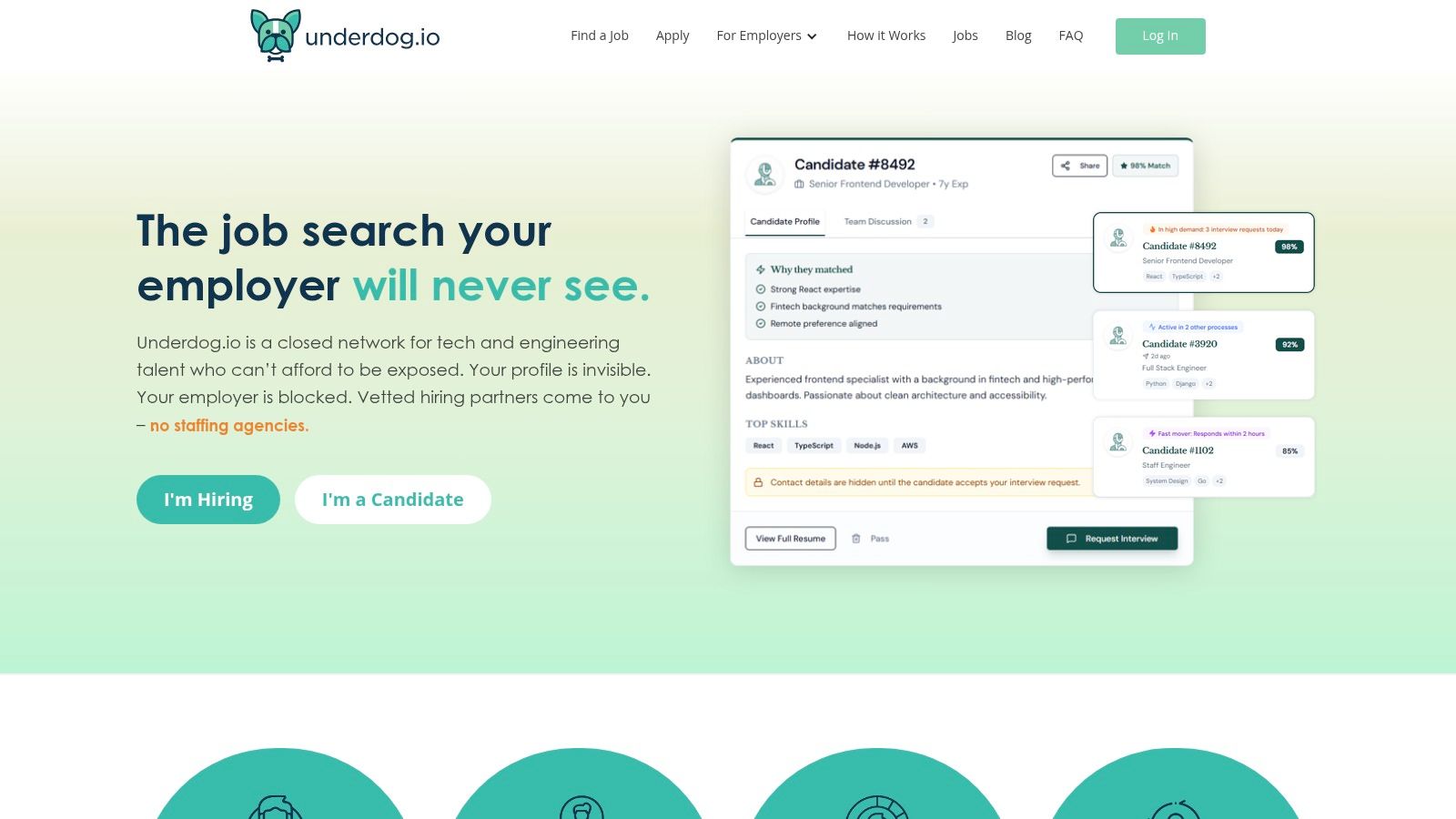
Use Underdog.io as a curated sourcing and matching layer, while keeping your ATS as the system of record. A hiring manager can review relevant introductions, move interested candidates into the ATS, and run interviews, assessments, approvals, and offers through the existing workflow. That pairing avoids forcing the marketplace to become a replacement for every recruiting process.
The platform is deliberately selective. Only about 5% of candidate applicants are accepted, according to the provided platform information, so it won't suit teams that want unrestricted candidate volume. Its startup-first inventory also limits its usefulness for companies hiring primarily outside technology startups or seeking traditional large-company career paths.
Practical rule: Use Underdog.io when fit, confidentiality, and passive-talent access matter more than maximizing applicant count.
The model is human-powered rather than based on keyword spam. Candidates typically receive 1 to 3 introductions per month, and the platform emphasizes an evergreen pool of active, high-intent talent, including approximately 85% passive candidates. Those figures come from Underdog.io's supplied platform information. For employers, the practical benefit is a more focused conversation queue, not a promise that every introduction will become an interview.
Pros
Cons
Website: Underdog.io
Greenhouse is a mature ATS for startups that have moved beyond ad hoc hiring and need structured decision-making. Its core strength is the discipline it brings to interview plans, scorecards, approvals, and hiring-manager collaboration. That structure helps prevent every interviewer from evaluating a different version of the role.
The platform also supports a native CRM, talent pools, prospect rediscovery, candidate portals, and a broad integration ecosystem. Teams can connect it to HRIS and payroll systems, assessments, background checks, scheduling tools, and other parts of the hiring workflow through integrations and APIs. Greenhouse has also expanded its AI capabilities, including candidate rediscovery, content drafting, and fraud detection and verification through Real Talent.
Greenhouse works best when founders and hiring managers are willing to follow a consistent process. A scorecard only improves decisions if interviewers complete it independently and on time. A carefully designed approval workflow only helps if the company has agreed on who owns headcount, compensation, and offer decisions.
The trade-off is operational weight. Pricing is quote-based, and add-ons can increase the total cost. Reporting depth and configuration also create a learning curve, especially for a small team without recruiting operations support. A startup hiring intermittently may find that the system is more powerful than its current process requires.
Choose Greenhouse when you need an ATS that can support structured hiring as the company grows toward more complex recruiting. Pair it with Underdog.io for curated startup talent, then use Greenhouse to manage the downstream workflow. Don't buy Greenhouse solely because larger companies use it. Buy it when structured hiring, compliance, integrations, and repeatable reporting justify the administrative investment.
Website: Greenhouse
Lever combines an ATS and native CRM in one interface, which makes it a practical choice for startups that need to manage active applicants and passive prospects together. Recruiters can keep candidate records, build outreach campaigns, send text messages, monitor pipelines, and report on hiring activity without immediately adding a separate CRM vendor.
Its recruiter-facing design is one of its clearest advantages. Small teams can usually ramp faster on an intuitive pipeline than on a system that requires extensive configuration before hiring managers can use it. The unified database also reduces the common split between applicants in the ATS and sourced candidates in an external spreadsheet or outreach platform.
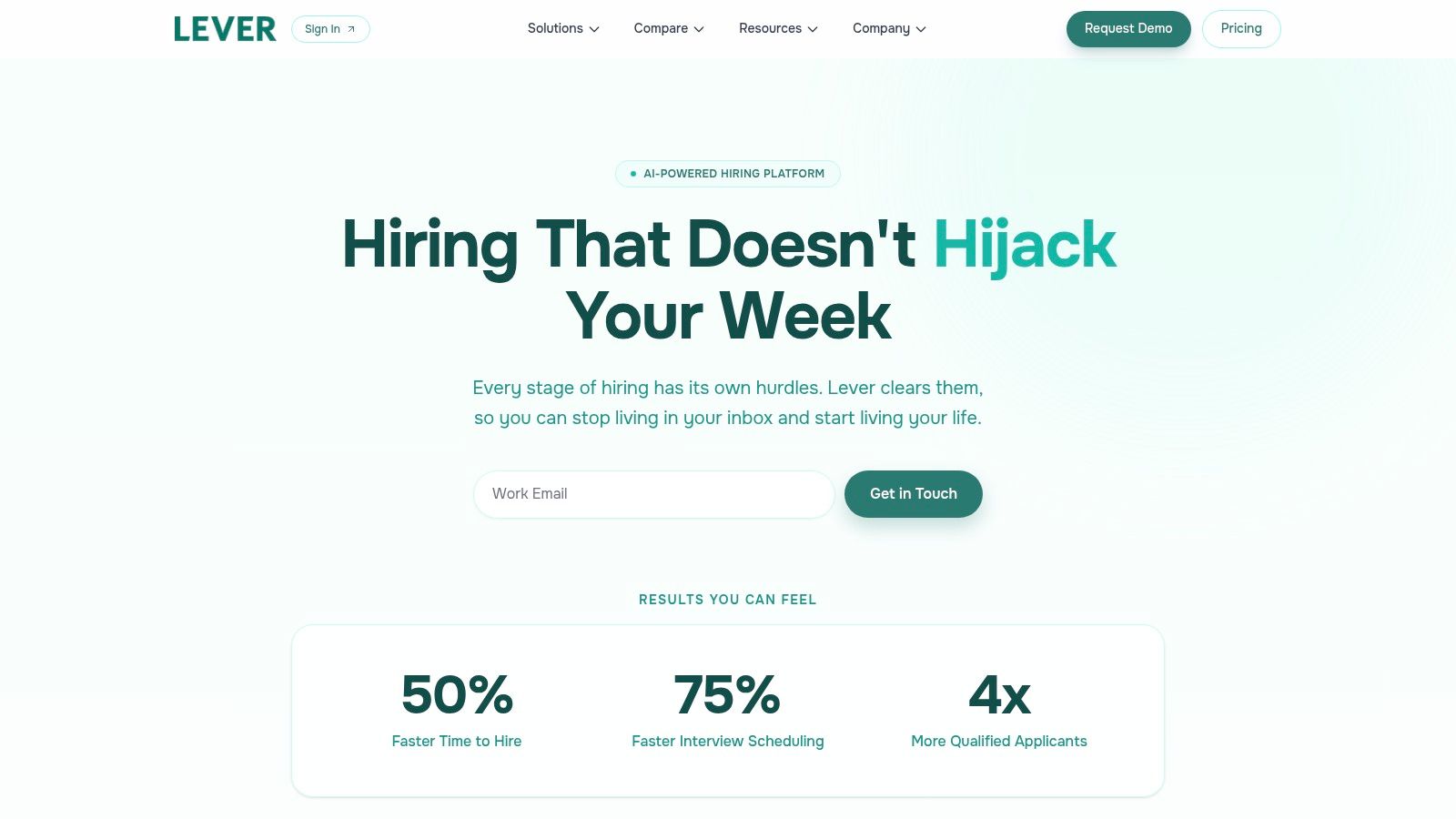
Lever supports integrations for HRIS platforms, background checks, assessments, and related hiring systems. Its advanced reporting can help recruiting teams see pipeline health and source performance, though teams that require highly specialized analytics or extensive customization may find best-in-class point tools deeper.
That trade-off matters for a startup deciding whether to consolidate. Lever can replace a basic ATS plus a lightweight candidate CRM, but it may not eliminate every specialist tool. Evaluate whether the built-in outreach and reporting meet your operating needs before adding vendors around it.
For a practical operating model that combines process, ownership, and tooling, use this guide to building a recruiting system that scales with talent engineering. The important decision is not whether Lever has every possible feature. It's whether recruiters and hiring managers will keep candidate data current and feedback inside the system.
Website: Lever
Ashby is built for teams that treat recruiting data as an operating instrument, not a monthly report. It combines ATS workflows with scheduling, email, sourcing add-ons, automation, and detailed dashboards. That makes it a strong option for high-growth startups trying to replace a scattered collection of recruiting tools with one analytics-forward platform.
The platform's value appears when leaders ask questions such as which sources produce qualified interviews, where candidates stall, how long each stage takes, and how recruiter capacity affects throughput. Executive-ready dashboards can turn those questions into recurring operating reviews rather than one-off spreadsheet projects. Agency collaboration controls and contract integrations can also help teams manage external recruiting partners without losing process visibility.
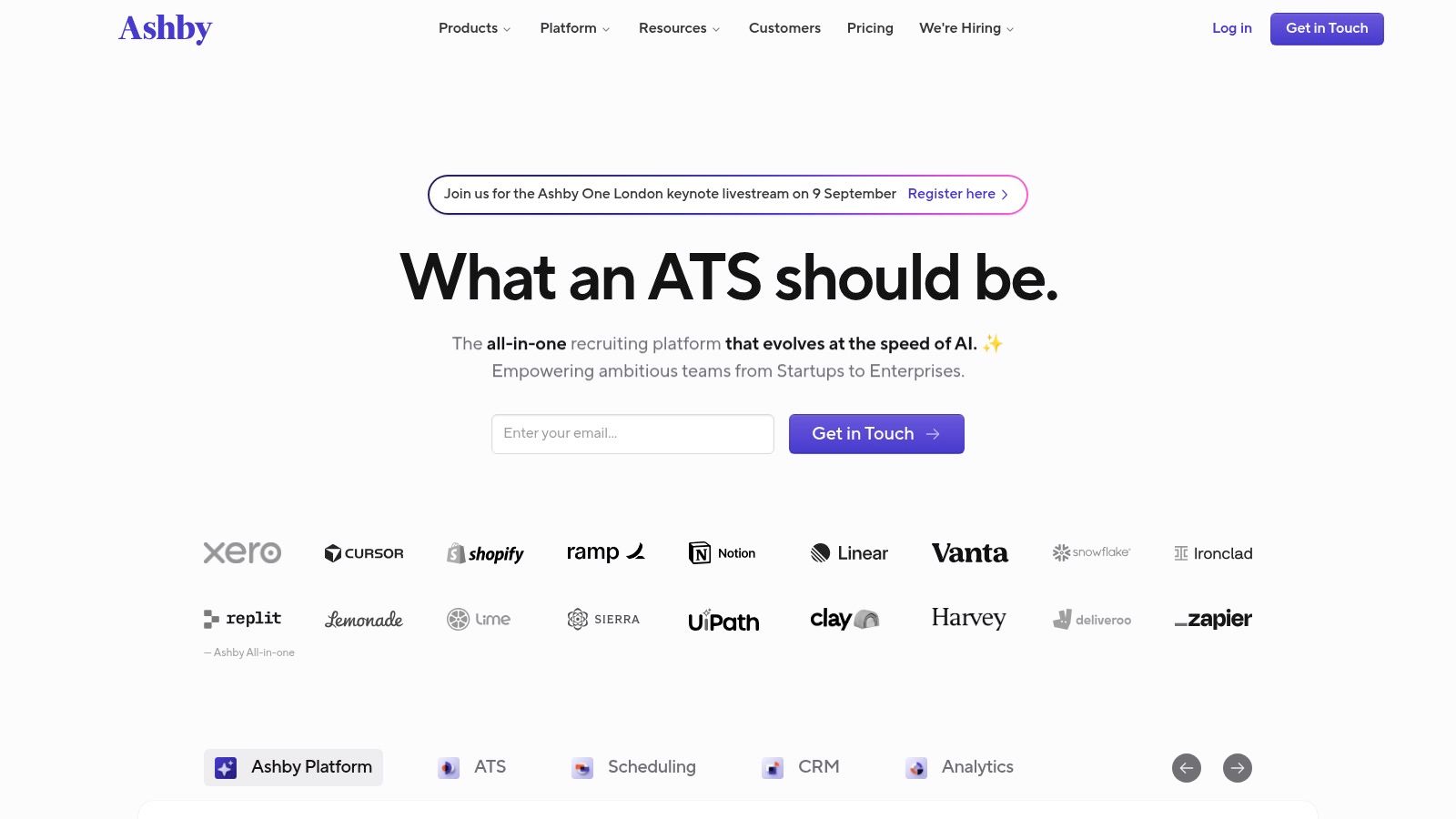
Ashby can replace several separate contracts, particularly when sourcing, scheduling, analytics, and ATS functions currently sit in different systems. But consolidation only works if the company configures the platform around a clear process. A system with extensive dashboards and automations can create more work when nobody agrees on stage definitions, ownership, or reporting conventions.
Pricing is premium and scales with seats and features. That makes Ashby less attractive for a startup that only needs basic candidate tracking, but more defensible for a team already paying for multiple systems and spending time reconciling their data.
Use Ashby when analytics and consolidation are central requirements. Keep marketplace introductions from Underdog.io, inbound applications, sourced prospects, and agency candidates in one consistent workflow so the dashboards reflect the whole funnel rather than only one channel.
Website: Ashby
Workable fits early teams that want a self-serve ATS with predictable setup and built-in job distribution. It provides career-site functionality, hiring pipelines, evaluations, offers, templates, and broad job-board posting without requiring a long implementation project.
That combination is useful when a founder or HR generalist owns hiring alongside other responsibilities. The team can create a role, publish it across relevant boards, collect applications, assign evaluations, and move candidates through a visible process. Workable Agent also provides AI credits within plans, giving teams a way to experiment with assisted recruiting without purchasing a separate AI product immediately.
The main limitation is depth. Teams with advanced CRM requirements, complex analytics, or detailed sourcing operations may eventually need specialist tools. Add-ons and higher employee bands can also change the cost picture, so a transparent initial plan shouldn't be treated as the final cost of a growing stack.
Workable is a sensible replacement for spreadsheets, email threads, and manual job-board posting. It isn't necessarily a replacement for a curated marketplace or a dedicated outbound sourcing platform. A lean combination might use Underdog.io for selective startup talent, Workable for application and interview management, and a separate scheduling or assessment integration only when the workflow demands it.
The best implementation starts with a small number of stages and required evaluation fields. Don't recreate every historical exception in the first configuration. A simple process that hiring managers use consistently is more valuable than a complex workflow that recruiters must constantly repair.
Website: Workable
Gem strengthens the part of recruiting that many ATS platforms handle poorly, outbound sourcing and relationship management. Its CRM supports sequences, analytics, diversity tracking, candidate rediscovery, pipeline forecasting, and AI-powered recruiting agents. A Chrome extension helps recruiters capture and enrich profiles while researching talent.
This is valuable for startups with a steady need to build technical pipelines before a requisition becomes urgent. Recruiters can segment talent, run outreach, monitor engagement, and return to previous prospects instead of treating every search as a new project. The resulting data can also help a hiring leader distinguish between a weak market, weak messaging, and weak follow-up discipline.
Gem now offers an all-in-one product that includes ATS, scheduling, analytics, and AI agents. That creates a choice. A startup can use Gem to consolidate sourcing, CRM, and applicant tracking, or it can connect Gem to an incumbent ATS and keep the existing system of record. The second approach reduces migration risk, but it can also leave duplicate data and overlapping workflows if ownership isn't explicit.
Pricing is custom and may add significantly to an existing ATS. The platform is most defensible when outbound sourcing is a meaningful part of the hiring motion and the team will review campaign metrics. Buying it for occasional sourcing creates unnecessary stack weight.
Use Gem when the bottleneck is not application management but consistent, measurable engagement with passive talent. Use Underdog.io alongside it when the team wants curated, human-reviewed introductions rather than increasing outbound volume across every possible profile.
Website: Gem
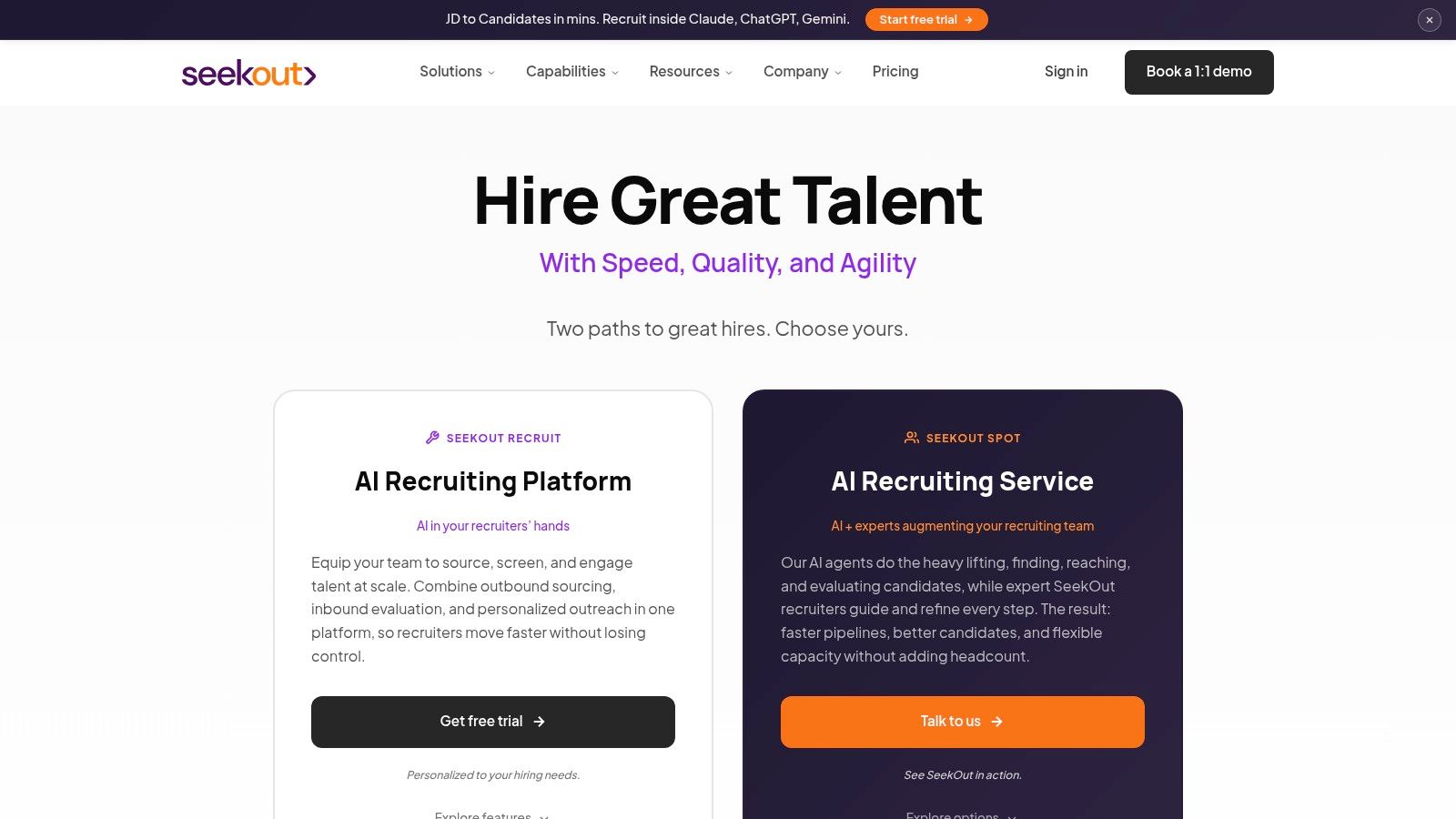
SeekOut is an enterprise-grade sourcing platform for teams handling hard-to-fill technical roles and complex talent searches. Its search environment supports deep filters for skills and experience, contact-data credits, profile enrichment, outreach, rediscovery, and AI agents. The platform also offers SeekOut Spot, an optional services layer that can deliver interview-ready candidates when an internal team needs additional capacity.
That software-plus-services model is useful during a hiring surge. A startup can use its own recruiters for priority roles while adding external delivery support for searches that would otherwise consume too much time. It also gives a talent leader a way to test whether the problem is sourcing capacity or a shortage of qualified people in the target market.
The trade-off is planning. Custom pricing, seats, and contact-data credits require careful usage assumptions, especially when multiple recruiters source at different intensities. Teams that only perform occasional outbound searches may not capture enough value to justify the platform.
SeekOut is strongest when a startup has repeatable sourcing motions, specialized technical requirements, and recruiters who know how to use advanced search well. It can replace separate contact-data and sourcing tools, but it won't replace the ATS, interview workflow, or employer-branding work that converts interest into a hire.
For a broader framework covering sourcing systems for early-stage teams, see these candidate sourcing tools for startups. Pair SeekOut with an ATS that records every contact and outcome, then compare source quality by qualified response and completed interview, not just profile count.
Website: SeekOut
hireEZ is designed for lean teams that want to combine candidate data, enrichment, outreach, and market intelligence in one sourcing workflow. It provides verified contact data, profile enrichment, email and campaign automation, ATS rediscovery, market insights, a Chrome extension, and sourcing tools.
The platform can replace several point solutions when recruiters currently move between a profile database, contact finder, sequencing tool, and spreadsheet. That consolidation reduces context switching, but it also makes data quality more important. If the platform's contact coverage is weak for a particular talent pool, bringing more functions under one vendor won't solve the underlying sourcing problem.
hireEZ is a good fit for a small recruiting team that runs steady outbound campaigns and wants a single place to manage sequences and responses. It's less compelling for a founder making occasional hires, where a curated marketplace, targeted referrals, or direct networking may produce better signal with less setup.
Pricing isn't publicly listed, and the plan structure varies by team size and usage. Test sourcing accuracy against real roles before committing. Review the quality of profiles, the reliability of contact information, the ease of exporting or syncing records, and how quickly recruiters can stop outreach when a candidate responds.
Use hireEZ with clear outreach ownership. The ATS should remain authoritative for candidate stage and disposition, while hireEZ manages prospecting and engagement. Without that division, teams can create duplicate records and lose the history that hiring managers need before an interview.
Website: hireEZ
LinkedIn Recruiter remains the broadest general-purpose option for accessing a professional talent graph. Recruiters can search across the network with more than 40 filters, use Spotlight signals, send InMail, run bulk outreach, collaborate across team seats, and connect activity with major ATS platforms, according to the product information supplied for this comparison.
Its advantage is coverage and familiarity. Most recruiting teams already understand the interface, and candidates are accustomed to receiving professional outreach there. That makes LinkedIn Recruiter fast to operationalize when a startup needs to open a broad search across engineering, product, design, sales, or operations.
The weakness is not search capability. It's the quality of the interaction after the search. Response rates depend heavily on employer branding, message relevance, role clarity, and follow-up discipline. A large candidate pool can also create false confidence if recruiters measure activity instead of qualified conversations and completed interviews.
Pricing is quote-based, and renewals may increase materially from one year to the next. Teams should model seat ownership, InMail usage, and overlap with other sourcing tools before signing. If Gem, hireEZ, SeekOut, or an ATS already covers the team's outreach needs, LinkedIn Recruiter may become an expensive duplicate.
Use it when breadth matters and recruiters can personalize outreach at a sustainable pace. For a startup with a highly specific, passive-talent brief, combine it with Underdog.io rather than assuming a larger search universe automatically produces better matches.
Website: LinkedIn Recruiter
Wellfound is a startup-focused talent marketplace and job board with a community of candidates interested in early-stage technology companies. It supports candidate search, outreach, job posting, employer branding, and campaign tools, giving founders a relatively direct route to startup-oriented talent.
The platform is useful when a company needs to explain its mission, product, ownership, and working style to people who are actively considering startup environments. Its audience can be a better contextual fit than a broad job board for roles where ambiguity, pace, and equity are part of the employment proposition.
Wellfound is more generalist than an introduction-only marketplace. Teams still need to write strong role descriptions, respond quickly, and screen for the skills and working patterns that matter. Results also tend to be strongest for popular technology hubs and remote-friendly roles, so a company with a narrow location requirement should validate the available candidate pool before relying on it.
Use Wellfound when employer branding and startup audience access are the priority. Use Underdog.io when the team wants a more curated, confidential, human-matched pipeline. The two can complement an ATS, but they shouldn't create separate candidate records or competing communication processes.
Founders looking for practical ways to improve startup hiring can also use this guide to finding great talent. The common lesson is simple: marketplace reach matters, but the role narrative and follow-through determine whether interested candidates keep moving.
Website: Wellfound
| Platform | Core focus / Key features | Candidate experience & quality | Employer value / USP | Target audience | Pricing model |
|---|---|---|---|---|---|
| Underdog.io (Recommended) | Curated, candidate-first marketplace; 60s anonymous profile; human-powered matches | Highly vetted (~5% accepted); anonymous until mutual; selective intros (1–3/mo); high response rates | Access to passive, startup-focused talent; quality control of companies; success-based hiring + Hunt recruiters | Engineers, PMs, designers; early-stage to Series B startups; passive candidates | Free for candidates; employer pay-per-hire / contingent fees |
| Greenhouse | Structured ATS + interview plans, CRM, integrations, AI features | Candidate portal (MyGreenhouse); scalable, compliance-ready | Enterprise-grade workflows, deep integrations, strong enablement | Scaling startups to enterprises; structured recruiting teams | Quote-based; add-ons can increase cost |
| Lever | Unified ATS + native CRM; outbound campaigns and texting; analytics | Recruiter-friendly UX; strong pipeline visibility | Native CRM avoids silos; fast ramp for small teams | Startups wanting integrated ATS+CRM and easy adoption | Quote-based pricing |
| Ashby | Analytics-forward ATS with scheduling, dashboards, automation | Strong candidate experience tooling; executive-ready analytics | Consolidates tools into one platform; rich reporting | High-growth startups needing analytics and automation | Premium pricing; scales with seats/features |
| Workable | Self-serve ATS with job distribution and AI credits | Quick setup; broad job-board reach for candidates | Transparent per-band pricing; easy online checkout | Early teams seeking predictable costs and quick launch | Per-band pricing with bundled AI credits |
| Gem | Recruiting CRM + sourcing automation; ATS and AI agents | Scales outbound sourcing; sequencing and enrichment | Unifies sourcing, CRM, ATS; strong pipeline metrics | Teams scaling outbound sourcing and outreach | Custom pricing; add-on to existing ATSs |
| SeekOut | Enterprise sourcing with advanced search, AI agents, Spot services | Deep candidate coverage and verified contact data | Robust filters for hard-to-fill tech roles; optional delivered candidates | Enterprise and technical hiring teams doing heavy sourcing | Custom pricing; credits for data |
| hireEZ | AI-assisted sourcing, enrichment, outreach sequencing | Multi-channel outreach; verified emails/phones; Chrome extension | Consolidates data + outreach; good for lean teams | Small/lean teams focused on outbound sourcing | Custom pricing; usage-based plans |
| LinkedIn Recruiter | Full-network search, InMail, bulk outreach, ATS integrations | Massive professional coverage; familiar UX for candidates | Ubiquitous reach and messaging deliverability; fast to operationalize | All recruiters; enterprise and agency teams | Subscription / quote-based; often expensive |
| Wellfound (AngelList) | Startup-focused talent marketplace and job board | Startup-minded candidate community; employer branding tools | Easy setup; tailored to startup hiring and employer branding | Early-stage startups and startup-seeking candidates | Marketplace access with optional premium placement options |
The right stack starts with the bottleneck, not the vendor category. If candidates are disappearing between conversations, fix scheduling, follow-up, and disposition discipline. If recruiters can't find qualified people, add a sourcing or marketplace layer. If hiring managers submit inconsistent feedback, prioritize structured scorecards and clear decision ownership before purchasing more automation.
Choose one system of record first. Greenhouse, Lever, Ashby, or Workable can anchor the candidate journey, depending on how much structure, analytics, CRM functionality, and self-serve simplicity your team needs. Wellfound and Underdog.io can feed the top of the funnel, while Gem, SeekOut, hireEZ, or LinkedIn Recruiter can support outbound sourcing. Scheduling, technical assessments, employer branding, and analytics should connect around that central record instead of creating parallel versions of the truth.
The market evidence supports a consolidation mindset. HR.com's 2025 research found that only 43% of organizations rated their talent-acquisition technology stack as good or excellent, while 54% didn't plan to buy new talent-acquisition tools in the following year. The same research reported that half of organizations use only 2 to 5 paid talent-acquisition tools, and 38% were both consolidating existing tools and adopting new ones. HR.com's Future of Recruitment Technologies 2025-26 report points toward a sustainable stack, not an ever-expanding one.
Candidate experience needs operating metrics, not vague promises. Application completion rate can be calculated as completed applications divided by applications started, multiplied by 100, using LinkedIn's candidate-experience metrics guidance. Application-to-interview conversion and disposition SLA are also useful because they show whether candidates move from interest to a clear outcome without unnecessary delay, as described by the Candidate Experience Institute's recruiting metrics framework.
Speed should be measured in stage-level terms. Metaview defines time to hire as the period from candidate application to accepted offer, with a healthy range of 18 to 30 days, and time to fill as the period from requisition opening to accepted offer, with a healthy range of 30 to 45 days. It also recommends keeping time in each active stage under 7 days. These benchmarks come from Metaview's recruiting benchmarks, and they give teams concrete alerts to configure in their ATS.
Underdog.io can fill the curated, passive, startup-focused introduction role while the ATS remains the system of record. That combination is especially useful when a startup needs high-signal conversations but doesn't want to replace its interview plans, assessment workflow, approvals, or reporting infrastructure. The marketplace can reduce sourcing noise, while the ATS preserves the operational discipline required to move candidates fairly and quickly.
The best stack is the one your recruiters and hiring managers will use consistently as hiring volume changes. Start with one bottleneck, test one replacement candidate, and keep the tools that improve qualified movement through the funnel without creating another administrative project.
Underdog.io gives high-growth startups access to curated, startup-focused talent through human-reviewed introductions, including confidential connections with passive candidates. Visit Underdog.io to explore a sourcing layer that can complement your ATS without adding high-volume noise.