How to Build a Recruiting System That Scales with Talent Engineering
The bluntest hiring benchmark is also the most useful one. AI/ML engineering roles can take 89 days to fill, while general U.S. roles average 44 days and software engineering sits at 62 days in the same benchmark set, which means the recruiting system has to be built for delay resistance, not just activity volume. The teams that win at scale are the ones that instrument the funnel so intake, sourcing, scheduling, and decisions don't add up to compounding drag, because the difference between a fast system and a brittle one shows up in every downstream stage (tech hiring benchmarks 2026).
A lot of teams still confuse more applicants with better hiring. That breaks quickly when application-to-hire conversion averages 0.6%, or roughly 1 hire per 167 applicants, and tech roles can require about 191 applicants per hire in the cited benchmark summary (talent engineering funnel benchmarks). Talent engineering exists because the answer isn't another pile of resumes. It's a recruiting system that treats each handoff, each screen, and each interview loop as a measurable part of a productized workflow.
The first thing that breaks is time. In tech hiring, the clock runs longer than most leaders expect, and the variance gets worse as the role gets more specialized. A benchmark set for 2025 and 2026 puts U.S. average time-to-fill at 44 days, tech roles at 48 days, software engineering at 62 days, and AI/ML engineering at 89 days (tech hiring benchmarks 2026). Senior and staff-plus engineering searches can also exceed 90 days in 40% of cases, which is why a scalable system has to standardize intake, sourcing, interview scheduling, and decision-making instead of leaving each req to improvised coordination.
The second thing that breaks is funnel logic. If your team keeps adding inbound volume while the conversion path stays leaky, recruiters end up sorting noise instead of advancing signal. One 2026 benchmark summary reports 0.6% average application-to-hire conversion, and the same source says applications per open role doubled from 46 in 2021 to 95 in 2026 (talent engineering funnel benchmarks). That's the core scaling problem. Volume rises, but the system doesn't get better at selecting, routing, or matching.
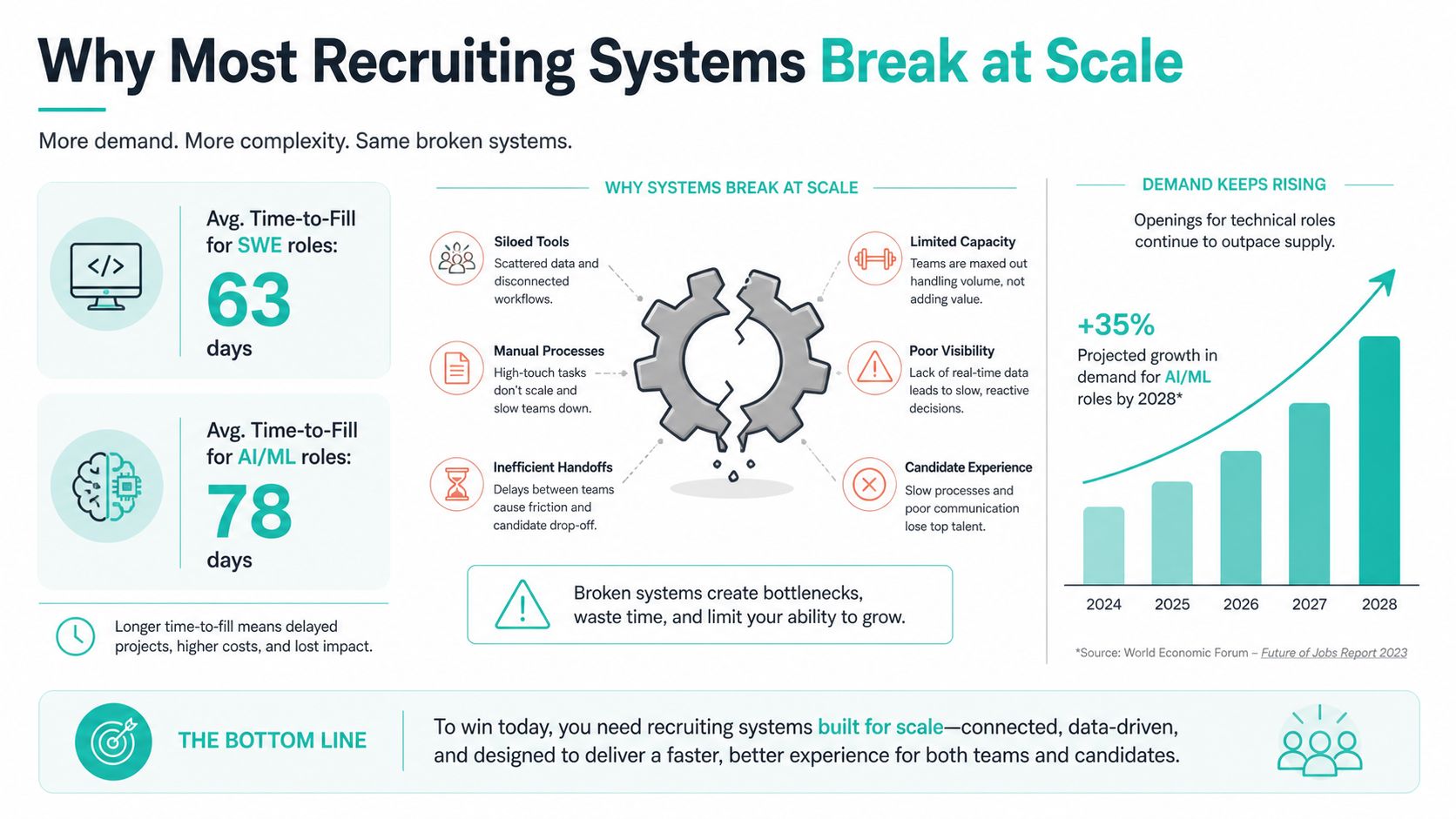
When teams scale badly, the root cause is rarely “we don't have enough applicants.” It's usually manual intake notes, half-owned follow-up, inconsistent scorecards, and interviewers who all evaluate the same candidate through different lenses. That creates a pipeline that looks busy and behaves slowly.
Practical rule: if a stage depends on someone remembering to forward context, it's already a scaling risk.
Top-performing teams prove the opposite. Recruiting operations benchmarks show that strong teams can produce time-to-first shortlist in 1 to 2 days and 90% to 95% 90-day retention, while average teams need 5 to 7 days and retain only 65% to 72% at 90 days (tech hiring benchmarks 2026). That gap isn't cosmetic. It tells you that the operating system underneath recruiting is doing real work, or it isn't.
Talent engineering is the discipline that closes those gaps. It doesn't treat recruiting as a series of heroic exceptions. It turns hiring into a repeatable system where speed, selectivity, and quality can all be measured in the same funnel.
A recruiting system that scales starts with ownership, not tools. The cleanest model is one stage, one owner, one system, and one automation. Candidate discovery sits in the sourcing stack, outreach lives in the sequencing tool, application tracking belongs in the ATS, and scheduling should move through a booking layer that's tied directly to the record, so the candidate never gets duplicated or loses context between handoffs (recruiting system that scales).
The reason to map the workflow before adding automation is simple. Tools don't remove ambiguity, they amplify it if the process isn't clear. If you buy software before clarifying where context lives, who approves what, and how candidates move, you create more admin work instead of less. The better sequence is workflow mapping first, automation second, then a pilot on one live role before full migration.
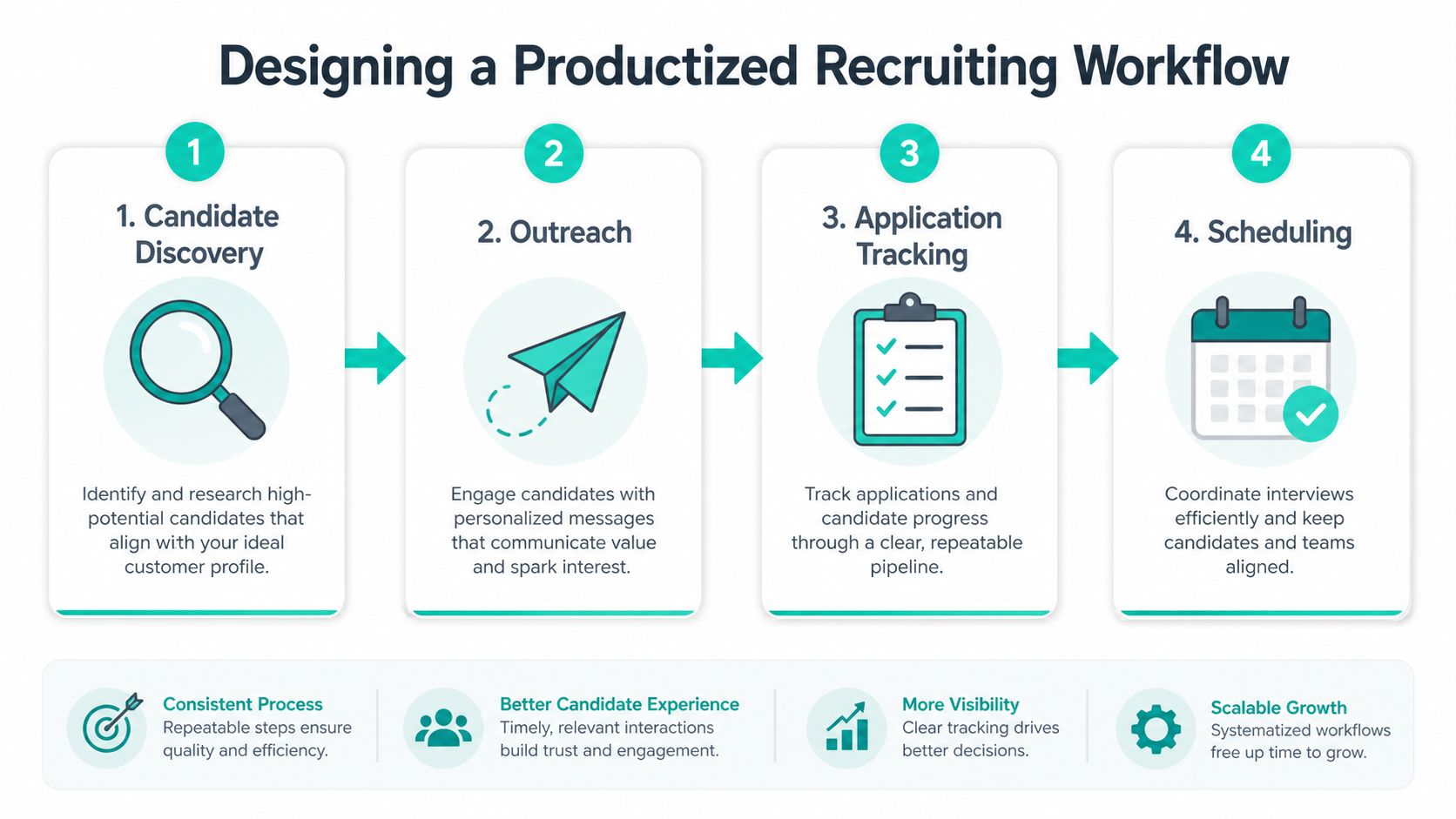
The most useful operating question is not “what tools do we use?” It's “where does the candidate record live at every step?” That's where the system either stays coherent or starts leaking. A shared inbox, ATS-linked scheduling, and a single source of truth for notes prevent recruiters from rebuilding context every time a candidate responds.
For teams planning the sequence, planning for recruitment is worth reading alongside this workflow view, because the work is aligning pipeline design with hiring demand before the reqs go live. That's also where scorecards and interview loops matter. Standardized scorecards keep decisions comparable across interviewers, and fixed loops stop each search from becoming a custom project.
A practical way to think about this is to separate human judgment from mechanical movement. Humans should judge fit, evidence, and trade-offs. Systems should move the candidate, preserve context, and trigger the next step without asking a recruiter to babysit the handoff.
A productized workflow only scales when every transition is visible, owned, and recoverable.
A useful external tool in this layer is Qcard's resume-grounded interview coaching, which can help candidates prepare for structured screens without changing the rigor of the process. Used well, that kind of prep reduces avoidable friction on both sides of the interview table.
The question founders usually ask is direct, and it should be. How many recruiters, sourcers, and coordinators do you need before the process starts slipping? One scaling playbook cites a benchmark of roughly one recruiter for every 15 to 20 hires per year, with added sourcing support for technical roles because passive candidates dominate those markets (scaling engineering team hiring). That ratio is a useful planning anchor, not a universal law, but it's far better than waiting for burnout to tell you the team is overloaded.
At low volume, a generalist can often carry sourcing, coordination, and closing if the workflow is tight. Once hiring starts running in parallel across several technical roles, the job changes. Sourcing becomes a distinct motion, coordination becomes a real capacity constraint, and closing needs enough senior attention that it can't just be squeezed into the margins of a recruiter's week.
A capacity model usually needs to answer three questions:
The most common mistake is waiting until the team is already reactive. The better move is to add dedicated capacity before the pipeline is under stress, because reactive hiring almost always produces worse prioritization and weaker candidate follow-through. That's especially true in technical hiring, where candidate attention is limited and delays are easy to interpret as low signal.
| Annual Hires | Recruiters Needed | Sourcing Support | Coordination Support |
|---|---|---|---|
| 10 to 15 | 1 generalist | Light support, often shared | Light support, often shared |
| 15 to 20 | 1 recruiter | Add when technical roles are mixed in | Add if scheduling starts slowing screens |
| 20+ | Multiple recruiters | Dedicated sourcing becomes more useful | Dedicated coordination reduces drag |
The table isn't about headcount vanity. It's about keeping the recruiting machine from turning every req into a custom scramble. Once the team can see where capacity breaks, it can assign work before quality drops.
A useful companion resource here is recruitment planning for scaling teams, because capacity only matters if the candidate journey stays coherent while the team grows.
A scalable recruiting system runs on conversion math, not hope. The core metrics to track are time-to-fill, source effectiveness, pipeline velocity, quality of hire, offer acceptance rates, and 90-day retention (talent engineering pipeline guidance). Each one reveals a different bottleneck. Time-to-fill shows where the process slows, source effectiveness shows where signal is coming from, and retention tells you whether the system is producing durable hires or just fast offers.
The important shift is to stop treating these as reporting artifacts. They're operating signals. If source effectiveness is weak, the team shouldn't just post more jobs. If pipeline velocity is slow, the problem may sit in scheduling, interviewer availability, or too much manual review. If offer acceptance is slipping, the issue may be candidate trust, compensation positioning, or an interview process that's too noisy to inspire confidence.
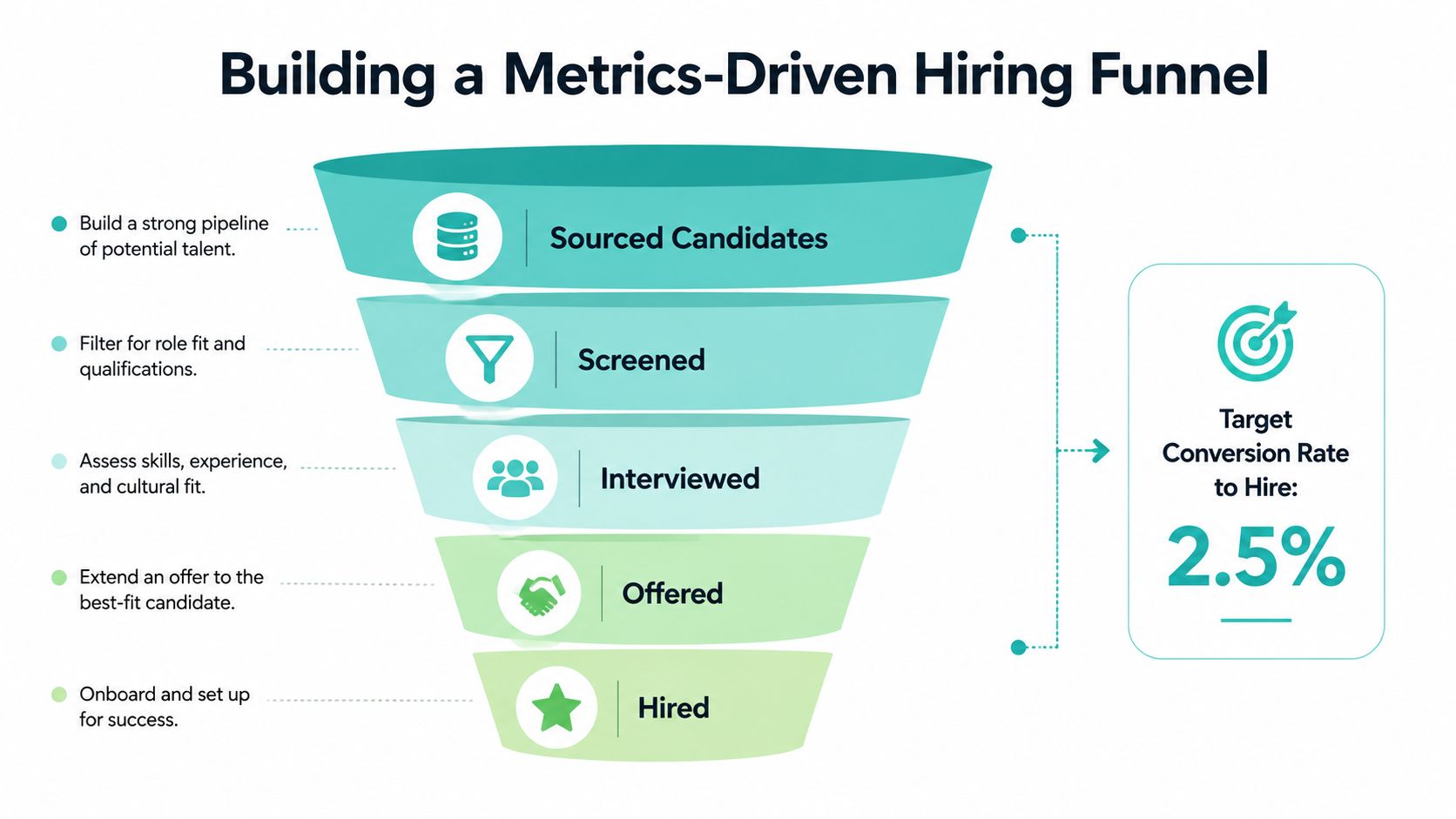
For engineering hiring, a three-tier screen creates throughput without sacrificing signal. Start with a rapid rubric-based resume review, move to an asynchronous technical assessment, and then use a structured interview loop. That model is specifically recommended for fast-growing engineering organizations because it narrows noise early and reserves live interviewer time for candidates who have already cleared an evidence threshold (talent engineering pipeline guidance).
The key is that every tier should answer a different question. Resume review checks for baseline fit. The assessment checks for applied problem-solving. The structured interview checks for consistency, communication, and role-specific judgment. If you collapse those questions into one unstructured conversation, the funnel gets slower and less reliable.
Hire smarter with workforce data is a useful reference point for teams that want to make the reporting layer more decision-useful, especially when headcount plans start changing faster than the recruiting team can manually recast them.
Operational truth: a recruiting dashboard only helps if someone is changing behavior because of it.
That's why capacity planning matters here too. Headcount plans should translate into recruiter capacity before the reqs open, not after the team is already buried. When demand spikes, add specialized support instead of stretching generalists until quality falls apart.
Automation doesn't automatically improve hiring quality. It can also make weak assumptions move faster. If a team only optimizes for speed, it can end up with a cleaner funnel and a worse workforce because it never tests whether the sources, screens, or messages are producing the right people. Talent engineering has to behave like an experiment-driven system when supply is constrained and the market is selective.
Controlled experiments in recruiting should start with sourcing channels, interview calibration, and candidate messaging. Those are the levers most likely to affect who enters the funnel and how they experience it. If one channel brings candidates who advance farther and accept more often, that's a signal worth preserving. If another channel fills the top of funnel but weakens the rest of the process, it may be creating work without value.
The same logic applies to calibration. If interviewers don't score the same evidence the same way, the funnel can look rigorous while producing inconsistent outcomes. Structured calibration sessions reduce that drift by getting interviewers aligned on what “good” looks like before candidate volume rises.
Candidate messaging matters too, especially in major startup markets where passive candidates have more options and more reasons to ignore generic outreach. Personalization isn't decoration in that environment. It's part of the signal. The more selective the market, the more trust and specificity matter.
Run one change at a time when you can. If you change sourcing, scorecards, and messaging together, you won't know what moved the result.
A lot of teams drift into false efficiency. They automate screening, accelerate outreach, and declare the system improved because recruiter activity dropped. But if the accepted-offer quality slips, or if candidates disengage before final stages, the system may just be moving faster in the wrong direction. The better standard is whether the experiment improved the right outcome, not whether it reduced manual work.
Talent engineering at scale means protecting quality under constraint, not just chasing throughput. That's the difference between a recruiting stack that looks polished and one that compounds into better hires over time.
A recruiting system stays healthy when candidates can feel the coherence, even if they never see the machinery. Treat the hiring process like a product. Define the target users, map the journey from first touch to first week, and look for the places where drop-off, confusion, or friction keeps showing up. High-growth hiring teams that do this well also keep the operating rhythm tight with weekly hiring syncs, standardized scorecards, interview loops, and automated pipeline tracking (hiring at scale).
Knowledge-sharing is the other half of durability. If the best sourcing sequences live in one recruiter's head, the team can't scale cleanly. If the interview rubric exists only in a manager's memory, calibration breaks as soon as that person is out for a week. Playbooks should capture sourcing sequences, note-taking conventions, scorecard standards, and the exact way the shared inbox routes replies so the next hire ramp happens faster than the last one.
For teams formalizing the candidate side of the system, candidate experience best practices is a useful companion, because experience is not separate from operations. It's what operations feels like to the candidate. The same is true after offer acceptance, where the first week matters. A strong remote onboarding playbook for HR leaders helps preserve the continuity between recruiting promises and day-one reality.
The most durable systems make a few things essential. They keep pipeline tracking current, they use the same scorecard language across interviewers, and they make sure every candidate interaction has a visible owner. That's how teams keep quality and quantity in balance while volume rises.
If you're building a recruiting system that has to survive technical hiring at scale, Underdog.io can help you reach startup-ready candidates through a curated marketplace built around high-signal matching. Visit Underdog.io to see how a quality-first pipeline can support the same operational discipline this article describes.