Most startups don't have a hiring problem because they lack applicants. They have a hiring problem because about 70% of the global workforce is passive talent and only a minority are actively job hunting, so the best people usually aren't sitting on job boards waiting to be found. LinkedIn's hiring data also shows that people look for jobs through online job boards (60%), social professional networks (56%), and word of mouth (50%) LinkedIn hiring stats. If you're building a startup team, that changes the game. You're not filling an inbox, you're building a system for reaching people who already have work, options, and low tolerance for vague outreach.
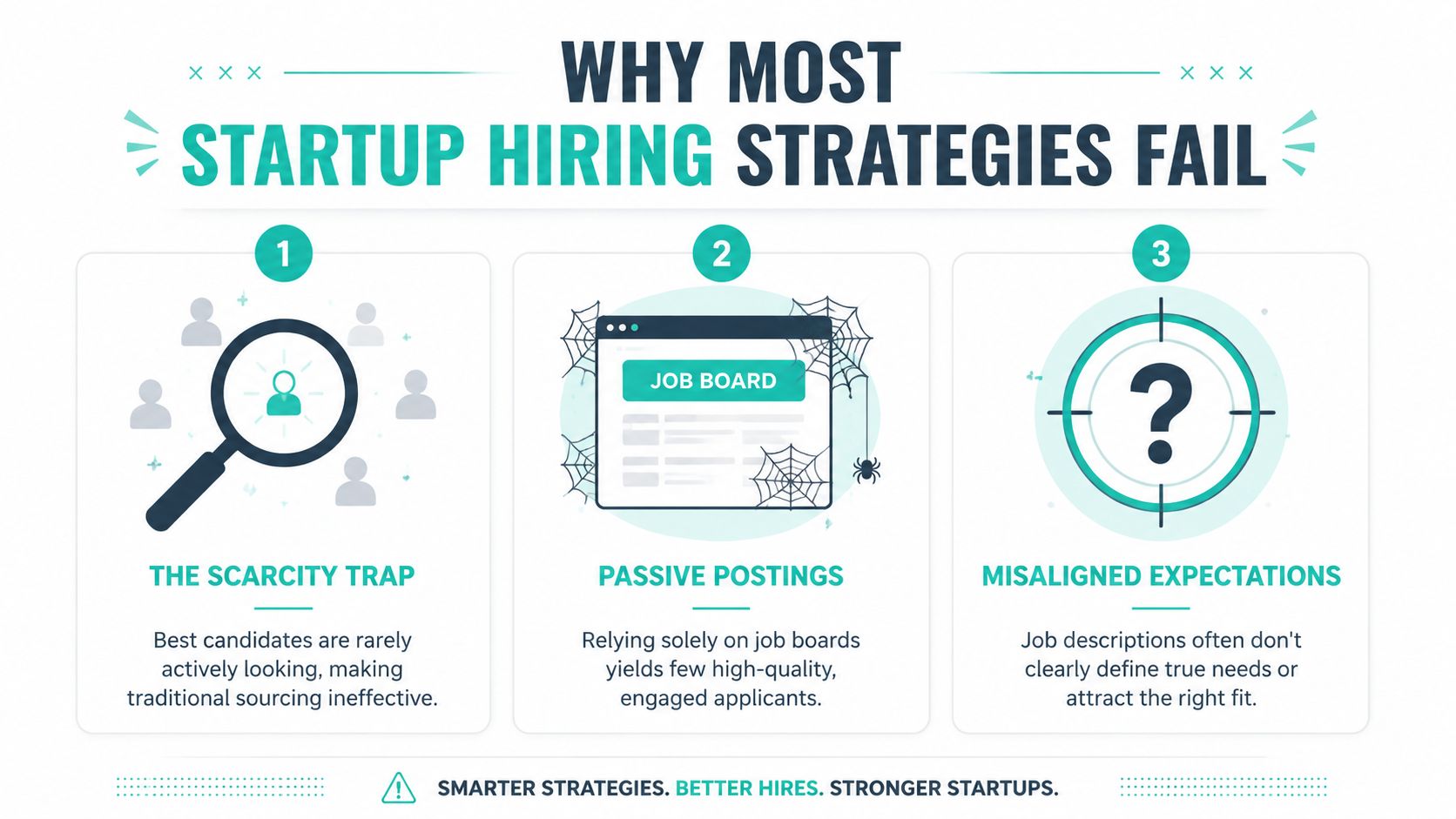
The easiest mistake is to treat hiring like a broadcast problem. Post a role, wait for applicants, sort through resumes, and hope signal appears in the pile. That approach can generate volume, but it doesn't solve the central issue that great candidates are often employed and only lightly open to change, which is why a startup can spend days watching generic applications arrive while the people it wants never see the post.
The first failure is believing there's a deep pool of obvious candidates. There isn't, not for senior engineers, product managers, or designers who already have strong options. The funnel narrows fast after a role goes live, with a typical corporate opening getting about 250 resumes, only 4 to 6 candidates usually reaching interview, and the average hiring process taking about 36 days. Recruiters also spend roughly 7 to 10 days sourcing talent for a position, which is a blunt reminder that speed matters because competitors are chasing the same people recruiting statistics.
Practical rule: if your outreach assumes candidates are browsing full-time, your pipeline will look busy and still underperform.
The second failure is over-relying on job boards because they're easy. They're also where everyone else posts. That creates a flood of applicants who are often unqualified, loosely interested, or applying everywhere at once. For startups without a household brand, that means your job description competes with larger companies, safer bets, and internal promotions.
The third failure is misalignment. A lot of startup job descriptions describe a fantasy teammate instead of a real need, then wonder why the people who reply don't fit. The better move is to get specific about the work, the environment, and the trade-offs before you source a single person. If you want a broader view of candidate-side behavior and screening workflows, understand AI resume screening 2026 is a useful companion read, especially if your team is trying to reduce noise without making the process colder.
The lesson is simple. Great startup hiring is outbound, selective, and persistent. You need to reach people where they already are, speak to a concrete problem they'd care about, and filter hard enough that the team isn't drowning in optimism and mediocre fits.
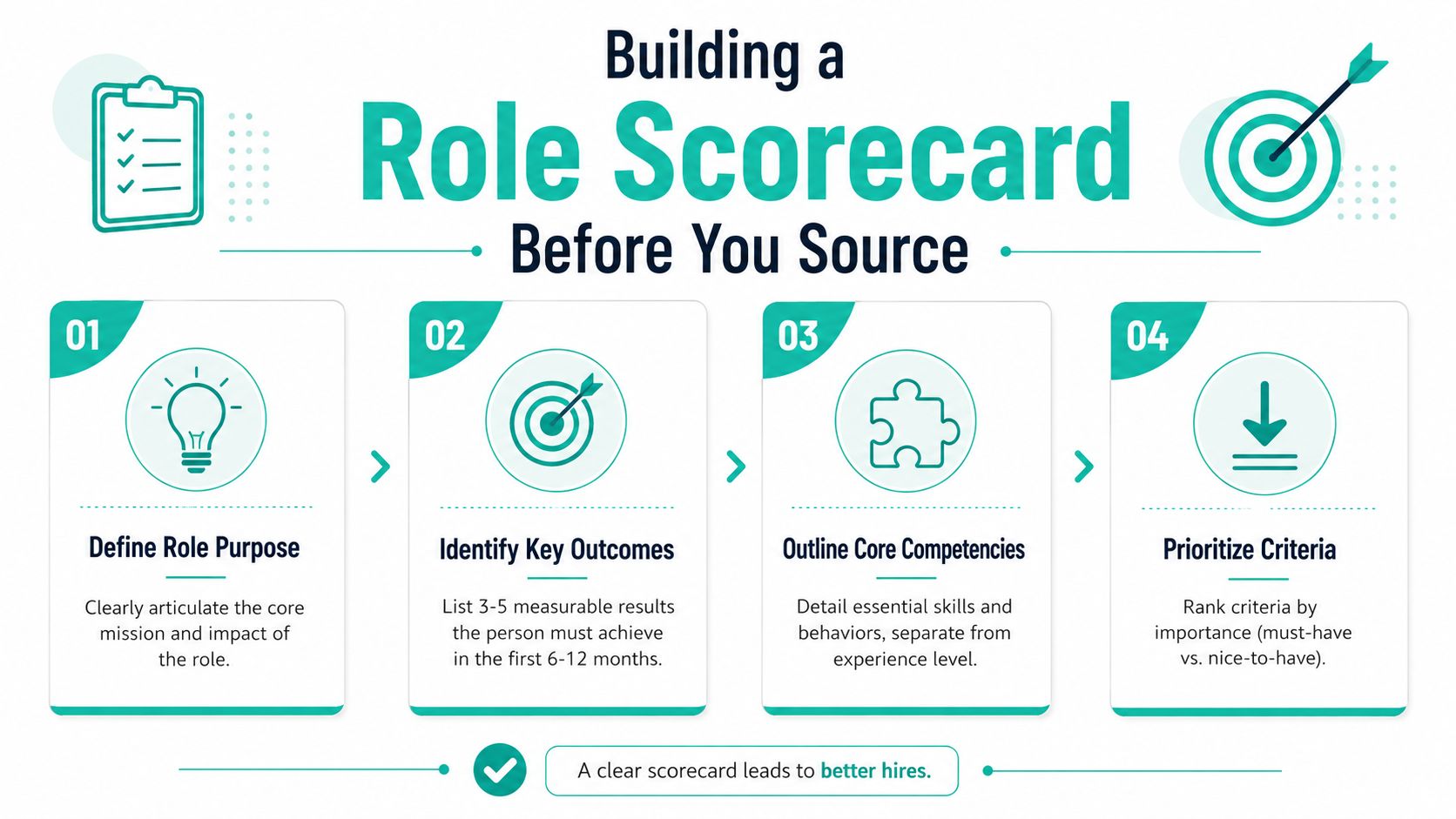
Most hiring teams rush into sourcing with a job title and a loose list of skills. That feels productive, but it usually produces fuzzy decisions later. A role scorecard turns the job into something you can evaluate, which matters because you can't hire for excellence if you never define what excellence looks like.
Write down 3 to 5 success outcomes for the role. For a senior backend engineer, that might mean stabilizing a flaky service, improving deployment confidence, and owning a critical integration without supervision. For a product manager, the outcomes should center on product decisions, cross-functional execution, and the ability to turn customer pain into shipped work. The point is not to list everything the person might do, it's to define what makes the hire valuable in the first place.
A weak scorecard says things like “strong communicator,” “team player,” or “startup experience.” Those are traits, not outcomes. A stronger scorecard says the person must reduce incidents, ship against ambiguous requirements, or synthesize customer feedback into a roadmap that engineering can execute against. That gives you something observable.
A scorecard is useful when two interviewers can read it and score a candidate the same way without debating the job itself.
Once the outcomes are clear, translate them into must-have competencies. Keep the list tight. A startup team doesn't need a giant matrix of nice-to-haves, it needs a small number of capabilities that move the role forward. If a candidate can't do the core work, a great pedigree won't save the hire.
For practical planning, keep the criteria in three buckets:
If you need a planning template before you write the scorecard, this recruitment planning guide is a helpful reference point. It's the kind of pre-work often skipped, leading to later issues like inconsistent interviews and muddled feedback.
The useful test is whether the scorecard changes how you screen. If it doesn't, it's too vague. If it does, you'll feel the difference immediately. Your sourcing gets sharper, your interviews get easier to compare, and your team spends less time arguing about vibes disguised as judgment.
The channels that generate the most applicants are rarely the ones that produce the best hires. Startups need channels that create real conversations, not just inbox clutter. That means balancing time, targeting, and signal, then dropping anything that keeps producing the same mediocre pattern.
| Channel | Response Rate | Time Investment | Hire Conversion |
|---|---|---|---|
| Employee referrals | Usually solid when the network is relevant | Low to moderate | Strong if the team is calibrated |
| Niche communities | Often better than generic boards | Moderate | Good when the role is specialized |
| GitHub and open-source contributions | Variable, but high signal for builders | Moderate to high | Strong for technical roles with real artifacts |
| Targeted LinkedIn outreach | Depends on message quality and targeting | Moderate | Good when the role and candidate list are precise |
| Curated talent marketplaces | Higher intent than open job boards | Lower once the system is set up | Strong when the marketplace is selective |
Employee referrals are efficient, but they aren't enough on their own. They reflect the shape of your current team, which can be useful and limiting at the same time. Niche communities usually outperform generic posting because the people there already care about the craft, whether that's a framework, design discipline, or product domain. GitHub contributions can also surface strong builders, though commercial environments demand different pacing and trade-offs than open-source work.
Targeted outreach is where a lot of startups leave value on the table. Not spam, not a blast, real targeting. If you want a practical walkthrough for building lists and messaging on LinkedIn, how to recruit with Sales Navigator is a solid reference for the mechanics of focused outbound.
Generic boards are the classic trap. So are broad posting strategies that assume volume equals progress. One of the main reasons they disappoint is that the people you really want are already busy, and the people applying broadly aren't always a fit for a high-context startup environment.
If you're deciding where to spend limited recruiting time, the simplest filter is this, does the channel help you talk to the kind of person who could do the job? If the answer is no, it's probably a volume play, not a hiring play. For a deeper look at passive outreach specifically, this guide on passive candidate sourcing fits well with a startup process that depends on outbound motion.
A lot of teams still use credentials as a shortcut because it feels safe. Elite schools, famous employers, and impressive titles are easy to recognize, but they're not the same as evidence of performance. The best startups I've seen hire more effectively when they look for trajectory, judgment, and adaptability instead of letting logos do the screening.

Start with growth over time. Has the person handled increasing responsibility successfully? Have they improved consistently, even if their early background wasn't polished? That kind of pattern is often more informative than a perfect resume, especially when you're hiring for an environment that changes fast. One high-potential framework also treats true HiPo talent as a combination of aspiration, ability, and engagement, which gives you a better lens than pedigree alone HiPo guidance.
Then look for evidence of problem-solving in ambiguity. Strong candidates don't need every answer handed to them. They can explain how they'd investigate, what they'd test, and where they'd gather input. That's especially valuable when your team needs people who can operate with incomplete information and still move work forward. For a broader sourcing perspective on overlooked candidates, LinkedIn's discussion of sourcing tactics to find exceptional and overlooked candidates is useful because it pushes you to search beyond the obvious signals LinkedIn talent sourcing tactics.
Practical rule: remove the logo from the resume first, then ask whether the evidence still looks strong.
Use work history as a trail of proof, not a status symbol. A candidate who has steadily taken on harder problems, built useful things, or learned new domains quickly can be a much better bet than someone with a shiny title and thin evidence. Scenario questions help here, especially when they force the person to explain trade-offs instead of reciting polished answers.
The win is not being anti-credential. It's being pro-evidence. If your hiring system can identify people who haven't had the same access, networks, or brand exposure but still show capability, you'll widen your funnel without lowering the bar.
Interviews fail when they reward performance theater. A candidate who's polished, calm, and fast on memorized prompts can still struggle in the actual job. The interview should measure whether the person can think clearly, learn quickly, and work with others when the answer isn't obvious.
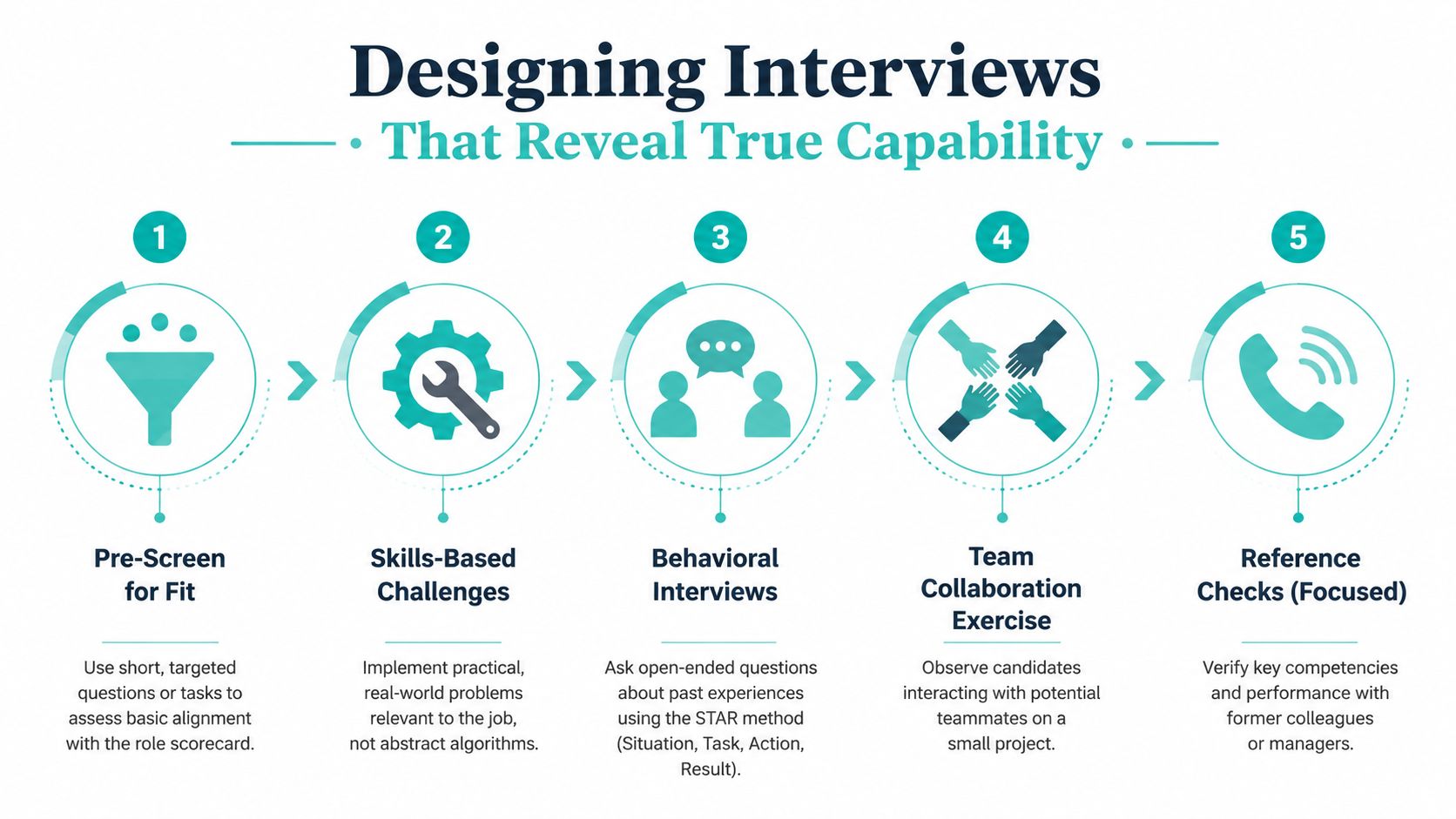
Use a short pre-screen tied directly to the scorecard. Then move into a work-sample that reflects the actual job, not a puzzle for the sake of it. For engineering roles, that means a realistic debugging or architecture task. For product roles, it means prioritization, customer reasoning, or a decision memo. For design, it means problem framing and critique, not decorative taste.
The next layer is behavioral depth. Ask open-ended questions about a difficult project, a missed expectation, or a time they changed course after new information came in. Listen for intellectual honesty. The best answers often sound like, “I don't know, but here's how I'd find out.” That kind of response shows learning agility, which matters more than polished certainty in fast-moving teams how to spot great talent.
Reference checks shouldn't be an afterthought. One practical approach is to tell candidates up front that they'll be responsible for arranging reference calls with former managers, then verify key claims in a brief manager conversation afterward top talent hiring guidance. That keeps the process grounded in evidence instead of polished self-description.
If you're training interviewers, give them a rubric tied to the scorecard and stop letting them freestyle. Hiring manager interview training is worth using internally because interviewers need a shared standard, not just better instincts.
Strong interviews don't uncover who speaks best, they uncover who can do the work with the least confusion later.
The practical payoff is consistency. When every interviewer is evaluating the same competencies, the team can compare candidates more cleanly and spot the difference between enthusiasm and readiness. That's how you reduce the odds of making a hire that looks good in the room and fails in the role.
Finding great people does not help if they walk away. Startups lose strong candidates when the process drags, the story is unclear, or the offer feels like an afterthought. Closing well takes the same discipline as sourcing well, a clear value proposition, a tight process, and a feedback loop that shows what is working.
Senior candidates rarely move for generic hype. They move for a combination of mission, scope, learning opportunity, and confidence that the team knows what it is doing. If compensation is below big-company levels, be direct about equity, growth path, and the problems they will own. Do not oversell stability if the startup is still in a building phase. Experienced candidates can spot that immediately.
Employer branding helps, but only when it reflects reality. Teams that publish real technical thinking, share what they are building, and talk plainly about trade-offs tend to attract more credible interest than teams that only post recruiting copy. That kind of visibility also creates passive pull over time, which matters when the best candidates are not actively applying.
The hiring system improves when you watch a few core metrics and ignore the noise. Pay attention to sourced-to-hire ratio, response rate by channel, stage-to-stage conversion, and time-to-hire by role. Those measures show where the funnel is leaking and whether a source is producing real hires or just busywork. The earlier recruiting benchmarks make the underlying constraint clear, there are lots of resumes, far fewer interviews, and not much time before the market moves on.
A simple review cadence helps:
Quality-of-hire is the only metric that matters if the process looks good but the team keeps missing.
The point is not to optimize every number at once. It is to know which lever is moving. If outreach is getting replies but interviews are weak, the message or target list is off. If interviews are strong but offers are being declined, the story or package needs work. If hires look good but ramp is slow, the scorecard was probably too loose.
A startup hiring system gets better when every search produces a little more evidence than the last one. That is the difference between random recruiting and a real capability engine.
If you want a more structured way to source vetted startup candidates without living in a resume pile, Underdog.io helps companies reach pre-vetted tech talent through a curated marketplace built for startup hiring. Visit Underdog.io if you want a pipeline that is designed around quality, speed, and signal instead of broad application volume.