Read Time: 7 min read
In the high-stakes world of tech and startup interviews, your qualifications, resume, and portfolio get you in the door. However, your nonverbal cues often determine whether you advance to the next round or receive an offer. Communication is far more than just the words you choose; research consistently shows that a significant majority of its impact comes from visual signals. This means your posture, gestures, and eye contact are telling a story about your confidence, credibility, and engagement long before you answer a single technical question.
This guide moves beyond generic advice like "sit up straight" and "make eye contact." We will provide a comprehensive roundup of eight actionable, nuanced strategies to help you master your body language during an interview. Each point is designed for immediate implementation, with specific examples tailored for in-person, remote, and technical role interviews. Mastering your non-verbal cues is especially critical when demonstrating your experience. For instance, your ability to project composure while detailing a complex project can be as impactful as the story itself. If you're preparing for those scenarios, it's also worth learning how to ace behavioral interviews by structuring your verbal responses effectively.
Whether you're a software engineer, product manager, or designer, these insights will help you project unwavering confidence, build genuine rapport with your interviewers, and silently communicate that you are the right cultural and professional fit. By consciously controlling these silent signals, you can turn a good interview into a great one, ensuring your perceived competence matches your actual expertise.
Your handshake is often the first, and sometimes only, physical point of contact in an interview. This simple gesture acts as a powerful non-verbal introduction, setting the stage for the entire conversation. It's a critical piece of your body language during an interview that communicates confidence, professionalism, and respect before you even say a word beyond "hello."
A well-executed handshake should be firm, but not bone-crushing. It conveys self-assurance and competence. Conversely, a limp or weak handshake can signal nervousness or a lack of conviction, while an overly aggressive grip can come across as domineering. In a startup or tech environment where collaboration and cultural fit are paramount, finding this balance is key to making an excellent first impression.

For technical roles, a confident handshake challenges the outdated stereotype of the socially awkward engineer. It immediately signals that you possess the soft skills necessary to collaborate with product managers, designers, and other stakeholders. Startup founders, in particular, often use this moment to gauge a candidate's energy and cultural alignment, seeing it as an indicator of how they might interact with clients or team members.
Follow these actionable steps to ensure your handshake is a positive part of your interview performance:
Pro-Tip for Remote Interviews: You can't shake hands through a screen, but you can create a similar effect. When your interviewer appears, look directly into the camera, smile warmly, and deliver a clear, confident greeting like, "Hi [Interviewer's Name], it's great to meet you." This digital "handshake" establishes a positive and professional tone from the start.
Beyond the initial handshake, your ability to maintain appropriate eye contact and demonstrate active listening is a continuous signal of your engagement and confidence. This combination of non-verbal cues shows the interviewer that you are present, processing information, and genuinely interested in the conversation. In the fast-paced, collaborative world of startups, this piece of your body language during an interview is critical for building rapport and conveying honesty.
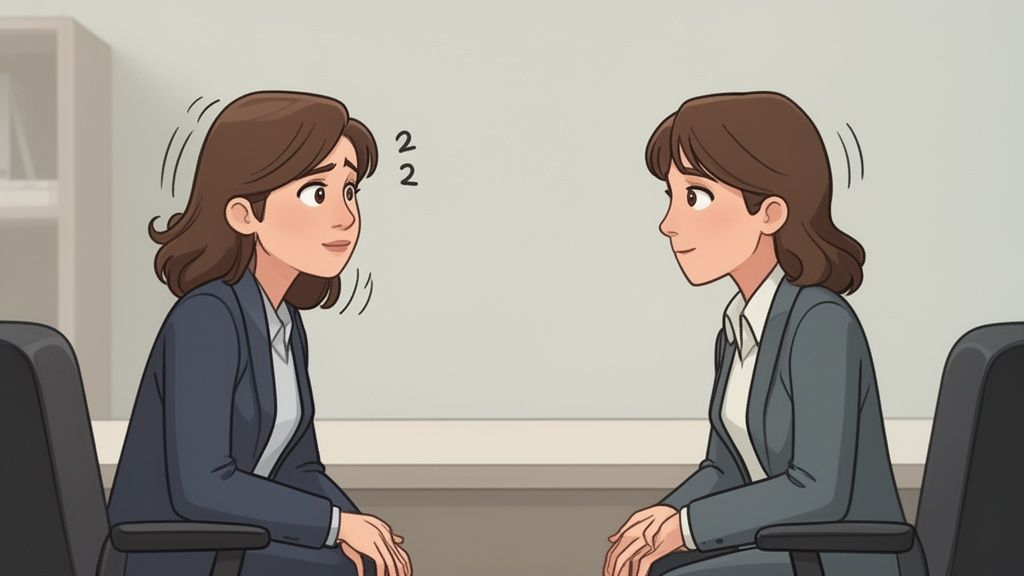
Effective eye contact is a delicate balance. Too little can suggest dishonesty or a lack of confidence, while too much can feel aggressive or unsettling. Paired with strategic nodding, it creates a powerful feedback loop, assuring the interviewer that their message is being received and understood. This non-verbal communication is a cornerstone of a successful interview dialogue.
In a startup environment, clear communication is everything. Hiring managers are not just assessing your technical skills; they are evaluating your ability to listen to feedback, understand complex requirements from a product manager, and collaborate effectively. Active listening signals that you are a receptive and thoughtful team member. For engineers, this can be particularly impactful when answering common engineer interview questions, as it shows you are fully processing the problem before diving into a solution.
Follow these actionable steps to project confidence and engagement throughout your interview:
Pro-Tip for Remote Interviews: Since non-verbal cues can be lost over video, make your active listening signals slightly more pronounced. A clear, intentional nod or a slight lean toward the camera when the interviewer is speaking shows you are locked in and engaged, even through a screen.
Beyond your handshake and eye contact, the way you hold your body throughout the interview sends constant, subtle messages about your confidence and engagement. Open posture involves keeping your body in a relaxed and receptive state, such as uncrossing your arms and legs. This element of your body language during an interview is critical for signaling that you are approachable, confident, and genuinely interested in the conversation.
Conversely, a closed posture, like crossed arms or a slouched-back position, can subconsciously project defensiveness, anxiety, or disinterest. In a fast-paced startup environment where collaboration is essential, demonstrating openness through your physical presence can be just as important as the answers you provide. It shows you're ready to engage and be part of a team.

For tech professionals, open posture helps build immediate rapport and communicates strong soft skills. A developer who leans forward when discussing a complex project with a product manager appears more collaborative than one who leans back with arms crossed. Startup founders often look for candidates who are not just technically skilled but also adaptable and enthusiastic, and your posture is a primary indicator of these traits. It suggests you're receptive to new ideas and feedback, a crucial quality in an agile work culture.
Use these actionable tips to project confidence and engagement through your posture:
Pro-Tip for Remote Interviews: On a video call, your "posture" is what's visible from the waist up. Sit up straight with your shoulders relaxed and back. Ensure you are centered in the frame and lean slightly toward the camera to convey engagement, mimicking the effect of leaning forward in person. Avoid swiveling in your chair, which can be distracting.
Your face is the most expressive part of your body, communicating volumes of information before you even articulate a thought. During an interview, controlled facial expressions and authentic smiles are critical components of your body language, conveying warmth, confidence, and trustworthiness. An authentic smile, known as a Duchenne smile involving both the mouth and eyes, builds an immediate connection and makes you more likable.
In the fast-paced startup world, where cultural fit and authentic presence are highly valued, your facial expressions must align with your words. A genuine, relaxed expression reinforces your credibility, while a forced grin or a stoic face can create distance and doubt. Mastering a positive baseline expression prevents you from appearing disengaged, overly anxious, or bored, ensuring your non-verbal cues support your professional narrative.
For product managers, designers, and engineers who collaborate constantly, facial expressions are a key part of effective communication. An approachable and engaged expression signals you are a cooperative team player. Startup founders often look for candidates who show genuine enthusiasm and resilience, qualities that are immediately reflected in a confident and authentic smile. Research from UC San Francisco has shown that genuine smiles increase the perception of trust, a crucial factor when a small team is deciding whether to bring on a new member.
Follow these actionable steps to ensure your facial expressions work in your favor:
Pro-Tip for Remote Interviews: Your face is the primary focus in a video call. Position your camera at eye level to simulate direct eye contact and ensure your lighting is bright and flattering. Practice on camera to see how your expressions are perceived, making sure you appear engaged and approachable rather than just a static image.
Strategic hand gestures are a powerful tool in your non-verbal arsenal, transforming your interview responses from simple statements into compelling narratives. Deliberate, purposeful movements enhance communication, underscore key points, and project an image of confidence and engagement. This aspect of body language during an interview is about making your hands an active, supportive part of your story, not a distracting sideshow.
Properly used, gestures make you appear more competent, dynamic, and connected to your subject matter. Keeping your hands visible and using them to illustrate concepts signals transparency and engagement. In contrast, fidgeting, wringing your hands, or keeping them hidden can be interpreted as nervousness or a lack of self-assurance. Finding the right balance shows you are both articulate and composed.
In a tech interview, you're often tasked with explaining complex systems, architectural decisions, or user flows. Thoughtful hand gestures can be invaluable for helping interviewers visualize these abstract concepts. Describing a system's architecture while using your hands to map out the flow of data makes your explanation clearer and more memorable. For a startup, this kind of animated yet controlled communication style signals you can effectively articulate ideas to both technical and non-technical stakeholders.
Follow these actionable steps to use your hands effectively and avoid common pitfalls:
Pro-Tip for Remote Interviews: Your hands are just as important on video. Before the interview, check your camera framing to ensure your upper body and hands are visible. Practice gesturing within this frame so your movements are seen and not awkwardly cut off, which can be distracting. This ensures your non-verbal communication remains effective even through a screen.
Mirroring is the subtle, often unconscious, act of matching another person's body language, speech patterns, or energy level. In an interview context, strategic mirroring is a powerful tool for building rapport and creating a sense of connection. This piece of your body language during an interview makes the interviewer feel understood and aligned with you, which can significantly influence their perception of your cultural fit.
When executed correctly, mirroring fosters a feeling of similarity and comfort, making the conversation flow more naturally. It's not about mimicry or being inauthentic; it's about finding a common non-verbal ground. This is especially crucial in startup interviews where personal chemistry and team dynamics are weighed heavily. Demonstrating that you can sync with your interviewer's communication style suggests you'll integrate well with the team.
In the tech world, collaboration is king. Hiring managers are looking for candidates who can not only code but can also communicate effectively with diverse teams. Research on "the chameleon effect" has shown that mirroring increases affiliation and liking. By subtly matching your interviewer's energy, you signal that you are adaptable and socially aware, key traits for anyone working in a fast-paced, collaborative startup environment. It helps you build a bridge of familiarity that can make your technical skills and experience even more impactful.
Follow these actionable steps to use mirroring effectively without appearing manipulative:
Pro-Tip for Remote Interviews: Mirroring works on video calls, too. Pay attention to the interviewer's head tilts, speaking speed, and level of formality. If they smile or nod frequently, reciprocate. Matching their vocal tone and pace helps bridge the digital divide and create a stronger personal connection, even through a screen.
Proxemics, the study of how we use space, is a subtle yet powerful aspect of non-verbal communication. In an interview setting, managing your physical distance from the interviewer demonstrates social awareness, respect, and professionalism. Maintaining an appropriate distance-typically around 2.5 to 3.5 feet in professional Western cultures-is crucial for ensuring the interviewer feels comfortable and receptive.
Getting this distance wrong can create an immediate, often subconscious, negative impression. Standing or sitting too close can be perceived as intrusive or aggressive, while too much distance can signal disinterest or excessive formality. This element of your body language during an interview is about creating a zone of comfort that allows for an engaged and professional exchange.
In the dynamic environment of a startup or tech company, where open-plan offices and collaborative spaces are the norm, your awareness of personal space is constantly being evaluated. Hiring managers are looking for candidates who can navigate these fluid social settings. Demonstrating good proxemic awareness shows you can respect personal boundaries while still being an engaged team player, a key trait for success in highly collaborative tech roles.
This is particularly important in cross-cultural interactions, as proxemic norms vary widely. A misinterpretation of space can be a source of unconscious bias, so showing you can read and adapt to the interviewer’s cues is a valuable soft skill that suggests strong emotional intelligence.
Follow these actionable steps to manage your personal space effectively and build rapport:
Pro-Tip for Remote Interviews: Proxemics still apply on video calls. Your "personal space" is defined by your camera frame. Sit centered with a clear, professional background. Avoid leaning too close to the camera, which can feel confrontational, or sitting so far back that you appear disconnected. A good rule of thumb is to have your head and upper shoulders fill the frame, creating a sense of presence without being overwhelming.
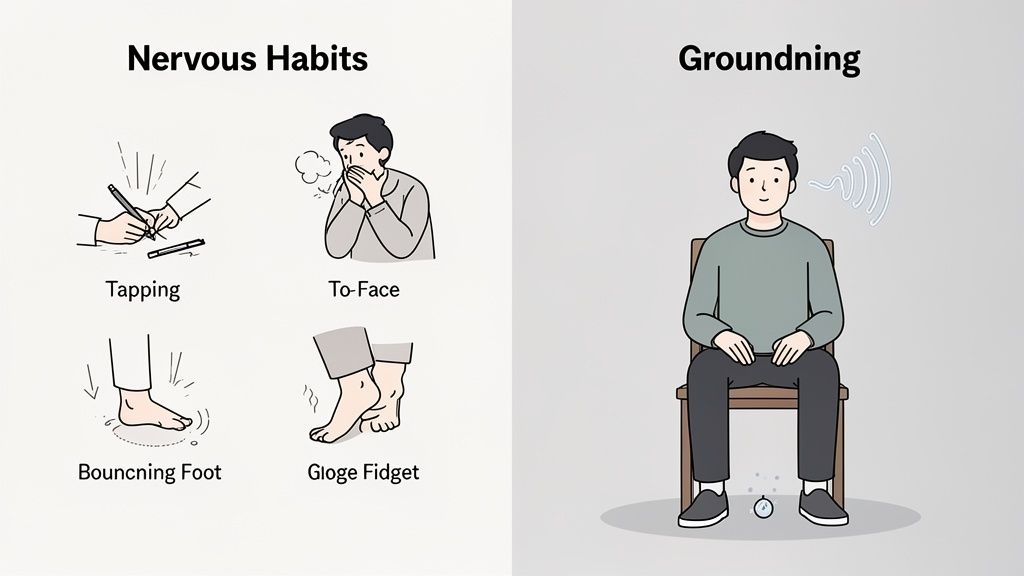
Nervous habits like bouncing your leg, tapping a pen, or touching your face are unconscious tells that signal anxiety and can undermine your credibility. These self-soothing behaviors, while natural, distract the interviewer from your message and can create a perception of low confidence or even dishonesty. Your expert answers and impressive qualifications can be overshadowed by these small, repetitive movements.
Controlling these habits is a crucial aspect of mastering your body language during an interview. It demonstrates high self-awareness and professionalism, qualities that are especially valued in high-stakes startup environments where founders are assessing emotional intelligence and cultural fit just as much as technical skills. By learning to ground yourself, you take control of your non-verbal narrative.
In a tech interview, especially for collaborative roles, visible anxiety can be misinterpreted as a lack of conviction in your technical solutions or an inability to handle pressure. A candidate who appears flustered may raise concerns about their ability to manage tight deadlines, handle critical feedback, or present to stakeholders. Effectively managing your nervous energy shows that you are composed and can perform well under stress, a daily reality in fast-paced startup cultures.
Follow these actionable steps to identify your nervous habits and use grounding techniques to remain composed:
Pro-Tip for Managing Anxiety: Remember that a moderate level of anxiety is normal and can even enhance performance. The goal is not to eliminate nerves but to channel that energy into focus. If you catch yourself fidgeting, don't panic. Simply pause, take a quiet breath, and consciously reset your posture and hand position. This small act of control reinforces your composure.
Mastering your body language during an interview is not about adopting a persona or memorizing a rigid script of movements. It’s about developing a deep sense of self-awareness and learning to consciously align your nonverbal communication with the professional expertise and genuine enthusiasm you already possess. The strategies we've explored, from the initial firm handshake to the subtle art of mirroring, are not isolated tricks; they are interconnected elements that form a cohesive, powerful narrative of competence and confidence.
Think of it as a toolkit rather than a checklist. Your goal isn't to perfectly execute every single tip in every interview. Instead, it's about understanding the principles behind them and applying them authentically. An open posture isn't just about uncrossing your arms; it's about projecting approachability. Deliberate hand gestures aren't about wild gesticulation; they're about adding conviction to your technical explanations. Active listening isn't just about nodding; it's about showing the interviewer that you are present, engaged, and genuinely processing their questions.
The true power of effective body language emerges when these actions become second nature, freeing up your mental energy to focus on what truly matters: articulating your value and solving the problems presented. To get there, you must move from passive knowledge to active practice.
Ultimately, your command of body language during an interview serves one primary purpose: to remove any unintentional friction between you and the hiring manager. When your nonverbal signals are confident, open, and engaged, you create an environment of trust. The interviewer can then focus entirely on the substance of your answers, your technical skills, and your cultural fit, without being subconsciously distracted by signals of nervousness, disinterest, or a lack of confidence.
This alignment ensures that your brilliant solution to a system design problem is received with the full weight of your conviction. It allows your passion for product development to shine through not just in your words, but in your engaged expression and posture. By making these behaviors a natural extension of your professional self, you ensure that every aspect of your presentation works in your favor, leaving a lasting impression that reinforces your qualifications and makes you a truly memorable candidate.
Your qualifications get you in the door, but your non-verbal cues often determine if you advance. Research shows a significant majority of communication's impact comes from visual signals. In startups, where cultural fit and collaboration are paramount, your posture, eye contact, and gestures tell a story about your confidence and engagement before you answer a single technical question.
To avoid an intense, uncomfortable stare, gently shift your gaze every few seconds between the interviewer's eyes and their mouth, forming a triangle. This makes your eye contact feel more natural and conversational, projecting confidence without aggression. For virtual interviews, simulate eye contact by looking directly at your camera lens, not at the interviewer's face on the screen.
Aim for firm, not bone-crushing pressure—match the pressure you receive. Ensure your grip is complete with the web of your hand meeting theirs. If you have sweaty palms, discreetly wipe your hand just before greeting. Always maintain eye contact and smile during the handshake. For remote interviews, create a "digital handshake" by looking into the camera and delivering a clear, warm greeting.
Open posture means keeping your arms and legs uncrossed, with your hands visible and relaxed. This signals you are approachable, confident, and receptive. A closed posture (crossed arms, slouching) subconsciously projects defensiveness or disinterest. In a video call, your posture is what's visible from the waist up—sit up straight, center yourself, and lean slightly toward the camera to show engagement.
An authentic "Duchenne" smile engages both your mouth and eyes. Before the interview, think of a genuinely pleasant memory—like solving a tough problem or receiving positive feedback. This naturally activates the muscles around your eyes, creating a warm, genuine expression. Establish a relaxed "resting interview face" by practicing a neutral-to-positive baseline expression in the mirror beforehand.
Use deliberate, purposeful gestures to emphasize key points and make your answers more compelling. Keep movements controlled and within your "gesture box" (from your chest to your waist). Avoid pointing directly at the interviewer, which can feel aggressive. In video calls, ensure your hands remain visible in the frame occasionally to add warmth and energy to your communication.
Distribute your gaze and posture evenly. When answering a question, start by looking at the person who asked it, then briefly make eye contact with each of the other interviewers as you speak. This includes everyone in the conversation and shows you value the entire team's perspective.
The most common and damaging mistake is a mismatch between verbal and non-verbal cues—like saying "I'm excited about this role" while slouching, avoiding eye contact, or speaking in a monotone. This disconnect erodes trust. Your body language must consistently reinforce your words to project authenticity and conviction.
Ready to put your polished interview skills to the test? Underdog.io connects ambitious tech talent with curated opportunities at top startups and tech companies, ensuring you spend your time in interviews that matter. Let your confident body language complement a world-class profile on Underdog.io.