Picture a software engineer who doesn't sit at a desk in the main office. Instead, they're embedded on-site with your most important clients, working directly inside the customer's technical environment to solve their gnarliest problems. That’s a forward deployed engineer. They aren't just writing code; they're part software engineer, part high-stakes consultant, and part technical diplomat, bridging the gap between a powerful product and a customer’s real-world setup.
In the world of complex enterprise software, especially in AI, the real work often begins after the contract is signed. That’s when a company's sophisticated platform collides with a customer's messy, unique, and often legacy-filled technical ecosystem. This is exactly where the forward deployed engineer proves to be a game-changer.
Think of them as the special forces of the engineering world. They have the deep technical chops of a senior software engineer but operate far from the comforts of HQ. Their "deployment" is directly with the customer, where they write code, debug integrations, and build custom solutions on the front lines to make sure a product actually delivers on its promise.
The soaring demand for FDEs isn't just a fleeting trend. It points to a major shift in how B2B software companies, particularly in the AI space, define success. Companies are quickly learning that for high-value enterprise clients, a one-size-fits-all product is almost never enough. Real success demands hands-on, expert intervention.
A forward deployed engineer is a software engineer who embeds directly with our customers to configure existing software platforms to solve their toughest problems. While a traditional software engineer focuses on creating a single capability for many customers, FDEs focus on enabling many capabilities for a single customer.
This hands-on approach is becoming a critical competitive edge. In fact, job postings for the forward deployed engineer role saw explosive growth, surging by more than 800% between January and September 2025. This incredible acceleration shows just how badly businesses need embedded technical experts to navigate complex AI adoption. You can dig deeper into this trend in this analysis on FDE growth.
Let's be clear: this is not a glorified support or sales engineering role. FDEs aren’t just fielding tickets or demoing features. Their work is deeply technical and strategic. It typically involves:
Ultimately, their mission is to own the technical success of a customer's implementation from start to finish. They ensure the client gets the outcomes they were promised and sees the maximum possible value from the product.
To really get what a forward deployed engineer does, it helps to see how they stack up against other tech roles you might already know. While titles can get a little fuzzy in the startup world, the day-to-day reality for an FDE is fundamentally different from their colleagues in software engineering, sales engineering, and solutions architecture.
Let's use an analogy: building a high-stakes, custom home for a crucial client. The Solutions Architect is the one who draws up the blueprints. They work from a distance, designing the high-level system to make sure the client's vision is technically feasible. They design the plan, but they aren't on-site pouring concrete.
The Sales Engineer is the one who sells the dream. They use polished demos and technical presentations to convince the client that the blueprint is the perfect fit for their needs. Once the contract is signed, their main job is done, and they move on to the next deal.
The forward deployed engineer is the master builder on the ground, living at the construction site. They take the architect’s blueprint and make it a reality, adapting it to the unique challenges of the land. They are the ones digging the foundation and framing the walls.
More importantly, they’re the ones who solve the inevitable, on-the-spot problems—like hitting bedrock where the plans showed soft soil or needing to reroute plumbing around an unforeseen obstacle. Their job isn’t just to build; it’s to make the client’s home work perfectly for them, which often means deviating from the original plans with creative, hands-on solutions.
The core difference is focus. A traditional software engineer builds a scalable feature for thousands of users. A sales engineer focuses on winning the deal. A solutions architect designs the high-level plan. An FDE, however, is laser-focused on delivering a successful outcome for a single, high-stakes customer.
This unique position requires FDEs to wear multiple hats, blending deep technical skills with strong client partnership and product feedback.
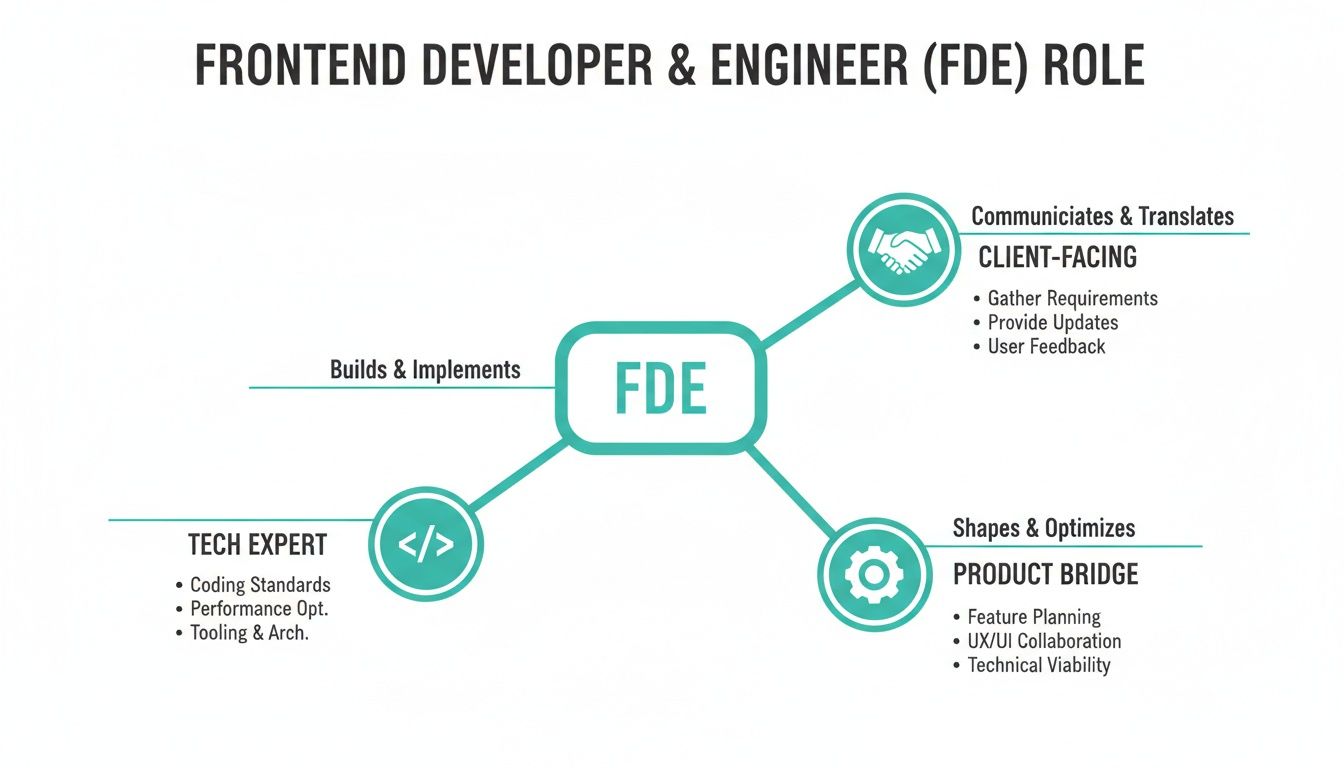
As the diagram shows, the role demands a unique balance of being a hands-on technical expert, a client-facing partner, and a critical bridge back to the product team.
To make these distinctions even more concrete, this table breaks down how these roles compare across key responsibilities and goals. It highlights the very different worlds these professionals operate in, even when working at the same company.
As the table shows, a software engineer’s success is measured by the quality of their code for thousands of users. In sharp contrast, an FDE’s success is tied directly to the tangible outcome they deliver for one specific customer.
They write code not for the entire user base, but to solve a single client's critical problem. This post-sale, outcome-driven focus is what truly sets them apart in the tech ecosystem.
Definitions are one thing, but to really get what a forward deployed engineer does, you need to see them in the wild. Let's walk through a typical day for an FDE—we'll call her Maya—as she jumps from high-level strategy to hands-on coding, all before EOD.
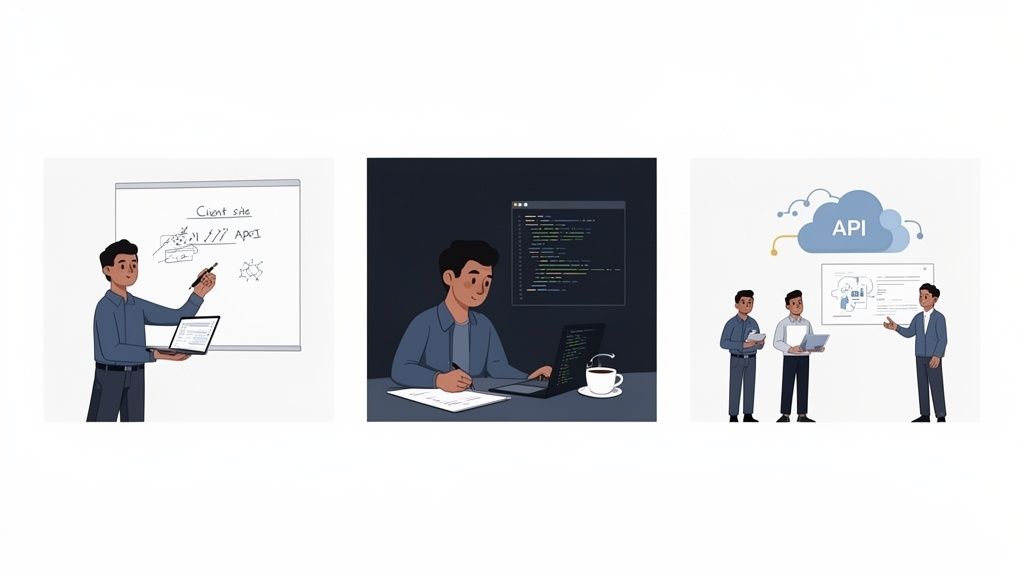
Her day doesn't start at HQ. It starts on a video call with a new enterprise client, a massive logistics firm. They just signed on to use her startup's AI-powered forecasting platform, but there's a problem. Their entire inventory system is a proprietary relic from another era, and it wasn't built to talk to modern cloud services.
Maya’s first job is to play technical detective. She spends the morning in a deep-dive discovery session with the client's IT team, asking sharp, probing questions. She's not just taking feature requests; she's digging for the real business problem they need to solve.
The client says they want "better inventory reports," but Maya knows that's just the surface. She maps out their tangled data flows and pinpoints the technical bottlenecks. It turns out their system can only spit out data in a bizarre, fixed-width text format once every 24 hours. This is the real blocker.
This diagnostic phase is crucial. An FDE doesn't just take orders; they partner with the customer to define the real problem. Success isn't about building what the client asks for, but delivering what they truly need.
After the call, Maya doesn’t just write a ticket for the product team and call it a day. She owns this problem. Her next move is to architect a solution that gets the client up and running—fast.
This is where the FDE switches hats from consultant to builder. Maya sketches out a plan: she'll write a custom Python script that runs on a lightweight server. The script will grab the client's daily data export, parse the ancient text file, transform it into clean JSON, and feed it straight into her company's API.
She spends the afternoon getting her hands dirty in the code, building this custom connector. This isn't some new feature that will get rolled into the core product. It's a bespoke piece of code, a technical bridge built for one specific customer to get them across the implementation finish line. This is the "deployment" in action.
While building, she hits a snag. The client’s data has an undocumented quirk that makes her script fail. So, she methodically debugs the issue, adding robust error handling and logging to make the integration more resilient.
By late afternoon, Maya has a working prototype. She quickly schedules a follow-up with the client to demo her progress, showing tangible results in less than a day and earning a huge amount of trust.
But her work isn't done. Maya knows that while her script solves the immediate problem, this client's struggle points to a bigger product gap. Other logistics customers probably have similar legacy system headaches.
She documents her findings and the workaround, then shares this critical insight with the product management team. She proposes they consider building a more generalized "legacy data importer" in a future release. In that moment, she becomes the voice of the customer, turning a one-off field solution into strategic feedback that can make the product better for everyone.
By the end of her day, Maya has been a consultant, architect, developer, and product strategist. She managed expectations, wrote and debugged code, and translated a customer’s real-world pain into a product opportunity. This unique blend of skills, all focused on making a customer successful, is the essence of the forward deployed engineer.
If this dynamic mix of problem-solving and coding appeals to you, you can explore current forward deployed engineer jobs on Underdog.io to see what opportunities are out there.
Excelling as a forward deployed engineer isn't just about being a great coder or a smooth talker. It’s about being both, often in the same meeting. The role demands a rare blend of deep technical chops and sophisticated people skills, making it one of the most unique positions in tech.
You have to be a translator, a builder, and a problem-solver all at once. You’ll diagnose a client's vague business problem, architect a technical solution on the spot, and then go build it yourself.
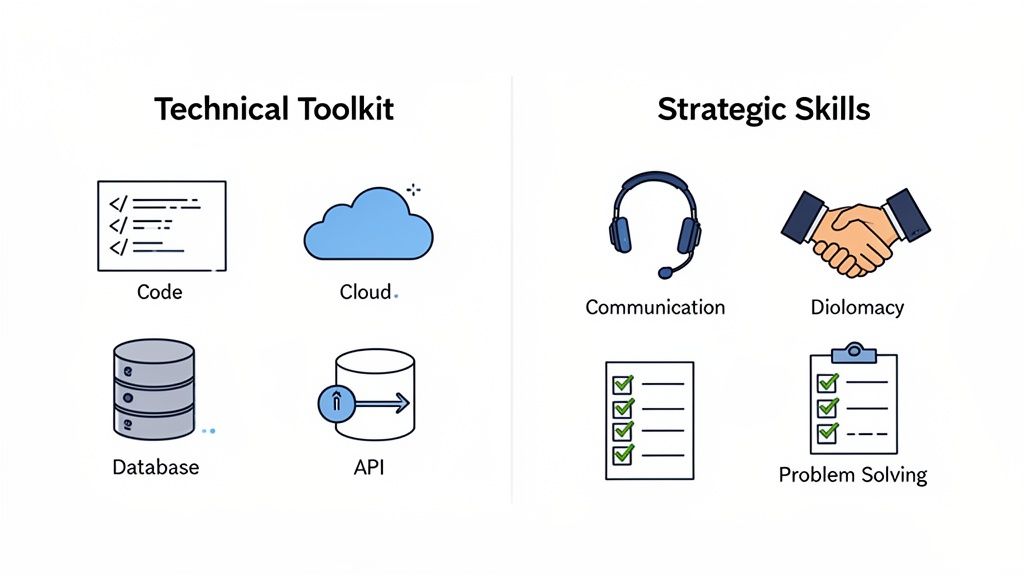
We can break these skills down into two core buckets: the technical toolkit you use to build things and the strategic skills you use to navigate tricky customer relationships. Mastering both is what separates a good FDE from a truly exceptional one.
At its heart, the FDE is an engineering role. You’ll spend a huge chunk of your time with your hands on the keyboard, writing code that directly solves customer problems. These core technical skills are absolutely non-negotiable.
For FDEs who spend most of their time working with cloud solutions, an AWS Solutions Architect certification can be a great way to validate their ability to design and build complex cloud architectures—a key part of the job.
Technical chops alone won't get you very far. The "forward deployed" part of the title means you are the face of the engineering team to the customer. This requires a completely different set of muscles to manage that relationship effectively.
The best FDEs blend technical ability with ownership and empathy. What matters most isn't technical perfection—it's drive, communication, and the will to solve customer problems end-to-end.
This means you’re not just a technician. You have to be a partner, a consultant, and a trusted guide for your customer.
Key Strategic Skills Include:
Ultimately, the most successful FDEs are those who can switch between these two modes effortlessly. They can spend the morning writing a Python script to parse a gnarly data file and the afternoon leading a delicate negotiation about project scope.
When you blend deep technical chops with high-stakes client management, you get a role that commands a premium salary. Compensation for a forward deployed engineer reflects this strategic value, often packaging a strong base salary with bonuses and that all-important startup equity.
The financial rewards are often much better than for other customer-facing technical roles. In fact, data shows forward deployed engineers typically pull in 16.2% more than Technical Account Managers and a hefty 23.7% more than Customer Support Engineers. If you want to see the full financial breakdown, you should check out our 2025 Tech Salary Guide.
While FDEs earn a premium, their compensation can track slightly lower than a pure software engineer—about 9.2% on average—who is heads-down on core product development. Geographically, these roles tend to cluster in major business and government hubs. You'll find 35% in New York, 11% in San Francisco, and another 9% in Washington, D.C. You can discover more insights about these FDE compensation trends to see how the market is shifting.
Of course, the rise of remote work has blown the doors open, making FDE positions accessible to talented engineers everywhere. This has been a huge shift, reducing the need for constant travel or relocation that was once a given for the role.
Here’s the thing: the salary is great, but the long-term career trajectory an FDE role unlocks might be even more valuable. This isn't just a job; it’s a career accelerator. By living at the intersection of product, engineering, and the customer, FDEs get a ground-level view of real market needs you just can't find anywhere else.
A forward deployed engineer isn't just solving a single customer's problem. They're gathering market intelligence, identifying product gaps, and seeing firsthand what it takes to win and retain high-value accounts. This experience is career gold.
This unique vantage point makes the FDE role an incredible launchpad into senior leadership. The skills you gain are directly transferable to some of the most impactful career paths in tech.
Common Career Paths After Excelling as an FDE:
Ultimately, the role gives you a holistic business perspective that’s incredibly hard to get in a traditional software engineering job. You don’t just learn how to build something; you learn why you’re building it and how it creates tangible value. That combination of technical expertise and business acumen makes former FDEs some of the most sought-after leaders in the industry.
Landing a job as a forward deployed engineer isn't like applying for a standard software engineering role. You have to prove you can do more than just write clean code; you need to show you can build relationships, solve messy customer problems, and act as a technical translator. This is a role that demands a unique blend of hands-on coding and customer-facing finesse.
So, how do you prove you’ve got that unique mix? Let’s break it down.
You don't need the "Forward Deployed Engineer" title on your resume to get noticed. What you need are experiences where you’ve acted like one. Think back to any project where you used your technical skills to directly solve a problem for a customer or an internal stakeholder.
Your job is to frame your accomplishments around customer impact. Instead of just saying you "built a data processing script," give it context. Try something like, "developed a Python script that automated a key client's manual data entry, saving them 10 hours per week and ensuring a successful product renewal." One version is about code; the other is about solving a business problem.
Your resume should tell a story of problem-solving. Highlight moments where you were handed a messy, real-world issue and used your technical skills to build a bridge between the product and the person using it.
For a deeper dive into crafting a standout technical resume, check out our complete guide on how to get a software engineering job.
The FDE interview is a hybrid, designed to test both your technical chops and your communication skills under pressure. You won’t just be whiteboarding algorithms. Expect a multi-stage process that’s much more dynamic.
Not every company that posts an FDE job truly gets what the role is about. The questions you ask are just as important as the answers you give because they help you vet the opportunity. You need to figure out if the company has a mature, strategic vision for this function.
Try asking questions like these:
The answers will tell you if the role is a strategic engineering position or just a glorified support job in disguise. And to succeed, it’s not just about what you know, but who knows you—it's critical to build an online presence that showcases your unique project experience.
It’s impossible to talk about this role without mentioning Palantir Technologies. They were instrumental in defining this career path and remain a huge force in the talent market, employing roughly 50% of all FDEs in the United States. In fact, until 2016, the company employed more FDEs than traditional software engineers, which shows just how vital the role has been to their model from day one.
It's a unique role, so it’s no surprise that a lot of questions pop up. Let's clear up a few of the most common ones to give you the final pieces of the puzzle.
There's no single answer here—it really runs the gamut. Some FDE roles are pure road-warrior gigs, especially at companies serving government or high-security clients. In those cases, you could be looking at travel up to 50-80% of the time, with long stretches spent physically on-site.
But the tide is definitely turning. Many modern tech companies and startups are building remote-first or hybrid FDE teams. In these roles, you’ll rely heavily on virtual tools, and travel might just be for a few strategic visits, like project kick-offs or critical troubleshooting sessions. This is something you absolutely have to get crystal clear on during the interview process.
Yes, it's definitely possible, but it depends on the company's maturity. Some big names with well-oiled FDE programs, like Palantir and Addepar, are known for hiring sharp computer science grads right out of school. They’ve built robust training and mentorship programs to ramp up new talent.
On the flip side, many companies prefer to see a few years of software engineering experience under your belt. They’re looking for someone who has already built a solid technical foundation and has had at least some exposure to client-facing work, even if it wasn't a formal part of their title.
The biggest challenge for an FDE is often the intense context-switching. You must simultaneously act as a deep technical expert for the customer, a product advocate for your internal teams, and a project manager for the entire deployment. Balancing these competing demands under pressure requires exceptional organizational and communication skills.
No, this is a critical distinction. An FDE is fundamentally a post-sales technical role. Their job isn't about closing a deal or hitting a quota; their work kicks off after the contract is signed.
Their entire focus is on making sure the customer succeeds with the product they’ve already bought. Success isn't measured in commission checks—it's measured in customer satisfaction, successful implementation, and long-term product adoption. They are engineers first, and their goal is to deliver a technical victory for the client.
The real difficulty is in juggling the different hats you have to wear. One minute, you could be deep in the weeds, debugging a tricky API integration. The next, you're on a call with a C-level executive, explaining a project delay in plain English, without all the technical jargon.
You're the translator, the bridge between the customer’s world and your engineering team's world. This constant mental shift—from hands-on coder to strategic consultant to relationship manager—is what makes the job so demanding. It takes a rare mix of deep technical skill, emotional intelligence, and an unwavering sense of ownership over the customer’s success.
A forward deployed engineer is a software engineer who embeds directly with a company's enterprise customers to configure, integrate, and customize the product within the client's specific technical environment. Rather than building features for the entire user base, a forward deployed engineer focuses on making the product work successfully for a single, high-value customer. The role sits at the intersection of software engineering, technical consulting, and customer success, and is especially common at AI, data, and enterprise SaaS companies.
A traditional software engineer builds scalable product features intended for a broad user base, with minimal direct customer contact. A forward deployed engineer writes code too, but the purpose is different — they build custom scripts, integrations, and workarounds for a specific client's unique technical environment. Where a software engineer's success is measured by code quality and broad adoption, a forward deployed engineer's success is measured by a single customer's outcome: whether they successfully adopted the product, whether it solved their business problem, and whether they renew.
A sales engineer operates primarily before the contract is signed — their job is to run demos, answer technical questions during the sales cycle, and help close deals. Once the contract is signed, they typically hand off to another team. A forward deployed engineer takes over after the sale and owns the technical implementation from that point forward. Their goal isn't to win business; it's to make the business already won a success. The two roles are complementary but serve entirely different stages of the customer lifecycle.
The role requires a combination of strong software engineering fundamentals and client-facing communication skills. On the technical side, proficiency in Python or another scripting language, hands-on experience with APIs and system integrations, and comfort working in cloud environments like AWS or GCP are common requirements. On the softer side, the ability to diagnose vague business problems, communicate technical concepts to non-technical stakeholders, manage project timelines under pressure, and maintain composure in high-stakes customer situations are equally important. The rarest and most valued skill is the ability to switch between these two modes fluidly.
No two days look exactly the same, but a typical day might include a discovery call with a client's IT team to understand a technical blocker, an afternoon writing and debugging a custom integration script, a check-in with the internal product team to relay customer feedback, and a client-facing update call to demo progress. The role demands constant context-switching — from deep technical problem-solving to relationship management to strategic product feedback — often within the same few hours.
Forward deployed engineers typically earn more than other customer-facing technical roles. Data shows they earn around 16 percent more than technical account managers and roughly 24 percent more than customer support engineers. Compensation tracks slightly below pure software engineers — about 9 percent on average — given that the role blends engineering with client-facing work. Geographically, the highest concentrations of forward deployed engineer roles are in New York City, San Francisco, and Washington D.C., though remote positions have grown significantly.
It's widely considered one of the best career accelerators in tech. Because forward deployed engineers sit at the intersection of product, engineering, and the customer, they develop a rare combination of technical depth and business intuition. This makes them natural candidates for product management, engineering leadership, and entrepreneurship. Many former forward deployed engineers go on to found startups, having seen firsthand which product gaps represent real market opportunities and what it actually takes to deliver value to enterprise customers.
Yes, though it depends on the company. Organizations like Palantir and Addepar have established programs specifically designed to bring in strong computer science graduates and train them for the forward deployed engineer role from the ground up. At smaller or earlier-stage startups, companies often prefer candidates with a few years of software engineering or technical consulting experience already under their belt. If you're a new graduate interested in the role, targeting companies with known rotational or early-career FDE programs is the most direct path in.
It varies widely. Some roles — particularly those serving government or high-security enterprise clients — involve heavy travel, sometimes 50 to 80 percent of the time, with extended on-site engagements. Many modern tech startups, however, have built remote-first or hybrid FDE teams where travel is reserved for key moments like project kick-offs or critical troubleshooting sessions. Travel expectations are one of the most important things to clarify during the interview process, as they vary dramatically from company to company.
No. This is a common misconception. A forward deployed engineer is a post-sales technical role — their work begins after the contract is already signed. They don't carry a quota, and their performance isn't measured in deals closed. Their entire focus is on technical implementation, product adoption, and customer success. They are engineers whose mission is to deliver a successful outcome for the customer, not to sell them anything additional.
Finding the right startup where you can thrive as a forward deployed engineer can be tough. Underdog.io makes it simple by connecting you with hundreds of vetted, high-growth companies looking for talent just like you. Create one profile and let the best startup roles find you. Explore your next opportunity on Underdog.io.