Let's get right to the numbers you care about. A senior data analyst salary in 2026 is a serious topic, and for good reason. The demand for analysts who can do more than just build dashboards is through the roof.
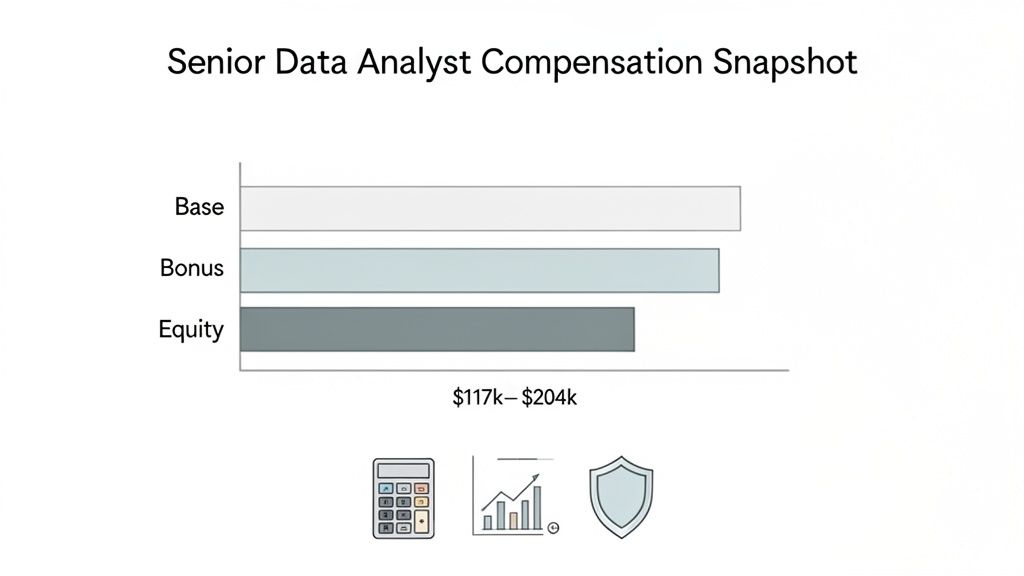
Most experienced analysts are seeing total compensation packages between $117,000 and $204,000 annually. This reflects a major shift in the industry: senior data analysts are no longer just report-builders; they’re core strategists who translate raw data into business wins.
As more companies finally figure out how to use their data effectively, the value of a sharp analyst has skyrocketed. Your compensation is a direct reflection of that importance.
But to truly know your market value, you have to look past the base salary. An offer is a package deal, and in the tech world, that almost always includes performance bonuses and some form of equity.
To accurately size up any offer, you need to understand how each piece works. Think of it as three distinct levers that determine your total earnings.
Here are the core components you’ll see:
To give you a clearer picture, we've compiled data from verified salary profiles for senior data analysts across the US.
This table breaks down the typical compensation tiers you'll encounter. While the base salary is your reliable foundation, the bonus and equity components are where top earners can really pull ahead.
While most senior data analysts see total earnings between $117,000 and $204,000, the data shows that the top 10% of earners are consistently breaking the $204,000 mark, with some reaching as high as $305,000 when you factor in high-value equity grants and performance bonuses. This guide will give you the intel needed to push your own compensation into that top bracket.
Of course, knowing the numbers is only half the battle. You have to know how to research them for your specific situation. A great starting point is learning how to do your homework with a solid market salary research guide.
Digging into over 800 verified professional profiles reveals some interesting trends. For example, compensation can vary by gender, with male senior data analysts averaging $144,000, female analysts averaging $131,000, and non-binary professionals averaging $123,000. You can explore more of these compensation trends and get deeper insights from verified salary data on 6figr.com.
While your skills are the engine driving your career, your zip code can feel like the road you're driving on—and some roads are paved with a lot more gold. For a senior data analyst, location has a massive impact on your paycheck, often creating salary swings of tens of thousands of dollars for the exact same job.
It’s all about supply and demand. Companies in major tech hubs are in a constant battle for talent, competing against hundreds of other well-funded firms. To attract and keep top analysts, they simply have to pay a premium.
Major metropolitan areas, especially established tech and finance centers, consistently offer higher pay. And we’re not talking about a slight bump. It’s a significant leap that can reshape your financial picture.
This concentration of large companies, venture-backed startups, and specialized industries creates a high-stakes bidding war for your expertise. Take New York City—the density of finance, media, and tech companies all vying for top-tier analytical talent forces salaries upward. This premium isn’t just to cover a higher cost of living; it reflects the immense value data analysts bring to these hyper-competitive markets.
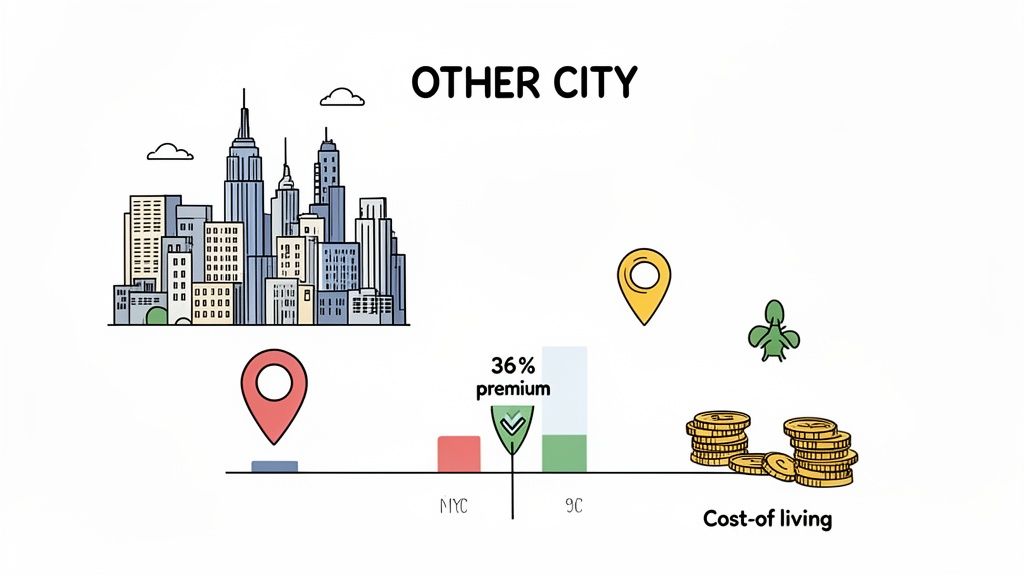
A global salary analysis confirms this, showing that while a US-based senior analyst with 5-7 years of experience earns around $102,816, certain cities pay a remarkable premium. An offer in New York can top the national midpoint by 36.5%, while San Francisco offers a 35% premium and Denver a 20% boost. You can dig into more details about these geographic differences in this in-depth salary report on DataCamp.
To see how this plays out in the real world, let’s look at a few examples. An analyst in a smaller city might get a strong offer of $120,000. But for the exact same skills and responsibilities, a company in San Francisco might have to offer $160,000 or more just to stay in the game.
Here’s a quick look at the salary premiums you can expect in major US hubs:
It's crucial to evaluate an offer in the context of its location. A $130,000 salary in Austin, Texas, might provide a higher quality of life than a $150,000 salary in San Francisco, once housing and taxes are factored in.
The explosion of remote work has added a new, complex layer to the salary equation. While companies are no longer limited to local talent, they’ve created an evolving set of rules for remote pay. Some companies have adopted a location-agnostic salary, paying the same no matter where you live.
Many others, however, use a tiered approach that adjusts salaries based on the cost of living in your area. For example, a New York-based company might offer three different salary bands for the same remote role:
This is a critical factor to clarify during negotiations. Understanding a company's remote compensation philosophy is just as important as knowing the base salary, as it directly shapes your long-term earning potential if you ever decide to relocate.
Not all senior data analyst offers are created equal. Far from it. The company you join—whether it's a scrappy seed-stage startup or a household tech name—dramatically changes how you get paid.
This isn't just a simple choice between office perks. It’s a fundamental decision about your financial future. Are you looking for predictable, high cash flow right now, or are you willing to trade some of that certainty for a shot at a much bigger, future payday?
To see how this plays out in the real world, let's walk through three common scenarios for a senior data analyst.
First up is Alex, who just landed an offer from a massive public tech company. On the surface, the numbers are fantastic: a $165,000 base salary, a target annual bonus of 15% (that’s $24,750), and $100,000 in Restricted Stock Units (RSUs) that vest over four years.
This kind of offer is all about predictability. Alex gets a huge, reliable paycheck and a bonus that’s tied to clear performance metrics. Because the RSUs are shares of a public company, their value is liquid and easy to track. This path is built for someone who prioritizes high immediate income and low financial risk.
Next, we have Jordan, who's joining a well-known Series C tech firm. It’s not public yet, but it’s a major player in its industry. Jordan’s offer features a very competitive $150,000 base salary and a slightly smaller performance bonus of 10% ($15,000).
But here’s where things get interesting: the equity. Instead of RSUs, Jordan receives stock options for 20,000 shares with a low exercise price. Right now, those options are just paper value. But if the company has a successful IPO or gets acquired, that equity could dwarf the RSU grant from the big tech offer. This is the balanced path—a strong salary for today with a real stake in the company’s future upside.
Finally, there’s Casey. They're taking a leap of faith and joining a 15-person, seed-stage startup. The offer comes with a lower base salary of $130,000 and no guaranteed bonus to start. The trade-off? A significant grant of stock options that represents 0.15% of the entire company.
This is the classic high-risk, high-reward play. The salary is more than enough to live on, but the equity is the real prize. If this tiny startup becomes the next industry titan, Casey’s 0.15% stake could be life-changing, potentially turning into millions. Of course, if the startup fizzles out, that equity is worth nothing.
Making this kind of bet requires a solid understanding of how equity works. To get a handle on what to look for, you need to understand the startup equity basics for job seekers.
The core decision comes down to your personal risk tolerance. Choosing between these paths requires you to evaluate not just the base salary, but the entire compensation philosophy and how it aligns with your long-term financial goals.
To make these differences even clearer, here’s a table breaking down how compensation philosophy shifts with company size.
This table offers a comparative look at how different company stages approach senior data analyst compensation, highlighting the trade-offs between base pay, bonus, and equity.
Ultimately, there’s no single “best” path. The right choice depends entirely on your personal financial strategy and how much risk you’re willing to stomach for a potential windfall.
It’s not just about the years you’ve put in. Climbing the salary ladder is really about the value you can create. While experience certainly matters, your final paycheck as a senior data analyst comes down to the specific skills you bring to the table. Mastering the right tools and business skills is what turns you from a good analyst into an indispensable strategic partner.
Think of it like this: anyone can get a job done with a basic toolkit. But when you have advanced SQL, Python, and powerful visualization software in your arsenal, you can build things that are far more complex and valuable. That’s why companies are more than willing to pay a premium for analysts who can deliver more than just a simple report.
To be a top earner, some technical skills are simply non-negotiable. These are the tools that let you tackle complex data challenges on your own and deliver insights that truly move the needle.
SELECT * FROM queries. Mastery means writing complex joins, subqueries, and window functions to pull exactly what you need from massive databases, and doing it efficiently.The chart below breaks down how different types of companies weigh these skills, which you can see reflected in their typical compensation packages.
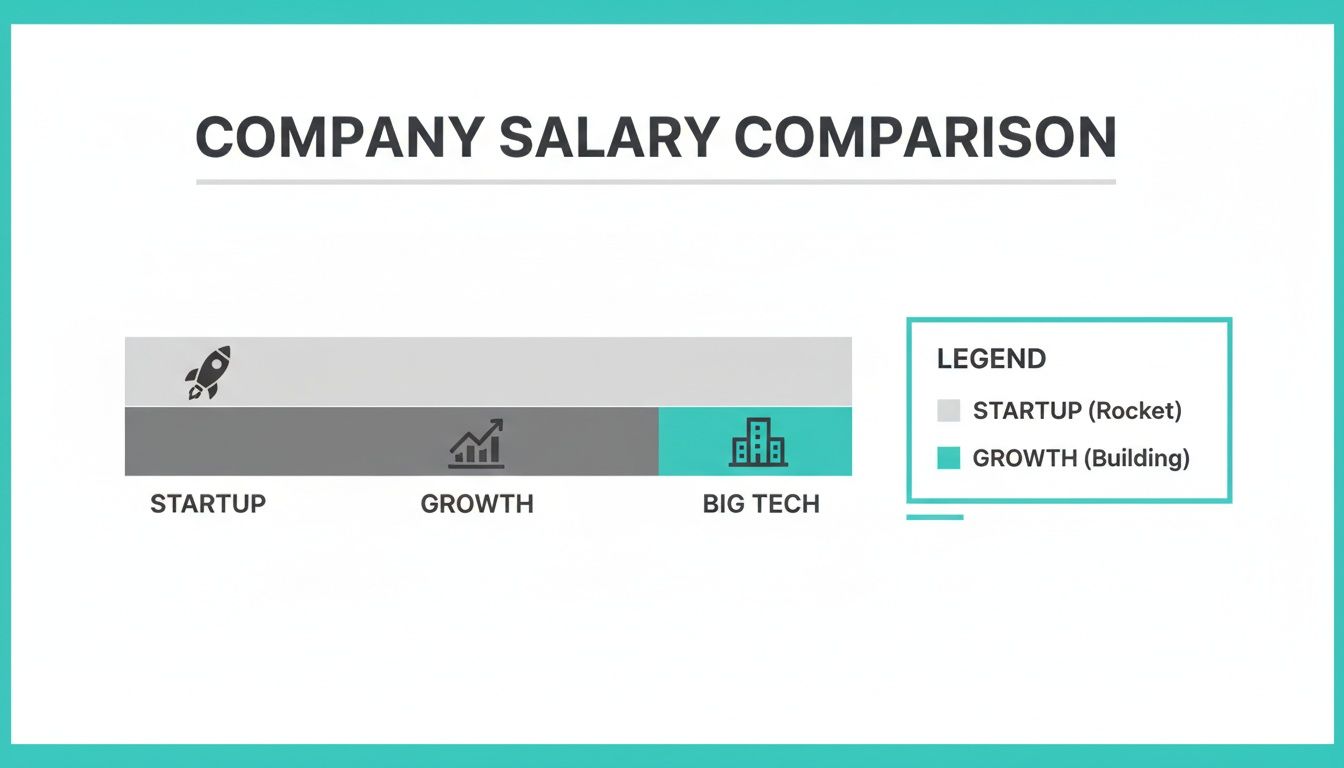
As you can see, compensation strategies vary wildly—from high-equity startup offers to the cash-heavy packages you'll find at big tech firms.
The salary path for a senior data analyst really shows the premium companies place on deep experience and specialized skills. As you advance, your earning potential grows substantially, especially if you move into leadership or more specialized technical roles. For example, an analytics manager can make an average of $131,202, while a director of analytics commands $184,828. Moving into an adjacent role like a data engineer can push that even higher, with some earning $233,999. You can dig into more salary data on this progression by reviewing this comprehensive data analyst salary guide on Coursera.
A senior analyst who can not only pull data but also use Python to forecast next quarter’s customer churn is exponentially more valuable than one who only builds historical reports. This is the difference between reporting the past and shaping the future.
Your technical skills might get you in the door, but it’s the soft skills that truly unlock senior-level salaries and leadership opportunities. They act as the bridge between your technical work and its real-world business impact.
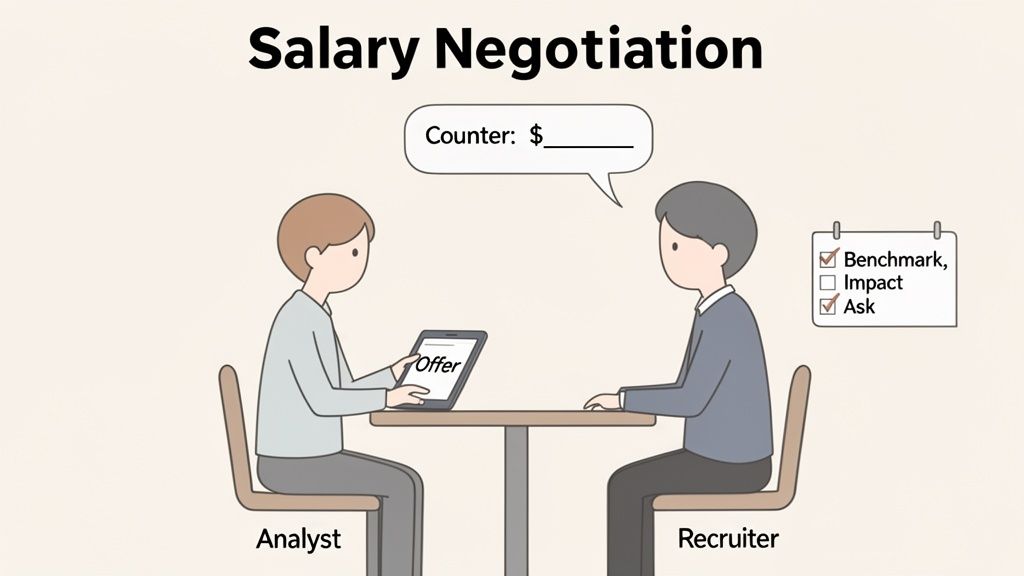
Getting that job offer feels like crossing the finish line, but it’s really the start of your final—and most important—conversation. This is your moment to make sure the compensation on the table truly reflects the value you bring. Forget generic advice; negotiating a senior data analyst salary demands a data-driven approach.
Here’s the thing: that initial offer is almost never the company’s best and final. Most hiring managers expect you to counter. They have a pre-approved range they can work with, and your goal is to confidently and professionally guide the conversation toward the top of it.
Before you even think about firing off a response, you need to arm yourself with data. A knee-jerk reaction can leave thousands of dollars on the table. Instead, take a breath and build your case.
This really boils down to three key actions:
Having this information ready transforms the negotiation from an emotional plea into a business discussion based on facts.
Now it’s time to build your narrative. When you present your counteroffer, it shouldn’t sound like you're just asking for more money. It should be a logical argument that directly connects your requested salary to the value you’ll create for them.
So instead of saying, "I'd like more," frame it around your proven impact.
Example Script:
"Thank you so much for the offer! I'm incredibly excited about the opportunity to join the team and tackle the customer analytics challenges we discussed. Based on my research into the market rate for a senior analyst with my expertise in Python and predictive modeling, I was targeting a base salary closer to $155,000. In my previous role, I developed a customer churn model that led to a 10% reduction in attrition, and I'm confident I can bring similar value to your team."
This approach anchors your request to your past performance and future potential, making it much harder to dismiss. You're not just asking for more; you're justifying it with evidence.
A good negotiation is rarely a one-and-done email. It's a conversation that might involve several moving parts of your compensation package. Be ready to discuss more than just the base salary, especially when interviewing for startup roles where equity is a major factor.
Here are a few tips for navigating this stage:
Mastering this process is a critical skill for any professional. To dive deeper, plenty of resources can teach you How to Negotiate Salary After a Job Offer. You can also explore our own guide on how to effectively counter a job offer for more specific scripts and strategies.
Okay, you’ve done the research. You have a solid grasp of your market value, and now it’s time to find a company that actually gets it. Your job search shouldn't be a numbers game where you just spray and pray. It needs to be a focused, strategic mission.
Instead of casting a wide net and hoping for the best, you can now target the specific kinds of companies that align with what you want, both in salary and in your career. Think of this guide as your launchpad—you know that location, company size, and your unique skills are the biggest levers you can pull to boost your pay. The trick is putting that knowledge into action.
First things first: filter your search based on the compensation models we've talked about. Do you want the rock-solid stability and higher base salary that comes with a big tech firm? Or are you more interested in the high-risk, high-reward equity package from an early-stage startup? Just answering that one question will instantly shrink your search to a manageable size.
For example, if a base salary of $160,000 is your top priority, you should be looking at large, public tech companies or well-funded, late-stage startups. On the other hand, if you’re chasing a life-changing equity payout, you can focus on seed or Series A companies where your work will have a massive impact. If that sounds like you, check out our guide on how to find a startup job to learn how to spot those opportunities.
This approach saves a ton of time and makes sure you're only spending energy on roles that meet your financial goals right from the get-go.
High-growth companies are where your skills can create incredible value, and they’re usually the places most willing to pay for it. These firms are scaling fast, which means they have urgent, complicated problems that desperately need data-driven answers. They’ll often pay a premium for a senior analyst who can step in and provide immediate strategic direction.
Keep an eye out for these signals of high growth:
By turning your understanding of the senior data analyst salary landscape into a focused job search strategy, you move from a reactive candidate to a proactive career architect. You are now equipped to identify and pursue roles that don’t just pay well but also align perfectly with your long-term ambitions.
Your knowledge is your power. Use it to cut through the noise and zero in on the employers who will value your expertise and pay you what you're worth.
It's natural to have a lot of questions when you're figuring out your market value as a senior data analyst. The details around salary, equity, and career paths can get complicated, especially when you're weighing different options.
Let's clear up a few of the most common questions we see.
There's no single answer here, as remote pay philosophies vary wildly. Some companies pay a single, high salary benchmarked to a top-tier market like San Francisco, no matter where you live. This is the ideal, but it’s not the norm.
More often, you'll find companies that adjust your pay based on the cost of living in your specific location. This creates different pay bands for the same role. The best advice? Ask about their remote compensation policy on the very first call to make sure your expectations are aligned.
For a senior analyst role at a Series A startup, a typical equity grant falls in the 0.05% to 0.20% range. This number isn't pulled out of thin air—it’s heavily influenced by the company's current valuation, how much funding they've raised, and how the rest of your compensation package is structured.
Just remember that a higher equity offer usually comes with a lower base salary.
Choosing between a higher base and more equity is a deeply personal financial decision. A bigger salary offers guaranteed income right now, while a larger equity stake is a high-risk, high-reward bet on the company’s future success.
The typical path to a senior data analyst title takes about 4-7 years. But that timeline isn't set in stone.
What truly matters is your impact, not just the years you've put in. Analysts who quickly learn to connect their work to strategic business decisions and prove their value tend to get promoted much faster than those who just punch the clock.
Most senior data analysts in 2026 see total compensation packages between $117,000 and $204,000 annually. The average tier sits in the $117,000 to $145,000 base salary range, while the top 25% earn between $145,000 and $170,000. The top 10% of earners — particularly those at large tech companies or well-funded startups with strong equity grants — can reach $204,000 or well beyond when bonuses and stock are included.
The three biggest levers are location, company stage, and technical skill set. A senior analyst in New York City or San Francisco can earn 35 to 36 percent more than the national average for the same role. Company stage affects the mix of cash versus equity — large public companies offer higher base salaries and structured bonuses, while startups trade lower base pay for potentially significant equity upside. On the skills side, proficiency in Python, advanced SQL, and business intelligence tools like Tableau or Power BI consistently commands higher pay than analysts working in SQL alone.
Location can swing a senior data analyst's annual salary by tens of thousands of dollars. New York City offers a premium of roughly 36 percent above the national midpoint, San Francisco sits at around 35 percent, Seattle at 29 percent, and Denver at 20 percent. Remote roles complicate this further — some companies pay a single market-rate salary regardless of where you live, while others apply tiered pay bands based on the cost of living in your location. Always clarify a company's remote compensation philosophy before evaluating an offer.
A senior data analyst at a large public tech company can expect a higher base salary — often $155,000 to $170,000 or more — with structured annual bonuses and RSUs that have liquid, predictable value. At an early-stage startup, the base salary is typically lower, often in the $120,000 to $140,000 range, but the equity component can be substantially larger as a percentage of the company. Growth-stage companies (Series B and beyond) tend to offer the best of both: competitive base salaries plus meaningful stock option packages. The right choice depends entirely on your financial priorities and risk tolerance.
The technical skills that most reliably push senior data analyst salaries into higher brackets are advanced SQL, Python (especially with libraries like Pandas and scikit-learn for predictive modeling), and expert-level proficiency in visualization platforms like Tableau or Power BI. Soft skills also carry real financial weight at the senior level — business acumen, stakeholder management, and the ability to translate data findings into strategic recommendations are consistently cited as factors that differentiate analysts who earn top-of-band compensation from those who don't.
At a Series A startup, a typical equity grant for a senior analyst falls in the 0.05% to 0.20% range of the company's total shares. The exact amount varies based on the company's current valuation, how much funding has been raised, and how the rest of the compensation package is structured. A higher equity offer usually comes paired with a lower base salary. When evaluating a startup offer, it helps to understand the company's most recent valuation and the structure of the vesting schedule — typically four years with a one-year cliff — to estimate the realistic value of the grant.
Most analysts reach the senior level after four to seven years of experience, though the timeline varies significantly based on the complexity of the work, how quickly someone takes on strategic responsibilities, and the size and stage of the companies they've worked at. Analysts who demonstrate an ability to connect data work directly to business outcomes — not just build reports, but drive decisions — tend to be promoted faster regardless of tenure.
Effective negotiation at the senior level starts with benchmarking your specific market rate using location, years of experience, and skill set — not just general averages. From there, quantify past accomplishments in concrete terms before entering any negotiation conversation. When presenting a counteroffer, frame it around the value you'll create rather than simply asking for more. If a company's base salary is firm, explore other levers: a higher performance bonus, a signing bonus, a larger equity grant, or a professional development budget. Maintaining a collaborative and professional tone throughout keeps the conversation productive and increases the likelihood of a positive outcome for both sides.
Ready to find a role that values your expertise? On Underdog.io, top startups and high-growth tech firms apply to you. Sign up in 60 seconds and let your next high-paying opportunity find you.