
Your resume gets you in the door, but it’s your body language during interview sessions that often seals the deal. We communicate so much without saying a word, and those nonverbal cues signal confidence and engagement long before your answers do.
Nailing these signals is what separates you from just another candidate in the stack. It makes you the one they remember.
Before you even get a chance to talk about your impressive experience, your nonverbal communication is already telling a story. Hiring managers, especially in fast-paced startups, are wired to read these signals. They’re looking for the qualities a resume just can't show.
Think about it—they aren't just listening to your answers; they're watching how you deliver them.
This whole process is about them decoding the story your body is telling. Are you open and collaborative, or are you closed off and defensive? Do you project a sense of ownership, or do you come across as hesitant? Your posture, eye contact, and gestures are the subtext, and they can either supercharge your words or completely undermine them.
Hiring managers are looking for clues in a few key areas, especially for roles in tech where collaboration and confidence are non-negotiable:
"Body language communicates more than words, and can offer insights into how a person is feeling, or what they’re thinking. Insights gained from reading body language can be used to inform and guide recruiters and hiring managers to make the right decision about candidates when all other variables are equal."
In the end, this isn’t about memorizing a bunch of stiff poses. It’s about making sure your physical presence aligns with your professional abilities. You want your body language to be an honest reflection of the competent, enthusiastic, and collaborative pro you are.
If you really want to get a handle on the power of nonverbal cues and boost your presence, it helps to explore how to master your body language for public speaking. The same principles that help you command a stage will help you own the room in an interview.
You’ve heard it a thousand times: first impressions matter. But in an interview, that impression is formed long before you answer the first question. It starts the second you walk through the door.
Imagine two candidates. One shuffles in, shoulders slumped, and offers a limp, hesitant handshake. The other strides in confidently, head held high, and delivers a firm handshake with a warm, genuine smile. Who do you think already has the edge? It’s all about projecting competence and approachability from the get-go.
That initial handshake is your first physical connection with the interviewer. It’s a make-or-break moment.
Aim for a grip that’s firm but not bone-crushing, and make sure it lasts for about two to three seconds. A weak handshake can signal insecurity, while an overly aggressive one might come across as domineering. The key is to pair it with direct eye contact and a real smile to start building rapport instantly.
Once you take a seat, resist the urge to shrink into the chair. Sit up straight, with your back supported and your feet flat on the floor. This posture doesn't just look professional; it actually helps you feel more grounded and confident. A practical tip is to place your belongings (like a portfolio or bag) on the floor beside you, not on your lap, which can create a physical barrier.
Your posture is probably the loudest nonverbal signal you send. Slumping can make you seem up to 15% less professional. On the flip side, simply sitting up straight with your shoulders back projects the exact kind of confidence that fast-growing startups are looking for.
It's not just a feeling, either. A CareerBuilder poll revealed that a staggering 67% of hiring managers have rejected candidates for poor posture or lack of eye contact. When you combine strong posture with a solid handshake—a skill mastered by 72% of successful interviewees—you gain a significant advantage. You can find more practical tips on mastering these cues in this guide to nonverbal communication.
This infographic breaks down how quickly an interviewer assesses your confidence, potential, and cultural fit based on these early signals.
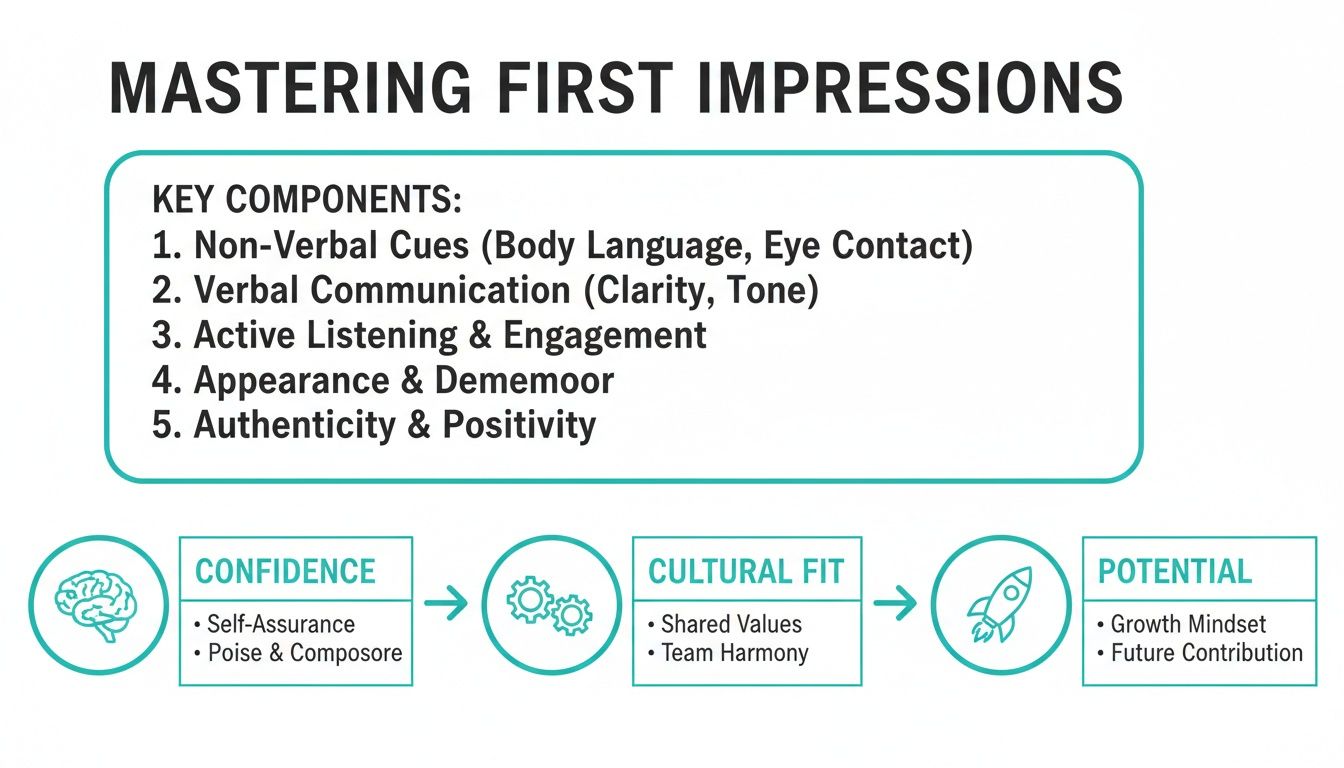
To help you get this right, here’s a quick cheat sheet on the signals you’re sending.
By consciously managing these nonverbal cues from the moment you arrive, you turn those first few awkward seconds into a powerful opportunity. You’re not just showing up; you’re establishing your presence and subtly commanding the room.
Once the handshakes are done and you’ve settled in, the real conversation begins. This is where your interview body language pivots from making a first impression to actively building a connection with the person across the table.
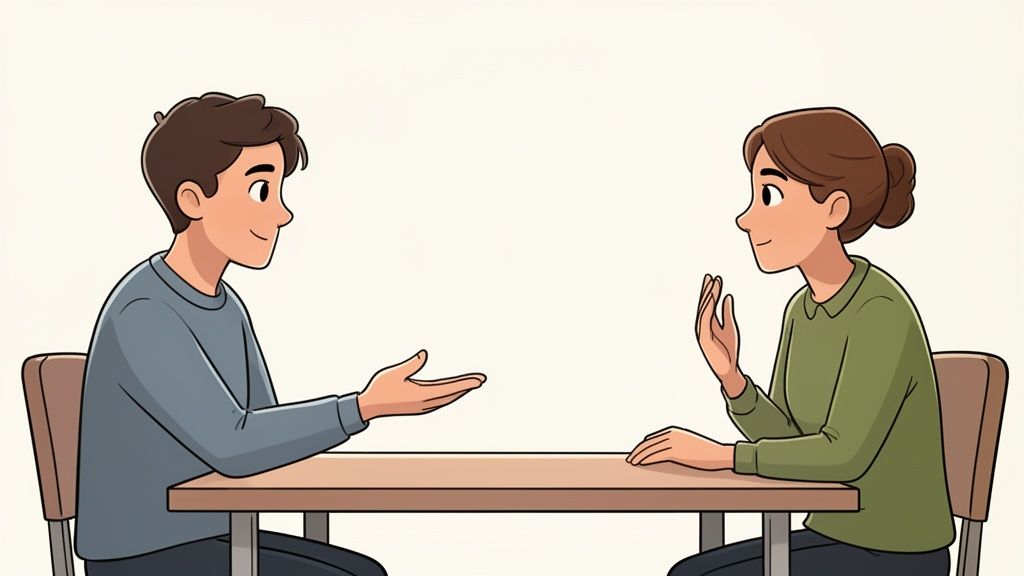
Your eyes and hands are your most powerful tools here. They can transform a simple Q&A session into a dynamic, engaging discussion.
Never underestimate the power of these nonverbal cues. Research consistently shows that a huge chunk of communication is nonverbal—one study breaks it down to 55% from body language alone. This is probably why a staggering 67% of employers admit they’ve rejected a candidate based on poor eye contact. You can find more data on the impact of body language in interviews on vorecol.com.
Eye contact is the bedrock of trust and shows you're actively listening. But there's a fine line between engaged and... well, creepy. The goal is to hold the interviewer's gaze naturally, proving you're paying attention without making them feel like they're under a microscope.
An actionable tip is the "triangle technique." Let your gaze move in a slow, natural triangle from one of their eyes to the other, then briefly down to their mouth or nose bridge. This keeps your gaze active and stops it from becoming an awkward stare. Hold contact for about 4-5 seconds at a time, then briefly look away to gather your thoughts before re-engaging.
A genuine smile can deliver a 90% boost in how positively you're perceived. When you pair that with steady, comfortable eye contact, you create an impression of warmth and confidence that words alone just can't match.
Breaking eye contact is also a strategic move. When you're asked a tough question, it's perfectly normal to look slightly up or to the side for a moment while you think. This signals thoughtfulness, not dishonesty. The key is to bring your gaze back to the interviewer as you begin your answer.
Your hands should add to what you're saying, not distract from it. Tapping your fingers, fidgeting, or hiding your hands under the table can broadcast nervousness or a lack of confidence. Instead, use them to add emphasis and show your enthusiasm.
Here are a few simple, effective ways to use your hands:
Think of your hand gestures as painting a picture that supports your words. If you're talking about growth, a subtle upward motion reinforces the idea. Discussing bringing two departments together? A gesture that moves your hands toward each other adds a powerful visual layer to your story.
Okay, you’ve nailed the fundamentals—sitting up straight, making solid eye contact, and using your hands to help tell your story. Now it’s time to layer in the techniques that separate a good candidate from a memorable one.
These are the subtle, almost subconscious cues that really connect with an interviewer. This is especially true in startups, where hiring managers are constantly on the lookout for people who radiate initiative and a deep sense of ownership from the get-go.
One of the most powerful—and most human—ways to build a connection is through mirroring. It’s the simple act of subtly matching your interviewer's body language to create a sense of alignment. This isn’t about being a copycat; it's about subconsciously showing you’re in sync with them.
The key is to keep it natural and delayed. If the interviewer leans forward while sharing an exciting detail about the company, give it a moment, then lean in slightly yourself as you respond. If they use a specific hand gesture to describe a process, you might use a similar, smaller version later in your own explanation.
Think about matching these elements:
Mirroring isn’t about mimicry; it’s about creating harmony. Done right, it sends a powerful message: "I get you. We're on the same wavelength." Suddenly, the interview feels less like an interrogation and more like a collaborative conversation between two professionals.
Startups aren't just hiring for a role; they're looking for partners who will grab the reins and own their work. Your body language can scream "I'm that person" long before you even start talking about your experience.
Think about how you act when you're genuinely fired up about an idea. You get more animated, you lean in, you become more expressive. You can consciously tap into that energy.
For example, when describing a project you led, lean forward slightly. This small movement closes the distance and physically signals your engagement. When you get to the part about results, let your hand gestures become more expansive. For instance, you could say, "We increased user engagement by 30%," while making a gesture that moves from small to large, visually illustrating the growth. This shows ownership and impact.
These cues might seem small, but they’re incredibly potent. They show you’re not just reading off a resume—you’re reliving your achievements and are genuinely excited to do it all over again for them. That’s the kind of energy that tells a founder you’re ready to invest yourself in their mission.
Nonverbal communication doesn't just disappear because there's a screen between you and the interviewer. In a lot of ways, your body language during interview sessions is even more critical in a virtual setting. The interviewer has fewer cues to read you by, and the camera creates this tight, focused window where every visible movement gets magnified.
The real challenge? What works in person doesn't always translate perfectly to a video call. You have to be much more intentional about projecting confidence and engagement through that tiny little lens.

Before the call even begins, your camera setup is already shaping the interviewer's first impression. Bad camera placement can create an instant—and awkward—disconnect, making you seem checked out or even a bit arrogant.
Get your camera to eye level. Seriously. Looking down into a laptop camera isn't flattering and can make you seem subordinate. On the flip side, a camera angled up from below can make it look like you’re literally looking down on the interviewer. Prop your laptop on a stack of books or invest in an external webcam to nail the angle.
Also, be sure to frame yourself from the chest up. This gives the interviewer enough context to see your posture and any hand gestures you use, which creates a much more dynamic presence than a simple floating head. A good test is to extend your hands forward; if they're visible without being cut off, your framing is likely correct.
This is the weirdest part of video calls. Making "eye contact" feels completely unnatural because it means looking directly at the camera lens, not at the person's face on your screen. It's a skill that takes a little practice, but it's absolutely vital for building rapport.
When you're speaking, make a conscious effort to look right at that small green or black dot on your camera. It's okay to glance back at the interviewer's image on your screen when you're listening. This balance stops you from looking like you're in a staring contest while still forging a strong sense of connection.
Here's a pro tip: Leaning in slightly toward the camera when the interviewer is talking is a powerful nonverbal cue. It signals that you're locked in and genuinely interested in what they have to say, effectively closing that virtual distance between you.
Your hands are still one of your best communication tools, but you have to keep them in the shot. Gestures that are too wide will vanish off-screen, and keeping your hands hidden below the desk can make you look stiff or like you're hiding something.
Practice keeping your gestures within that chest-to-shoulder frame. Use smaller, more controlled movements to emphasize your points—think counting on your fingers or using an open-palm gesture to show transparency. This keeps your energy visible and helps you come across as the dynamic, enthusiastic person you are. You can find more tips on this in our complete guide to virtual interviews and hiring remotely.
As remote work makes global teams the norm, being culturally aware of your body language is more important than ever. A gesture that's perfectly friendly in one culture might be completely misunderstood in another. If you're interviewing with a global company, spend a few minutes researching cultural norms around nonverbal cues.
Doing a little homework shows respect and adaptability—two key traits for anyone hoping to join a distributed, international team.
Knowing the theory behind interview body language is one thing, but putting it into practice under pressure is a whole different ballgame. This is where you turn knowledge into instinct. Creating a simple, repeatable plan before your interview can make confident nonverbal communication feel like second nature, freeing you up to focus on your answers.
Start with a pre-interview ritual. A few minutes before you leave or log on, find a private space and try a "power pose." Stand tall, put your hands on your hips, and hold your head high for just a minute. It might feel a bit silly, but this simple action can genuinely boost feelings of self-assurance.
It's also a great idea to practice your key talking points in front of a mirror or record yourself with your phone. This isn't about memorizing a script. It’s about catching those nervous habits you might not even be aware of. Do you touch your face when thinking? Do you jiggle your leg? Seeing it for yourself is the first step to getting it under control.
Your goal is to build a simple mental checklist for the interview itself:
For many, developing confident body language also means tackling internal challenges. It can be incredibly helpful to explore resources for overcoming imposter syndrome at work to build a stronger foundation of self-belief.
Nervous energy is completely normal—it’s how you manage it that counts. The trick is to redirect that energy into positive, controlled actions rather than letting it manifest as distracting fidgeting.
Instead of tapping your foot or clicking a pen, channel that excess energy into a controlled hand gesture to emphasize a point. Clasp your hands lightly in your lap or rest them on the table to keep them steady when you're listening. Another practical tip: focus on your breathing. Taking a slow, deep breath before answering a question can calm your nervous system and prevent fidgeting.
This simple act of redirection gives your nervous energy a productive outlet. It transforms a potential negative signal into a positive one that communicates passion and engagement.
For technical roles, this controlled energy is especially important; check out our guide on software engineer interview preparation for more role-specific advice. By making these actions part of your plan, they become automatic, allowing your skills and personality to truly shine through.
Even after you’ve done all your prep, a few last-minute questions about body language always seem to pop up. Getting these sorted is the final step to walking in (or logging on) feeling completely confident.
The trick is to redirect that nervous energy, not just try to crush it. Forcing yourself to "stop" fidgeting often backfires, making you look stiff and unnatural. Instead, give that energy a job.
If you’re a foot-tapper, try consciously planting both feet flat on the floor. This simple move can feel surprisingly grounding. If you tend to mess with your hair or click a pen, gently clasp your hands in your lap or rest them on the table. You're giving your hands a quiet, stable home, which keeps them from becoming a distraction.
First off, don't panic. It's easy to jump to conclusions and assume you're bombing, but it’s probably not about you. Your interviewer could be distracted by a critical Slack message that just came through, or they might just have a more reserved, poker-faced personality.
Your best move is to stay the course. Keep your own energy positive and engaged. Continue to lean in slightly when they speak, hold steady eye contact, and use those open hand gestures. Your professionalism can often be the very thing that pulls a distracted interviewer back into the conversation. A practical action you can take is to ask an engaging question, such as, "What has been the most exciting project you've worked on here?" This can re-engage them in the conversation.
If you walk out of an interview feeling like you got mixed signals, a great follow-up email is your best friend. It’s a chance to reiterate your interest and professionalism, no matter what vibes you picked up in the room.
You bet it does. Your "interview" isn't over until you are completely out of sight. That includes your chat with the receptionist on the way out and even how you carry yourself walking through the parking lot. Maintain a confident posture and a pleasant expression until the very end.
This goes for virtual interviews, too. The interview isn't done until you've clicked "Leave Meeting." Don't start to slump or glance at your phone the second you think the official questions are over. Finish strong. A genuine smile and a confident wave as you sign off can leave a fantastic final impression. And speaking of finishing strong, our guide on crafting thank-you emails after a phone interview can help you lock that in.
Body language is a powerful form of non-verbal communication that conveys your confidence, engagement, and attitude. Interviewers subconsciously read these cues to assess your fit for the role. Positive body language can reinforce your verbal answers, while negative cues can undermine them, creating a disconnect even if your words are perfect.
The foundational cues are: confident posture (sitting up straight, shoulders back), appropriate eye contact (aim for 50-60% while speaking), a genuine smile, and controlled hand gestures to emphasize points. Leaning slightly forward also shows engagement and interest in the conversation.
Common mistakes include: slouching or crossing arms (which can seem defensive or disinterested), avoiding eye contact (which can suggest dishonesty or low confidence), fidgeting excessively (like tapping pens or shaking legs, which signals nervousness), and checking your watch or phone (which clearly shows disinterest).
Awareness is the first step. Practice your answers while recording yourself to spot fidgeting. During the interview, keep your hands calmly in your lap or resting on the table if one is present. If you feel a nervous habit starting, take a slow, deep breath and consciously relax your shoulders. It's okay to take a brief pause to collect yourself.
Keep them visible and in the frame, resting calmly on the desk. Use occasional, small hand gestures to appear engaged and natural, but avoid large, sweeping movements that can be distracting on camera. Be mindful not to touch your face excessively or adjust your hair, as this can be amplified on screen.
For virtual interviews, you must manage a smaller "box." Eye contact means looking directly at your webcam, not at the interviewer's face on the screen. Sit closer to the camera to create a better sense of connection, and ensure your upper body and hands are visible. Your posture is still crucial, even if only the top half is seen.
Yes, this is an important consideration. Norms for eye contact, personal space, and hand gestures can differ. While a firm handshake is standard in the U.S., it may be less common elsewhere. If you are interviewing with a company from a culture different than your own, it's worth doing a small amount of research on general business etiquette to avoid unintended misunderstandings.
The best method is to practice answering questions in front of a mirror or, even better, record mock interviews on your phone or computer. Watch the playback critically and look for the positive cues you want to project and the nervous habits you want to eliminate. Ask a trusted friend for feedback as well.
Ready to put your interview skills to the test? At Underdog.io, we connect top tech talent with innovative startups. Sign up in 60 seconds and let the best opportunities come to you. Find your next role on Underdog.io.


