Structured interviews had a predictive-validity coefficient of 0.42, compared with 0.19 for unstructured interviews, according to a 2022 meta-analysis of employee-selection methods. That's a useful lens for buying a candidate sourcing tool: consistent evidence matters more than an impressive-looking profile. Before paying for more names, decide how you'll recognize someone who can do the work.
A useful sourcing tool should help your team find relevant people, understand why they fit, and start credible conversations. More profiles and faster outreach aren't improvements if recruiters spend the saved time rejecting weak recommendations.
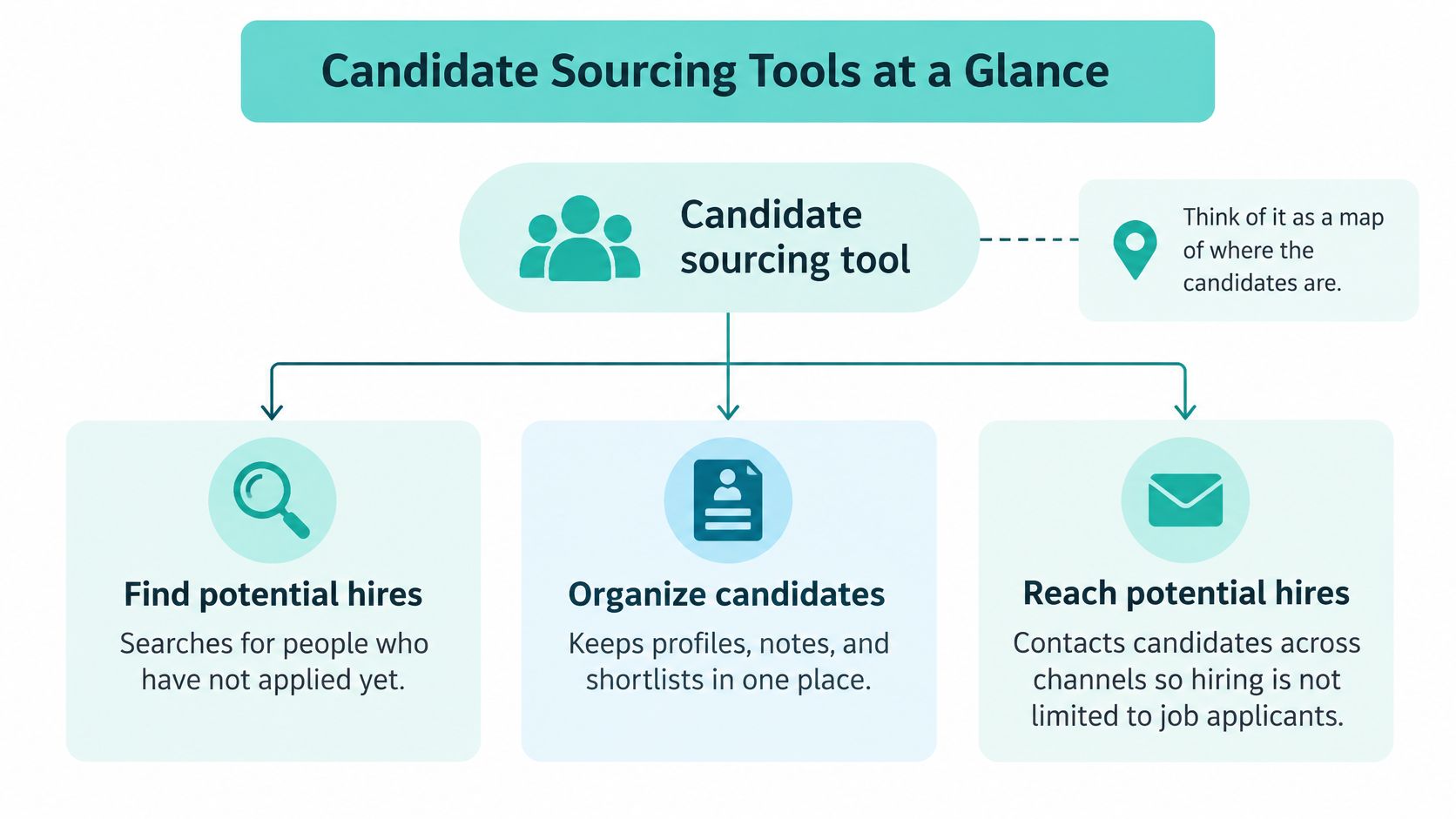
A candidate sourcing tool finds, organizes, and reaches potential hires, so you aren't limited to people who apply to a job post. Think of it as a map of where the talent is, rather than a net waiting for applications.
Employers already combine channels: for nonexecutive hiring, SHRM's Talent Access Benchmarking Report found that employee referrals were used by 89% of organizations, company websites by 86%, paid job boards by 75%, LinkedIn by 67%, and free job boards by 66%. Those channels serve different purposes. Your sourcing software should close a gap between them, not force every role through the same workflow.
| Tool type | Core job | Best for | Main limit |
|---|---|---|---|
| Applicant tracking system | Stores and moves applicants through hiring stages | Managing inbound applications | Finds no new candidates on its own |
| Recruiting CRM | Tracks past and future candidates and nurture contacts | Building a talent pool over time | Candidates must be added first |
| Professional network search | Finds and messages people by profile | Reaching passive candidates directly | Profiles can be outdated and outreach is manual |
| Job board | Collects applications from active job seekers | High-volume or generic roles | Low response from passive talent |
| AI sourcing platform | Ranks profiles by inferred skill and fit | Large searches across many profiles | Rankings can be opaque and need human review |
| Curated marketplace | Delivers pre-vetted, matched candidates | Hard-to-fill technical and startup roles | Smaller pool that depends on the platform's vetting |
These are functional categories, not rigid product boundaries. An ATS may include search or CRM features, but storing applications doesn't automatically give it a strong candidate-discovery capability. Likewise, an AI ranking feature doesn't establish that the underlying profiles are current or accurate.
Say you're hiring a senior infrastructure engineer who's unlikely to answer a generic advertisement. A professional search platform or curated marketplace addresses that discovery problem more directly than another job posting. If entry-level applications are plentiful but nobody can track screening decisions, improve the ATS workflow instead.
Buying rule: Name the gap first, then find the tool type that closes it.
Most tools organize or reach candidates. Your team still needs an explicit standard for deciding whether those candidates belong on the shortlist.
A sourcing tool earns its price when it improves judgment about fit, not when it produces a larger pile of profiles. In a 2025 survey of 930 North American talent professionals, 65% identified ineffective use of technology, analytics, or market insights as a major obstacle, while 44% cited mismatch between candidate skills and business requirements, according to the Future of Talent Acquisition and Recruitment report. Buying another interface won't fix an unclear hiring standard.
Score the demo against one role you need to fill. Bring the hiring manager's must-have evidence, two adjacent backgrounds you would accept, and one profile type you want excluded. Then run a blind review: strip names and employers from a sample slate, score the profiles against your rubric, and compare that judgment with the tool's ranking before sales narration colors the result.
Score each criterion from 1 to 5 as an internal purchasing rubric. Give the lowest score when the capability is absent, the middle score when it works with manual intervention, and the highest score only after the vendor demonstrates it against your role.
| Criterion | Question to ask | Red flag |
|---|---|---|
| Skill evidence | Does it separate demonstrated skills from keyword matches? | Ranks candidates by title or keyword count alone |
| Adjacent skills | Does it surface people with related but non-identical experience? | Returns only exact-title matches |
| Recommendation review | Can a recruiter see why each profile was recommended? | No reason is shown for any match |
| Outcome tracking | Does it report qualified-interview and hire rates? | Reports outreach volume only |
| Integrations | Does it connect to your applicant tracking system and calendar? | Candidates must be exported by hand |
| Pricing model | Is it pay-per-hire, subscription or per seat? | Full cost is unclear until the contract |
For skill evidence, request the underlying project, responsibility, or work sample. A backend engineer who owned production incidents offers a different signal from someone whose profile merely lists the infrastructure stack.
For adjacent skills, test a deliberately imperfect title match. A founding engineer might have relevant product ownership without ever holding a product engineering title. Our guide to Boolean strings for sourcing software engineers can help turn requirements into a controlled search rather than an expanding keyword wishlist.
Ask each vendor to price the same expected hiring volume over twelve months. Include recruiter review time, implementation, contact limits, and paid add-ons in your comparison, not just the subscription. Set the baseline from your last comparable searches: profiles reviewed, qualified profiles, recruiter hours, and hires. A tool should be judged against that baseline, not against a demo-week spike in replies.
For a geographically focused search, put regional salary, fee, and compliance assumptions into the same model before comparing sourcing fees; a pricing page such as LatoJobs' budget for hiring LATAM engineers is useful only as an input to normalize, not as proof of candidate quality.
At Underdog.io, we offer pay-per-hire or subscription pricing. Our pricing page lists a personalized employer page, candidate feedback analysis, hiring process data and analytics, new user training, dedicated support, ATS integrations, and diversity sourcing. Evaluate those inclusions against the work your team would otherwise perform.
Reject a tool scoring 2 or lower on skill evidence or outcome tracking. That's a purchasing threshold, not an industry benchmark. Record scores beside each vendor on one shared sheet so a persuasive demo can't erase missing functionality.
Start with replies and qualified candidates, not database size. An Ashby analysis of more than 500,000 candidate-sourcing sequences, covering January 2022 through January 2024, recorded an average reply rate of 19.6%, including 19.4% for technical roles and 18.7% for business roles, alongside an average campaign interest rate of 37.7%.
Those are directional reference points, not interchangeable measures or guaranteed results. In particular, don't assume the published interest-rate denominator matches your internal calculation. For purchasing purposes, treat broad reply benchmarks as a minimum challenge to beat for comparable roles, rather than a target worth celebrating.
| Metric | How to calculate | Reference point | Why it matters |
|---|---|---|---|
| Reply rate | Replies divided by messages sent | Published overall reply benchmark above | Shows whether the message and candidate match |
| Interest rate | Interested replies divided by messages sent | Published campaign interest benchmark above, only if denominators match | Separates replies from genuine interest |
| Qualified-candidate rate | Qualified profiles divided by profiles reviewed | Your pretrial rate for comparable roles | Measures list quality before outreach |
| Time to qualified slate | Days from brief to first qualified shortlist | Your previous comparable searches | Measures speed without giving up fit |
| Interview-to-offer conversion | Offers divided by interviews | Your historical conversion by role | Tests whether shortlists hold up under interview |
| Retention by source | Hires still employed at 12 months, grouped by source | Your mature hiring cohorts | Shows whether fit lasts after hiring |
Curated tools make this denominator question concrete. Underdog.io screens every candidate profile before employers see it, and its matching engine searches that pool for high-intent candidates. Its fact-based matching is worth testing against the same denominator, response window, and candidate eligibility rules you use for competing tools. A reply rate measured against a pre-screened pool and one measured against a raw outbound list are different metrics wearing the same name, so force the same rules on both before you compare.
Before outreach, log the sources of your last three hires as a practical starting exercise. Reconstruct the searches behind those hires, including reviewed profiles, contacted candidates, interviews, offers, and recruiter hours. Hire-source labels alone won't tell you how efficiently a channel worked.
If records are incomplete, mark the gaps rather than manufacturing a conversion rate. Separate technical and nontechnical searches, and don't compare an executive search with an entry-level campaign.
Use quality-of-hire metrics to connect immediate sourcing outcomes with later performance. Retention won't mature during a short trial, so schedule that assessment separately.
Keep a tool only if its reply rate and qualified-candidate rate both beat your baseline, and its time to a qualified slate doesn't rise.
A useful trial tests the vendor's recommendations against live demand without letting brand recognition influence reviewers. Freeze the evaluation rules before anyone opens a search result.
The following schedule is a recommended operating procedure, not a claim about how quickly every hiring team should produce results. A small trial can expose poor recommendations and workflow friction, but close results need a longer test.
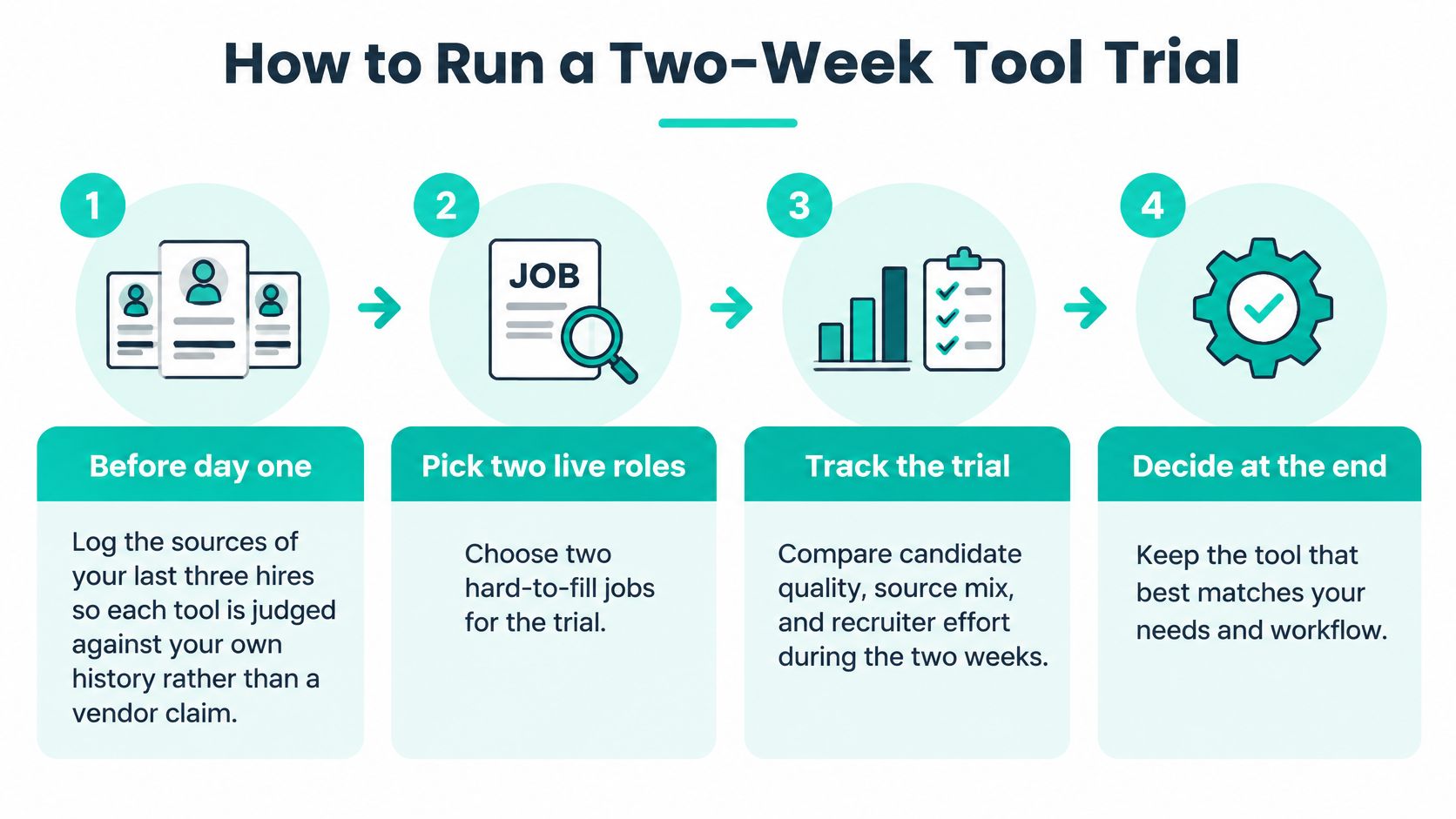
Before day one, document your history. Record the sources of your last three hires and recover the underlying funnel records. Agree with the hiring manager on what qualified means before comparing results.
Choose two live, hard-to-fill roles. Use one technical and one nontechnical opening. Real vacancies reveal compensation, location, and scope constraints that a vendor's polished sample search can avoid.
Write three must-have evidence bullets for each role. For an infrastructure engineer, these might be production experience with your stack, ownership of a relevant migration, and responsibility for technical decisions. For a product marketer, use launch ownership, relevant buyer experience, and evidence of positioning work.
Release the same brief on the same day. Include compensation boundaries, work arrangement, exclusions, and acceptable adjacent experience. Record vendor clarification questions and share material answers with every participant.
Review the first 20 profiles from each tool blind. Have a coordinator remove vendor branding, source labels, and promotional summaries while retaining job-relevant evidence. A recruiter marks each profile qualified or not and supplies a one-line reason.
Contact 15 to 20 qualified candidates per tool, using this as a trial design target rather than a performance standard. If a tool can't supply enough qualified profiles, record that shortfall instead of lowering the bar to fill the sample.
Keep the message structure consistent, but tailor the evidence-based opening to each person. Explain the relevant work, the role's scope, and why their experience connects to it. Use the same follow-up schedule and observation window.
Track opens as a secondary diagnostic, replies as an engagement outcome, and positive interest separately. Deduplicate candidates before sending so nobody receives competing trial messages from your team.
At the end of two weeks, apply the keep rule without relaxing it for your favorite vendor. A tool that saves search time but adds more review work hasn't necessarily reduced cost.
The common mistake is changing the brief halfway through. If the hiring manager changes the requirements, close that test and restart the comparison with the revised brief.
Privacy and oversight belong in the purchase decision: in 2025, 59% of HR decision-makers ranked data privacy and security as the most important factor when evaluating AI tools, while 58% prioritized human oversight, 50% explainability, and 45% regulatory compliance, according to the HackerRank Tech Recruiting Benchmark Report.
A tool that ranks people using hidden signals can exclude a good candidate without giving your recruiter anything to question. Access to more information isn't helpful if nobody can explain how it affected the recommendation.
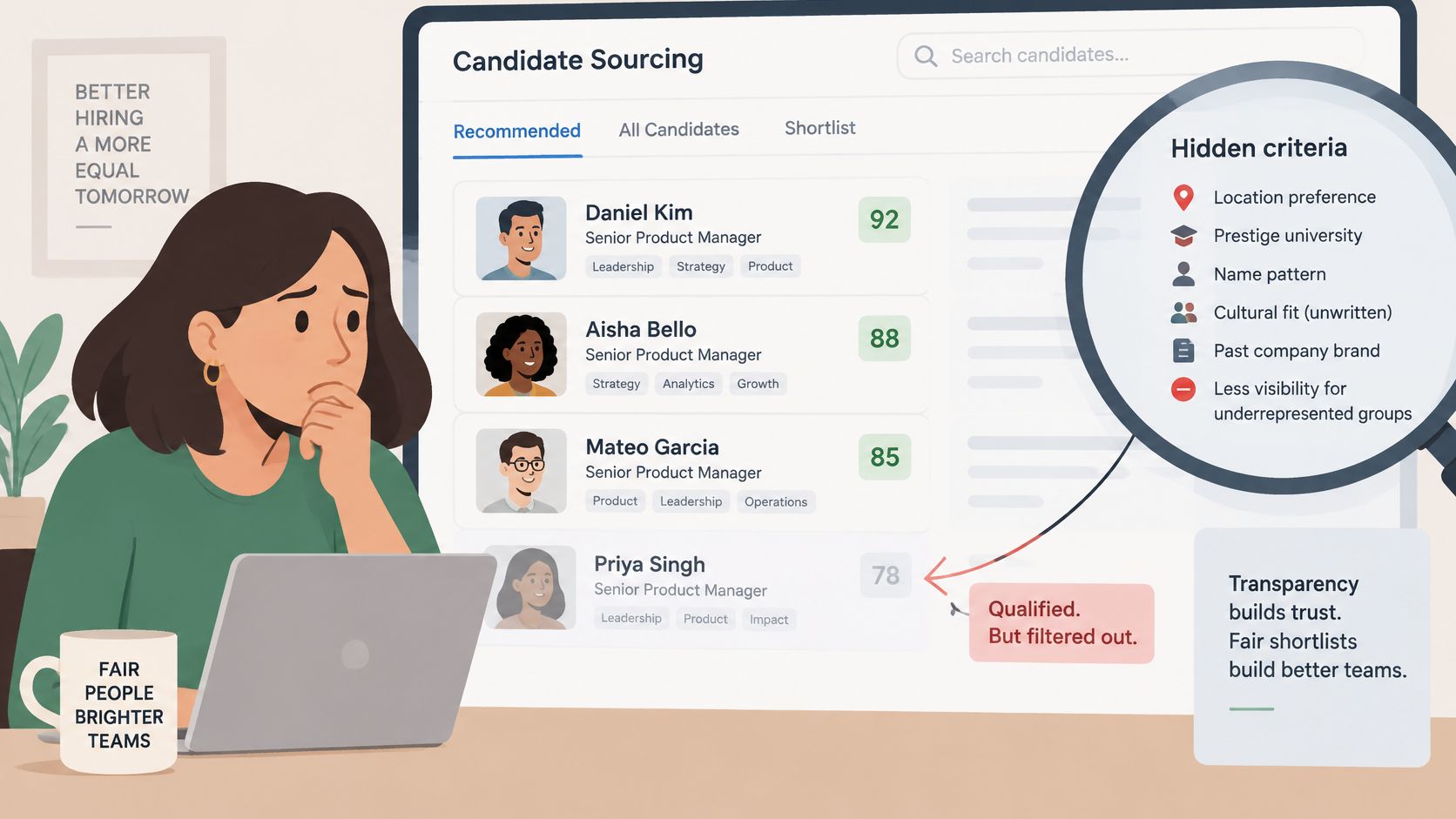
At our marketplace, we screen every candidate profile before employers see it, and we hide candidates from their current and past employers. Those safeguards address specific risks, but they don't remove the employer's responsibility to evaluate people consistently.
Anonymization can reduce exposure to identity-based cues, but indiscriminate removal can also hide relevant career context. Keep evidence of responsibilities, project outcomes, and transferable experience visible. Handle work authorization through an explicit, consistent question rather than inferring it from a name, location, or education.
Say a strong profile receives a low-fit label because of a gap year. The recruiter needs to see that reason, assess whether it's relevant, and override it when it isn't. A score without an explanation makes that correction impossible.
Trust is an operating requirement: Candidates should understand profile visibility, when interest is disclosed, and why an employer is contacting them.
Favor controlled outreach, clear visibility settings, and plain-language match explanations. Speed doesn't compensate for contacting the wrong person or exposing someone's confidential search.
Curated marketplaces trade self-service search effort for an already-filtered pool. The strongest use case is a hiring team that knows the work it needs done but lacks the hours to build and maintain every search itself.
In Gem's recruiting benchmark, outbound candidates had a 58% top-of-funnel passthrough rate, compared with 23% for inbound candidates, and ultimately resulted in a hire 2.4% of the time versus 0.5%. Outbound candidates converted less effectively at later offer stages, though. Strong early selection does not excuse weak candidate motivation or a poorly sold opportunity.
| Approach | Your team owns | Best reason to choose it | Main trade-off |
|---|---|---|---|
| Curated marketplace | Brief calibration, shortlist decisions, interviews | Reduce initial search and screening work | Coverage follows the platform's candidate pool |
| Searchable database | Queries, validation, outreach, ongoing calibration | You know the niche and have sourcing capacity | More recruiter labor and data checking |
| Staffing firm such as nexusITgroup.com | Partner selection, brief, hiring decisions | You need a partner to run the full search on a contingent basis | More dependence on partner execution |
For startup technology hiring, our curated tech marketplace screens every candidate profile before employers see it and sends a new vetted batch each week. That changes the recruiter's starting task from assembling a list to evaluating relevant possibilities.
Our job matching includes access to 300,000+ pre-vetted candidates. Pool size alone is not a reason to buy. Your actual shortlist must still satisfy the role's evidence requirements and contain people interested in the opportunity.
We also offer access to passive candidates, including designers who are employed but open to a better role. Willingness to take a conversation is not the same as readiness to accept an offer. Discuss scope, manager expectations, and reasons to move early.
A self-run database remains sensible for a narrow specialty when your recruiter already knows the relevant employers, titles, and project signals. Curation adds less value when your team can identify that population efficiently and needs full control over search construction.
Ask two questions before choosing: Does this role need people who wouldn't apply? Does fit matter more than volume? If both answers are yes, start with a curated marketplace, then require it to pass the same blind review as every alternative.
Choose the candidate sourcing tool around the next hiring decision, not a hypothetical future recruiting department. The right purchase removes a specific obstacle without creating a larger review or administration burden.
Use this decision sequence:
For startup technology roles, our marketplace is the recommended first trial because it combines screened candidates with a fact-based matching approach. That's a recommendation about where to start, not permission to waive the acceptance criteria.
Compare vendors using the same expected hire volume and include the employment costs associated with your target market. For founders hiring in the UAE, Founder Connects' guide to the true cost of employment in Dubai offers useful context beyond the sourcing bill.
Book the trial for your chosen roles, document baseline sources before outreach, and put a review date four weeks after kickoff on the calendar. Use the additional time after the trial to examine interview progression and confirm workflow costs. If the results hold, extend access to the next team; if they don't, inspect the brief and rejection reasons before replacing the tool.
We offer a curated marketplace of screened developers, designers, product managers, and business candidates for startup hiring. Visit Underdog.io to discuss your live roles and evaluate whether our fact-based matching can deliver a more qualified, engaged shortlist for your team.