You joined a startup because you wanted momentum. Instead, you're three months in, doing the work of a product manager, project coordinator, customer researcher, and occasional support lead, while your title hasn't changed. Your manager praises your initiative, but promotion conversations keep moving to “later,” after the next fundraise, product launch, or hire.
That situation captures the promise and the trap of career growth in startups. You can gain scope faster than in a large company, but hard work alone doesn't create progression. The right company, visible ownership, credible sponsors, and a clear understanding of the organization's growth stage matter just as much.
A startup rarely gives you a neat ladder. It gives you a problem, limited context, and a deadline.
At a larger company, your role may be carefully bounded. A product manager owns a roadmap, an engineer owns a service, and a designer works within an established research and design system. In a young company, those boundaries move constantly. You might ship a feature in the morning, interview a customer in the afternoon, and help a salesperson prepare a demo before the day ends.
That breadth can accelerate your judgment. You learn how decisions connect across product, engineering, design, marketing, sales, and operations. But it can also create a misleading feeling of progress. If you're handling more tasks without owning a meaningful outcome, you're accumulating activity, not impact.
A useful perspective on startups as career development bootcamps is that the learning comes from compressed responsibility. The strongest roles let you make decisions, see the consequences, and improve quickly. The weakest roles turn resource constraints into permanent firefighting.
Startup org charts stay flat because the company hasn't yet built layers of management. That creates access to founders and senior leaders, but it also reduces the number of formal promotion steps. You may move from individual contributor to team lead without a title change, or become the person everyone relies on without receiving authority over budget, hiring, or priorities.
This is why your career evidence must focus on scope, decisions, and outcomes, not only tenure. Keep a record of the problems you owned, the teams you coordinated, the decisions you influenced, and the results your work enabled. A promotion case based on “I've been here long enough” is weak in a startup. A case based on “I now operate at the level this role requires” is much stronger.
Startups are a major engine of job creation. In the United States, they've historically added about 3 million jobs in a typical year, and one widely cited study found that the average startup cohort creates 3.2 million jobs in its founding year. Surviving startups average 3.3 employees seven years later, compared with about 0.6 workers at inception, according to the startup employment analysis from the University of California.
Practical rule: Treat every startup role as a bet on both your own growth and the company's ability to keep creating useful work.
The highest acceleration often appears during the company's first 1 to 5 years, when employees can move from execution into ownership as the organization forms around them. That window can produce exceptional growth, but only if the startup survives, leaders make room for internal advancement, and your responsibilities become more valuable rather than merely more numerous.
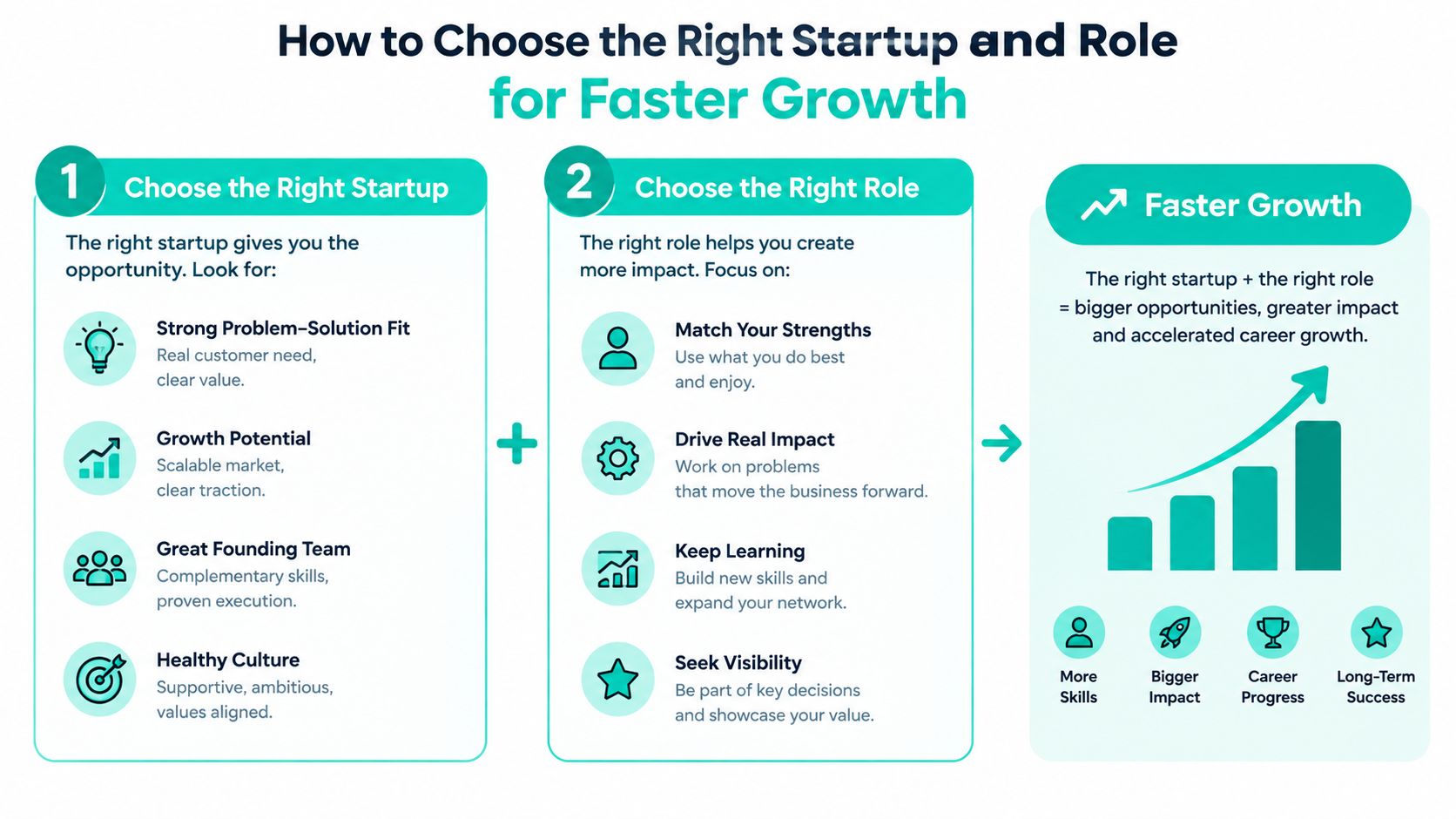
The best startup for career growth isn't automatically the youngest or most exciting. It's the company where the business is gaining enough traction to create new ownership areas, while the organization is still small enough for you to shape decisions.
Start with the company's growth signals. Ask how headcount has changed, which functions the company plans to build next, and what responsibilities the role will absorb as those teams arrive. Funding matters, but it's only a proxy for runway and ambition. The more useful question is whether the company has a credible plan for turning resources into customers, product progress, or operational maturity.
The Bureau of Labor Statistics data summarized by the Center on Budget and Policy Priorities shows why early roles can be unusually broad. U.S. startup firms accounted for about 1.7 million job gains in 2019, while averaging only 4 employees at birth. A small starting team gives employees room to shape processes, but it also means role quality varies sharply from one company to another.
StageTeam Size SignalGrowth ImplicationPre-seedA very small founding teamBroad exposure and high ownership, with limited structure and substantial company riskSeedEarly functional specialists begin joiningMore defined responsibilities, while cross-functional work remains commonSeries ATeams start separating by functionStrong opportunity to own systems, processes, and first management responsibilitiesSeries BLeadership layers and operating rhythms become clearerMore predictable progression, but greater competition for visible scope
These stages aren't rigid categories. A well-funded pre-seed company may offer more stability than a poorly managed later-stage company. During interviews, ask for examples of what someone in the role owned after joining, what decisions they can make independently, and what work the company expects them to stop doing as the team grows.
Look for a role with a clear ownership area, not a title that sounds senior. “Head of Growth” means little if the founder still controls every acquisition decision. “First product designer” can be powerful if you'll establish research practices, influence roadmap priorities, and hire future teammates.
You should also evaluate support work fairly. An executive assistant role can expose you to company-wide priorities and founder decision-making, but it needs a path toward operations, strategy, or a specialized function. Resources such as this guide to an Approved Lux Personal Assistant for founders can help clarify how the role is structured before you accept it.
Before signing, score the opportunity across four questions:
For practical sourcing, review how to find a startup job, then apply the same scrutiny to every opportunity you uncover. Selection is the first career-growth decision, not an administrative step before the actual work begins.
Once you've joined, stop trying to become useful everywhere. Choose the capabilities that make your work harder to replace and easier to trust.
In product, that might mean customer discovery, prioritization, and commercial judgment. In engineering, it could be system design, reliable delivery, and the ability to explain technical trade-offs. In design, it may combine user research, interaction quality, and strong collaboration with engineering. The exact skills vary, but the pattern is consistent: high-impact people connect specialist craft to company outcomes.
A startup's pace creates a short feedback loop. You can test an assumption, ship a change, speak with customers, and revise your approach without waiting for a large planning cycle. Use that speed deliberately rather than confusing urgency with progress.

Visibility doesn't require constant self-promotion. It requires making your decisions and results easy for other people to understand.
Write concise weekly updates that state the goal, what changed, what you learned, and what decision is needed next. Volunteer for a cross-functional problem that lacks a clear owner, but define the boundary before you begin. When you finish, share the result with the people who depended on it, not only with your manager.
A simple operating rhythm works well:
The risk is real. Kauffman Foundation data shows that one-year-old firms have a net employment growth rate of about 15% if they survive, compared with about 4% for firms aged 29 and above under similar conditions. At the same time, about 20% of startup jobs are lost because of establishment closures in the first year, as described in the Kauffman Foundation briefing on young firms.
Your reputation compounds when colleagues can predict that you'll turn ambiguity into a decision, a decision into shipped work, and shipped work into learning.
That reputation matters more than being the person who answers every message first. Responsiveness earns appreciation. Reliable judgment earns larger scope.
A startup offer can look generous until you separate dependable cash from a conditional ownership claim. Salary is relatively clear. Equity depends on the company's outcome, the grant terms, dilution, and whether you stay long enough for the award to vest.
Employee equity commonly comes from an option pool. Employers typically reserve 13% to 20% of equity for that pool, with the amount shaped by company stage and hiring needs, according to Carta's guide to employee equity. Evaluate the grant as a percentage of the company on a fully diluted basis, not by the raw number of options. Ask which instrument you are receiving and how future fundraising could change your ownership.
Before you model what the grant may be worth, use this guide to equity compensation for startups so you can compare offers on a fully diluted basis.
A common startup structure is a 4-year vesting schedule with a 1-year cliff. Employees typically earn 25% after 12 months, followed by the remaining 75% monthly over the next 36 months, according to Orrick's explanation of startup equity vesting.
The schedule protects the company from granting permanent ownership to someone who leaves quickly and gives employees a reason to remain through meaningful company-building periods. Leaving before the grant fully vests generally means forfeiting the unvested portion, as explained in this overview of vesting for startups.
Ask these questions before accepting:
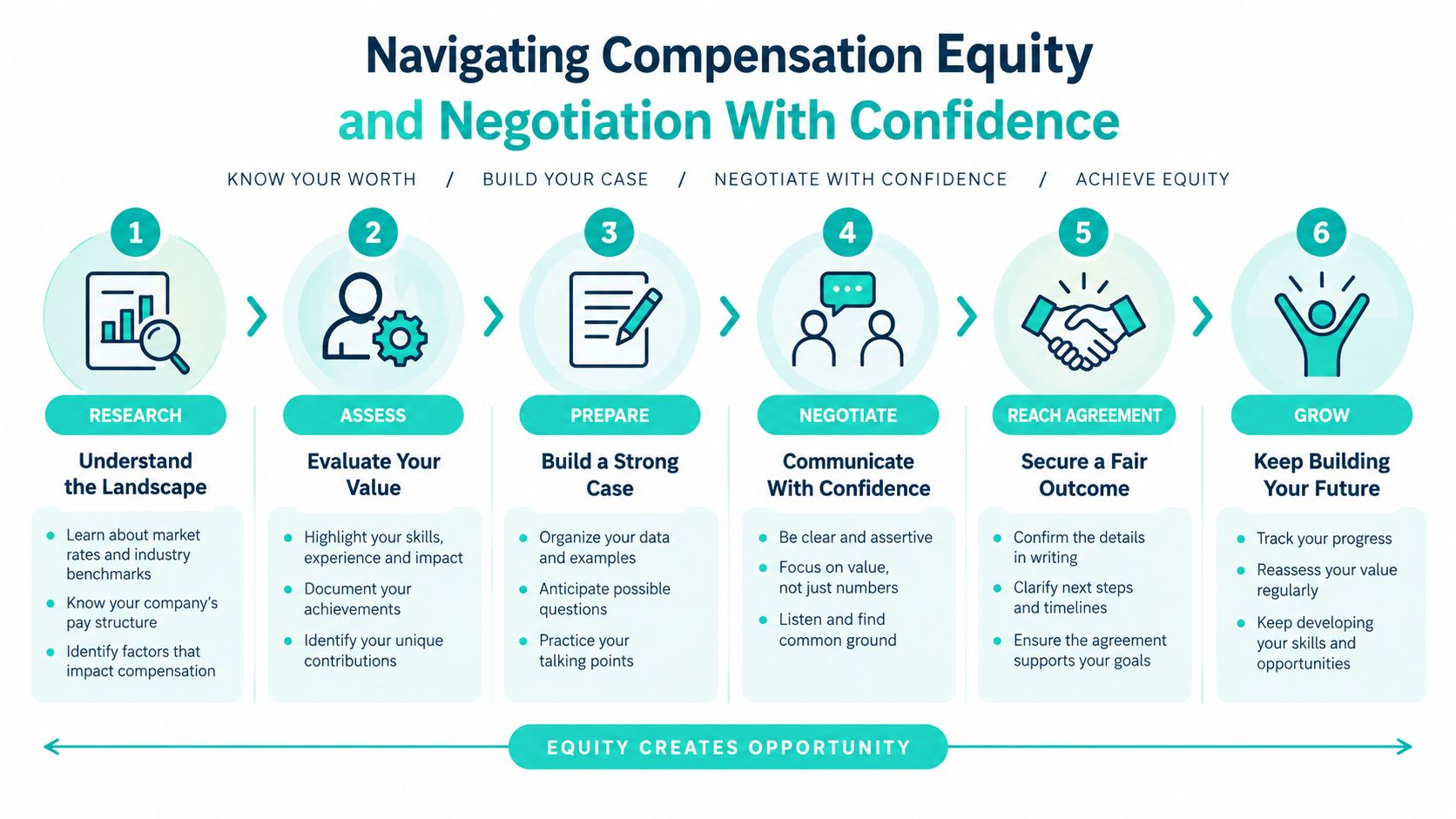
A negotiation can cover base salary, a signing payment, a later compensation review, title scope, professional development support, or a written commitment to revisit the role after a defined milestone. Connect each request to the responsibilities you will carry and the value you expect to create.
Use current market data to compare salary benchmarks before negotiating. Company-specific equity terms still require direct questions, especially about dilution, exercise windows, valuation information, and what happens if the company is acquired.
A practical script is: “I'm excited about the role. Given the ownership area we discussed, I'd like to understand how the equity percentage was calculated, what progression would look like after the next company milestone, and whether we can document a compensation review at that point.”
Treat equity as risk-bearing compensation, not cash with a different label. Its potential may justify accepting less salary, but only if the terms, timeline, and downside fit your situation.
A mentor helps you think. A sponsor helps other decision-makers see you as ready for more.
Startups often make mentoring informal. You may learn from a founder, a staff engineer, a product leader, or a peer who has already handled the problem in front of you. That access is valuable, but informal access can disappear when priorities change. Create a lightweight structure instead of waiting for a permanent program.
Ask a potential mentor for a focused conversation about one capability or decision. Bring a specific question, explain what you've tried, and return with an update. People are more likely to keep investing when they can see that their advice changed your actions.
A sponsor relationship develops through demonstrated trust. The person must have enough influence to recommend you for a larger role, and they must have seen you operate under real constraints. You can't demand sponsorship, but you can make it easier by owning work that matters, communicating clearly, and asking senior colleagues to include you in decisions where your context is relevant.
A resource such as this guide to finding a Chicago Brandstarters founder mentor can help you think beyond your immediate manager when building an advice network.
Don't ask your manager only, “What do I need to do to get promoted?” Ask, “What responsibilities would demonstrate readiness for the next level, and which of those can I own this year?”
Map the answer across three horizons:
These aren't promises or universal timelines. They're planning anchors. Match them to the company's expected hiring and organizational changes. If the company says it will build a data function, launch an enterprise motion, or add product leadership, ask what role you could credibly grow into and what evidence you'd need to provide.
Fast-growing startups can create career upside, but the payoff differs by function. Revelio Labs found that people who started at fast-growing startups were initially paid less than peers at slower-growing startups, then surpassed them after about three years, with the later premium ranging from 0.4% to 13.2% depending on job category, according to the Ashby talent trends report.
A multi-year plan should connect your development to a company need. If the company won't need the role you want, excellent performance may still leave you waiting.
Review the plan during regular one-on-ones. Keep a short document with your current scope, target scope, evidence, missing experiences, and the person who can validate your readiness. That document turns vague encouragement into a shared record.
Push for promotion when the company is growing around your work and leaders can describe the next role in concrete terms. Start looking elsewhere when your responsibilities expand but decision rights, compensation, and organizational support never follow.
The first test is internal mobility. Ask whether people in comparable roles have moved into larger positions, whether managers can name examples, and whether senior leaders develop successors. A startup can have a flat structure without having a promotion problem. The problem appears when leaders use flatness to avoid making commitments.
One industry report says 72% of executive roles are filled externally, while 45% of employees cite lack of career growth as their reason for leaving, according to the LSVP analysis of hiring and retention trends. Those figures don't prove that your company can't promote you, but they do justify asking whether leadership roles are available to internal candidates.
Bring a concise case:
A good manager may say you're not ready. That answer is useful if it includes observable gaps, a practical assignment, and a date to reassess. “Keep doing great work” isn't a development plan.
Timing also matters. Review your vesting position, the company's funding situation, and the likely impact of leaving on your responsibilities. Don't stay solely for unvested equity that you can't evaluate, but don't leave impulsively after a difficult week either. Compare the next role's scope, manager quality, learning potential, cash compensation, equity terms, and company health.
Leave professionally if the ceiling is real. Document your work, give reasonable notice, and preserve relationships with people who may become future colleagues, references, or sponsors. Startup markets are small, and your reputation travels through the work you leave behind.
Career growth in startups accelerates when you choose a company with room to expand, make your contribution visible, and verify that leaders promote from within. Underdog.io connects tech candidates with vetted startups and high-growth companies through a single application, giving you a practical way to explore roles where scope and progression deserve closer evaluation. Visit Underdog.io to assess your next move with more information and less guesswork.