Joining or building an early-stage tech startup means accepting both high reward and high risk. In the United States, only about 20% of new businesses fail during their first year, while about 35% remain active after 10 years (Stripe's startup survival data).
You might be an engineer holding an offer from a pre-seed company with an impressive founding team, a fresh product demo, and just enough funding to make the opportunity feel secure. Or you might be a founder trying to hire the first engineers who can turn an idea into a dependable product before the runway disappears. In both situations, enthusiasm matters, but it can't replace judgment.
Early-stage tech startups give people unusual access to decisions, customers, architecture, and company direction. They also expose candidates and founders to short runways, changing priorities, incomplete processes, uncertain equity, and hiring mistakes that become expensive later. The right question isn't whether startup work is risky. It is whether you understand the specific risk you're choosing and have a plan for managing it.
A startup offer often arrives with a compelling story. The founders understand a painful problem. Early customers are interested. The product has room to grow, and your role could expand from writing one service to shaping the technical organization. That combination can be more rewarding than joining a mature company with a narrow job description.
The same opportunity looks different from the founder's side. A founder may need someone who can build an MVP, talk with users, repair fragile code, and make sensible tradeoffs without waiting for a large platform team. Hiring someone who needs extensive structure can slow the company, while hiring only for technical brilliance can create a team that struggles with ambiguity.

Survival data provides a more useful starting point than dramatic claims that most startups fail immediately. Around 20% of new U.S. businesses fail in their first year, and only about 35% are still active after 10 years (Stripe). The first milestone tests demand, repeatable operations, and cash discipline. The later milestone separates durable companies from short-lived ventures.
Conditions vary by market. Stripe's compiled figures report that roughly 45% of European Union businesses survive five years, compared with about 10% of Indian startups, while Brazil's startup survival rate is approximately 50% after four years (Stripe's international comparison). Capital access, infrastructure, regulation, market size, founder experience, and skilled-worker availability all influence those outcomes.
Practical rule: Treat a startup job as a joint decision about the role and the company's survival plan.
A candidate should examine how the company validates demand, protects cash, and responds when assumptions fail. A founder should hire people who connect product work to customer behavior, not just people who can produce complex systems. Tools that reduce repetitive work can also matter, and a practical guide to AI tools for early-stage SaaS startups can help a small team assess where automation supports execution.
Funding stage isn't a guarantee of safety, but it gives you a useful map. An idea-stage company may have one founder and no employees. A pre-seed team usually needs its first builders, while a seed company is trying to form a repeatable product group. Series A often brings departmental growth, and Series B tends to introduce specialized roles, managers, and more formal processes.
The supplied stage illustration includes common planning ranges such as $250K to $1M for pre-seed, $1M to $3M for seed, $7M to $15M for Series A, and $20M to $40M for Series B. Those ranges are directional, not universal market rules, so candidates should ask what the company has raised and how much remains available.
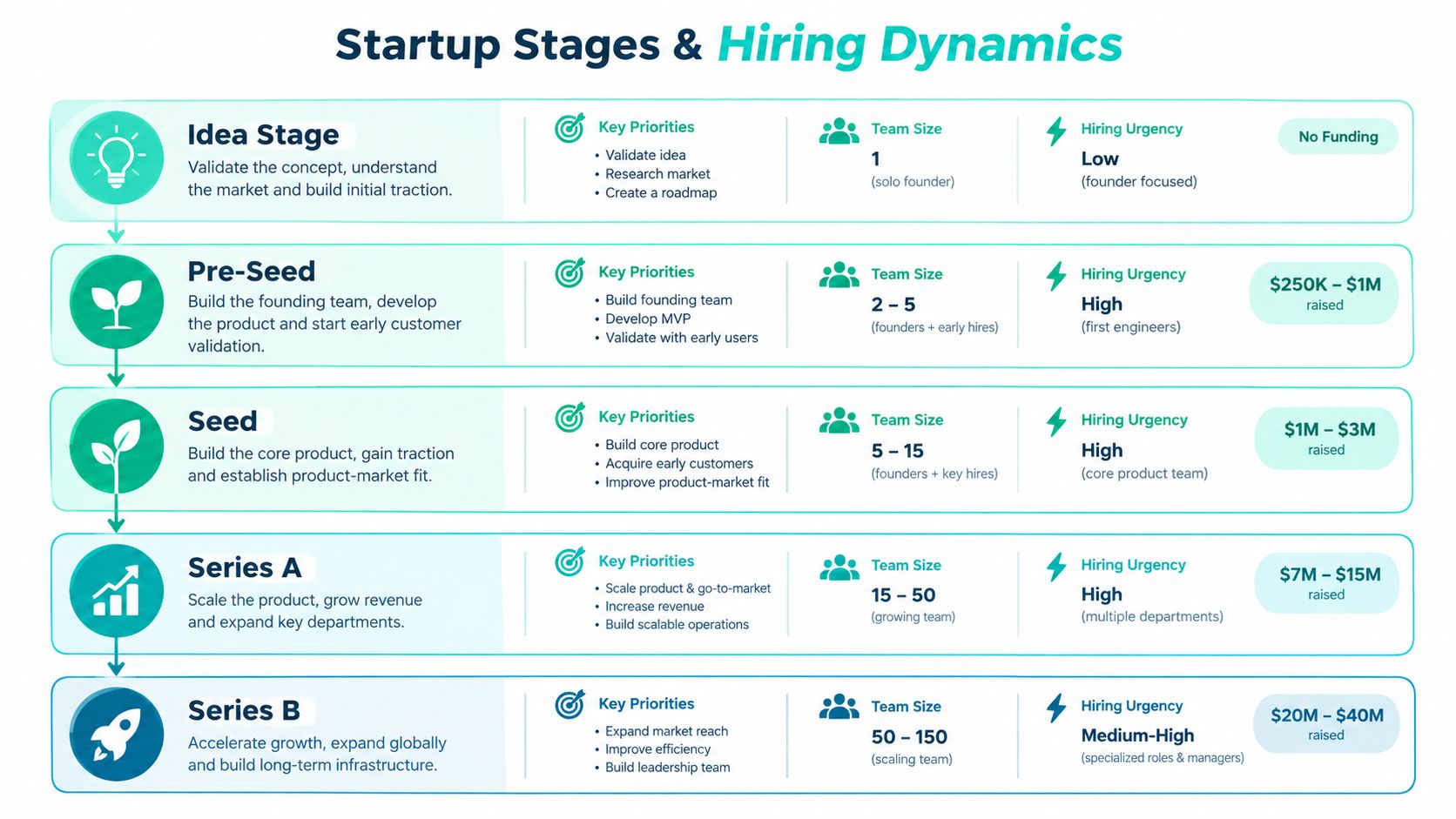
At pre-seed, engineers often work across product, infrastructure, analytics, and customer support. The founder may expect rapid prototypes and direct conversations with users. At seed, the company needs a core product team, clearer ownership, and enough engineering discipline to ship without losing speed.
At Series A, hiring usually becomes more deliberate. The company may add product managers, design leadership, recruiting support, and specialists who can turn one successful workflow into a dependable product. At Series B, functional expertise and management capacity become more important because coordination replaces some of the informal communication that worked earlier.
| Stage | Typical funding | Team size | Hiring focus |
|---|---|---|---|
| Idea | No funding may exist | Solo founder or very small team | Validation and early experimentation |
| Pre-seed | $250K to $1M in the supplied planning framework | 2 to 5 | First engineers and broad operators |
| Seed | $1M to $3M in the supplied planning framework | 5 to 15 | Core product and engineering team |
| Series A | $7M to $15M in the supplied planning framework | 15 to 50 | Departments, leadership, and repeatable delivery |
| Series B | $20M to $40M in the supplied planning framework | 50 to 150 | Specialists, managers, and scalable operations |
Funding is also concentrated. In 2024, U.S. venture deal value reached approximately $209 billion across 15,260 deals, while funds raised about $76.1 billion across 508 funds, the lowest annual fundraising total since 2019 in the same review (PitchBook and NVCA Venture Monitor). Thirty firms raised at least $500 million each, accounting collectively for 68% of total new commitments (the same market review). A founder should therefore plan hiring around milestones, not around the label attached to the round. Candidates should ask what the round must accomplish before the next financing decision.
A funding announcement tells you that money entered the company. It doesn't tell you how long that money will last, whether customers will renew, or whether the next hiring plan depends on another round. Candidates need to separate cash raised from operating durability.
Start with four questions. Ask for the current cash runway in months, the approximate monthly burn, the next product or revenue milestone, and what management will change if fundraising takes longer than expected. You don't need confidential financial statements, but you do need a clear answer that connects spending to priorities.
A paid customer is different from a pilot, and a pilot is different from an interested prospect. Ask how many customers are actively paying, how renewals work, whether one customer represents a large share of revenue, and which behavior proves that users receive continuing value.
The sector matters too. Recent global funding data shows that nearly 60% of invested capital went to 629 companies raising $100 million or more, while AI companies captured roughly $211 billion, about half of global funding. Early-stage funding reached $37 billion (Crunchbase's 2025 funding analysis). These figures describe concentration, not a promise that every AI company is overvalued or every non-AI company is weak. They do show why a strong headline can hide uneven access to future capital.
| Indicator | What to look for | Red flag |
|---|---|---|
| Cash runway | A specific horizon tied to the hiring plan | Leaders avoid discussing what happens if the next round is delayed |
| Monthly burn | Spending connected to measurable milestones | Hiring expands without a clear product or revenue objective |
| Revenue quality | Paid usage, renewals, and customer behavior | The company describes pilots as if they were durable revenue |
| Customer concentration | Several customers or a clear plan to diversify | One account determines the company's near-term survival |
| Financing dependence | A credible path to the next milestone | The business needs another round before proving its core assumption |
Use the startup due diligence checklist to organize your questions before interviews. Then ask the same core questions to the hiring manager, founder, and recruiter. Differences in their answers can reveal unclear planning.
Ask what success means after six and 12 months, who will manage you, what decisions you can make, and which responsibilities disappear if the company changes direction. A stable opportunity has a believable role even if the first product hypothesis fails. A fragile one may exist only until a single milestone or financing event.
Startup compensation usually reflects a tradeoff between immediate cash and uncertain upside. Earlier companies may offer broader responsibility and more equity, but benefits, salary consistency, and role definition can be less developed. Later-stage companies often provide more predictable compensation and clearer progression, while the equity grant may represent a smaller ownership share.
The exact comparison depends on location, seniority, dilution, company valuation, and negotiation. Don't treat a large option count as proof of a generous offer. Ask for the information needed to understand what the grant represents.
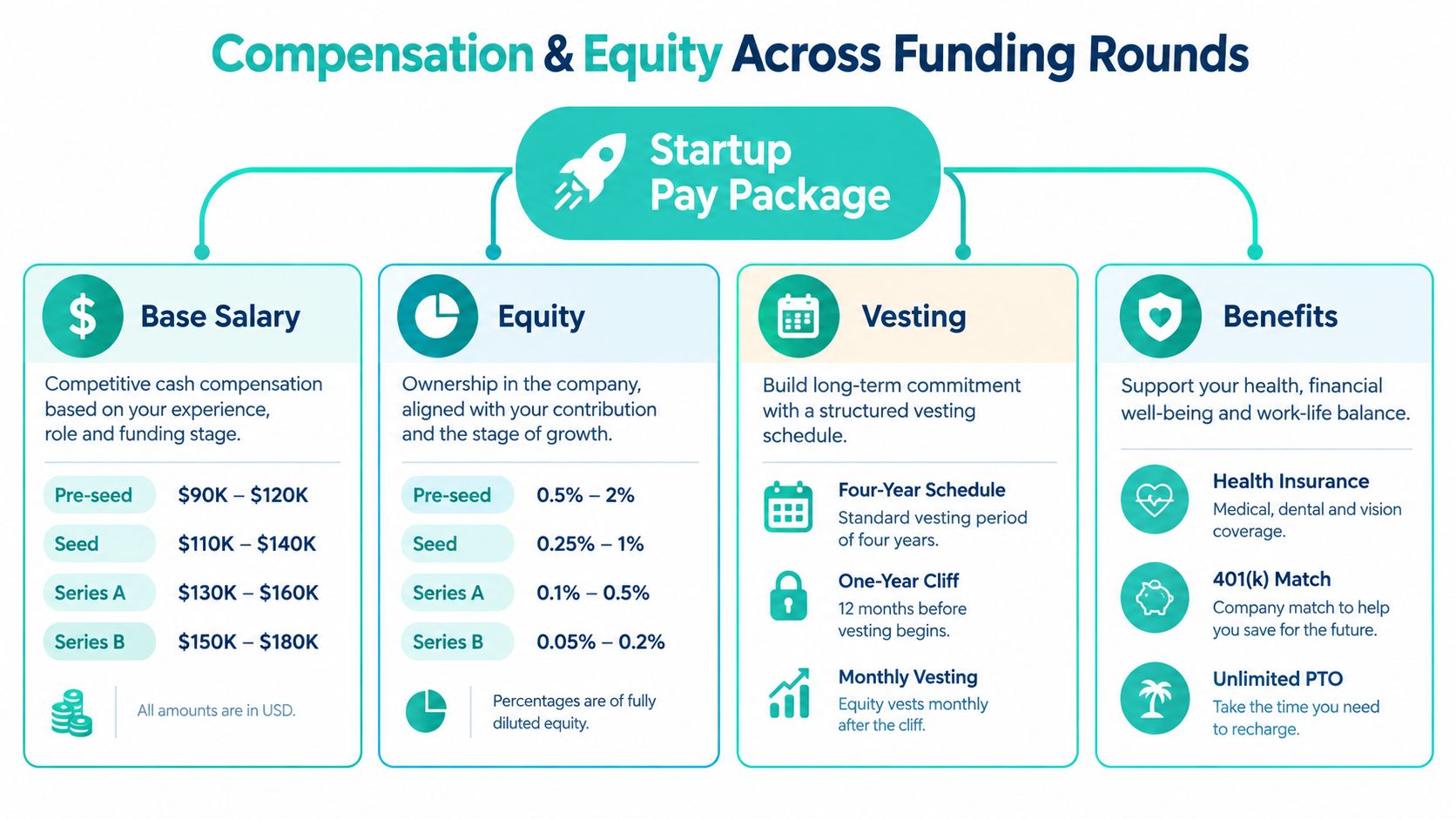
A standard option arrangement uses four-year vesting with a one-year cliff (Wise's vesting explanation). Nothing vests during the first 12 months. On the first anniversary, 25% vests, followed by the remaining 75% in equal monthly installments over the next 36 months. An employee receiving 10,000 options would receive 2,500 at month 12 and approximately 208 options per month afterward.
Leaving before the cliff generally means forfeiting the entire unvested grant. Before accepting, request the vesting commencement date, the exact schedule, and the treatment of vested options after departure.
| Term | Definition | Why it matters |
|---|---|---|
| Option count | The number of shares you may eventually buy | A count means little without the fully diluted share total |
| Fully diluted percentage | Your grant compared with all shares and potential shares | It shows approximate ownership rather than just a headline number |
| Strike price | The fixed price paid to exercise an option | You need the price to estimate the cash required |
| 409A valuation | A valuation used to establish fair-market value for common stock in U.S. private companies | It helps you understand how the strike price was set |
| Exercise window | The time allowed to exercise vested options after leaving | A short window can make the grant difficult to use |
Stock options give you the right, not the obligation, to buy shares at the strike price. Startup equity terminology explains why candidates should request the option count, fully diluted percentage, strike price, latest 409A valuation, vesting schedule, and expiration rules.
A commonly used post-employment window is 90 days, although some companies offer 12 months or several years (Startup Science's equity guidance). Exercise can require substantial cash and may create tax consequences, so consult a qualified adviser before making decisions. For a broader view of salary tradeoffs, compare the questions covered in this early-stage startup salary guide.
Founders often hire too late, then compensate by rushing. The result is a candidate who looks impressive on paper but hasn't shown the adaptability needed for incomplete requirements, direct customer feedback, and frequent reprioritization.
The first hires should complement the founders. If the technical founder can build quickly but avoids documentation, the next engineer may need to introduce lightweight testing and interface notes. If the founder sells well but lacks product discipline, an early product leader should turn customer conversations into testable decisions.
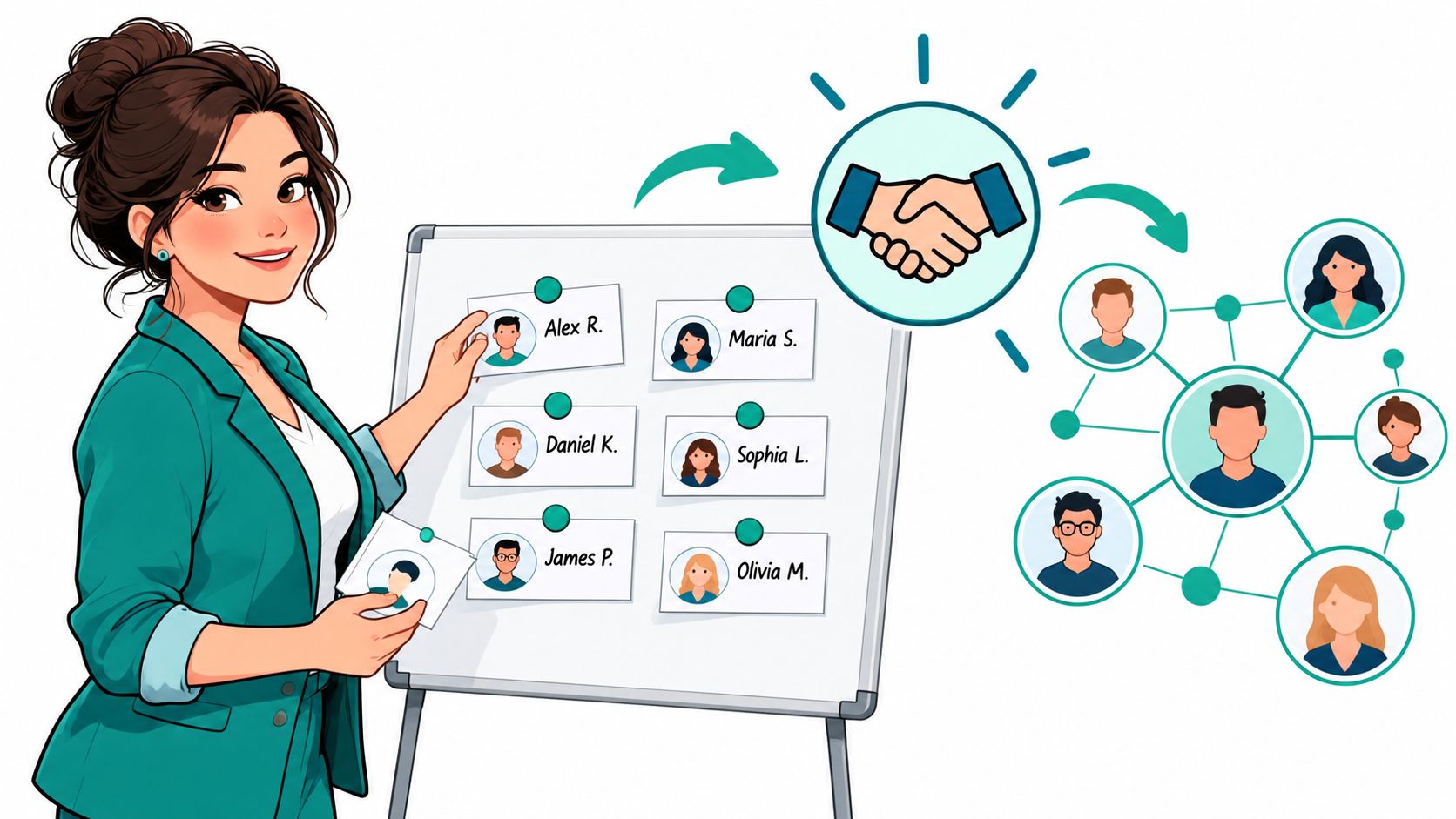
Write the role around outcomes, not an inflated list of technologies. A first engineer may need to release a customer-facing workflow, instrument activation, own production reliability, and explain tradeoffs to nontechnical teammates. A later specialist may need a narrower mandate, such as improving observability or building a data platform.
Use practical interviews. Show candidates a product constraint, a customer complaint, or a deliberately incomplete design and ask how they would investigate it. The strongest signal often comes from how someone frames uncertainty, not from whether they recite the preferred framework.
Founders should also make the offer legible. Explain salary, equity, vesting, exercise rules, reporting lines, expected scope, and the assumptions behind the hiring plan. Candidates can accept uncertainty more comfortably when leaders describe it plainly.
Startup retention isn't created by slogans about culture. It depends on manager continuity, decision-making authority, realistic scope, and whether people can see how their work compounds. A founder should define what the role owns now and how that ownership could change after the next milestone.
Remote and hybrid teams need written decisions, dependable documentation, and deliberate one-to-one conversations. Lightweight controls also protect speed. Research covering 86 startup cases found that team size and team experience predicted difficulty controlling technical debt, with poorly structured or poorly documented code showing the strongest relationship with lower productivity and product quality (startup technical-debt study). Hiring adaptable engineers doesn't mean accepting disorder. It means giving capable people enough structure to improve the system without burying them in process.
An engineer joins a small product team after the founders explain the customer problem, the next milestone, and the architecture's limits. The engineer ships an initial workflow, speaks with users, adds instrumentation, and gradually owns reliability. The role expands as the company learns, rather than through a promise of automatic promotion.
A different candidate joins after seeing a large financing announcement. Interviews center on ambition and equity, while nobody can explain the runway, the gap between pilots and revenue, or the next proof the team must produce. Fundraising takes longer than expected, hiring stops, and the role changes sharply. The employee leaves before the original promise can mature.
Technical ability matters, but it cannot carry a company through weak market evidence. Research on startup failure identifies market demand, customer acquisition, business development, limited customers, and funding constraints as major factors, grouping them into a dominant market-entry and customer-acquisition dimension (startup failure research). Without evidence that customers will adopt and pay, even a technically elegant product will fail.
A useful release earns its place by shipping and teaching the team what customers do next. The signals might include activation, return visits, conversion, or abandonment.
Founders should connect engineering milestones to activation, retention, time-to-value, trial or pilot conversion, and customer acquisition payback. Candidates should ask which behaviors the team measures and whether engineers can see the results. This link helps both sides judge progress: founders learn whether funding is producing evidence, while candidates see whether their work supports a real path to survival. A product team learning from customers is building more than a growing feature list.
A founder has a week to fill a senior role, yet the inbox contains dozens of loosely relevant applications. A strong engineer is considering a startup, but cannot tell whether the product, leadership, or role deserves the risk. Broad job boards create activity in both situations. They do not reliably create useful context.
Curated hiring marketplaces narrow that gap. Candidates are assessed for relevant experience in engineering, product, design, data, or marketing, as well as their comfort with startup work. Companies can be reviewed for funding status, team quality, and product viability. The result is a more informed first conversation, although neither side can skip proper diligence.
Candidates also need discretion. People who already have jobs may not want their search visible to colleagues or managers. Anonymous profiles and mutual interest let them explore opportunities without broadcasting that they are looking.
Founders gain a human signal that keyword matching often misses. Someone who has moved from product discovery into production operations may suit a seed-stage company better than a candidate with a longer tool list but little evidence of handling ambiguity. The right match depends on judgment, ownership, and stage fit, not just recognizable keywords.
Underdog.io reports that it accepts approximately 5% of applicants, with profiles manually reviewed for relevant experience and startup-culture alignment. That selectivity improves the starting signal, but it does not prove that a role is stable or that a candidate will succeed there. Both parties still need to examine the product, leadership, expectations, and evidence of progress.
Founders can combine curated sourcing with referrals, founder networks, technical communities, and direct outreach. Candidates can pair it with conversations with former employees, careful offer review, and questions about runway and retention. How curated hiring marketplaces work matters because the process should improve the first interaction while leaving verification to the people who will bear the outcome. Curation filters for relevance. It cannot replace judgment.
Early-stage tech opportunities will keep changing as small teams adopt more automation, build products around AI, and face greater pressure to show durable customer value. The important shift isn't merely that tools become more capable. It is that each hire may influence a wider surface area of the company, from product decisions and customer learning to security, reliability, and team habits.
Candidates should look for roles where the company can explain its assumptions and where managers make room for evidence to change the plan. Founders should build hiring processes that test adaptability, communicate uncertainty, and protect maintainability before growth makes every shortcut expensive.
Funding conditions deserve continued skepticism. Global funding can rise while capital remains concentrated in a small group of large rounds, and a company can raise money without proving repeatable demand. Retention deserves the same scrutiny. One large workforce study reported median tenure of 13 months at pre-seed companies and 16 months at Series A companies, with 29.6% of startup hires leaving within 12 months and 58.9% leaving within 24 months (PIN's funding-stage tenure study). Those figures don't explain every departure, but they make role durability a question worth asking.
A thoughtful decision balances ambition with evidence. Candidates should assess the manager, milestones, runway, equity terms, and likely learning. Founders should recruit for the company they are building now, while giving people a credible path to grow with it.
Underdog.io connects vetted tech candidates with startups and high-growth technology companies through a curated hiring marketplace. If you're evaluating an early-stage role or building a team for the next milestone, visit Underdog.io to explore a more focused way to make the connection.