Approximately 38.5% of workers who changed jobs in 2025 also changed occupational categories, up from 35% in 2019, according to Revelio Labs. Career switchers in tech are common now, and AI-related roles are one area drawing people from other fields. The bottleneck is legibility.
Your evidence is written in another occupation's vocabulary, while screening software scores your resume against one posting's exact wording. For career switchers in tech, getting seen when algorithms filter you out means doing two jobs: translating your record into proof a hiring manager can inspect, then distributing it through channels where a person reads context.
That proof-of-transferability packet pairs with a two-funnel plan: machine-readable applications on one side, referrals and curated channels on the other.
A 2025 TalentTuner industry analysis, covering 944 resumes across 529 job titles, reported 98.4% Fortune 500 ATS use, a 15% initial pass rate, a 57.6% average match score, and 1.9% scoring excellent at 85% or higher. Read those as one industry sample with a screening bias, not a census of hiring.
At most large employers, software still reviews your profile before a recruiter does. The system parses the file, extracts titles, dates, and skills, then scores overlap against the posting. If your last title was Operations Analyst and the role wants Product Analyst, SQL and dashboard work can score low when you called it reporting automation.
| Screening measure | Reported figure | What it means for a switcher |
|---|---|---|
| Fortune 500 companies using applicant-tracking systems | 98.4% | Almost every large employer filters by machine first |
| Submitted resumes passing initial screening | 15% | Most applications end before a person reads them |
| Average match score against job descriptions | 57.6% | Partial keyword overlap is the norm, so gaps decide the outcome |
| Resumes scoring excellent (85% or higher) | 1.9% | A tailored, legible resume is rare and stands out |
Say you're a former academic researcher applying for a data role. You designed experiments, cleaned messy datasets, and defended methods under peer review. A parser looking for A/B testing, SQL, and stakeholder delivery sees none of that unless you name the methods you used, in words the posting uses.
Stuffing keywords you can't back up won't fix that. A 2025 controlled experiment found that small resume changes involving career gaps and keyword usage materially altered AI-generated candidate evaluations, which is one more reason not to hide gaps or inflate titles. Filters misread people in both directions, so the safer move is precise naming: same work, standard words, no inflated title.
Run this test today: paste your resume beside one target posting and list every required tool or method you have used but did not name. Those missing words are your first edit.
The filter's failure is mechanical: it rewards wording it recognizes and misses evidence it cannot parse. Your margin is honest naming plus a route to a human reader.
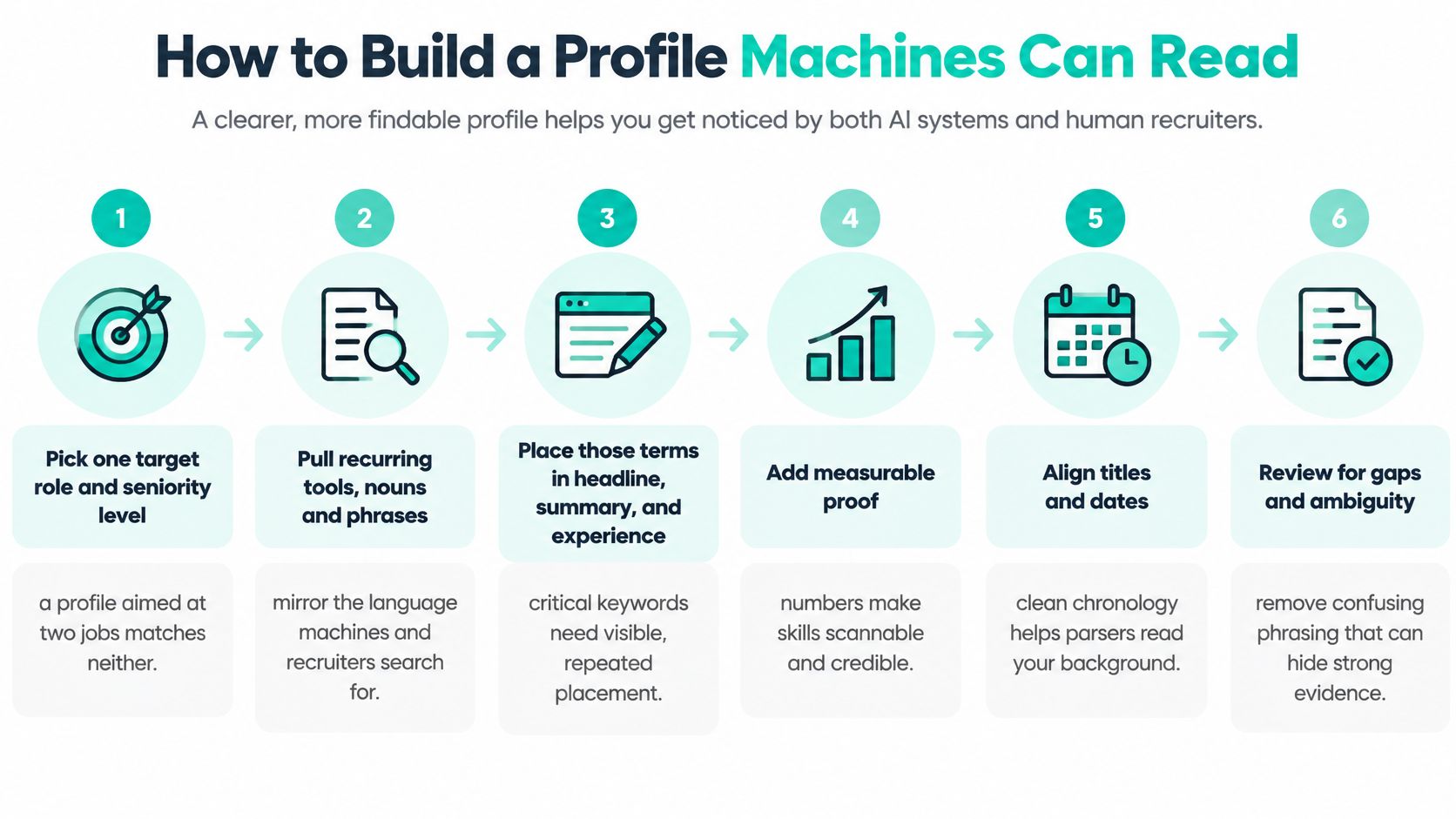
A machine-readable profile isn't a prettier template. It's one clear target, stated in standard language, with evidence attached to every claim. Work through these six steps in order.
Weak version: responsible for weekly reporting improvements.
Stronger version: automated weekly reporting with SQL queries feeding a dashboard, cutting preparation from two days to one hour. That follows evidence, action, result. The tool is named because it was used, and the outcome can be defended in an interview.
If you want a second pass on phrasing, you can optimize your resume with AI and then edit the output back into your own words. Don't submit polished bullets that claim outcomes you can't explain line by line.
For section-by-section layout help, this guide on how to write a tech resume that hiring managers actually read covers structure and ordering in more detail. Apply it after you know your target, not before.
A clean finished profile is easy to recognize. Your headline carries the target title, your skills section holds five to eight core skills, and every one of them is backed by a project, certification, shipped feature, or quantified result below it. Anything on the page without evidence behind it is a liability, not a signal. Delete it or prove it.
Chronology argues that you held jobs. A proof-of-transferability packet argues that you can do this one. Start by pulling five to eight requirements from your target role and building a competency matrix, then map each requirement to work you've already done.

| Target requirement | Prior-domain achievement | Proof artifact | Metric to state |
|---|---|---|---|
| Automation | Replaced manual spreadsheet reporting with a SQL-fed dashboard | Dashboard screenshot and query repository | Hours saved per week |
| Stakeholder delivery | Led a vendor rollout across three regional teams | Launch plan and sign-off document | Sites live on schedule |
| Data analysis | Built a churn model for the account team | Notebook with methodology notes | Churn change in percentage points |
| Shipping under ambiguity | Redesigned a process with no written spec | Case study with trade-offs | Cycle time reduction in days |
| Debugging | Traced recurring data errors in a pipeline | Post-incident write-up | Error rate before and after |
Take a former operations analyst moving into product analytics. The weekly reporting rebuild maps to SQL and dashboarding, with the query repository as the artifact. The process redesign, done without a spec, maps to shipping under ambiguity, which startups care about more than title history. Each row becomes one resume bullet and one interview story you can tell without stretching.
Where a row stays empty, don't fill it with coursework you've only watched. Build one deliberately scoped project using the target stack, small enough to finish and specific enough to inspect. Publish it as a short case study with the problem, your method, what you implemented, the metric that moved, and the trade-off you accepted. Place it above less relevant experience, not under it.
Career changes also read better when you've heard someone narrate one. This podcast conversation with Katharina Baum follows a move from banking into presales, and it's useful for how she frames prior experience as relevant rather than apologizing for it.
Two pitfalls undo this work. First, listing tools you touched once invites technical questions you'll fail. Second, stating metrics you can't reconstruct kills trust fast. If you can't explain how a number was measured, either leave it out or describe the result in words you can defend.
Ask a practitioner in your target field to review the case study and resume together, and flag any claim they could not verify from the artifact alone.
That review matters because access follows proof. A Federal Reserve Bank of New York study found referrals represented only 6% of the applicant sample but 21% of hires. People forward packets they can vouch for. Give them something inspectable.
Different channels review you in distinct ways. Pick based on how your evidence gets evaluated, not on how easy the application feels.
| Channel | How you are reviewed | Main strength | Trade-off |
|---|---|---|---|
| Cold company application | Parsed by applicant-tracking software and scored against title and keywords | Fast to submit | Lowest odds of reaching a person |
| Employee referral | Human recommendation plus the standard screen | Context on adaptability and adjacent skills | Requires a real contact on the team |
| Curated marketplace such as Underdog.io | Profile screened and reviewed by people before employers see it | Matches on fit rather than exact title | Favours full-time candidates with clear intent |
| Skills-based assessment | Work sample scored against the task | Shows ability instead of chronology | Costs time for a take-home or live exercise |
| Alumni or meetup contact | Informal introduction and direct conversation | Warm context and trust | Slow to build and hard to scale |
Cold applications still have a place, mainly as the formal record after a conversation. Submitting cold and waiting is the weakest plan available to you. If a posting is your only route in, tailor hard and move on quickly rather than spending a week on one application.
Referrals work when your contact can say something specific. Find employees in the target function, alumni from your school or a past employer, meetup speakers, or people you've collaborated with on open source. Weak ties are fine if your proof is strong. No relationship at all means the referral route isn't open yet, and building two or three real contacts beats messaging strangers at scale.
Curated channels put a human between you and the employer. On Underdog.io, every candidate profile is screened before employers see it, so a switcher's context gets read by a person first. Underdog.io also hides candidates from their current and past employers, which matters when employed. This overview of curated hiring marketplaces and how they differ from job boards explains the model before you commit time to one. The honest limit is fit. These marketplaces favour candidates with clear full-time intent, so part-time or exploratory searchers get less from them.
Skip any version of "please keep me in mind." Send three things instead.
Run both funnels at once. One funnel is the parsable, focused application. The other is a distribution list of several credible contacts who receive the request above. If either funnel is empty, you're depending on a single point of failure, and for switchers that point usually fails.
Sometimes the fix isn't a better resume. It's a different surface where your work gets judged directly. That challenges the usual advice, but the evidence for it is strong.
In a randomized controlled trial involving more than 37,000 applicants for a junior developer role, candidates who advanced through an AI-assisted pipeline were 20 percentage points more likely to succeed in a subsequent blind human interview than candidates selected through resume screening. The improvement was strongest among earlier-career applicants, the group whose resumes say the least about ability.
This is the core of the legibility argument. A career switcher's resume fails because the machine can't parse the transfer, not because the skill is missing. An assessment surface bypasses the parse entirely and lets the work speak.
| Evidence surface | Best-fit role | Main strength | Trade-off |
|---|---|---|---|
| GitHub project | Software or data engineering | Public, inspectable code | Needs time and clear documentation |
| Paid project | Contract-friendly technical roles | Real client outcome | Hard to win without a network |
| Technical exercise | Engineering roles with take-home screens | Direct test of job skills | Costs hours of unpaid time |
| Product teardown | Product management and UX | Shows judgment on a real product | Graded subjectively |
| Customer research | Product, UX research and analytics | Evidence of user insight | Rarely scored by automated screens |
| Structured interview | Any role with a defined rubric | Human assessment on job tasks | Only available if the employer offers one |
Match the surface to the job. Engineers should lead with documented code, since a hiring manager can inspect it before any conversation. Product candidates show judgment faster through a teardown of a real product's onboarding or pricing flow. If you're presenting a project visually, browsing product tour inspiration from Trupeer can help you structure a walkthrough that shows decisions, not just screens. This piece on why skills are replacing degrees in tech hiring adds context on how employers are formalizing that shift.
Requesting an assessment takes care. Try this framing: "My background is adjacent rather than direct, so I'd welcome a short exercise if that's useful. I could complete a scoped task in a few hours. What criteria would your team evaluate it against?" You're offering evidence and asking for the rubric, which reads as confidence rather than a request for special treatment.
Prepare one AI workflow in advance: document a real task where AI assisted you, keep the raw output, and show what you changed and why.
AI proficiency is becoming a live screening expectation, not a bonus. Employers increasingly fold it into interviews and technical assessments, and the candidates who do well show judgment about the tool rather than claiming fluency with it.
Don't rebuild everything. I would start with three actions and let the results tell you what to fix next.
Add the curated route in parallel. Applying through Underdog.io takes 60 seconds, with no cover letter and no retyping of your full work history, and profiles are reviewed before employers see them. Be honest about fit first. Candidates who have the most success on Underdog.io are looking for full-time positions, have not recently graduated from a coding bootcamp, and do not require visa sponsorship. If that isn't you, the referral and assessment funnels still work, so run those harder.
Check yourself at 30 days. Count referral requests sent, conversations held, interviews booked, and skills evaluations offered. If applications are high and conversations are zero, your distribution is the weak funnel. Fix that before adding a single new application.
If your background doesn't match a posting word for word, a human-reviewed route is worth having alongside your own outreach. Underdog.io screens every candidate profile before employers see it and introduces accepted tech candidates to vetted startups, so your transferable proof gets read in context instead of scored on title alone. Create your profile this week, lead with your strongest artifact, and let employers come to you.