
51% of hiring managers now prioritize skills over college degrees, and 90% of companies say they make better hires when they hire that way (skills-based hiring statistics). That changes the conversation.
The old shortcut was simple. A degree stood in for competence, discipline, and baseline knowledge. In 2026, that shortcut still exists in some roles, but it no longer decides the market. Employers want evidence that you can ship, debug, analyze, write, communicate, and learn fast enough to keep up with modern tech teams.
That's why the phrase Skills Are In, Degrees Are Out lands. Not because degrees are worthless. Because a credential without proof of work is weak, and proof of work without a traditional credential is now viable in a way it wasn't a few years ago.
If you're a candidate, this is good news with a catch. The good news is that you can compete without pedigree. The catch is that you have to show your work clearly enough that a hiring team trusts it.
If you're a hiring manager, the upside is bigger. You can stop filtering out strong people just because they took a different route. But once you remove the degree filter, you need a better system for identifying who can perform.
Skills-based hiring means replacing proxies with evidence. Instead of assuming someone can do the job because they have the right school, title, or credential, you evaluate what they can produce.
That sounds obvious. It also changes almost every stage of hiring.
A degree-first process usually starts with pedigree filters. Skills-first hiring starts with work signals. Those signals might include shipped product, GitHub activity, technical writing, portfolio walkthroughs, project case studies, certifications tied to specific tools, or interview answers grounded in real execution instead of academic theory.
A lot of teams used to say they valued skills while still screening resumes by school brand. That gap is shrinking. The market has gotten more practical. Fast-moving teams don't have much patience for résumé theater when they need someone who can contribute quickly.
Here's the shift. Skills-first hiring isn't anti-education. It's anti-assumption.
Practical rule: If a candidate can't show how they think, build, or solve problems, the degree does too much of the talking.
The strongest candidates now make hiring easier because they reduce uncertainty. They don't just claim they know React, SQL, product analytics, lifecycle marketing, or cloud infrastructure. They show artifacts that let a hiring manager verify it.
For candidates, the bar isn't lower. It's more concrete. You don't win by saying you're passionate, self-taught, and adaptable. You win by making those claims visible in public work, concise explanations, and credible examples.
For hiring teams, the mistake is assuming a degree filter is neutral. It isn't. It removes many strong candidates before anyone sees their work. It also keeps weaker but better-credentialed applicants in the funnel longer than they should be.
A clean way to think about it is this:
| Old model | New model |
|---|---|
| Degree as proxy | Work as evidence |
| Screening for background | Screening for capability |
| Resume-first evaluation | Artifact-first evaluation |
| Prestige bias | Practical validation |
The phrase skills are in degrees are out is shorthand for a deeper correction. Employers still care about knowledge. They just trust demonstrated knowledge more than implied knowledge.
The shift didn't happen because recruiting teams suddenly became more enlightened. It happened because the old model stopped working well enough.
Large employers and public institutions have already moved. Google, IBM, Apple, and Accenture have reduced degree requirements for large categories of roles, and over 16 U.S. states have dropped degree requirements for government positions (where degrees still matter in a skills-first market).

A degree can still be useful. It often builds fundamentals, structure, and context. But in startup hiring, a degree is often like a map of a city you've never driven through. It tells me you studied the terrain.
A portfolio, a shipped side project, or a clean incident write-up tells me you've driven the streets.
That's the distinction hiring teams care about when the job involves ambiguity, speed, and tools that keep changing.
Three pressures sit underneath this shift.
A hiring process should answer one question clearly. Can this person do the work we need done here?
Most startup teams aren't trying to make a philosophical statement about higher education. They're trying to reduce hiring risk. They want candidates who can ramp fast, solve real problems, and adapt without a lot of hand-holding.
That changes how they read applications.
| Degree-first mindset | Skills-first mindset |
|---|---|
| “Where did you study?” | “What have you built?” |
| “Do you match the credentials?” | “Can you handle the scope?” |
| “Does your background look familiar?” | “Can you show me relevant execution?” |
The strongest hiring teams now write job descriptions around outcomes, not pedigree. They interview for judgment, not memorized terminology. They ask for examples that look like the work itself.
That's why Skills Are In, Degrees Are Out isn't just a slogan. It's a hiring response to a market that rewards demonstrated ability more than formal signaling.
Most advice on this topic stops too early. It tells candidates to “build a portfolio” and “show your skills.” That's directionally right and operationally useless.
The gap is trust. Many articles note that employers prioritize skills, but they don't explain the concrete artifacts, like GitHub commit patterns or portfolio case study structure, that make a non-degree candidate credible (discussion of proof-of-work gaps).
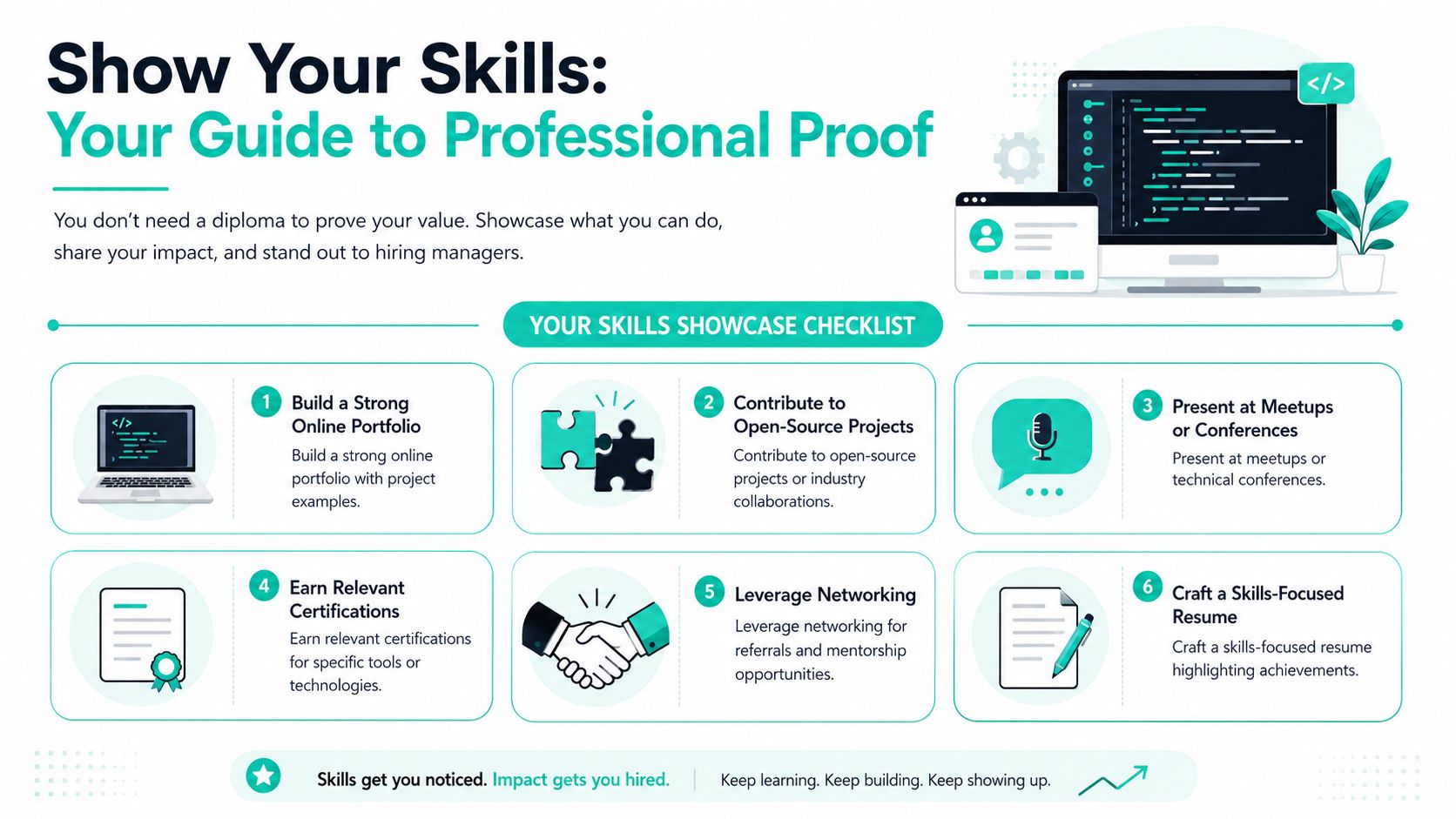
A good proof-of-work artifact answers three questions fast:
If your materials don't answer those, you're asking the recruiter to guess. They won't.
A GitHub profile shouldn't look busy. It should look legible.
Good signals include:
Weak signals are easier to spot than candidates think. Ten cloned tutorials. No explanation. No deployment. No indication of what you changed, why it mattered, or what you learned.
If I have to reverse-engineer your contribution from a pile of disconnected repos, you haven't made the hiring job easier.
A portfolio case study should read like a mini postmortem, not a brag sheet. Use a structure like this:
| Section | What to include |
|---|---|
| Problem | What needed to be solved and for whom |
| Constraints | Time, tooling, data quality, dependencies, scale, ambiguity |
| Your role | What you owned personally |
| Decisions | What you chose and why |
| Outcome | What changed, qualitatively if needed |
| Next step | What you'd improve now |
This format works for engineers, designers, PMs, marketers, and data candidates. It shows judgment.
For engineers, screenshots of the UI aren't enough. Include architecture decisions, trade-offs, edge cases, and how you handled failure. For product candidates, include prioritization logic and what you chose not to build. For marketers, walk through audience, channel choice, copy decisions, and measurement framework.
Your resume should point toward evidence, not replace it. A strong, skills-focused resume makes it easy to connect experience to artifacts. This guide on how to write a tech resume is useful because it pushes your materials toward specificity rather than generic claims.
A few practical fixes help immediately:
Don't defend your background. Translate it.
Say what you learned, how you learned it, where you applied it, and what broke along the way. That last part matters. Candidates become more credible when they can describe mistakes, trade-offs, and revisions without sounding rehearsed.
A simple interview pattern works well:
That structure makes self-taught experience sound like professional experience, because when it's real, that's what it is.
The companies that cling hardest to degree filters usually think they're protecting quality. In reality, they're often protecting familiarity.
In early-stage tech, that costs you access. Skills-based assessments are five times more predictive of job performance than education credentials alone, and a deployed portfolio project scores 9.2/10 in hiring value versus 5.1/10 for a degree (skills versus degree in tech hiring).
Most hiring problems start in the job description. If the posting says “must have bachelor's degree” and then lists a pile of technologies, you've already defaulted to filtering instead of evaluating.
A stronger posting describes outcomes.
That framing attracts candidates who can see themselves doing the work. It also gives interviewers a cleaner rubric.
A respectful hiring process doesn't mean a soft one. It means the signal is relevant.
Good assessments usually share these traits:
Poor assessments tend to over-index on trivia, gotchas, or performative endurance. You don't learn much about actual job performance from that.
Hiring manager test: If your assessment rewards test-taking more than job execution, you're screening for the wrong thing.
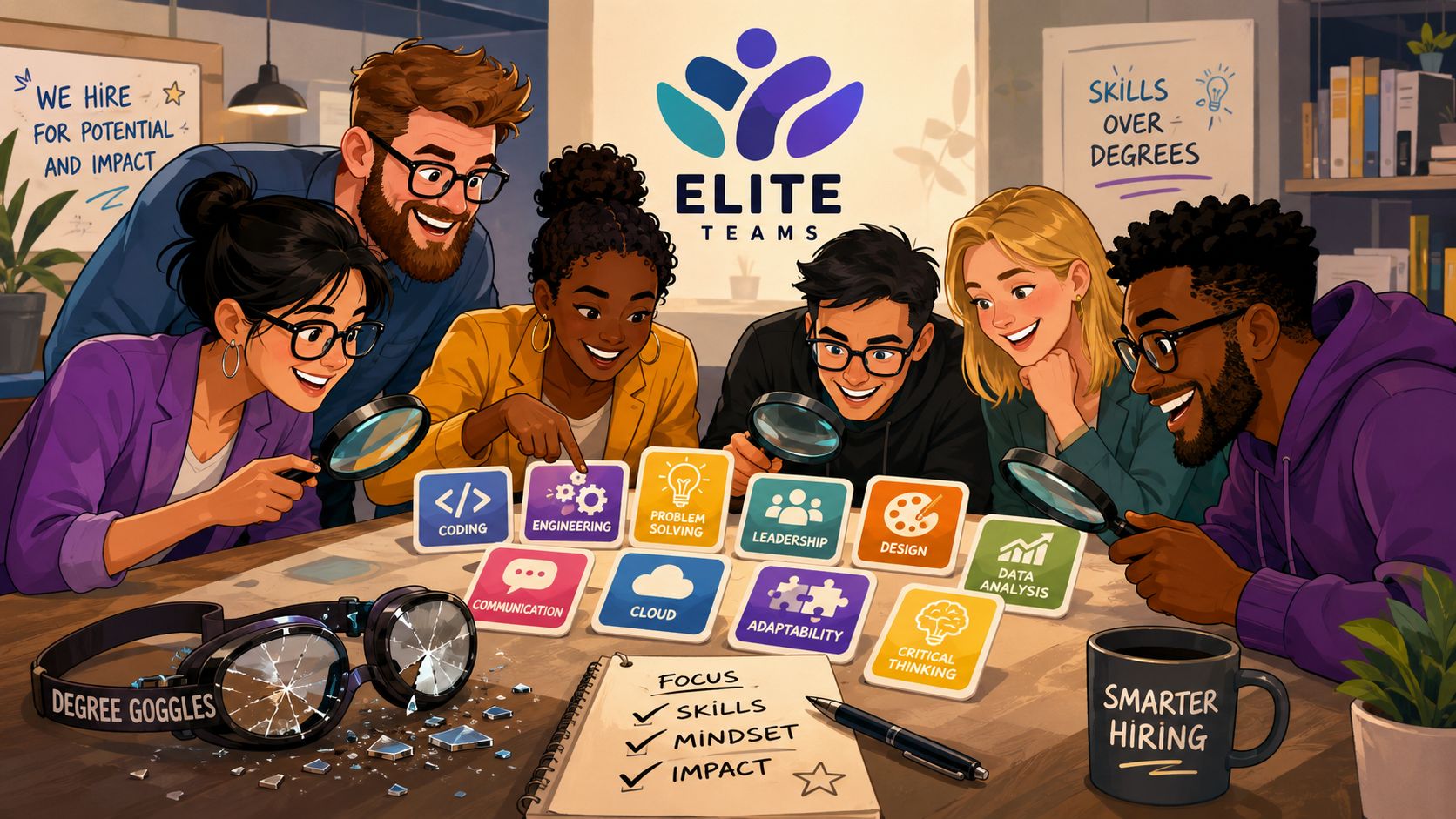
Once degree goggles come off, interviewers need better prompts.
Ask for examples of trade-offs, messy handoffs, changing requirements, and disagreements with stakeholders. Ask what the candidate shipped, what failed, and what they learned. Ask how they prioritize when everything feels urgent.
Those questions surface actual working style.
A structured process also reduces bias. This resource on strategies to reduce bias in your hiring process is worth reviewing if your team wants to widen the funnel without lowering standards.
Big companies can absorb slower ramp times and more false positives. Startups usually can't. That's why practical validation matters more in smaller teams.
The upside is strategic. When you stop treating degrees as default proof, you start seeing candidates with sharper grit, fresher tools, and more relevant execution than the standard pipeline would have shown you.
Once you remove the degree as the default filter, a new problem appears. Volume gets messy fast.
Candidates know they need to show proof of work, but many still present it poorly. Companies say they want skills-first hiring, but internal groups often lack the time to manually review hundreds of portfolios, GitHub profiles, project write-ups, and loosely framed resumes.
That gap is where curated marketplaces fit.

A skills-first market needs better validators. Not broader keyword matching. Not more application spam. Better validators.
A curated platform works because someone does the first layer of judgment before the intro happens. They look at relevant experience, artifact quality, role fit, and startup alignment. That doesn't replace the company interview. It improves the starting point.
For candidates, that means your background doesn't need to fit a prestige template to get seen. For employers, it means you spend less time on noise and more time talking to people who can plausibly do the job.
The practical difference is simple. Instead of tossing a resume into a giant stack, candidates get evaluated more like operators than like search terms.
That usually means a tighter set of signals:
If you're curious about the mechanics, how Underdog.io works lays out the model clearly.
The broader point is that the hiring ecosystem is catching up to the idea behind Skills Are In, Degrees Are Out. Once the old shortcut loses power, the market needs new trust systems. Curation is one of the better ones because it combines human judgment with practical evidence.
The takeaway isn't that degrees disappeared. It's that they no longer carry the whole case for you.
Your career now rides more on demonstrated fluency than on formal pedigree. The candidates who keep winning are the ones who can point to work, explain decisions, and keep learning in public or close-to-public ways.
That matters even more in areas where demand is shifting quickly. In the UK, demand for AI skills in job ads grew by 21% between 2018 and 2024, and those skills carry a 23% pay boost (AI skills and pay growth). The signal is clear. Specific, usable capability has become high-value career currency.
Focus less on looking qualified and more on being verifiable.
A degree can still help. It just can't do all the work for you anymore. In 2026, the people who move fastest are the ones who can make their ability obvious.
No. A degree still helps in some roles, some companies, and some stages of a career. It can provide fundamentals, credibility, and access. What changed is that it isn't sufficient on its own for many tech roles. If your portfolio is weak, the degree won't cover that gap for long.
Tech is leading the shift because the tools and workflows change quickly, and hiring teams can often inspect work directly. But the pattern shows up more broadly wherever employers can evaluate outcomes, practical skill, and learning ability.
Start building now. Don't wait for the perfect project. Publish one clean repo, one thoughtful case study, or one strong teardown that shows how you think. The goal is credibility, not volume.
Look at actual behavior. Ask for examples of influence, alignment, and decision-making under pressure. For leaders who want to assess and improve those signals more deliberately, a well-designed executive leadership program can be useful because presence, communication, and trust still matter even in a skills-first market.
A credential may open the door. Evidence gets you hired.
If you want a more efficient way to get in front of serious startup teams, Underdog.io is built for that. It gives tech candidates a curated path to vetted startups and high-growth companies, with a single application and a process designed around real fit instead of résumé black holes.


