If you’re a cloud engineer thinking about going remote, your timing couldn’t be better. The market for remote cloud roles, especially at startups, isn’t just hot—it's white-hot. This isn't some temporary blip; it's a deep, structural shift in how modern companies are built and scaled.
Let's get straight to it. The demand for skilled remote cloud engineers is real and it's not going away. Why? Because nearly every company, from a two-person startup to a global enterprise, now runs on cloud infrastructure. They need experts who can build, manage, and secure these environments from anywhere.
The numbers back this up. The US Bureau of Labor Statistics projects a staggering 15% growth for cloud computing jobs between 2021 and 2031. That's three times faster than the average for all other occupations. With nearly 90% of companies planning to increase their cloud spending through 2026, the opportunities are only going to multiply.
Startups, in particular, are leaning heavily into this model. They need to be fast, agile, and ready to scale at a moment's notice—all things a solid cloud architecture enables. Hiring remote gives them access to a global talent pool, letting them find the absolute best person for the job, not just the best person within a 30-mile radius.
This creates a perfect match:
Of course, working effectively from anywhere means your home setup has to be solid. A high-speed, reliable connection is non-negotiable. It's a foundational piece of the puzzle, and it's worth taking the time to find the best internet for remote work to ensure you can stay productive.
This intense demand translates directly into strong compensation. While salaries obviously shift based on your experience, location, and specialties, the earning potential in remote cloud engineering is significant. Knowing your market value before you start talking numbers is absolutely critical.
A quick look at the national averages shows just how lucrative this path can be, especially as you gain experience and target top-tier markets.
| Remote Cloud Engineer Salary Snapshot 2026 |
| :--- | :--- | :--- |
| Experience Level | Average National Salary Range | Top-Tier Market Potential (e.g., SF-Adjusted) |
| Junior (1-3 years) | $95,000 - $120,000 | $125,000 - $145,000+ |
| Mid-Level (3-6 years) | $125,000 - $160,000 | $165,000 - $190,000+ |
| Senior (6+ years) | $165,000 - $210,000+ | $220,000 - $275,000+ |
These figures underscore the massive opportunity available. But remember, your true value isn't just about listing AWS, GCP, or Azure on your resume.
Your real power comes from showing how you use those platforms to solve actual business problems—whether that's cutting costs, hardening security, or helping the company ship products faster.
Being strategic is key. You're not just another applicant firing off resumes; you're a high-value asset in a field where talent is scarce. This guide is your playbook for building the right skills, crafting an application that gets noticed, and crushing the interviews to land that top-tier remote role. We'll show you exactly how to find the best opportunities and connect directly with the startups you actually want to work for.
Just slapping "AWS" or "GCP" on your resume is the bare minimum these days. It’s the price of admission, not a ticket to the front of the line. High-growth startups looking for remote cloud engineers need more. They’re hunting for specialists who can do more than just use cloud services—they need people who can build, automate, secure, and optimize infrastructure with the business’s bottom line in mind.
The job market is a gauntlet. Demand is high, but so is the competition. The engineers who land the best roles are the ones who are most prepared.
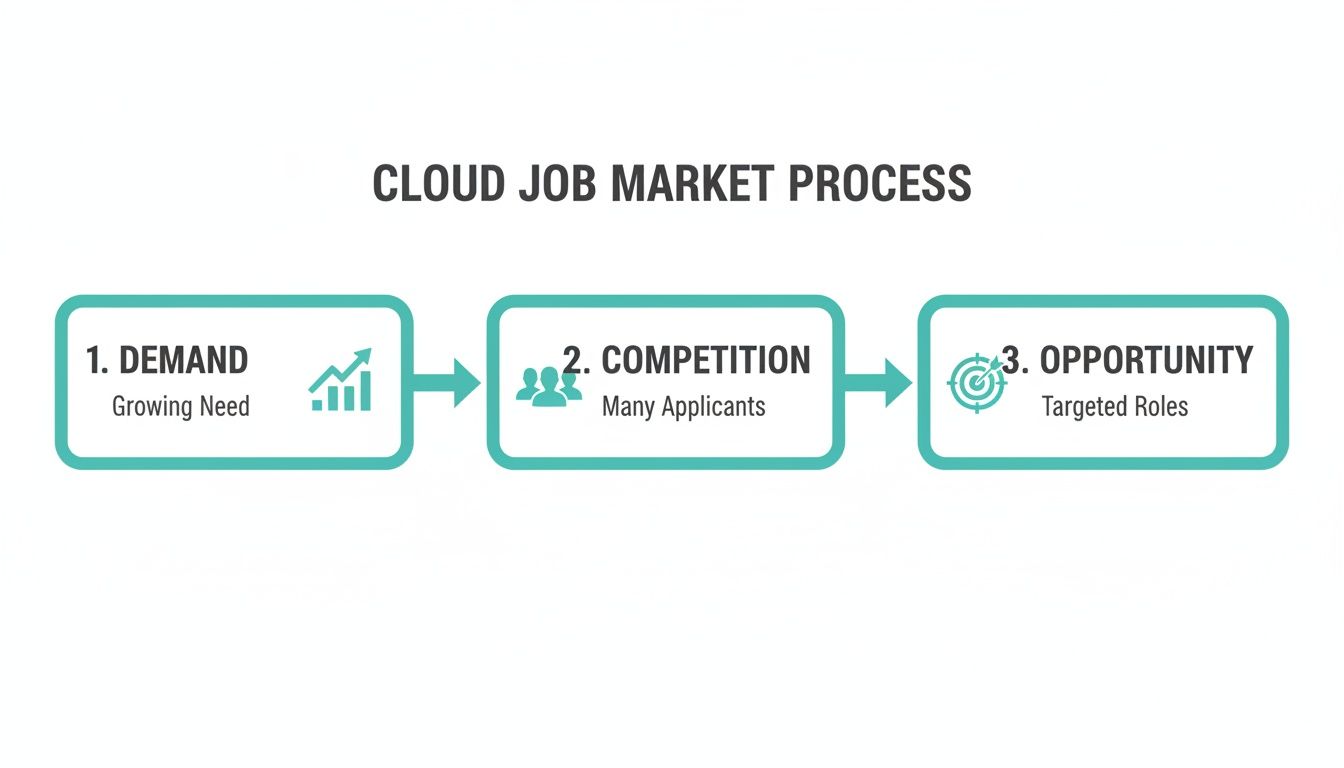
While there are plenty of jobs out there, the truly great opportunities are competitive. Building a modern, in-demand skillset is your straightest path to standing out from the pack.
Startups live and die by their ability to move fast and not break things. This is exactly why Infrastructure as Code (IaC) has become completely non-negotiable. If you can write production-ready Terraform or Pulumi, you have a superpower.
Don't just say you can spin up an EC2 instance. Show that you can build a reusable, version-controlled module that provisions an entire environment—networking, security groups, databases, and all. This proves you think in terms of scalability and repeatability, not just one-off tasks.
CI/CD pipeline automation is the other side of that coin. You absolutely must have hands-on experience with tools like GitHub Actions, GitLab CI, or CircleCI. Can you build a pipeline that automatically tests, builds, and deploys infrastructure changes? That’s the kind of practical skill that immediately signals your value to a fast-moving team.
Two things will always grab a hiring manager's attention because they directly impact a startup's bottom line: security and cost. Every engineer is expected to operate with a security-first mindset, but you need to show you can go beyond the basics.
For example, you should be able to demonstrate how you:
Cost optimization is just as critical. A cloud bill can spiral out of control in a heartbeat, and an engineer who knows how to tame it is worth their weight in gold. Knowing how to use Python automation scripts for AWS cost savings can give you a real, practical edge. It shows you’re thinking like a business owner, not just a technician.
A candidate who can talk about cutting an AWS bill by 15% by implementing automated instance shutdown scripts and Reserved Instance analysis is infinitely more compelling than one who just lists services they've used.
If you're building these skills, you’ll notice a lot of overlap with what’s required for remote DevOps roles. You can learn more by checking out our guide on how to land remote DevOps engineer jobs to see how these skill sets align.
In a remote world, your technical chops alone won't cut it. Startups need to know you're a reliable and proactive teammate who doesn't need constant hand-holding.
Two skills are absolutely paramount here:
Finally, while real-world experience beats everything, the right certifications can help get your foot in the door. The AWS Solutions Architect - Professional or Certified Kubernetes Administrator (CKA) both carry serious weight. They signal a deep, foundational understanding that goes way beyond surface-level knowledge, making your profile much more attractive to recruiters on the hunt for top talent.
Let's be real—your application isn't just a form you fill out. It's your personal marketing campaign. When you're gunning for the best cloud engineer jobs remote, a generic resume is a one-way ticket to the "no" pile. To actually get noticed, you need to build a complete package—your resume, your GitHub, your entire online presence—that tells one cohesive, compelling story about what you can do and, more importantly, the impact you can make.
Think of it less like submitting a document and more like launching a product. And you are the product. This shift in mindset means you have to move beyond just listing technologies and start showcasing quantifiable achievements that solve a startup’s biggest headaches: speed, security, and cost.
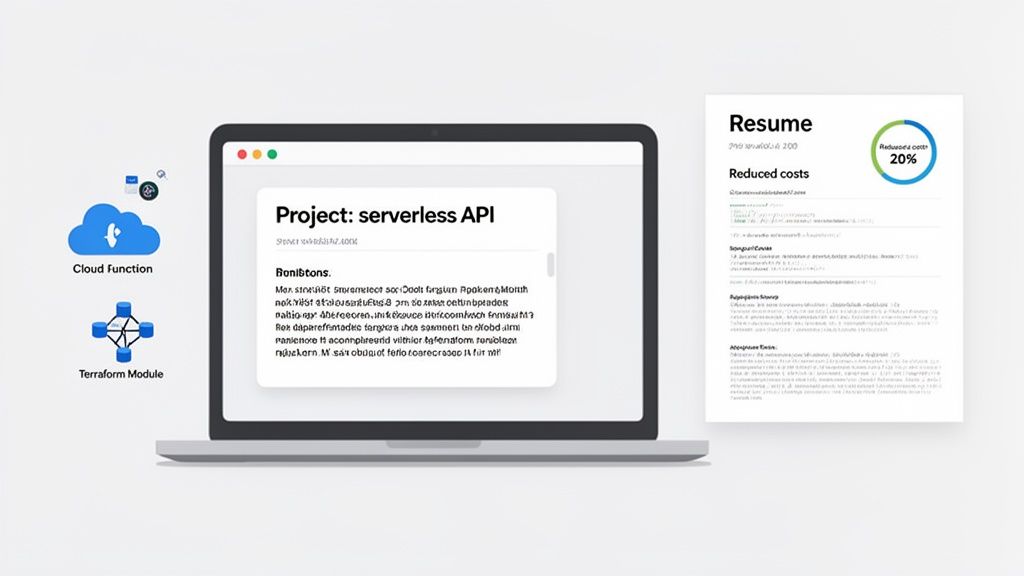
The single most powerful change you can make to your resume is to stop talking about tasks and start talking about outcomes. Hiring managers at fast-moving startups don't have time to connect the dots. They need to see, immediately, that you solve real, expensive problems.
Instead of a laundry list of responsibilities, translate them into specific, metric-driven wins.
| Vague Statement | Impact-Driven Alternative |
|---|---|
| "Managed AWS resources." | "Reduced AWS S3 costs by 20% through implementing intelligent tiering and lifecycle policies." |
| "Worked on CI/CD pipelines." | "Cut deployment times by 40% by optimizing our GitLab CI pipeline with parallel jobs and caching." |
| "Responsible for security." | "Eliminated 15 critical vulnerabilities by implementing a static analysis security testing (SAST) stage in our deployment process." |
This small shift in language changes the entire narrative. The "before" is a passive list of things you were assigned. The "after" is an active demonstration of the value you created. It proves you’re not just a technician who follows orders, but a strategic engineer who thinks about the business.
For any cloud engineer, your GitHub profile isn't just a code repository. It's your workshop, your showroom, and your thought process made tangible. A thoughtfully curated GitHub is one of the most powerful tools in your job-seeking arsenal, providing concrete proof of the skills you claim on your resume.
Your resume makes a claim. Your GitHub provides the evidence. A hiring manager who sees a great resume will almost always check your GitHub to verify your skills. Don't let them find a ghost town.
Make sure your profile is a direct reflection of the roles you're targeting. For a cloud engineering job, that means showcasing projects like:
README.md that explains exactly how to use it.Even contributing to open-source projects shows incredible initiative and passion for the craft. It shows you care enough to do this stuff in your own time. A strong portfolio, built on dedication, can open doors you never thought possible.
While building out your resume and GitHub is essential, there’s a far more efficient way to get in front of hundreds of vetted companies at once. This is where curated marketplaces completely change the game.
Platforms like Underdog.io are built to flip the traditional hiring dynamic on its head. Instead of you chasing companies, the companies chase you.
You create one detailed profile that showcases your skills, your experience, and what you’re looking for in your next role. That single profile is then put in front of hundreds of hiring managers at top startups who are actively looking for someone with your exact skillset. It's a low-effort, high-signal way to test the waters for remote cloud engineer jobs, especially if you're passively looking and want to keep your search quiet. Your profile stays anonymous, and you only hear from companies that are a genuine match, saving you from the endless noise of traditional job boards.
Now that your resume and profiles are polished, it’s time to hunt. But let's be clear: blasting your resume across massive job boards is a rookie mistake. It’s like shouting into a hurricane—you'll just get lost in the noise. For high-quality remote cloud roles at startups, you need precision, not volume.
The signal-to-noise ratio on the big platforms is just brutal. You’ll waste hours wading through irrelevant, low-quality, or flat-out fake postings. This is where a curated marketplace becomes your secret weapon.
Think of traditional job boards as a firehose of listings. In contrast, platforms like Underdog.io act as a filter, specializing in connecting skilled tech talent with hand-picked startups and high-growth companies. They’ve already done the hard work of vetting the opportunities, so you only see roles that meet high standards for funding, company quality, and relevance.
This approach is a game-changer, especially if you're passively looking. You build one killer profile and let vetted companies apply to you. It completely flips the script, putting you in control while you discreetly test the waters. If you're curious about who's hiring, we keep a running list of the top companies that hire remotely.
Of course, you might still stumble upon your dream job on a company's career page or LinkedIn. When that happens, don't just click "Apply" and pray. A direct, personalized message can instantly put you at the top of the pile.
The goal is to sidestep the black hole of the HR application system and land directly in the inbox of the person who actually feels the pain your skills can solve: the hiring manager.
First, you need to find the right person. Jump on LinkedIn and search for titles like "Engineering Manager," "Head of Infrastructure," "Cloud Architect," or even "CTO" at the company. You're looking for the person whose team you’d likely be joining.
Next, craft a message that's short and all about the value you can bring to them. Keep it brief, respectful, and laser-focused.
Remember, the point of this first message isn't to land the job. It's to start a conversation. You're showing initiative and proving you’ve done your homework.
Let's say you find a startup hiring a cloud engineer, and the job description is full of language about controlling costs. A simple, effective message could look like this:
Subject: Question re: Cloud Engineer role
Hi [Hiring Manager Name],
I saw your team is looking for a Cloud Engineer, and the focus on FinOps in the description really caught my eye.
In my last role, I led a project that cut our AWS spend by 15% by automating instance scheduling and overhauling our Reserved Instance strategy.
Would you be open to a quick chat next week about how my experience with cloud cost optimization could help your team?
This works. It's short, it shows you actually read the job description, and it hits them with a specific, metric-backed example that solves a problem they clearly have. It’s a powerful way to make a memorable first impression and cut right through the noise.
This is where all your prep comes together. The remote interview process is a unique kind of performance, staged entirely through your screen. It's your shot to prove not just your technical chops, but your ability to communicate and collaborate as a remote team member. Success isn't just about knowing the right answers; it's about how you articulate your thought process with clarity and confidence.
The path usually winds from a quick screening call to a much deeper system design round, often capped off with a take-home project. Each step is designed to test a different part of what makes a great modern cloud engineer.
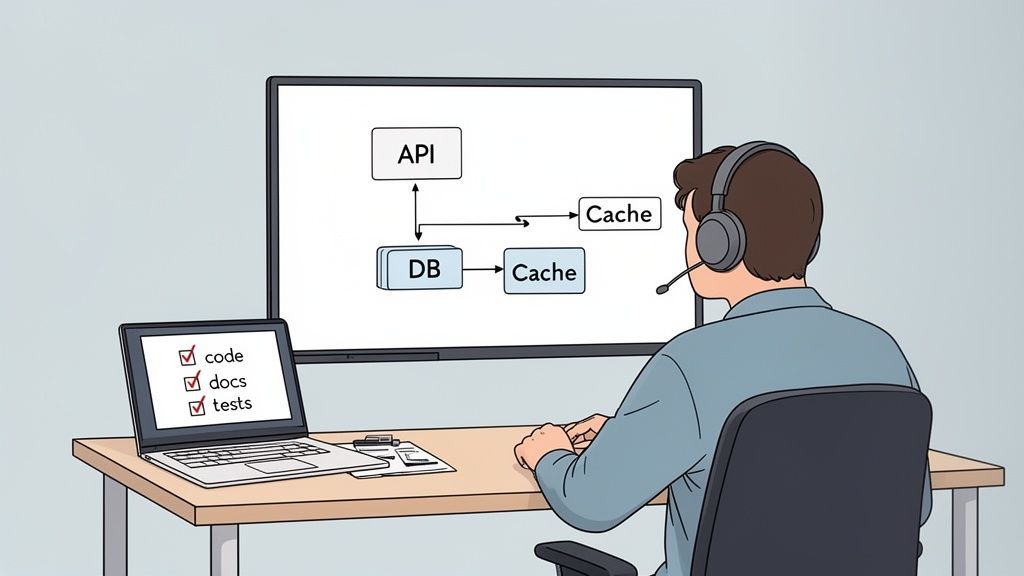
The system design round often feels like the most intimidating part of the whole ordeal, but it really doesn't need to be. Here’s the secret: interviewers aren’t looking for one "perfect" architecture. They want to see how you think. What really matters is your ability to discuss trade-offs around scalability, security, and cost.
Start by getting your bearings. Ask clarifying questions to narrow the problem's scope:
As you begin sketching on the virtual whiteboard, narrate your decisions. Explain why you might lean toward a serverless approach with Lambda over a container-based one with ECS or Kubernetes, or the other way around. Talk about the pros and cons of using a relational database versus a NoSQL option for a particular service.
The candidates who really impress are the ones who can tie their technical choices directly to business outcomes. For example, explaining that you’d use Spot Instances for batch processing to slash costs by up to 90% shows you’re not just an engineer—you’re a strategic thinker.
The take-home project is your chance to really shine, away from the pressure of a live interview. This is how startups get a real-world look at your coding standards and operational mindset. They need to see if you can deliver work that's ready for production.
Hiring managers are looking for way more than just a solution that "works." They’re evaluating your entire approach.
README.md: Think of this as the user manual for your project. It should clearly explain what the project does, how to set it up, and how to run it. A great README shows you respect your future colleagues' time.Dockerfile for easy deployment? These are the details that separate senior-level thinking from junior-level execution.This is your moment to prove you have the skills that justify a top-tier salary. Speaking of which, the latest data on salaries for remote cloud engineers in 2026 shows that experience pays off big time. Mid-level engineers can expect to bring in between $118,448 and $147,586 nationally. Senior-level pros command salaries from $138,900 up to $182,560 or more, with top talent in markets like San Francisco hitting as high as $237K. You can explore the full salary breakdown to see how your skills stack up.
Finally, don't sleep on the importance of your physical setup. A professional-looking and sounding interview environment is a powerful signal that you’re serious and well-prepared for remote work.
These small details add up, contributing to the overall impression you leave. They help prove you're a competent, organized, and professional remote team member who's ready to hit the ground running from day one.
Getting the offer is a huge win, but don't pop the champagne just yet. The proposal you just received isn't the finish line—it's the starting gate for your negotiation. With a strong offer for a remote cloud engineer role in hand, your leverage has never been higher. Now, it's time to make sure you get paid what you're worth.
Before you even think about picking up the phone, you need to arm yourself with data. Nothing strengthens your position more than knowing the current market rates inside and out. For example, remote cloud engineers are pulling in an average base salary of $131,448, which often climbs to around $145,000 when you factor in bonuses. Top-tier engineers, especially those with in-demand AWS or Azure skills, are seeing offers as high as $170,000 a year. You can dig into the latest cloud salary benchmarks to get your numbers straight.
A startup offer is a different beast entirely. It's rarely just about the base salary. You need to look at the whole picture, which usually breaks down into a few key pieces.
When you open the conversation, always anchor your requests in the value you deliver, not just what you want.
Here’s a professional way to kick things off: "Thank you so much for the offer; I'm incredibly excited about the opportunity to join the team. Based on my research and experience in X, I was expecting a base salary closer to [Your Target Number]. Can we discuss how to bridge that gap?"
This frames the negotiation as a collaborative effort to find a win-win, not a confrontation. The same goes for benefits. You could say, "To make sure I can hit the ground running with a productive remote setup, I'd like to discuss the possibility of a one-time stipend for my home office."
For an even deeper look at current comp trends, our 2025 Tech Salary Guide is packed with insights that will give you more confidence at the negotiating table. The end goal here is to land a complete package that truly reflects the skills and experience you bring.
When you’re hunting for a remote cloud role, the same questions seem to pop up again and again. I’ve heard them from countless engineers over the years, so let's cut through the noise and get you some straight answers.
Let's get this one out of the way: No, you absolutely do not. While a CS degree certainly doesn't hurt, startups and modern tech companies care far more about what you can build than where you went to school.
Your GitHub profile is your new diploma. A portfolio packed with real-world cloud projects, a few key certifications, and the ability to talk through your technical decisions will open more doors than a degree ever could on its own. Focus on creating tangible proof that you solve problems.
Hands-on experience will always be king. Nothing beats having solved real problems under pressure. That said, don't sleep on certifications, especially when you're looking for cloud engineer jobs remote.
Certs are a massive signal on your resume. They help you get past the initial filters, both human and automated. More than that, studying for something like the AWS Solutions Architect - Professional or the Certified Kubernetes Administrator (CKA) forces you to master the fundamentals in a way that ad-hoc learning often misses.
Think of certifications as a valuable supplement that validates your knowledge and gets you in the door, but your hands-on experience is what will ultimately land you the job.
It can be tougher, I won't lie. Startups often need engineers who can hit the ground running with minimal supervision. But it's far from impossible. Plenty of forward-thinking startups with great mentorship programs are looking to hire and shape junior talent.
The trick is to show you have incredible drive and a real hunger to learn. Your project portfolio is your secret weapon here. If you can show a hiring manager that you’re already building interesting things and solving problems on your own, they'll see you have the foundation and motivation to succeed.
Ready to stop scrolling through endless job boards and let the best startups come to you? Join Underdog.io and get your profile in front of hundreds of vetted companies actively hiring for remote roles. Create your free profile today.