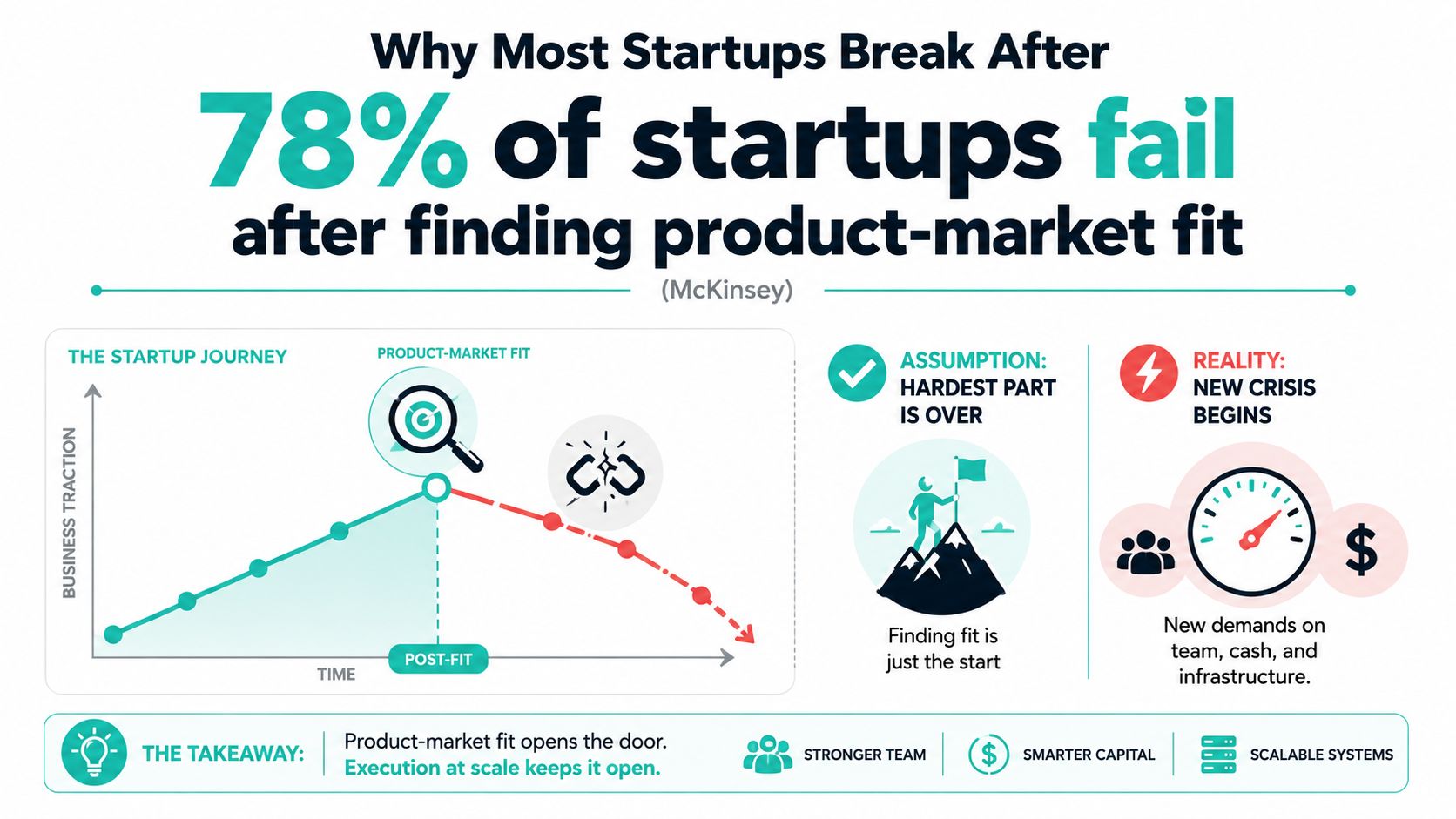
The cleanest warning sign in startup growth isn't slow traction. It's the moment a company has already found product-market fit and still can't hold together under scale, which McKinsey's UK analysis places at 78% of companies that fail to scale after reaching fit (McKinsey). That number changes the conversation fast, because it says the hard part usually isn't demand, it's the operating system underneath the business.
Founders like to describe scaling as a collection of separate problems, hiring, process, culture, tech, fundraising, leadership, org design. In practice, those problems collapse into one another. A weak interview loop creates the wrong manager. The wrong manager creates a coordination bottleneck. The bottleneck slows product delivery. Slower delivery stresses cash. Cash pressure changes hiring quality. The cycle is the point.
If you've ever reread a business book after a painful quarter, the same logic shows up in different language. One useful companion is ForumSpace on Good to Great, because it points at the same core issue, a company doesn't scale by winning one market moment, it scales by building a system that keeps working after the first win.
The most expensive misconception in startup life is that product-market fit ends the hardest phase. McKinsey's leadership research says even companies with successful products have a greater than 80% chance of failure, and it attributes 65% of portfolio failures to people and organizational issues rather than product problems (McKinsey). That's why scaling isn't a demand problem once fit exists, it becomes an execution problem.
The business starts getting more customers, more hires, more internal requests, and more coordination points. If the company still runs on founder memory and informal trust, the load lands on the same few people over and over. That's when response times slow, decisions get revisited, and small mistakes start looking like strategic issues.
The pattern is visible in a lot of growth-stage startups. Teams call it “pressure,” but the cause is usually less mystical. The company hasn't updated its operating system for the new amount of work, so every function begins to fight the others for attention.
Practical rule: if a problem needs the founder to resolve it twice, it's already a system problem.
A good way to think about this is to separate market validation from organizational readiness. Fit tells you people want what you've built. It doesn't tell you the team can repeatedly deliver, support, sell, and improve that product at a larger scale. Those are different capabilities.
The strongest scaling teams spot this early and treat it as a design question. They don't ask only whether demand exists. They ask whether the company can absorb the next layer of complexity without creating churn inside the team. That's the transition from startup to scale-up, and it's where many companies stall.
The seven challenges do not arrive as separate fire drills. They usually show up as one chain of friction, where a miss in one layer spills into the next. A recent study on scaling barriers points to the same pattern, resource limits, internal constraints, employee bottlenecks, and fundraising pressure all sit on top of one another.
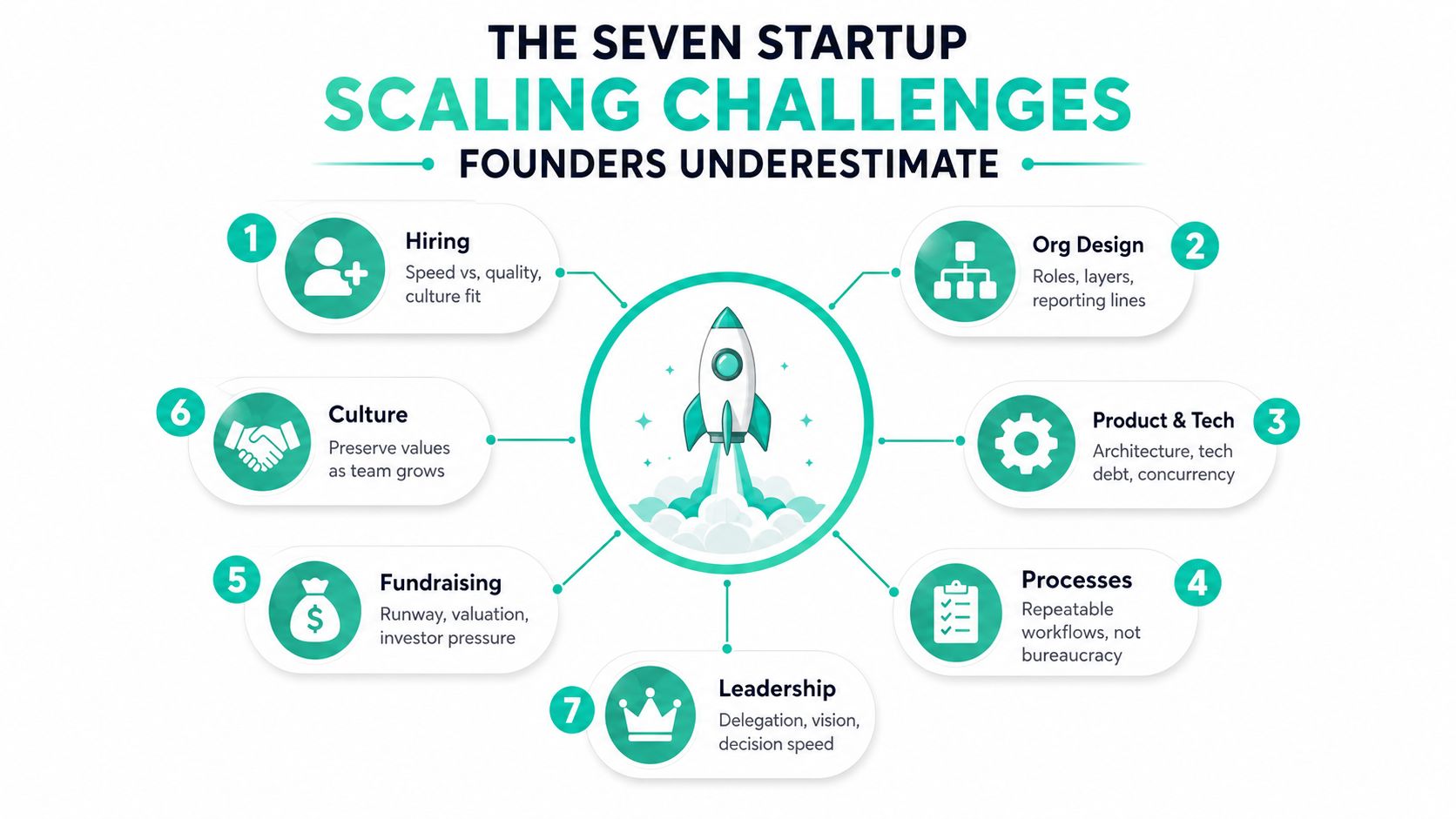
The root cause is usually speed without signal. The first warning sign is that interviews start relying on gut feel, and teams cannot explain why one candidate was chosen over another. At that point, hiring begins to reflect urgency more than fit, and the cost shows up later in manager time, rework, and avoidable exits.
The root cause is unclear decision rights. The first warning sign is repeated escalations to the founder, even for decisions that should already belong to a manager or function head. When that happens, the org is still organized around access to the founder instead of around accountable ownership.
The root cause is capacity mismatch. The first warning sign is that shipping slows while incident load, bugs, or coordination around releases keeps rising. A team can still be busy and still be falling behind if every new request pushes core work farther out.
The root cause is work that lives in people's heads. The first warning sign is that a task goes missing whenever one specific person is out. That kind of hidden dependency usually means the company has not turned repeatable work into a repeatable system.
The root cause is usually a weak operating story or weak economics. The first warning sign is that runway conversations become more urgent than customer conversations. Investors may hear momentum, but if the company cannot explain how the business expands without breaking, the raise becomes harder and the time between rounds starts to matter more.
The root cause is unspoken norms becoming inconsistent across teams. The first warning sign is that different groups start defining “how we work here” in different ways. That split is often subtle at first, then it shows up in speed, trust, and how conflicts get handled.
The root cause is a founder who still acts like the only decision engine. The first warning sign is decision paralysis, because the team is waiting for approval instead of acting on a clear mandate. When leadership does not shift, the company keeps adding people without adding enough judgment where the work actually happens.
Once the binding layer is visible, the fix is to treat the company as one operating system. If hiring is breaking because managers are overloaded, reduce interview drag before you add more headcount. If product delivery is slipping because decision rights are unclear, tighten the org map before you ask engineering for more output. The weekly habit that helps is simple, name the single constraint, decide which team owns it, and remove one source of friction before the next planning cycle.
Most hiring advice fails because it treats throughput as the whole problem. The issue is preserving quality while the company doubles or triples headcount, without turning every manager into an interview coordinator. In one survey of 1,000 U.S. business leaders at companies generating $1 million or more in annual revenue, 67% said at least one employee was limiting growth, and only 50% believed their current team could support 10x growth (survey summary). That gap is the warning.
A founder can't personally “save” hiring quality by joining more interviews. That just moves bottlenecks around. The better move is to standardize the loop so each interviewer knows exactly what signal they own, then use structured scorecards and calibrated debriefs to keep judgment consistent.
As you do that, cut the hidden work. Work samples can replace long live exercises. Async screening can remove unnecessary calendar churn. A tight loop is easier to scale than a heroic one.
Use this test: if two strong interviewers keep disagreeing and nobody can explain the difference in signal, the loop isn't calibrated yet.
For teams looking for a practical starting point, the startup talent acquisition playbook is a useful reference point because it keeps the focus on startup-specific hiring mechanics rather than generic HR theory.
The first management failure at scale is usually overload, not laziness. A strong individual contributor doesn't automatically become a strong manager of eight direct reports. When a team starts missing deadlines, look at whether one manager is trying to coach, approve, and unblock too many people at once.
That's also where the structure matters. Some teams need a split before they need another layer of leadership. Others need a tech lead who can step into management. In larger functions, a dedicated engineering manager makes more sense because the role exists to absorb coordination work, not just to “help out.”
The practical move is to pair hiring with onboarding discipline. A 30-60-90 day plan turns a new hire from an interview success into an operating asset. The company should know what good looks like by week two, not wait until the quarter closes to discover the person is still guessing.
If you need a wider recruiting lens, Underdog.io has a startup-focused recruitment resource that fits this same quality-first approach to startup hiring.
Flat teams work until the founder becomes the routing layer for every important decision. Then structure starts to matter more than raw effort. A Stanford/SSRN note on scaling startups frames the problem around formalizing organizational structure, executive transitions, management systems, board role, and entrepreneurial culture as the company grows (SSRN).
A clean org design still fails if decision rights stay fuzzy. I've seen startups add managers, rename functions, and redraw boxes while the founder continues to approve the same work twice. The result is slower execution with a nicer org chart.
Founder-led teams are fast because context is concentrated. Functional teams scale better because expertise clusters around shared work. Divisional structures make sense when products or markets diverge. Matrix structures add flexibility, but they also add coordination cost.
The trap is jumping into a structure before decision rights are clear. If everyone knows the box they sit in but nobody knows who decides, the company gets slower, not faster. Repeated escalations to the founder are the most obvious signal that the system hasn't matured. A simple rule helps here, create management layers only when the work can no longer be coached directly by the founder without slowing execution.
That is also where a written structure map helps. A practical startup organizational structure guide gives the team a shared view of ownership, escalation paths, and where decisions should live before the company starts guessing. When the company is still small, that may look like fewer layers and tighter founder involvement. As the business expands, the same clarity keeps flat teams from turning into a bottleneck.
The first managers define the tone of the next stage. They need coaching on delegation, written updates, and how to make decisions without seeking permission for every move. If they came from a high-autonomy startup culture, they often need help shifting from “just do it” to “delegate it, then inspect it.”
The hardest part is that manager promotion changes the job, not just the title. A strong contributor can still fail if they keep doing individual work and only handle people issues when something breaks. Founders need to watch for managers who are hoarding context, because that usually shows up as stalled decisions and overused one-on-ones. It also helps to pair the role change with explicit expectations about cadence, escalation, and what gets documented.
A practical checklist for the founder is straightforward:
Office space planning can become part of this same transition, especially when headcount changes quickly. If you're mapping physical growth alongside team growth, Tandem Space offices for scaling teams offers a useful framing for how space and organization interact. The office can either reinforce the new structure or make it harder for people to see where decisions live.
Technology scaling is usually a capacity-planning problem disguised as a rewrite problem. SST Cloud notes that 44% of founders cite technology or product issues as a primary reason a business did not survive, and it recommends keeping LTV/CAC above 3.0 and retention above 90% before scaling acquisition or infrastructure aggressively (SST Cloud). That's a strong reminder that architecture and economics belong in the same conversation.
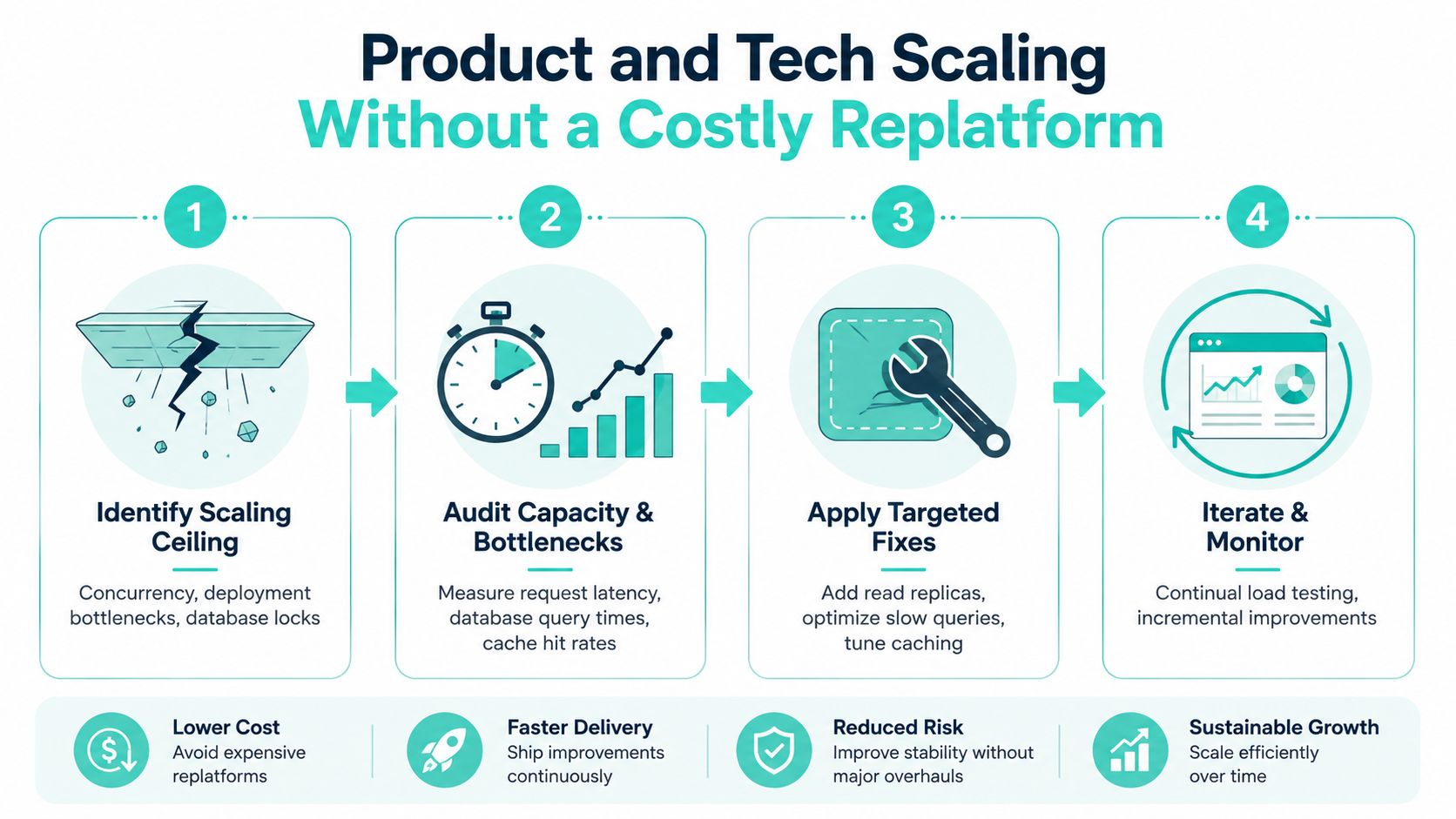
Teams don't hit a vague “tech debt” wall. They hit one of a few specific ceilings, concurrency, deployment velocity, observability, or data architecture. When that happens, load growth starts creating friction in the exact places the business can least afford it.
The fix isn't always a replatform. Often it's a targeted change. Managed services can remove operational drag. Horizontal scaling primitives can buy room for more traffic. Feature flags can let product teams ship without a synchronized launch ceremony every time.
You don't need to wait for an outage to justify better infrastructure. You need to watch the signals that show the system is approaching its limit. Latency creep, error spikes, slower deploys, and poor visibility into failures are the kind of warnings that matter.
A healthy architecture review asks a few blunt questions. Can the current stack handle more concurrency without manual intervention? Can developers ship without creating release-day bottlenecks? Can the team see failures quickly enough to fix them before customer trust erodes?
If the answer is no, the business may already be paying for the constraint in hidden ways. That cost shows up as slower launches, more coordination, and more time spent on maintenance than on customer value.
Culture breaks when a company grows. The founder still thinks values are obvious, but new hires only see the operational habits that get repeated. The result is predictable, feedback loops stretch out, communication becomes less direct, and people start interpreting the same behavior in different ways.
Culture scales through habits, not slogans.
That's why rituals matter more than posters. Weekly all-hands meetings keep the company synced on priorities. Written decision logs make trade-offs visible after the room empties. Skip-level conversations keep leaders from drifting too far from the work. None of that is decorative. It's operating discipline.
The founder's hardest transition is moving from maker to multiplier. The job changes from producing output directly to creating the conditions where other people can produce output well. That usually means structured 1:1s, written strategy memos, and clear delegation boundaries.
A few habits are worth adopting immediately:
The companies that do this well stop relying on charisma to keep alignment. They build a rhythm that makes alignment repeatable even when the founder isn't in the room.
In the Slush Impact Startup Struggle Survey 2024, founders ranked fundraising as their biggest challenge, ahead of customer acquisition, scaling, and revenue growth. The harder truth is that fundraising usually becomes visible first, while the actual constraint sits inside the business. A company raises when its economics, operating cadence, and cash timing make the next round plausible, and that is the part many teams underestimate.
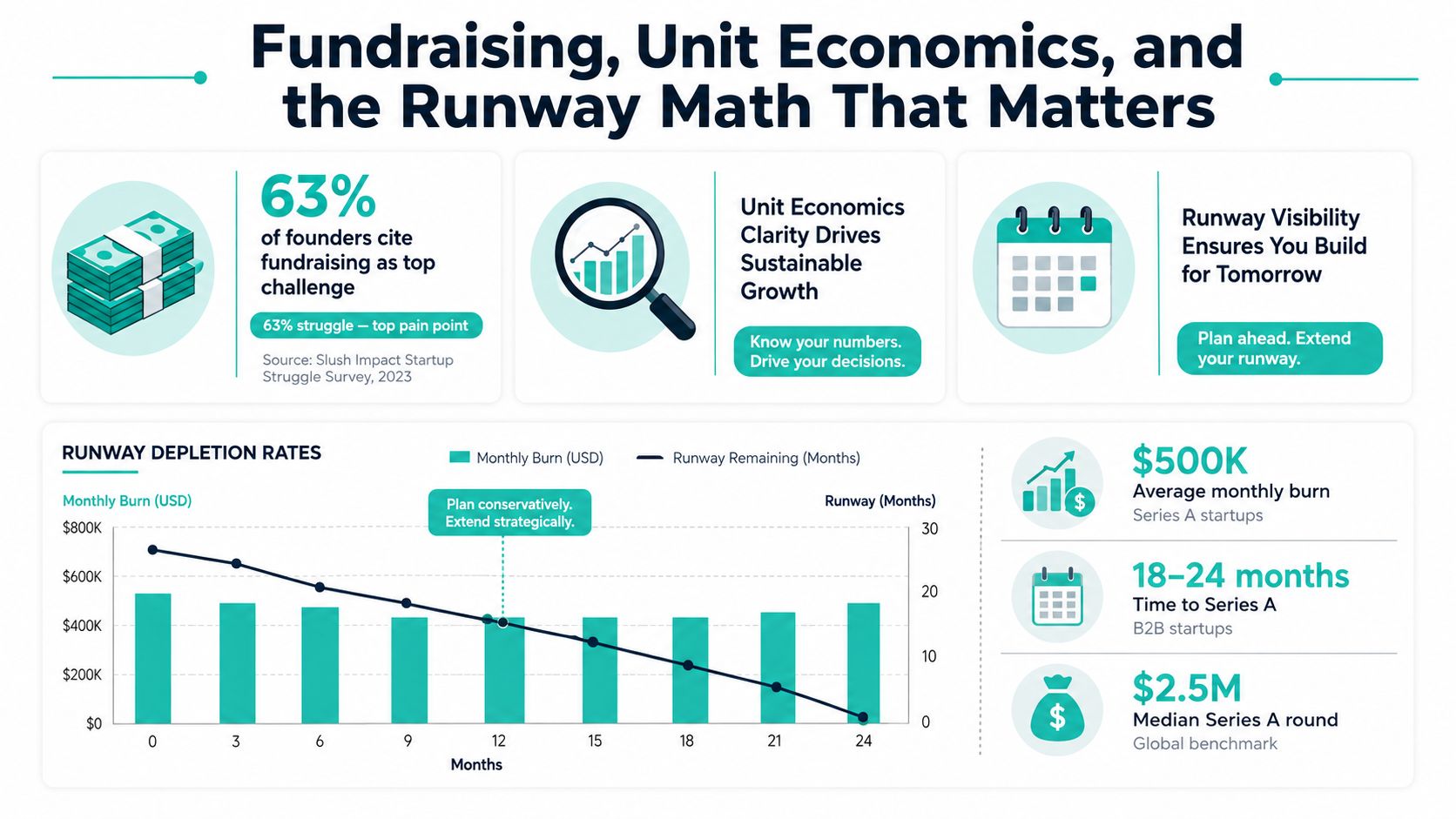
Investors want growth that gets more efficient as it scales. They watch retention, gross margin direction, and the relationship between acquisition cost and lifetime value because those signals show whether the machine is improving or just getting bigger. If those numbers move the wrong way, a larger round only buys more of the same pressure.
The operating trade-offs show up quickly. Hiring ahead of revenue can be the right move if it removes a bottleneck that is already limiting output. Cutting acquisition spend can also be the right move if the funnel is producing activity without payback. The point is to match the spend to the constraint, not to follow a formula that ignores the economics underneath it.
A lot of teams look at cash only when they feel uncomfortable. By then, the choices are already narrowed. Runway belongs in the weekly review beside product delivery and hiring, because it shows whether the current plan is creating time or consuming it.
That weekly check should answer one question clearly. Is the company using cash to improve the system, or just to keep it alive for another month? The first choice creates room to fix the business. The second choice buys delay.
Founders also need to understand how financing options map to the evidence they have already built. A practical overview of venture capital funding stages helps connect capital timing to the operating proof investors expect at each step.
The cleanest way to handle startup scaling challenges is to pick the constraint closest to breaking first, fix it, then move to the next one. Do that quarterly, not yearly. The point isn't to solve everything at once. It's to keep one weak layer from dragging down the rest of the company.
Watch the leading indicators together, not in isolation. Time-to-hire tells you whether hiring is slowing growth. Manager span of control tells you whether org design is too thin. Deployment frequency tells you whether the product system can absorb demand. Net revenue retention tells you whether customers are sticking. eNPS by team tells you where culture is fraying before it becomes visible in turnover.
A practical 90-day cadence works well:
That sequence is boring, and boring is useful. Scaling usually fails when a company confuses urgency with progress. The better move is to keep the operating system ahead of the growth curve, one quarter at a time.
If you're hiring through the messy middle and want a faster, more curated path to startup talent, visit Underdog.io. It connects startups with vetted candidates in a way that fits the pace and quality demands of real scaling.