A lot of salary guides make one mistake. They flatten the market into a single number.
That number matters, but it hides the part candidates need to understand. In the United States, data analyst salaries reached an average of $111,000 in 2026, up from $90,000 in early 2025, a 22% year-over-year increase according to 365 Data Science’s analysis of Glassdoor data. That’s a striking jump. It also tells only part of the story.
A junior analyst at a stable employer, a product analyst at a Series A startup, and a senior analyst in a finance-heavy growth company can all have the same title and very different compensation. Base salary changes with experience, but so do the hidden pieces: scope, technical stack, location, bonus structure, equity, and how directly your work affects revenue, retention, or risk.
I’ve seen candidates underprice themselves because they benchmarked against broad averages instead of their actual market. I’ve also seen candidates overshoot because they copied compensation expectations from Big Tech roles that have very different economics from early-stage startups. The useful question isn’t “What do data analysts make?” It’s “What does someone with my skills, in my target market, doing this kind of work, get paid?”
That’s where most salary content falls short. It gives the national picture and stops there. The unwritten rules sit underneath the averages, especially at high-growth startups where compensation is rarely just salary.
Average U.S. data analyst pay jumped 22% year over year, as noted earlier. That kind of movement changes candidate behavior fast, especially in startup hiring, where salary bands get revised more often than most public guides suggest.
The demand behind that growth is straightforward. Startups and growth-stage companies need analysts who can turn product usage, acquisition, retention, and revenue data into decisions leaders will implement. In Series A and Series B companies, that need is even sharper. Headcount is still tight, data volume is growing, and one strong analyst can influence roadmap priorities, pricing decisions, funnel fixes, and board reporting at the same time.
That is why broad national averages only get you part of the way. A data analyst maintaining recurring dashboards at a stable employer is competing in a different market than a product analyst joining a venture-backed startup where the role includes experiment design, KPI ownership, and direct exposure to founders.
Titles hide a lot.
I’ve seen “data analyst” mean spreadsheet-heavy reporting support. I’ve also seen it mean product analytics, stakeholder management, event taxonomy design, SQL on large warehouse tables, and weekly recommendations to the executive team. Those are different jobs with different hiring bars, and compensation follows impact.
Startup candidates miss this point all the time. They benchmark against a national average, then walk into a process without a view on how startup economics change the offer. Early-stage companies may not match late-stage cash compensation, but they often pay for range, ownership, and equity in ways broad salary roundups fail to capture. Candidates targeting that segment should benchmark against the actual role shape, not just the title. For a useful comparison point on the upper end of the market, review these senior data analyst salary ranges.
A realistic benchmark usually comes down to a few variables:
Candidates who understand those variables do better in process. They do not ask for “market rate” as a generic number. They explain why their background maps to a higher-value version of the role, and they evaluate startup offers based on the full package, not base salary alone.
Experience is still the cleanest starting point for benchmarking data analyst salaries. It’s not the whole story, but it gives you a useful frame before you layer in skills, city, and company type.
In the US technology sector, the midpoint salary for data analysts in 2026 is $117,250, with entry-level roles starting around $96,250 and senior roles reaching $138,500 or more, according to Robert Half’s 2026 salary trends. That tech-specific midpoint is more useful for startup candidates than a broad national average because it reflects the environment where product analytics, growth analytics, and business intelligence are tied closely to execution.
At the entry stage, most candidates overfocus on tools and underfocus on reliability. Hiring teams want SQL, spreadsheet fluency, and enough data judgment to avoid breaking trust with messy analysis.
The work usually includes:
What doesn’t work at this stage is trying to sound more senior than you are. A recruiter can tell when a candidate has memorized tool names without owning outcomes. Early-career analysts get paid more when they show they can ship accurate work, work fast, and explain trade-offs clearly.
At this stage, salary movement tends to accelerate. The gap between “can produce analysis” and “can shape a business decision” gets expensive for employers.
Mid-level analysts are often expected to:
At this level, title inflation becomes a trap. Plenty of people call themselves senior because they’ve spent enough time in seat. But compensation follows problem difficulty. If you’re still waiting for someone else to define the question, the market won’t pay you like a strategic analyst.
A useful reference point for readers thinking ahead is this breakdown of senior data analyst salary expectations, which helps distinguish true senior scope from just longer tenure.
Senior pay comes from ownership. The strongest senior analysts don’t just answer stakeholder requests. They create decision frameworks, pressure-test assumptions, mentor other analysts, and influence roadmap conversations.
Here’s the practical progression employers care about:
| Career stage | What employers usually pay for |
|---|---|
| Entry level | Accuracy, speed, clean reporting |
| Mid level | Independent analysis, stakeholder trust, metric design |
| Senior or lead | Strategy, prioritization, cross-functional influence, team leverage |
Strong senior analysts often sound more like product partners than report builders.
Three mistakes show up constantly in compensation conversations:
Counting years instead of scope
Five years doing repetitive reporting won’t price the same as three years owning growth analytics in a demanding environment.
Ignoring business communication
Analysts who can explain trade-offs in plain English tend to command better offers than equally technical peers who can’t present clearly.
Confusing title with market value
A “lead” title at one company may carry less responsibility than a plain “data analyst” title at another.
Experience matters. But employers pay for the level of judgment you bring, not just the number of years on your resume.
Location still changes data analyst salaries, even with distributed teams and remote hiring. The old pattern of “move to a major hub or accept less” has softened, but it hasn’t disappeared.
Indeed salary data shows clear geographic variance, with McLean, VA at $111,829 and Washington, DC at $94,832 among the leading markets. In startup-heavy ecosystems, San Francisco and New York can command premiums of up to 20 to 30% above the national average because competition is intense and living costs remain high.
That premium isn’t just about rent. It reflects company density, hiring urgency, and the concentration of firms willing to pay for product and growth analytics talent.
Below is a simple benchmark using only the verified city data available.
| City | Median Base Salary | Premium vs. National Average |
|---|---|---|
| McLean, VA | $111,829 | Above national average |
| Washington, DC | $94,832 | Above national average |
| San Francisco | Not specified in verified data | Up to 20 to 30% above national average in startup markets |
| New York | Not specified in verified data | Up to 20 to 30% above national average in startup markets |
The missing point estimate for San Francisco and New York is important. Many articles pretend to have exact startup-market figures when they don’t. The useful takeaway is qualitative: those hubs still pay a premium, but the exact offer depends heavily on company stage, equity, and scope.
In startup markets, companies compete for a narrower group of candidates who can operate with less structure. That shifts compensation upward.
Hiring teams often pay more when the role requires some mix of:
That’s why a startup analyst role in New York or San Francisco can outperform a larger company’s more rigid analytics job. The analyst isn’t just maintaining reporting. They’re helping a lean team decide what to build, where to invest, and what’s failing.
A high-cost city doesn’t automatically create a high-value role. Scope does. But the best-scoped roles still cluster in the biggest startup hubs.
Remote hiring flattened some of the old salary spread, but it didn’t erase it. Companies now use a wider mix of compensation models. Some pay nationally. Some adjust by market. Some split the difference and maintain broad bands with exceptions for expensive cities.
For candidates, that creates a practical challenge. A remote offer can look competitive until you compare it against the type of companies making the offer. A profitable software company with a distributed team may pay one way. An early-stage startup with limited cash but stronger equity upside may pay another.
Use this filter when evaluating remote roles:
Candidates usually do best when they benchmark in layers instead of searching for one perfect number.
Start with the city. Then narrow to industry. Then narrow again to company stage and role type. A data analyst supporting executive reporting at a mature employer doesn’t live in the same compensation world as a product analyst joining a fast-moving Series B startup, even in the same metro.
That’s a key lesson from geography. Location sets the outer band. The role still determines where inside that band you land.
Two analysts can work in the same city, hold similar titles, and earn very different pay. The gap usually comes from technical depth and business context.
Coursera’s salary guide notes that technical data analysts average $90,827, and that proficiency in Python, cloud platforms, and machine learning can enable 20 to 35% higher earnings than analysts who work mainly in SQL and Excel. That matches what hiring teams look for in growth-stage companies. Once a candidate can move beyond static reporting into experimentation, automation, and large-scale analysis, the market treats them differently.
A simple way to think about it is this: SQL and Excel help you answer questions. Python and cloud tools help you answer harder questions, faster, and at a scale the business requires.

Foundational analytics skills still matter. No serious employer ignores SQL. But high-paying teams often use a stack where each added skill expands the kind of problems you can own.
| Skill area | What it signals to employers |
|---|---|
| SQL and Excel | You can extract, clean, and validate data |
| Tableau or Power BI | You can package analysis for non-technical stakeholders |
| Python | You can automate workflows and handle more complex analysis |
| Cloud platforms like Snowflake, BigQuery, or Redshift | You can work inside modern data infrastructure |
| Machine learning interpretation | You can support model-informed decisions without turning the role into pure data science |
The highest-value candidates don’t list these as buzzwords. They tie them to execution. “Built in Python” is weaker than “used pandas to reduce manual reporting work and improve consistency.” “Experience with BigQuery” is weaker than “wrote analysis directly against warehouse data and partnered with product and engineering on metric logic.”
Not all industries use analytics the same way. Compensation follows the business consequences of being right, and the cost of being wrong.
A few patterns show up often:
The best-paid analysts usually combine one technical premium with one domain premium. Tooling alone helps. Tooling plus industry relevance is stronger.
Candidates often ask whether they should chase certifications, more dashboards, or a new title. Usually the answer is neither. The best path is targeted depth.
Focus on the skills that change your day-to-day scope:
What doesn’t work is shallow stacking. A resume with ten tools and no story behind them rarely moves compensation much. Employers don’t pay extra for exposure. They pay for capability.
Startup offers confuse candidates because the headline base salary is only one piece of the deal. In early-stage companies, especially Series A and Series B startups, total compensation often matters more than the salary line itself.
That’s where people make expensive mistakes. Some dismiss equity because it feels uncertain. Others overvalue it because the grant size sounds impressive without understanding vesting, strike price, dilution, or how likely the company is to create liquidity. The right move is neither blind optimism nor blanket skepticism. It’s disciplined evaluation.
This visual helps frame the parts of a startup package.
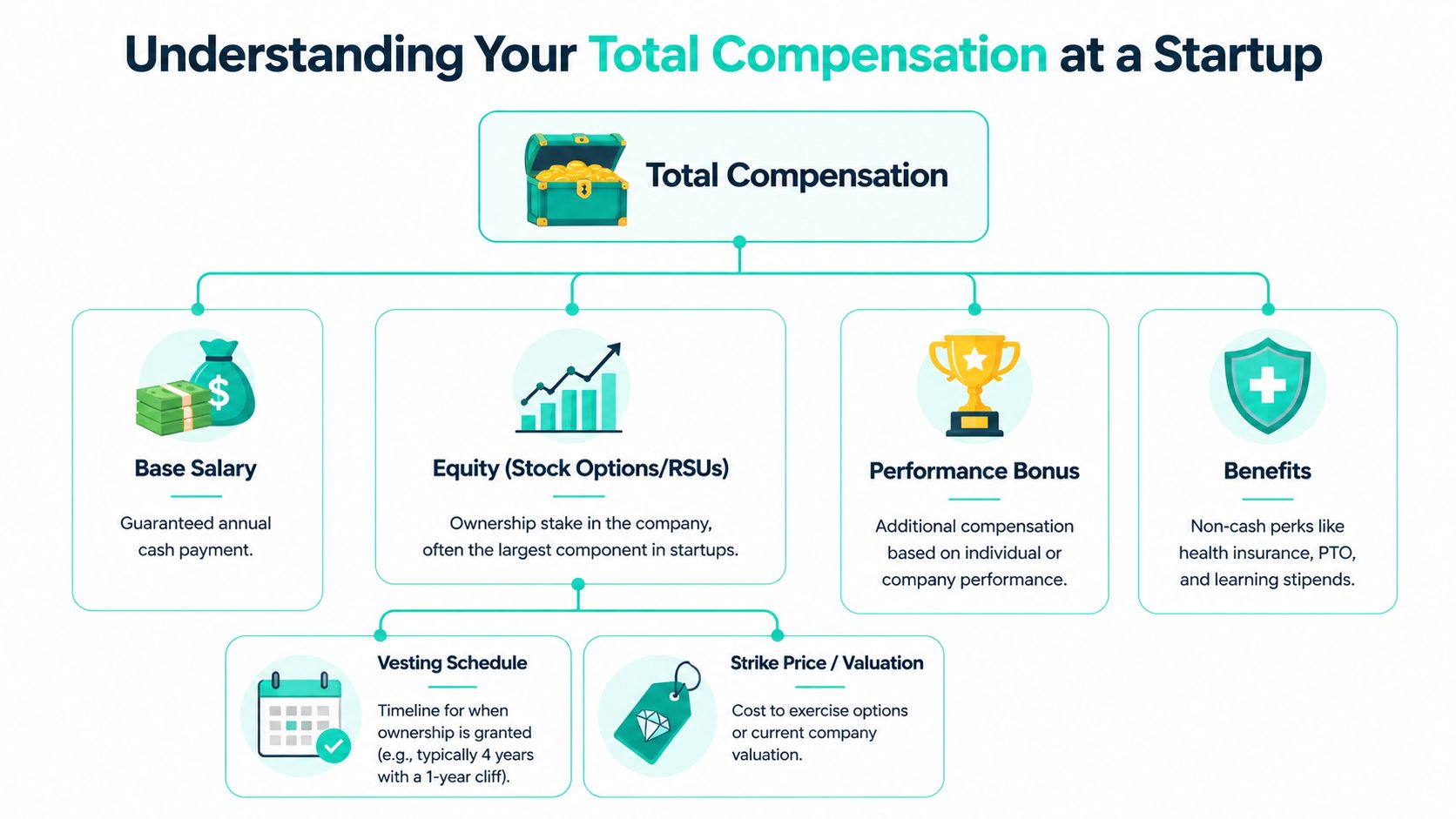
A startup offer usually combines these components:
Base salary
This is your guaranteed cash compensation. It determines your monthly quality of life, your immediate risk tolerance, and often your negotiating anchor.
Equity
This is your ownership stake. At startups, it’s often what makes a lower-cash offer potentially worth considering. But “potentially” is doing a lot of work there.
Performance bonus
Some startups offer one, some don’t. If they do, you need to know whether it’s discretionary, formula-based, or tied to company milestones you can’t control.
Benefits
Health coverage, time off, parental leave, learning budgets, and remote stipends don’t make for a flashy headline, but they affect real value fast.
For a broader market view of startup packages, this guide to startup compensation benchmarks is useful context.
Candidates hear these terms constantly and often treat them as interchangeable. They aren’t.
Stock options give you the right to buy shares later at a set price. Their value depends on the company growing beyond that price and eventually creating a liquidity event.
RSUs are a promise of actual shares, usually delivered over time as they vest. They’re more common in later-stage companies than in classic early startup offers.
If you’re considering a startup data analyst role, ask plainly which one you’re getting. Then ask what you need to do to realize value from it.
Good candidates differentiate themselves from passive ones through their engagement. Don’t say “great, thanks” when the recruiter mentions options. Ask follow-up questions.
Good startup candidates don’t negotiate equity as a lottery ticket. They negotiate it as one component of risk-adjusted compensation.
Don’t reduce this to “higher base versus lower base.” That misses the trade-off.
A larger company often gives you cleaner predictability. The salary is easier to benchmark, bonus structures may be clearer, and the equity, if any, may be easier to value. A startup may offer lower immediate cash but stronger upside, broader scope, and faster title growth if the company performs.
Use a simple decision lens:
| Offer component | Mature company | Series A or B startup |
|---|---|---|
| Cash predictability | Usually clearer | Often tighter |
| Role scope | More defined | Broader, often messier |
| Equity upside | Often lower or more mature | Potentially higher, less certain |
| Learning pace | Can be narrower | Often faster |
| Promotion path | Structured | Less formal, can move quicker |
The wrong way to evaluate a startup offer is to chase upside while ignoring whether the base salary still works for your life. The opposite mistake is rejecting equity outright even when the company is strong, transparent, and hiring for a role with serious scope.
Negotiation isn’t about trying to “win” against a company. It’s about making sure the offer matches the value of the work you’re being asked to do.
Most analysts underperform in negotiation for one simple reason. They talk about effort instead of value. Employers don’t pay more because you worked hard to learn SQL, Tableau, pandas, or BigQuery. They pay more if those skills let you own decisions, move faster, and reduce risk for the team.

Before you discuss numbers, define your market case. Don’t walk in saying you “feel” underleveled or “deserve” more. Use a structured argument based on role scope, technical depth, location, and industry fit.
A strong prep sheet usually includes:
This makes your negotiation cleaner because you’re not asking the company to guess why you belong in a higher band.
Candidates often surrender their negotiating advantage too early. If a recruiter asks for expectations before you understand the role, team, and leveling, you’re being asked to price an incomplete problem.
A better response is direct and calm:
“I’d like to anchor to the scope of the role, the team’s level expectations, and the full compensation package. If this role is aligned with the kind of analytics ownership we’ve discussed, I’m targeting a competitive package for that market.”
That keeps the conversation open without sounding evasive.
If the recruiter presses for a range, give one only after you’ve done enough discovery to know whether the role is closer to reporting support or genuine ownership.
Candidates often stop at base salary because it feels tangible. That’s fine in a straightforward corporate role. It’s incomplete in a startup process.
When the first offer comes in, review these parts separately:
A candidate who says “Can we improve the package?” gets less traction than one who says, “The role scope looks strong, but the current mix feels light on cash relative to the ownership level. Is there room to move on base, or alternatively improve the equity piece?”
That sounds like someone who understands compensation, not someone bluffing.
Don’t negotiate from rent, inflation, or general life costs. Those may be real, but they’re weak negotiating points.
Use evidence tied to the job:
“Based on the combination of cross-functional scope and the technical expectations for the role, I’d be more comfortable if we could adjust the package to better reflect that level.”
Not every offer has room. Some startups are cash constrained. Some have tight bands. Some are willing to trade salary for meaningful equity and faster growth.
Good negotiation isn’t endless pressure. It’s clear prioritization.
If the company can’t move on salary, ask whether they can move on:
What works is choosing the one or two points that matter most and pushing there. What doesn’t work is turning every line item into a battle.
The hardest part of navigating data analyst salaries isn’t finding salary content. It’s finding the right roles to compare against.
Public salary averages are useful for orientation, but they blur together weak openings, mis-leveled jobs, enterprise reporting roles, and standout startup opportunities. That’s why many candidates end up benchmarking themselves against the wrong market. They aren’t seeing enough of the roles where compensation, scope, and upside are all strong.
That variance is real. While national averages often sit around $85k to $93k, some startup roles on curated platforms can go much higher. A company like 10X Genomics can offer roles up to $219k, according to CBT Nuggets’ salary analysis. The point isn’t that every analyst should expect that number. The point is that broad market data hides how wide the spread can be once you move into better companies and more selective openings.
A curated marketplace is useful because it filters for company quality and candidate fit before you spend weeks in process. That matters for analysts because title matching alone is noisy. “Data analyst” can mean KPI reporting, BI ownership, product analytics, growth analytics, or a catch-all hybrid role with unrealistic expectations.
A stronger search process usually gives candidates three advantages:
For job seekers who want a startup-focused process, how Underdog.io works explains the model clearly.
The practical upside is simple. Instead of applying blindly and hoping a role is well-scoped, candidates can focus on companies that are already vetted for startup relevance and hiring seriousness.
That helps in a few ways:
For analysts targeting high-growth environments, that kind of filtering is often more valuable than another generic salary range article.
Data analyst salaries aren’t fixed. They’re built.
Experience sets the foundation. Location still matters. Technical depth changes your ceiling. Industry context changes how employers value your work. Then negotiation determines how much of that value is included in the offer.
The candidates who do best in this market usually do four things well. They benchmark themselves against the right peer group. They build skills that increase scope, not just resume density. They understand startup compensation beyond base salary. And they negotiate from business value instead of personal need.
That matters more in 2026 because the market has become more segmented. A generic analyst role and a high-impact startup analytics role can sit far apart even when the titles look nearly identical. If you want stronger compensation, you need to know which market you’re in and which one you’re trying to enter.
The upside is that this is learnable. You don’t need perfect timing or insider access. You need accurate benchmarks, a realistic read on your strengths, and the discipline to evaluate offers like a professional.
If you want access to vetted startup roles where compensation, scope, and growth potential are easier to evaluate, create a profile on Underdog.io. It’s one of the cleanest ways to see what strong data analyst opportunities look like in the market, especially if you’re targeting high-growth teams.